
What Is a Servo-Driven Cartoner? A Simple Explanation
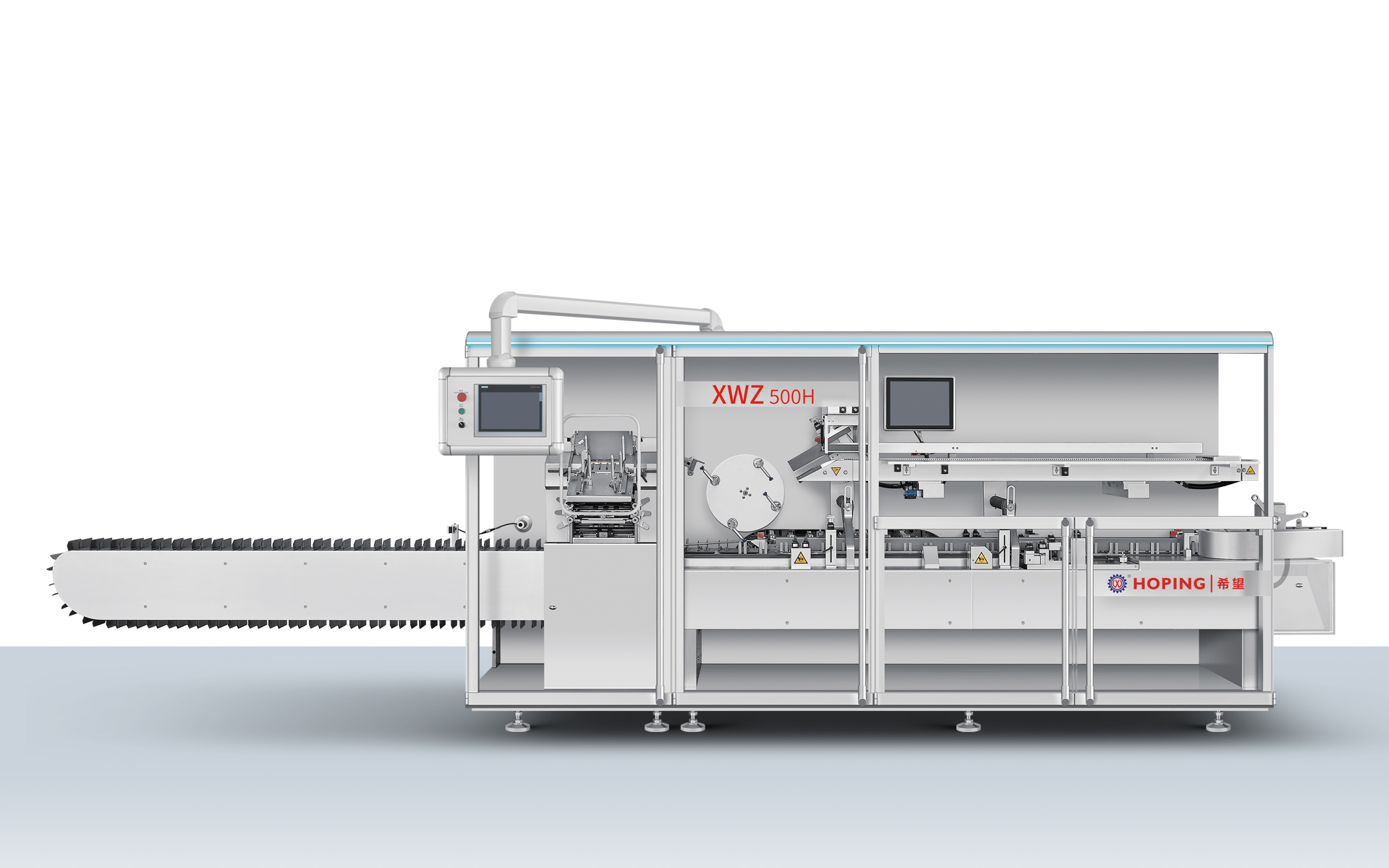
The XWZ500H full servo high-speed cartoning machine, rated at 100–500 cartons per minute, is the cartoning module used inside Hoping blister-cartoning configurations.
A servo-driven cartoner is an automatic cartoning machine in which each main motion — carton feeding, product insertion, leaflet folding, carton closing, coding and discharge — is driven by its own servo motor and coordinated electronically by a motion controller, instead of being tied to one main motor through mechanical cams and a drive shaft. In pharmaceutical packaging, that is the difference between a machine whose timing is fixed by hardware and one whose timing is stored as a recipe in the controller.
The simplest way to see the effect is at line level. The DHL8005H automatic blister-cartoning line is rated at up to 800 blisters per minute and up to 500 cartons per minute, and its control architecture pairs a Beckhoff motion controller with a CP9315 industrial PC. Neither the 500 cartons/minute figure nor the format changeover behaviour is achievable with a mechanically linked cartoner of the same footprint. This article explains, without unnecessarily technical language, what a servo-driven cartoner is, what sits inside it, how the servo axes actually produce that output, and what a pharmaceutical buyer should verify before specifying one.
The Problem: Why "Servo" Is the Hardest Word in a Specification Meeting
The difficulty is rarely the word itself. It is that two machines can both be described as "automatic cartoning machines" and still behave completely differently on the production floor.
In a mechanical cartoner, one main motor turns a camshaft. Carton opening, product pushing, leaflet folding and carton closing all happen at fixed phase angles defined by the cam profiles. This is reliable and easy to understand, but every change of carton size or leaflet format requires mechanical adjustment, and often new change parts. The machine's speed ceiling is set by the mechanics, not by the product being packed.
In a servo-driven cartoner, the same sequence is produced by independent servo axes whose phase relationships exist in software. The adjustment devices on such machines typically combine a digital display and a scale ruler so that operators can see the exact position they are setting. Format changes are then called up rather than rebuilt, which is why servo cartoners are specified for multi-format and multi-batch pharmaceutical production.
Two honest limitations belong in this explanation. First, a servo-driven cartoner does not correct an unstable upstream process — if blister feeding or product supply varies, the cartoner inherits that variation. Second, servo architecture adds control complexity: drives, parameter sets and controller documentation must be transferred to the buyer's maintenance team, otherwise the flexibility is never used. A servo cartoner is not automatically better; it is better when format changeover frequency, output stability and line integration are real requirements.
Industry Background: Why Cartoning Control Moved to Servo
The shift is driven by market scale and by regulation, not by fashion. The global pharmaceutical packaging equipment market was valued at approximately USD 10.71 billion in 2024 according to SkyQuest Technology, while the pharmaceutical cartoning machinery segment alone was valued at USD 1.46 billion in 2024 by Fortune Business Insights. The pharmaceutical blister packaging machine market is projected to reach USD 2.57 billion by 2025 with a CAGR of 2.8%, based on Custom Market Insights data.
Market estimates vary by methodology — Grand View Research sized the broader pharmaceutical packaging equipment market at USD 7.0 billion for 2025 against SkyQuest's USD 10.71 billion for 2024 — mainly because different studies include or exclude primary versus secondary equipment. For a buyer, the useful signal is direction and geography rather than a single number. Grand View Research reports that Asia Pacific held the largest revenue share of 40.7% in the pharmaceutical packaging equipment market in 2025, which is consistent with the concentration of blister-cartoning build capacity in that region.
At the other end of the market, concentration is moderate rather than extreme: the top three players (Uhlmann, IMA and Marchesini) collectively hold approximately 29% of the pharmaceutical blister packaging machine market, according to a Market Intelligence Report. The remaining share is served by a long tail of regional manufacturers, which is exactly why specification-level understanding — how many servo axes, which motion controller, which certificates — matters more than brand familiarity when comparing offers.
Regulation reinforces the trend. Pharmaceutical packaging machines must comply with ISO 15378, which integrates GMP requirements for primary packaging materials, and in the EU, equipment safety is governed by the Machinery Directive 2006/42/EC together with the EN 415 series for packaging machines. Machine designs that store format data electronically and reproduce it exactly are easier to document and requalify than designs that depend on manual mechanical resetting.
What a Servo-Driven Cartoner Is Made Of
Strip away the marketing and a servo-driven cartoner is a defined set of sub-systems. Understanding them makes it easy to compare two quotations that look similar on the cover page.
Frame and guarding. The structure is built from stainless steel and aluminium alloy, with transparent safety guarding that lets operators observe the carton path without opening the machine. Product-contact parts on Hoping machines are made of AISI 316L stainless steel, while non-product-contact parts are manufactured from AISI 304 stainless steel and anodised aluminium alloy. On several models, product-contact parts are made of FDA-compliant pharmaceutical-grade materials. The machine is designed and manufactured in accordance with GMP requirements, with corrosion-resistant and easy-to-clean surfaces.
Servo axes. The axes that matter in cartoning are carton magazine feeding, product insertion, leaflet transfer and folding, carton closing, coding, and discharge sorting. A quotation that says "servo" without listing axes is telling you very little.
Motion controller. This is the hardware that keeps the axes in phase at high speed. Hoping's DHL8005H and DHL6004 blister-cartoning lines specify a Beckhoff motion controller; the DHL1000/5H uses a Beckhoff motion controller with a high-bus industrial control system. Other lines in the same range use different platforms — the DHL7005H and DHL7004 use a Siemens motion controller with a TP900 HMI — which is a genuine procurement decision point rather than a detail.
Industrial PC. The DHL8005H, DHL6004, IXW800, IXW600 and IXW400 lines specify a CP9315 industrial PC as part of the control architecture. In cartoning terminology, the motion controller governs axis synchronisation, while the industrial PC is the computing and interface platform for the line — recipe and preset data, HMI display, and communication with inspection and downstream equipment. Which platform a line uses affects spare-part strategy and the skill set your maintenance team needs.
Transfer and replenishment systems. Different lines handle the blister-to-carton transfer differently: the DHL8005H and DHL1000/5H use a D3 intelligent top-loading parallel tracking transfer system; the DHL7005H and DHL7004 use a self-developed IRB24 intelligent transfer robot; the IXW800 combines D3 top-load robotics with a rotary manipulator. Product replenishment is also servo-driven and channel-count dependent — three-channel independent replenishment on the DHL8005H, four-channel on the DHL1000/5H.
Recipe and preset memory. The DHL8005H includes mold-change and preset-memory functions, and the DHL1000/5H includes mold-change and recipe memory functions. This is the feature that converts servo hardware into everyday operational benefit.
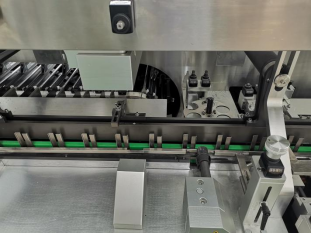
On the XWZ500H, the pressing carton device is servo-controlled for height adjustment. Changing to a different carton specification is done through the human-machine interface, and the servo motor adjusts the height of the carton.
How Servo Axes Deliver 500 Cartons per Minute, Step by Step
At 500 cartons per minute, roughly 8.3 cartons leave the machine every second. Nothing in that sequence can be improvised by an operator, and nothing can be left to mechanical tolerance. The following steps describe how the axes are sequenced on a modern blister-cartoning configuration.
Step 1 — Blister forming and sealing upstream. The blister machine forms the cavity, fills it, and seals the lidding material. On a linked line this happens continuously; on the DHL8005H, PVC and aluminium foil auto splicing keeps the web running without stopping the line for roll changes.
Step 2 — Transfer to the cartoner. Blisters are transferred from the blister machine to the cartoner infeed by a servo-synchronised transfer system. The transfer must track the blister pitch, which is exactly the kind of task a motion controller handles better than a mechanical linkage.
Step 3 — Servo carton magazine feeding. Cartons are drawn from the magazine by a servo-controlled feeding device. The XWZ500H uses a servo motor-driven magazine conveying device that can accommodate 1,800 boxes, and a large-offset suction turntable arrangement that increases contact time when suctioning the box, which supports secure suction at high speed.
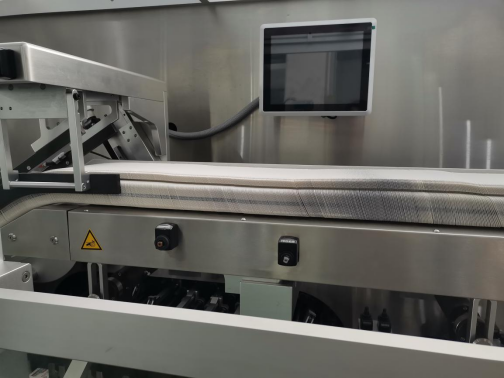
The XWZ500H carton magazine uses a servo motor-driven box library conveying device and can accommodate 1,800 boxes.
Step 4 — Leaflet folding and insertion. Where an instruction leaflet is required, it is folded and inserted before the carton is closed. On the XWZ500H, the folding machine is equipped with German GUK folding units and achieves a production capacity of 500 A4 sheets per minute, with servo drive transmission for stable performance and low noise. Leaflet supply is monitored by a laser material level detection device that signals the machine when the material level in the bin reaches the pre-installed section.
Step 5 — Carton closing with servo-controlled pressing. The carton is closed and pressed to shape. Because carton board varies between suppliers and batches, the pressing height is servo-adjusted through the HMI rather than by hand — a change of carton specification is a parameter change, not a mechanical rebuild.
Step 6 — Coding. The batch number and date coding is applied by a front-mounted batch number stamping device, positioned so that the three-date steel characters can be replaced conveniently and quickly during a batch change.
Step 7 — Discharge sorting at speed. The XWZ500H discharge sorting device uses a servo-controlled three-way rotary sorting mechanism that synchronises at a speed of 500 boxes per minute. This is where the 500 cartons/minute figure is physically realised: qualified cartons, rejects and sampling take-off are separated at line speed instead of being slowed down for manual sorting.
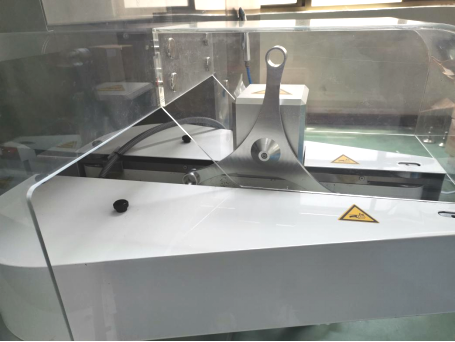
The discharge sorting device uses a servo-controlled three-way rotary sorting mechanism, capable of synchronising at a speed of 500 boxes per minute, making the sorting more precise and faster.
Step 8 — Line-level synchronisation. Above the cartoner, the motion controller maintains synchronisation between the blister machine, transfer system, cartoner and any downstream equipment. The DHL8005H is designed for connection to bundling, case-packing and palletising equipment, which means the 500 cartons/minute output has to remain synchronised with machines running at a different cycle rate.
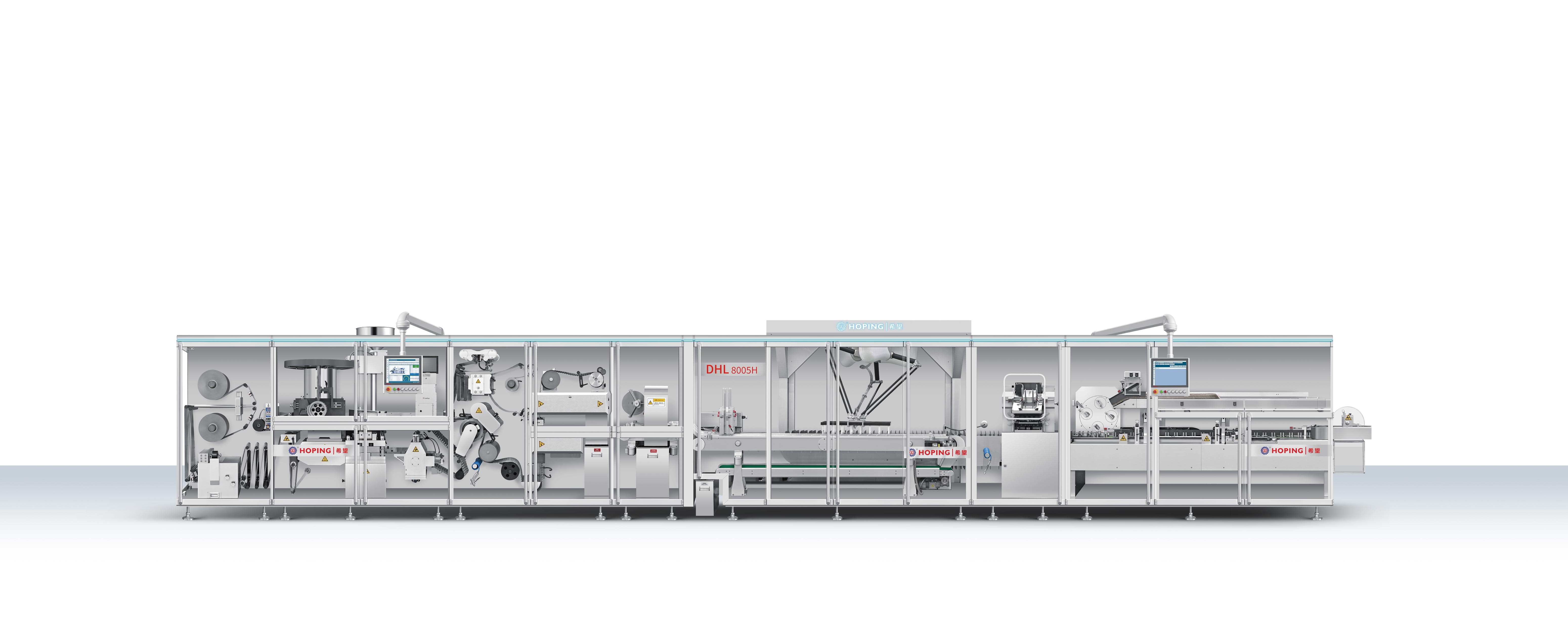
The DHL8005H automatic blister-cartoning line: up to 800 blisters per minute and 500 cartons per minute, with a Beckhoff motion controller and CP9315 industrial PC.
Where a Servo-Driven Cartoner Fits — and Where It Does Not
Servo cartoning is specified most often in four situations. The first is multi-format solid dosage production, where tablets, capsules or soft capsules are packed in several carton sizes on the same line and changeover frequency is high. The second is moisture-sensitive product that requires alu-alu blister construction before cartoning, where the transfer and insertion sequence has to handle a stiffer, flatter blister. The third is line integration, where the cartoner must feed a bundler such as the XWK4060, a case packer, or a case-packing and palletising unit such as the ICP12 without manual buffering. The fourth is capacity expansion, where an existing packaging hall is upgraded rather than rebuilt.
It is also used outside strict pharmaceuticals — nutraceutical, healthcare, food and cosmetic blister-cartoning projects use the same architecture, with the applicable format and compliance requirements confirmed per project.
Where it does not fit is equally worth stating. If a single carton format runs continuously for years, the flexibility of preset memory returns little. If the upstream blister machine cannot hold a stable pitch, servo cartoning will not recover the lost output. And if the local maintenance team cannot be trained on drive parameters and controller data, the buyer pays for capability that stays unused. Those are configuration judgements, not product limitations.
Servo-Driven Cartoner Models Compared
The table below compares cartoning machines and blister-cartoning lines from a single manufacturer's range, Hoping Machinery, using published model-level specifications. It is a configuration comparison, not a ranking of third-party suppliers.
| Model | Type | Capacity | Control platform | Notable specification |
|---|---|---|---|---|
| XWZ120 | Horizontal cartoning machine | 30–120 cartons/min | Siemens PLC; SEW main motor | Carton magazine 600–700 pieces; 380V 50Hz 3.5kW; approx. 3650 × 1330 × 1700 mm |
| XWZ300II | Intelligent high-speed cartoning machine | 60–220 cartons/min | Siemens or Meccano touch screen; SEW gear motor; Becker VT4.40 vacuum pump | 380V 50Hz 5kW; approx. 5160 × 1600 × 2100 mm; approx. 4800 kg |
| XWZ500H | Full servo high-speed cartoning machine | 100–500 cartons/min | Full servo drive; servo, electrical and pneumatic components | 380V 50Hz 14kW; approx. 6700 × 1950 × 2100 mm; approx. 6000 kg; servo discharge sorting at 500 boxes/min |
| DHL8005H | Automatic blister-cartoning line | Up to 800 blisters/min and 500 cartons/min | Beckhoff motion controller and CP9315 industrial PC | D3 top-loading parallel tracking transfer; three-channel servo replenishment; preset memory |
| DHL1000/5H | Automatic blister-cartoning line | Up to 1,000 blisters/min and 500 cartons/min | Beckhoff motion controller and high-bus industrial control system | Four-channel servo-driven independent replenishment; mold-change and recipe memory |
Two observations follow from the table. First, cartoning speed and blister speed are separate specifications — a line rated at 1,000 blisters/minute still cartons at 500 cartons/minute, because the carton, not the blister, sets the cartoner cycle. Second, control platform changes across the range, so spare parts, training and documentation should be settled at order stage rather than after installation.
Certification and Parameter Checks Before You Specify
For a constraint-driven purchase, certification is not a formality — it decides which market the line can serve. Hoping Machinery (Zhejiang Hoping Machinery Co., Ltd.) holds CE certification for its cartoning machine series under certificate number HTT190102307L, issued by Shenzhen HTT Technology Co., Ltd. against EN 60204-1:2006+A1:2009+AC:2010 and 2006/42/EC, issued on 2019-01-22. A separate CE certificate for the carton packing machine series, number UCN 900339024607, was issued by Certify International Ltd against EN 415-3:2000, 98/37/EC and 98/79/EC. A further CE certificate, number HTT190102175… series reference HTT190102306L, covers the blister packing machine series.
On management systems, the company holds ISO 45001:2018 certificate CN00123S33121R1M/3300 issued by China Quality Certification Centre (CQC), valid from 2023-10-10 to 2026-10-09, and ISO 14001:2015 certificate CN00123E33896R1M/3300 issued by CQC, valid from 2023-10-12 to 2026-10-11. Both certificates cover the design, production and after-sales service of packing machines and packing production lines.
Three checks are worth building into the technical agreement. Confirm that the specific model and configuration you are buying falls within the scope of the certificate. Confirm the material specification of product-contact parts in writing — AISI 316L stainless steel and FDA-compliant pharmaceutical-grade materials on product-contact surfaces, AISI 304 stainless steel and anodised aluminium alloy on non-contact parts. And confirm utility parameters at the quotation stage: cartoning machines in this range typically operate at 380V 50Hz with clean compressed air at 0.5–0.7 MPa, and air consumption differs by model — above 0.3 m³/min on the XWZ500H, above 0.15 m³/min on the XWZ120.
Frequently Asked Questions
Are servo-driven cartoners CE certified, and which certificates should a pharmaceutical buyer check?
CE certification is issued at series level rather than automatically to every configuration. For Hoping cartoning machines, the relevant CE certificate is HTT190102307L, issued by Shenzhen HTT Technology Co., Ltd. against EN 60204-1:2006+A1:2009+AC:2010 and 2006/42/EC; a separate certificate, UCN 900339024607, issued by Certify International Ltd, covers the carton packing machine series against EN 415-3:2000. Buyers should also request the management-system certificates — ISO 45001:2018 certificate CN00123S33121R1M/3300 and ISO 14001:2015 certificate CN00123E33896R1M/3300 — and confirm that the certificate scope explicitly covers the model and configuration being purchased.
How many cartons per minute can a servo-driven cartoner actually reach?
It depends on which machine in the range is specified. The XWZ120 horizontal cartoning machine runs 30–120 cartons per minute, the XWZ300II runs 60–220 cartons per minute, and the XWZ500H full servo high-speed cartoning machine runs 100–500 cartons per minute. At integrated line level, the DHL8005H blister-cartoning line reaches up to 500 cartons per minute while simultaneously handling up to 800 blisters per minute, and the DHL1000/5H is rated at up to 1,000 blisters per minute and 500 cartons per minute.
What configuration factors change the cost of a servo-driven cartoner?
Cost is driven by configuration scope rather than by a single headline figure. The largest variables are the number and type of servo axes, the control platform selected (for example Beckhoff motion control with a CP9315 industrial PC versus a Siemens motion controller with a TP900 HMI), the transfer system, the number of servo-driven replenishment channels, whether leaflet folding and coding modules are included, and how much downstream equipment — bundling, case packing, palletising — is connected to the same line. Format tooling, inspection and rejection functionality, and non-standard customisation of blister size, carton specification, feeding method or data interface also change the scope. These items should be listed explicitly rather than discussed as a single line price.
Can we test our own carton and blister format before placing an order?
Yes. The standard quality-control sequence is incoming material inspection, key component inspection, assembly inspection, electrical safety check, no-load trial run, material trial, factory acceptance test, customer witness acceptance and pre-shipment inspection. Material trials and the FAT are the stages where your own carton board, blister format and leaflet size are run on the machine, and where format-change procedure and preset-memory behaviour can be verified. The minimum order quantity is one set or one complete line, so a validation build can be arranged as a single unit.
What is the lead time for a servo-driven blister-cartoning line?
Lead time is typically 60–120 days after technical confirmation, and the final figure is subject to model, configuration, project complexity and contract terms. Monthly production capacity at Hoping is 30–40 units, and because the factory produces blister packaging machines, cartoning machines, case packing machines and end-of-line packaging machines in the same facility, line-level integration can be handled within one supply scope. To move from evaluation to a quotation, the fastest route is to send your carton size, blister format, required output and target market, and request a configuration proposal together with a material trial slot.
Conclusion
A servo-driven cartoner is not a different category of machine — it is an automatic cartoning machine in which motion is produced by independently controlled servo axes coordinated by a motion controller, with preset memory replacing mechanical resetting. That architecture is what allows a blister-cartoning line to run at 500 cartons per minute, to change format through the HMI, and to stay synchronised with downstream bundling, case-packing and palletising equipment.
For buyers in research and evaluation stage, the practical checklist is short: identify which axes are servo, name the motion controller and industrial PC, confirm the CE and ISO certificates that apply to the exact model, lock the material specification of product-contact parts, and verify the configuration through a material trial and FAT. Zhejiang Hoping Machinery Co., Ltd. (HOPING), established in 2001, manufactures blister packaging machines, cartoning machines, case packing machines and end-of-line packaging machines with more than 300 employees, a 28,800 ㎡ facility, an annual output of 500 units and an R&D team of 56 engineers, exporting around 25% of production to Southeast Asia, the Middle East, Eastern Europe, South America and Africa.
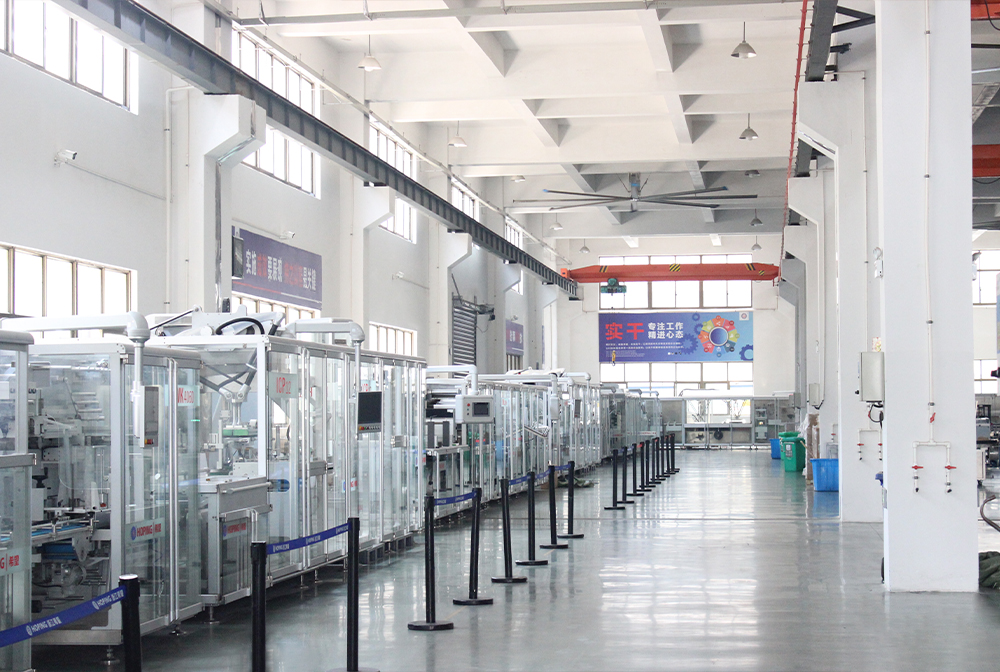
Machine showroom at Hoping Machinery — configuration review and material trial arrangements start here.
Next step: sample, quotation or full catalogue
Send your carton dimensions, blister format and required output, and request a servo-driven cartoner configuration proposal plus a material trial. The complete Hoping Machinery product range is available in the downloadable catalogue.
Download the Hoping Machinery Catalog (PDF)
Contact: Monica · Email: monica@xwbj.com · Tel / WhatsApp: +86 133-5610-5292 · Website: www.hopingcn.com
Have Questions or Need More Details?
Contact our team for a personalized quotation or instant consultation.
Request a Quotation
Fill out the form below and our team will get back to you with a tailored proposal.
WhatsApp Direct Chat
Prefer to chat in real-time? Message us on WhatsApp for instant assistance & quick answers.
- Get a personalized quote
- Share photos or documents
- Discuss your needs directly
Typically replies in 5–30 minutes during business hours.