
Fully Servo Blister-Cartoning Lines: A Discovery Guide
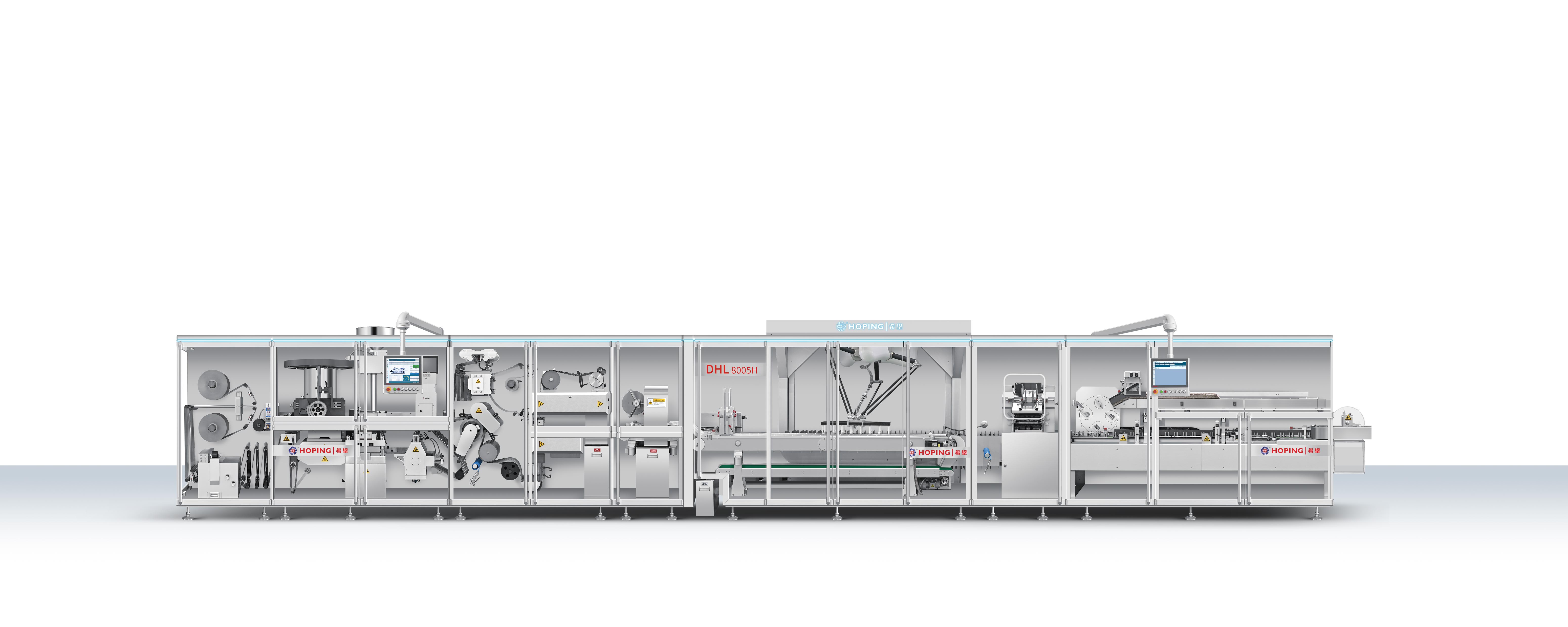
The DHL8005H integrated blister-cartoner: blister forming and sealing, blister transfer, leaflet handling and cartoning in one linked machine.
A fully servo blister-cartoning line is one pharmaceutical packaging machine that forms and seals blisters and then transfers them directly into erected cartons, with the blister end and the carton end driven and coordinated as a single unit. The phrase “fully servo” describes the drive architecture: the main motions are produced by servo motors and synchronised by a motion controller, rather than being taken from a single mechanical main shaft with cams and gearboxes.
HOPING (Zhejiang Hoping Machinery Co., Ltd.) builds one line in this class, the DHL8005H. Its published description lists a maximum output of up to 800 blisters/min and 500 cartons/min, a D3 intelligent top-loading parallel tracking transfer system, multiple feeding methods, a three-channel servo-driven independent replenishment system, PVC/Alu foil auto splicing, a Beckhoff motion controller with a CP9315 industrial PC, mold-change and preset-memory functions, and GMP-oriented product-contact parts and tooling supplied according to the technical agreement.
This guide is written for the discovery stage of a purchase, when the priority is vocabulary rather than paperwork. It defines the equipment categories behind the name, explains what each subsystem on an integrated line actually does, places the documented DHL8005H features in their correct position, and shows why the published maximum speeds are a starting point for a capacity conversation rather than a capacity guarantee. Tablets, capsules, soft capsules and healthcare products are all in scope; the boundaries are stated wherever the available information stops.
The Three Equipment Categories Behind the Name
“Blister cartoning line” is used loosely in the market. It can mean a blister machine, a cartoner, or the combined system, and quotations can differ simply because the three are being quoted against the same words.
Blister packaging machine — primary packaging
A blister packaging machine forms cavities in a forming film, fills them with product, seals the web with lidding foil and punches out blister cards. It is a primary packaging machine: when the card leaves it, the product is inside its first barrier. HOPING’s DPP260K, a flat Alu-PVC / Alu-Alu blister packing machine, illustrates the category: typical capacity 20–70 cycles/min, 380V 50Hz 9.5 kW supply and roughly 3,900 kg net weight. The unit matters — those are cycles per minute, not blisters. One cycle produces one blister card carrying as many cavities as the format allows.
Cartoning machine — secondary packaging
A cartoning machine erects a carton blank, loads the product (often together with a leaflet), closes the carton and applies coding. Horizontal cartoning systems accounted for 70.12% of cartoning machine market share in 2024, according to Mordor Intelligence commercial research — a share consistent with the horizontal layout used in blister cartoning, where blisters travel in line and are inserted into cartons that travel beside them.
Blister-cartoning line — the integrated system
An integrated line links blister forming and sealing, blister transfer, leaflet handling, carton opening, insertion and coding or inspection, and can connect onwards to bundling, case packing and palletizing. The DHL8005H’s published scope describes exactly this sequence, which is what separates a line from two machines standing near each other.
| Term | What it refers to | Why it matters at discovery stage |
|---|---|---|
| Blister / blister card | Formed pocket sealed with lidding foil | The unit counted in “blisters/min” |
| Forming film | Base web, commonly PVC | Material choice drives forming behaviour and barrier |
| Lidding foil | Aluminium sealing web | Named with PVC in the DHL8005H auto-splicing feature |
| Alu-Alu / cold form | Aluminium-based forming structure | A different forming route; confirm per model and format |
| Carton blank | Flat printed card that becomes the carton | Defines carton size range and changeover parts |
| Leaflet | Folded instruction sheet inserted with the blister | Adds a handling station and a format variable |
| Top-loading transfer | Blister inserted from above into an open carton | The D3 system on the DHL8005H is described as top-loading |
| Servo axis | Independently driven motion coordinated by a controller | Replaces a shared mechanical drive between stations |
| Preset / recipe memory | Stored machine settings for a format | Shortens and standardises changeover |
| End of line | Bundling, case packing, palletizing | Determines whether the line stops at the carton |
Why the Blister-to-Carton Handoff Is the Real Design Problem
On separate machines, blister output has to be buffered, oriented and presented at the cartoner’s rhythm. The blister machine works in cycles with a sealing dwell; the cartoner indexes cartons continuously. Between them sits a transfer conveyor and, in most layouts, some accumulation — which is intermediate stock that has to be counted, protected and reconciled before the batch can be closed.
An integrated line moves that handoff inside one machine, so the transfer becomes a controlled station rather than an inventory point. It does not make the two halves equal. The blister end still produces cards at its own rate, the cartoner still consumes them at its own rate, and the line is only as fast as the pairing allows for a given format, which is what the next sections examine.
Three questions separate a well-integrated line from a fast machine with a conveyor attached:
- How is a blister actually handed to the carton — pushed end-on, or lowered from above?
- What happens to the blisters already in transfer when the cartoner stops or a carton is missing?
- When the format changes, how many settings have to be repeated on a second screen?
Industry Background: Why Integration Is Being Specified
Blister packaging machinery for pharmaceutical applications was valued at USD 2.57 billion globally in 2025, with Asia-Pacific described as the fastest-growing region at an 8.87% CAGR to 2031, according to Custom Market Insights commercial research. The figures are a single publisher’s estimate with its own product definition, so they indicate the scale of the category rather than a benchmark for any individual project.
Two regulatory reference points matter at discovery stage. The U.S. FDA describes current Good Manufacturing Practice as the foundation for quality pharmaceuticals through regulatory standards — a framework statement, not a machine-specific design clause. ISO 15378:2017 specifies GMP requirements for primary packaging materials for medicinal products; it addresses the packaging material, so it belongs in the material-qualification conversation rather than being restated as a machine certification. Separately, a regulatory-affairs report notes that China has a draft GMP guidance for pharmaceutical packaging materials under public consultation, which would guide licence holders in reviewing packaging material suppliers — draft status, and worth tracking rather than treating as settled.
A directional signal comes from trade media reporting PMMI content: pharmaceutical manufacturers are described as turning toward digitised data collection and integrated solutions to meet regulations and improve visibility. That is commentary without a measured adoption rate, but it explains why line-level control architecture and data handling now appear in equipment discussions alongside mechanical speed.
Inside the DHL8005H: What Each Subsystem Does
The value of a documented example is that it turns abstract terms into named parts. Here is the DHL8005H sequence, station by station, with the practical question a buyer should attach to each.
1. Blister forming and sealing
The forming station heats the base web and draws cavities; the filling station doses product; the sealing station bonds lidding foil to the web. The DHL8005H lists PVC/Alu foil auto splicing, which means the film and foil reels can be joined to a new reel without stopping the line for a manual re-thread. For a high-speed line this is a continuity feature, not a speed feature: it changes how long the line runs between interruptions. Ask how the splice is detected and whether spliced sections are rejected downstream.
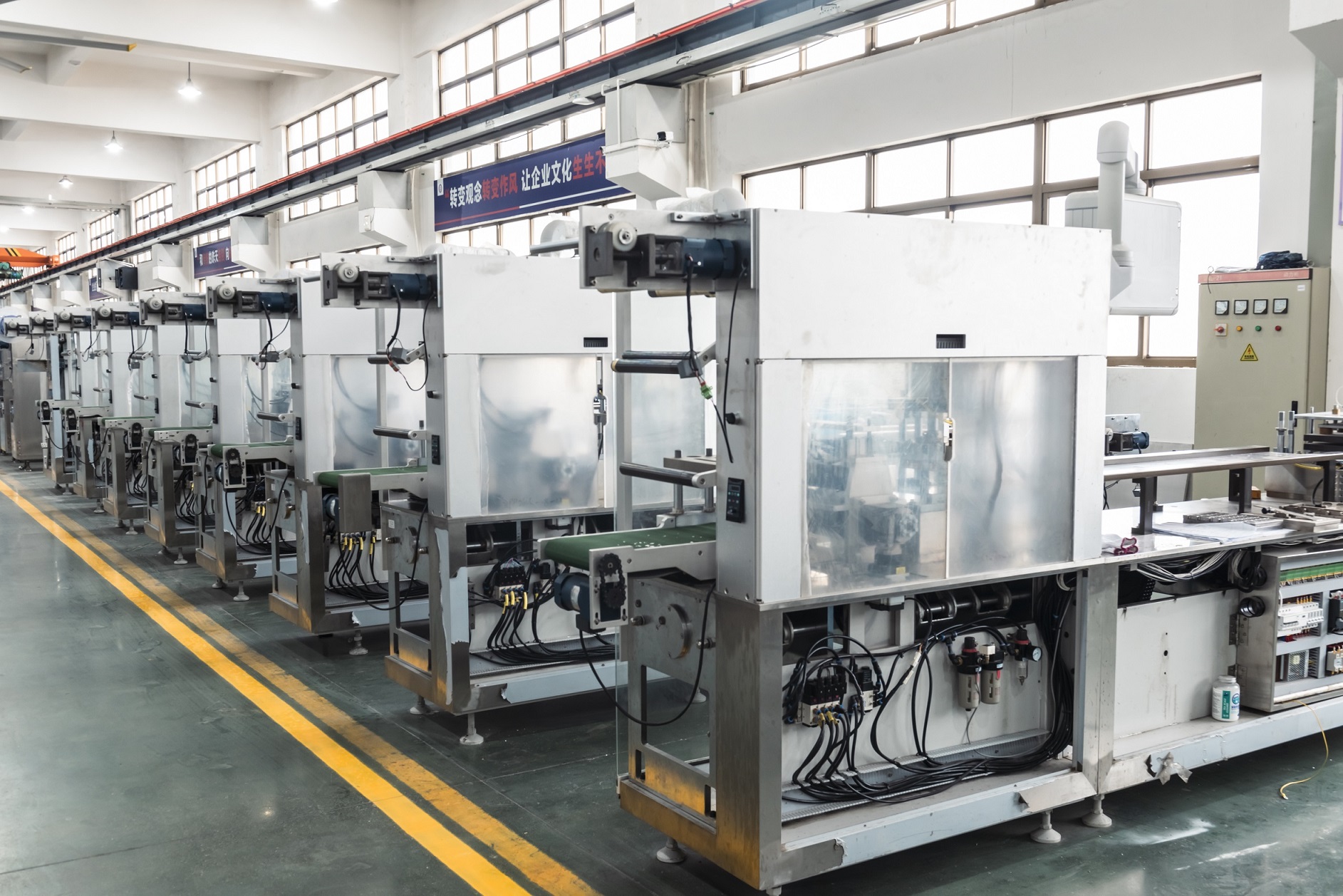
Blister machine assembly area at HOPING — the forming and sealing end of a blister-cartoning line.
2. Product feeding
The DHL8005H is described as supporting multiple feeding methods, and its application scope covers capsule and tablet packaging plus healthcare products. Feeding is where product shape decides hardware: tablets, capsules and soft capsules differ in how they orient, how they bridge in a hopper and how much they can be handled without damage. The honest position is that the feeder type must be matched to the product and confirmed in a format trial, not inferred from the model name.
3. Blister transfer
The D3 intelligent top-loading parallel tracking transfer system is the bridge between the two halves of the line. Top-loading means the blister is placed into a carton that is open at the top, rather than being pushed in from the end. Parallel tracking describes carriers moving alongside the carton pockets so that insertion happens while both are indexed together. The design intent is fewer handling steps between the sealed card and the packed carton; the actual behaviour at production speed is something an acceptance test should demonstrate.
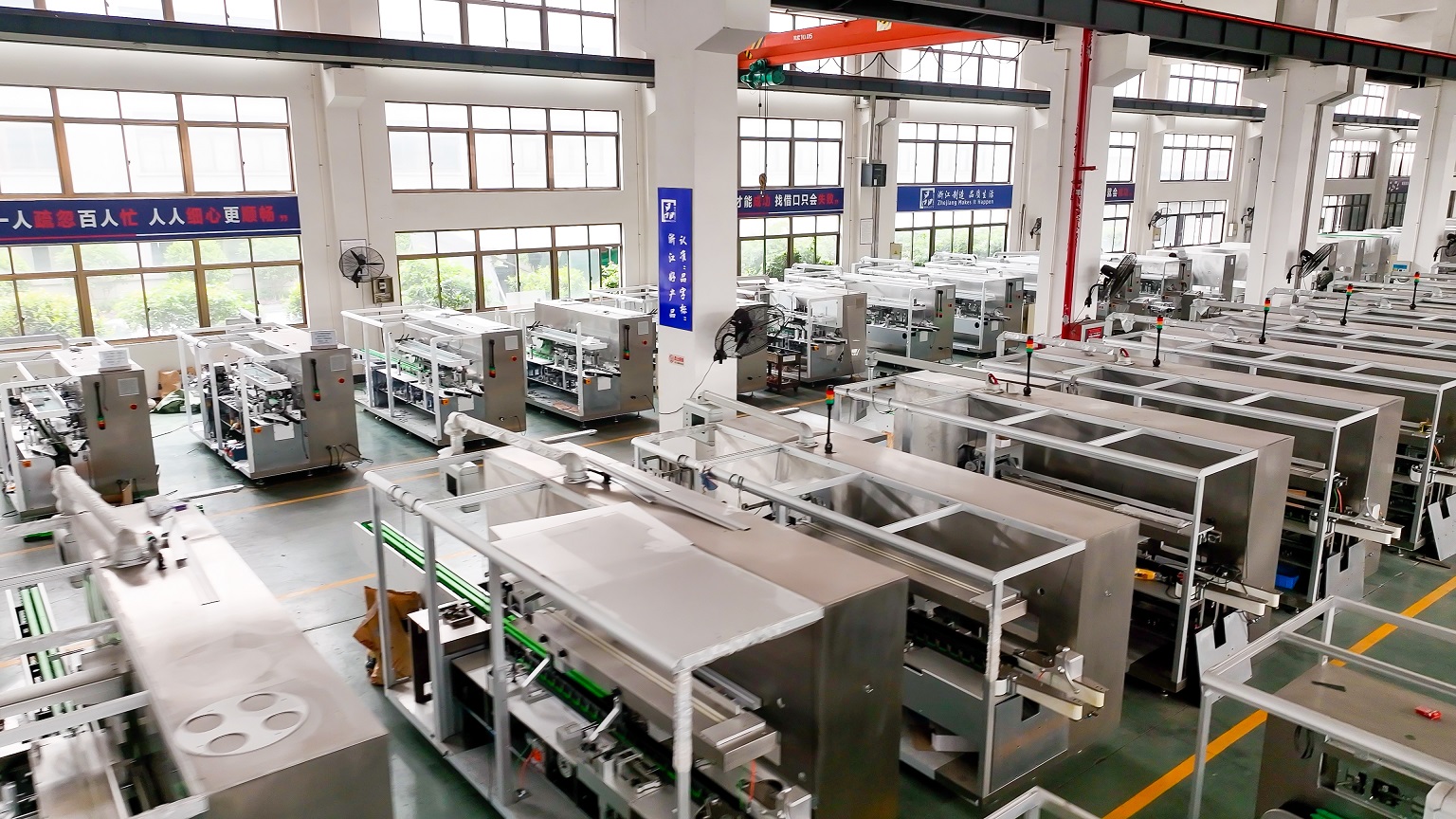
The cartoning end: carton erection, insertion and closing are assembled and tested in this workshop.
4. Three-channel servo-driven independent replenishment
Replenishment is the supply of blisters into the cartoning flow. On the DHL8005H this is handled by three channels, each with its own servo drive rather than sharing one mechanical drive. At a stated maximum of 800 blisters/min, the cartoner cannot be starved between cycles, so how blisters are buffered and released is a genuine engineering decision. The question to ask is what the line does when one channel runs empty or jams: does the remaining output continue, and how is the event recorded?
5. Leaflet, carton and inspection
Leaflet handling, carton opening, blister insertion and coding or inspection complete the secondary packaging step. Each added component is a format variable: a different leaflet size or carton size requires different tooling, and inspection settings must be re-qualified when the format changes. This is where a discovery-stage buyer should note how many formats the line is expected to run over its life, not just at commissioning.
6. Control architecture
A Beckhoff motion controller with a CP9315 industrial PC coordinates the servo axes and carries the machine logic. Mold-change and preset-memory functions mean a stored format can be recalled instead of re-entered. The industrial PC is also the natural point for batch data, alarm history and parameter records, so it is fair to ask what can be exported, in what format, and whether records are protected against editing. Those questions belong in the technical agreement; the published description does not state a data-integrity compliance position, so it should not be assumed.
7. Downstream connection
The line is documented as connectable to bundling, case packing and palletizing equipment. A carton output of 500 cartons/min is a large flow for manual handling, so the end-of-line decision is part of the line decision rather than an afterthought.
8. GMP-oriented design
The machine structure is stainless steel and aluminium alloy with transparent guarding, and product-contact parts and tooling are configured to the technical agreement. “GMP-oriented” is a design description, not a certificate. The verifiable version of that claim is documentation: material grades for contact parts, surface finish, cleaning access, and a change-control route for tooling.
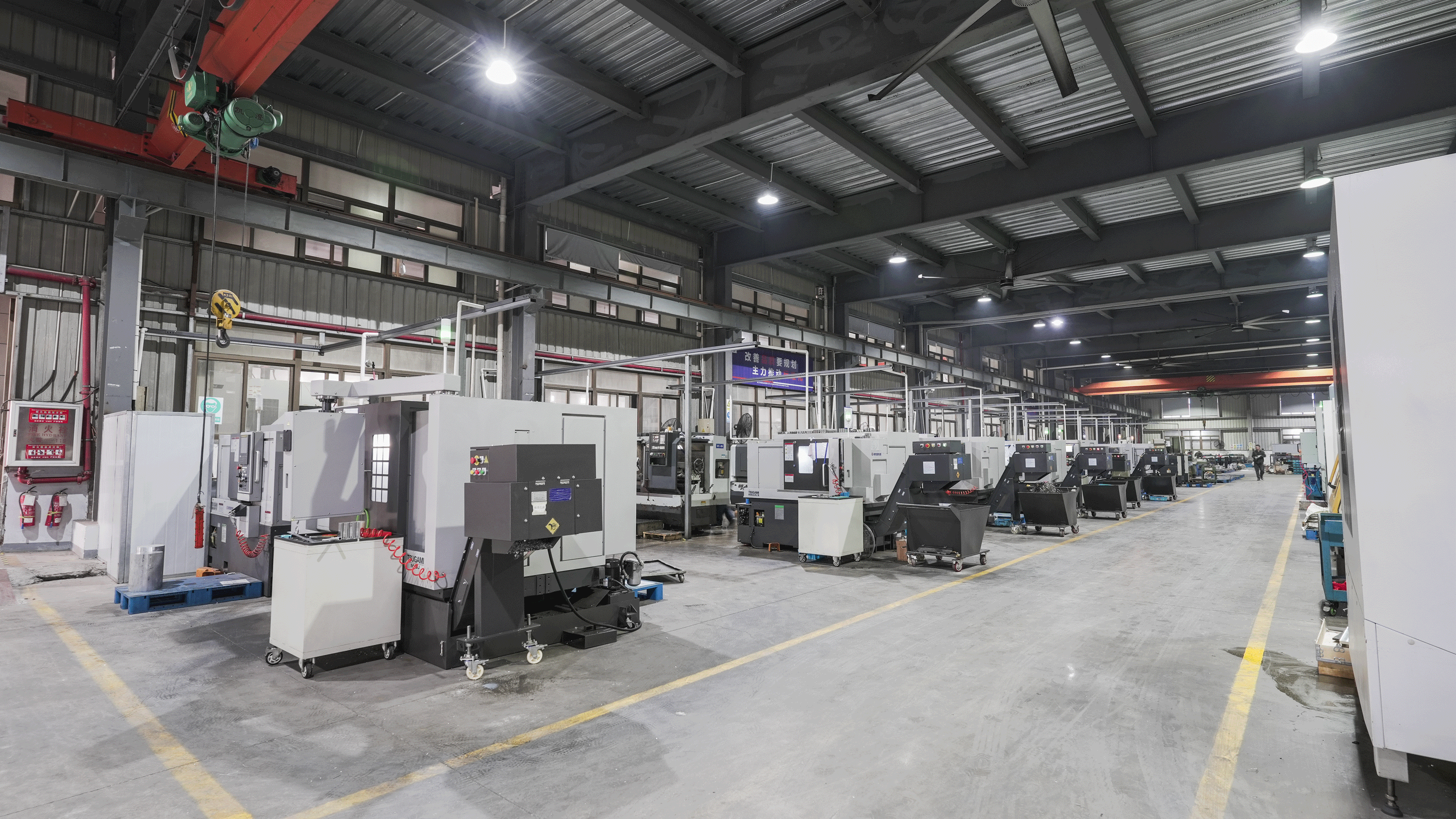
Component machining in house — the stage where tooling and contact-part specifications are fixed.
Reading 800 Blisters/min and 500 Cartons/min Correctly
Both numbers are stated maximums for the DHL8005H, and they are not a matched pair across all formats. The arithmetic shows why, using the two published figures: 800 ÷ 500 = 1.6, so the two maximums are consistent with roughly one to two blisters per carton (calculated from the stated maximums, not a measured production value).
Consider a format with two blisters per carton: at the full blister rate of 800 blisters/min, the cartoner would need 400 cartons/min, which is inside its 500 cartons/min ceiling. Now consider one blister per carton: 800 blisters/min require 800 cartons/min, and the cartoner’s 500 cartons/min limit would cap blister output at 500. Same machine, different constraint — the carton count per carton decides which end of the line governs.
Maximum output is also not sustained output. The verified industry picture is explicit on this point: nominal maximums are not comparable with other suppliers until format, station count, rejection rate and operating conditions are known. A buyer should request sustained output over a shift, the reject-rate basis, and the conditions under which the figure was obtained at factory acceptance testing.
How It Differs from Conventional Blister and Carton Equipment
A conventional setup pairs a primary packaging machine with a separate cartoner. Both are legitimate purchases; the difference is in what has to be managed between them.
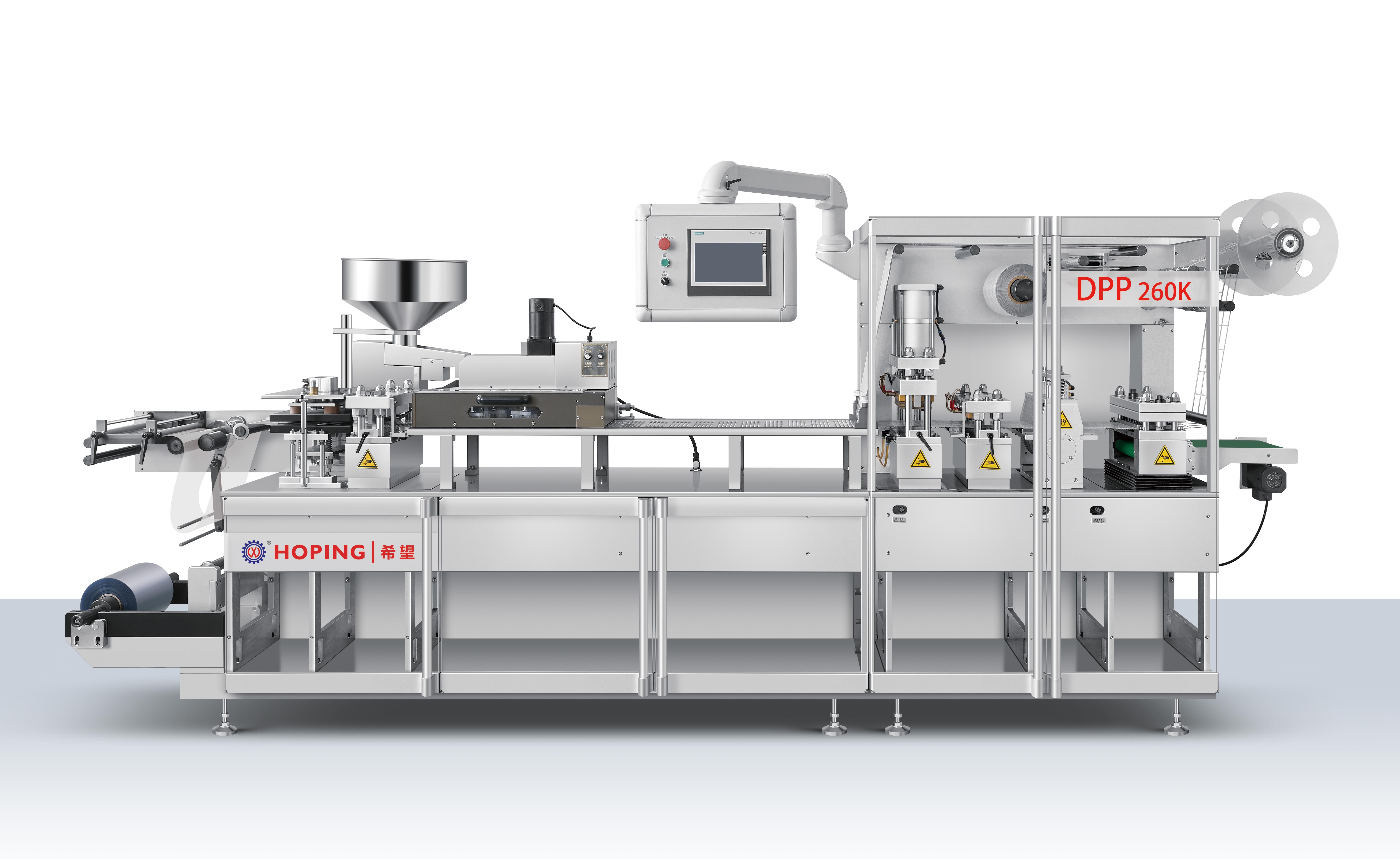
A stand-alone blister machine such as the DPP260K covers primary packaging only; cartoning would be a separate machine.
| Dimension | Separate blister machine + cartoner | DHL8005H integrated line (documented) |
|---|---|---|
| Packaging stages covered | Primary packaging only on the blister machine; cartoning on a second machine | Blister forming/sealing, transfer, leaflet handling, carton opening, insertion, coding/inspection |
| Drive and control | Two machines, driven and controlled separately | Beckhoff motion controller with CP9315 industrial PC; servo-driven motion components |
| Blister supply to the cartoner | Conveyor and, typically, an accumulation buffer between machines | Three-channel servo-driven independent replenishment |
| Material reel changes | Not documented for the stand-alone example | PVC/Alu foil auto splicing |
| Format change | Settings applied on two separate controls | Mold-change and preset-memory functions on one control system |
| Published maximum output | DPP260K: typical 20–70 cycles/min (blister machine only) | Up to 800 blisters/min and 500 cartons/min |
| Product-contact parts | Defined by the individual machine | GMP-oriented contact parts and tooling per technical agreement |
| Downstream | Separate transfer to a bundler or case packer | Documented connection to bundling, case packing and palletizing |
The comparison also has a limit. Separate machines remain the sensible choice when volumes are low, when primary and secondary packaging sit in different rooms or at different sites, or when a change on one side must not stop the other. Integration trades flexibility at the boundary for a controlled transfer.
Where the Line Fits: Tablets, Capsules, Soft Capsules, Healthcare Products
The DHL8005H is described for pharmaceutical solid dosage production, capsule and tablet packaging, healthcare products, and food and cosmetic blister-cartoning projects. Within oral solid dosage, the practical differences are format-driven rather than category-driven: cavity geometry and depth for the product, how many units go into each carton, carton size and board weight, leaflet format, and the coding and inspection settings that follow.
For Alu-Alu or cold-form structures, treat capability as a question rather than an assumption. The DHL8005H description specifies PVC/Alu foil auto splicing, while the DPP260K is described as an Alu-PVC / Alu-Alu machine and HOPING lists aluminium-aluminium blister equipment in its range; whether a specific integrated line runs a given Alu-Alu format is confirmed through the forming tooling and material trial.
Position within the family is also a discovery question rather than a ranking. The DHL6004 is published at up to 600 blisters/min and 400 cartons/min, the DHL8005H at up to 800 and 500, and the DHL1000/5H at up to 1,000 blisters/min and 500 cartons/min with a four-channel replenishment system and a high-bus industrial control system. Where flexible secondary wrapping is required instead of direct cartoning, the IXW600 blister-flow-wrap-cartoner line is published at up to 600 blisters/min, 300 packs/min and 300 cartons/min.
A Discovery-Stage Checklist
- Define the format set you intend to run for the next five years, not only the launch SKU.
- State carton count per carton, carton size and leaflet format, because these set which end of the line becomes the constraint.
- Ask for sustained output and reject rate on your product, alongside the published maximum.
- Confirm feeder type against tablet, capsule and soft-capsule handling behaviour.
- Confirm material route — PVC/Alu, or an Alu-Alu structure requiring separate tooling.
- Ask what the transfer does when a carton is missing or the cartoner stops.
- Request the contact-part and tooling documentation that supports a GMP-oriented design claim.
- Decide the end-of-line scope: cartons only, or bundling, case packing and palletizing.
Frequently Asked Questions
What does a pharmaceutical packaging machine manufacturer actually supply?
A pharmaceutical packaging machine manufacturer supplies the equipment that puts a pharmaceutical product into its primary and secondary packaging, and usually the engineering around it. The range typically spans blister packaging machines, cartoning machines, case packing and end-of-line equipment, sold either as individual units or as a linked line. Assessment at discovery stage focuses on whether the range covers your full packaging sequence, how much of the design and machining is done in house, the size of the engineering team, the annual output volume, and which export markets the manufacturer already serves. As an example of the profile to check: HOPING was established in 2001, employs more than 300 people, reports annual output of 500 units and an R&D team of 56 engineers, and lists blister packaging machines, cartoning machines, case packing machines and end-of-line packaging machines as its main products, with an export ratio of about 25% and markets in Southeast Asia, the Middle East, Eastern Europe, South America and Africa.
What is the difference between a blister packaging machine and a blister-cartoning line?
A blister packaging machine performs primary packaging only: it forms blister cavities, fills them, seals the lidding foil and punches out cards. A blister-cartoning line adds secondary packaging inside the same machine — blister transfer, leaflet handling, carton opening, insertion into the carton, and coding or inspection — and can connect onwards to bundling, case packing and palletizing. In short, a blister machine delivers blister cards; a blister-cartoning line delivers filled, closed cartons.
What does “fully servo” mean on this type of line?
On a fully servo line, the main motions are produced by servo motors and synchronised through a motion controller, instead of being taken from one mechanical main shaft with cams and gearboxes. On the DHL8005H this is documented as servo-driven motion components under a Beckhoff motion controller with a CP9315 industrial PC, plus a three-channel servo-driven independent replenishment system and mold-change and preset-memory functions. The practical consequence is that motion settings for a format can be stored and recalled rather than set mechanically — which is also why the changeover procedure and the format trial deserve close attention.
Can one line handle tablets, capsules and soft capsules?
Yes, in principle — the DHL8005H is described for capsule and tablet packaging, healthcare products, and food and cosmetic blister-cartoning projects, and soft capsules fall within that solid-dosage scope. What changes between products is the feeding method and the tooling: product shape, size and surface affect orientation, hopper behaviour and handling gentleness, and the forming and carton tooling follows the format. Because the published description states that multiple feeding methods are available rather than naming one feeder for all products, the feeder configuration should be confirmed against your specific product mix and demonstrated with your material during a format trial.
What should be verified before accepting a blister-cartoning line?
Verification should cover four areas. First, output: sustained rate over a shift on your product and format, plus reject rate, rather than the published maximum alone. Second, transfer behaviour: how the line handles a missing carton, a stopped cartoner or an empty replenishment channel. Third, documentation: contact-part materials and tooling records per the technical agreement, plus whatever control-system data export you require. Fourth, changeover: how many steps and how much time a real format change takes, using the preset memory rather than an engineer’s notes. If it helps to work from a single reference set, HOPING publishes its full machinery catalogue, including blister, cartoning and end-of-line equipment specifications, as a downloadable PDF: Hoping Machinery Catalog.
Conclusion
A fully servo blister-cartoning line is best understood as one machine with two packaging stages, not as a blister machine with a cartoner attached. The integration shows up in three places: the transfer, where blister cards move into open cartons inside the machine instead of through a buffer; the control architecture, where servo axes are coordinated by a motion controller with an industrial PC carrying stored formats; and the documentation, where one line file replaces two equipment files.
The DHL8005H illustrates the category with published maximums of up to 800 blisters/min and 500 cartons/min, a D3 top-loading parallel tracking transfer system, three-channel servo-driven independent replenishment, PVC/Alu foil auto splicing and GMP-oriented contact parts. The next step in a discovery process is not to compare those maximums against another supplier’s headline figure, but to convert them into your own format: carton count per carton, sustained output, reject rate and changeover time. That conversation is the one that decides whether an integrated line — or a separate blister machine and cartoner — is the right shape for your packaging hall.

Discovery conversations are easier with the machine in front of you; HOPING’s exhibition hall hosts equipment demonstrations and format discussions.
Have Questions or Need More Details?
Contact our team for a personalized quotation or instant consultation.
Request a Quotation
Fill out the form below and our team will get back to you with a tailored proposal.
WhatsApp Direct Chat
Prefer to chat in real-time? Message us on WhatsApp for instant assistance & quick answers.
- Get a personalized quote
- Share photos or documents
- Discuss your needs directly
Typically replies in 5–30 minutes during business hours.