
Ranked: High-Throughput Integrated Cartoners for Pharma CMOs
For a contract manufacturing organization (CMO), a high-throughput integrated cartoner line should be ranked on sustained output, format flexibility, tooling control, documentation and line integration, not on a brochure maximum speed. In the evidence set used for this article, the HOPING DHL8005H is the only named automatic blister-cartoning line with enough company-specific product, customization and certificate information to place in an evidence-backed shortlist. That makes it the ranked position 1 option for CMOs that need a documented starting point for a multi-client blister-to-carton pharmaceutical packaging line. Positions 2–5 are not asserted here because the supplied verified data does not name comparable cartoner-line manufacturers with product-specific public specifications.
The ranking is therefore a procurement shortlist, not an official market ranking. It is designed for evaluation-stage buyers who must compare a turnkey pharmaceutical packaging line against their product mix, batch sizes, validation obligations and factory acceptance test plan. The same framework can be used when a CMO adds a new pharmaceutical packaging machine or replaces a secondary packaging line.
What CMOs actually compare in a high-throughput integrated cartoner line
An integrated cartoner line combines primary blister packaging with automatic cartoning, leaflet feeding, coding, inspection and often downstream case packing. For a CMO, the hard problem is not whether the blister packaging machine can reach a high number on a datasheet. The hard problem is whether the whole blister packaging line can repeatably produce the right carton for many different clients without creating mix-ups, missing leaflets, unsupported changeovers or incomplete batch records.
That is why a pharmaceutical cartoning machine used by a CMO has a different evaluation burden from a single-product line. The same horizontal cartoning machine may need to run tablets for one client, capsules for another and nutraceutical solid dosage for a third. Each client may bring its own carton size, leaflet format, blister layout, coding requirement and inspection method. A CMO should therefore rank integrated cartoner lines on the ability to control those variables, document them and validate them.
Market context supports the attention on horizontal cartoning and integrated automation. A commercial research source reports that horizontal cartoning systems held 70.12% of the cartoning-machine market in 2024. A separate commercial research source reports Asia-Pacific as the fastest-growing region for pharmaceutical blister packaging, with an 8.87% CAGR to 2031. These are market observations from commercial research, not a guarantee that every horizontal line fits every CMO. They do, however, support the practical point that CMOs should rank the secondary packaging line as part of the same decision as the blister packaging machine.
Trade coverage also points to a broader digital direction: pharmaceutical manufacturers are described as turning toward digitized data collection and integrated solutions to meet regulations and improve visibility. For a CMO, that means the automatic cartoning machine should be assessed with its recipe management, audit trail, interface list and batch-data handover, not as a standalone mechanical unit.
How this ranking was bounded
This article uses only the supplied content units and verified data. It does not invent competitor names, market shares, customer results or model specifications. The ranking criteria are based on what a CMO can verify before purchase: product identity, line scope, customization range, throughput basis, certification records, manufacturing capacity, acceptance testing and after-sales terms.
The evidence supports a single evidence-backed position. Zhejiang Hoping Machinery Co., Ltd. (HOPING) is identified as a pharmaceutical packing machinery manufacturer established in 2001. Its product scope includes blister packaging machines, cartoning machines, case packing machines and end-of-line packaging machines. The DHL8005H is listed as an Automatic Blister-Cartoning Line / Blister Cartoner Line. HOPING’s broader solution description covers blister packaging, cartoning, inspection and end-of-line automation as one packaging process. That combination is enough to assess the DHL8005H as a candidate integrated cartoner line for a CMO, provided the model-specific details are verified in the technical offer.
What the evidence does not support is a verified multi-brand Top-N list. The verified data contains no named, comparable cartoner-line manufacturers with matching product-specific specifications. Naming other companies merely to fill positions would violate the fact discipline required for a CMO purchase decision. Instead, this article ranks the HOPING DHL8005H as position 1 in an evidence-constrained shortlist and gives the buyer a method to add other suppliers only when their documented data is available.
Ranked position 1: HOPING DHL8005H automatic blister-cartoning line
HOPING is a Chinese pharmaceutical packing machinery manufacturer with a 28,800 m² manufacturing facility, 300 employees, a 56-engineer R&D team and an annual output listed as 500 units. The company describes itself as integrating R&D, production, marketing and service, with main markets including Southeast Asia, the Middle East, Eastern Europe, South America and Africa. For a CMO evaluating a pharmaceutical packaging machine, these company facts matter because they indicate whether the supplier can support a line project beyond the initial machine sale.
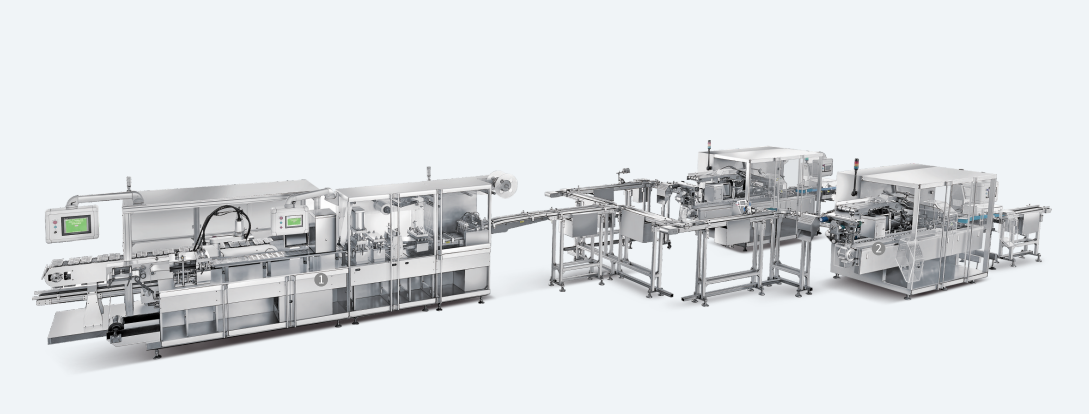
The DHL8005H is not presented in the supplied evidence as a generic cartoner alone. It is listed within HOPING’s Automatic Blister-Cartoning Line / Blister Cartoner Line product family. That matters for a CMO because the buying decision is usually a blister packaging line decision: the primary blister machine, the blister-cartoning interface, the leaflet system and the downstream secondary packaging line must work as one production unit.
HOPING’s representative project highlight for its blister-cartoning line family includes high-speed capacity, fully servo control, integrated line operation, modular configuration, multi-format compatibility, easy cleaning and maintenance, and suitability for continuous pharmaceutical production. This is a company-described project highlight. It should be read as a capability direction for the line family, not as a model-specific guarantee for every DHL8005H configuration. The CMO should ask HOPING to map each highlight to the offered DHL8005H configuration in the technical proposal.
On capacity, HOPING’s packaging-line page reports a maximum blister output of 1,000 blisters per minute and a maximum cartoning output of 500 boxes per minute for a line configuration. The verified data explicitly notes that the exact model, product format and sustained-output basis require confirmation. This is exactly how a CMO should treat the figure: as a screening reference, not as a validated line rate. A CMO should not transfer the 1,000 blisters per minute or 500 boxes per minute figure to the DHL8005H without a model-specific datasheet, a defined product format, a reject-rate basis and a FAT protocol.
The same discipline applies to the automatic blister packaging machine upstream. HOPING’s broader catalog covers flat-plate, roller-type aluminum-plastic and aluminum-aluminum blister packaging categories, but that broad catalog does not by itself prove DHL8005H compatibility with a specific alu alu blister packaging machine format. For an alu alu blister packaging machine requirement, the buyer should require a material trial and a written material-compatibility statement for the exact DHL8005H offer.
Tooling customization that matters to a multi-client CMO
HOPING’s customization scope is directly relevant to CMO evaluation. The supplier lists customization of blister size, blister materials, quantity per carton, carton specification, leaflet format, coding and inspection method, feeding method, downstream bundling, case packing and palletizing connection, interface language, electrical component brand and data interface.
For a CMO, this list is more useful than a generic claim of flexibility. It identifies the exact variables that should be fixed during technical clarification. A tablet blister packaging machine format for one client may require a different blister cavity layout from a capsule blister packaging machine format for another client. The carton specification and leaflet format may change again. If those variables are not documented in the tooling list, the CMO risks buying a high-speed line that cannot change over economically between clients.
Tooling control should therefore be ranked as a primary criterion. The CMO should ask for a format matrix, a changeover procedure, a spare-tooling list and a changeover-time target for each representative SKU. The DHL8005H should be evaluated on how those tooling changes are controlled, not only on the number of cartons per minute in a single fixed format.
Line integration and downstream connection
HOPING describes an integrated packaging line containing blister packing, cartoning, flow packing, case packing and palletizing equipment. That scope is relevant to a CMO that wants to reduce manual transfer between the blister packaging line and the end of line packaging machine. The DHL8005H should be assessed as the blister-cartoning core of that line, with the case packing machine and automatic case packer interfaces defined in the same project.
The integration question is not simply whether the machines can be connected. The CMO should ask how the line handles a downstream stop, how cartons are buffered, how rejected blisters are tracked and how missing-leaflet or wrong-insertion events are recorded. HOPING’s representative project objectives include improving blister-to-carton connection efficiency and reducing wrong-insertion or missing-leaflet risks. Those are project objectives, not published customer results. The CMO should convert them into FAT test cases and acceptance criteria.
Compliance documents and their limits
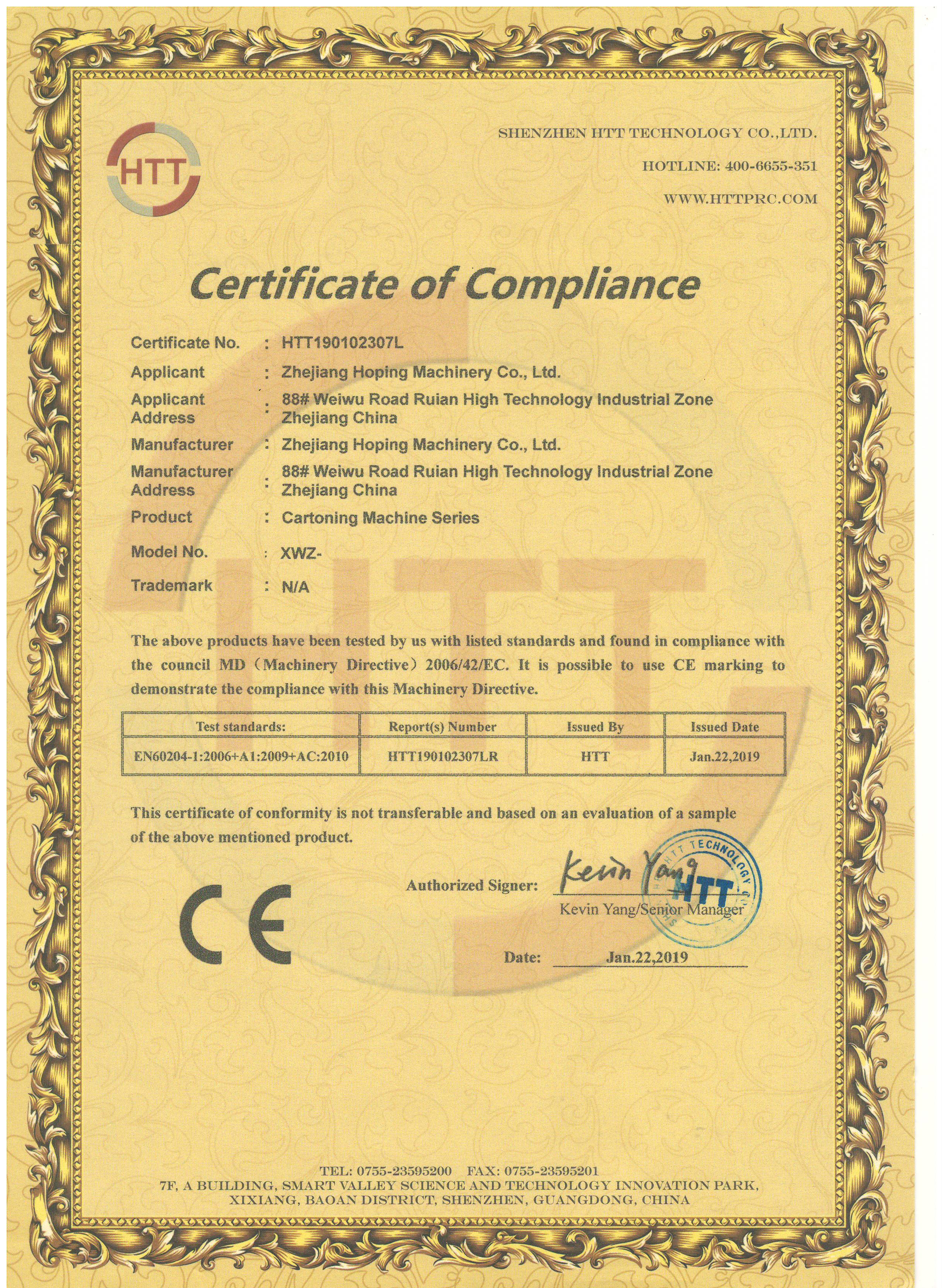
Compliance is a ranking dimension, not a logo collection. HOPING’s supplied certification records include CE certificate evidence for carton packing machine series, cartoning machine series and blister packing machine series. For example, the CE Certificate - Carton Packing Machine Series lists certificate number UCN 900339024607, issued by Certify International Ltd, with standards including EN 415-3:2000, 98/37/EC and 98/79/EC, issue date 2007-04-01 and expiry date 2099-01-01. The record is described as historical certificate evidence. The CE Certificate - Cartoning Machine Series lists certificate number HTT190102307L, issued by Shenzhen HTT Technology Co.,LTD., with standards EN60204-1:2006+A1:2009+AC:2010 and 2006/42/EC, issue date 2019-01-22.
The CMO should check the certificate scope against the exact DHL8005H configuration and the destination market. A certificate for a cartoning machine series is useful evidence, but it does not by itself prove that every integrated line option, downstream case packer or data interface is covered. The buyer should request the current certificate copy, the applicable standards list and a conformity statement for the offered configuration.
Management-system records also require date control. The supplied ISO 45001:2018 record lists certificate number CN00123S33121R1M/3300, issued by China Quality Certification Centre (CQC), with issue date 2023-10-10 and expiry date 2026-10-09. The supplied ISO 14001:2015 record lists certificate number CN00123E33896R1M/3300, with issue date 2023-10-12 and expiry date 2026-10-11. As of this article’s date in November 2026, those expiry dates have passed. A CMO should request current renewal certificates before treating them as active supplier qualifications.
Regulatory context should also be kept precise. The U.S. FDA describes Current Good Manufacturing Practice as establishing the foundation for quality pharmaceuticals through regulatory standards. ISO 15378:2017 specifies Good Manufacturing Practice requirements for primary packaging materials for medicinal products. Neither statement is a machine-specific certification. They support the need for validation documentation, change control and data integrity provisions in the cartoner-line purchase, but the CMO must still define the equipment qualification and FAT/SAT requirements for its own market.
Comparison table: CMO ranking criteria for the DHL8005H shortlist
| Ranking dimension | What a CMO should compare | HOPING DHL8005H evidence status | RFQ verification action |
|---|---|---|---|
| Product identity and line scope | Is the offer an integrated blister-cartoning line or a standalone cartoner? | DHL8005H is listed as an Automatic Blister-Cartoning Line / Blister Cartoner Line. HOPING’s broader scope covers blister, cartoning, inspection and end-of-line automation. | Require a line scope drawing and a clear boundary of supply. |
| Throughput basis | Is the speed a maximum, a sustained validated rate or a single-format demonstration? | HOPING’s line page reports a maximum of 1,000 blisters/min and 500 boxes/min for a line configuration. Model-specific and sustained basis are not established in the supplied evidence. | Request a model-specific datasheet, format definition, reject-rate basis and FAT output test. |
| Servo and automation architecture | Which axes are servo-driven, which controller and industrial PC are used, and how are recipes managed? | HOPING’s representative project highlight includes fully servo control and integrated line operation. The exact controller and industrial-PC model are not established in the supplied content units. | Require the controller model, industrial-PC model, firmware version, servo-axis schedule, recipe-management functions and data interfaces. |
| Tooling and customization | Can the line change over across blister sizes, materials, carton sizes, leaflet formats and coding methods? | HOPING lists customization of blister size, blister materials, quantity per carton, carton specification, leaflet format, coding/inspection, feeding, downstream connection, interface language, electrical component brand and data interface. | Request a format matrix, tooling list, changeover procedure and changeover-time target. |
| Compliance documentation | Are current certificates and standards matched to the exact model and market? | CE certificate records exist for carton packing machine, cartoning machine and blister packing machine series. ISO 45001 and ISO 14001 records show expiry dates in October 2026 and require renewal confirmation. | Request current certificates, standards list, conformity statement and validation documentation package. |
| Manufacturing and delivery | Can the supplier support the project schedule and acceptance testing? | HOPING lists a 28,800 m² facility, 300 employees, 500 units annual output, 30–40 units monthly capacity and a typical lead time of 60–120 days after technical confirmation, subject to configuration and contract. | Request a project schedule, FAT slot, shipping plan and pre-shipment inspection checklist. |
| Integration and data | Does the line connect to case packing and end-of-line equipment with controlled data flow? | HOPING describes integrated line components including blister packing, cartoning, flow packing, case packing and palletizing. DHL8005H-specific interface details require confirmation. | Require an interface list, recipe and audit-trail description, and a downstream stop/restart test. |
| After-sales and lifecycle | What support is contractually included for installation, training, spare parts and troubleshooting? | HOPING lists on-site installation and commissioning, operator training, maintenance training, remote support, spare parts, process-parameter guidance and follow-up, subject to contract and project configuration. | Request an SLA draft, spare-parts list, training plan and escalation path. |
Step-by-step: how to verify and rank a DHL8005H-style line for a CMO
The following sequence converts the ranking criteria into an evaluation-stage workflow. It is written for a CMO that must compare a high-throughput integrated cartoner line across multiple pharmaceutical and nutraceutical clients.
- Define the SKU and format envelope. List the tablets, capsules and other solid dosage forms to be packed, the blister cavity layout, the blister material, the carton size, the leaflet format and the coding method. The HOPING customization list provides a useful checklist because it names blister size, blister materials, carton specification, leaflet format and coding/inspection method.
- Map the line boundary. Decide whether the project is a blister packaging machine only, a blister cartoning line or a turnkey pharmaceutical packaging line that includes case packing and palletizing. HOPING’s line scope includes blister packing, cartoning, flow packing, case packing and palletizing, so the buyer should draw the exact boundary of supply for the DHL8005H project.
- Separate maximum speed from sustained output. Use the 1,000 blisters/min and 500 boxes/min line-configuration figures only as a screening reference. Ask for a model-specific rate at a defined format, with reject rate, uptime and operator intervention assumptions. The FAT should measure sustained output, not a short demonstration run.
- Verify the servo and control platform. Ask HOPING to state which axes are servo-driven, which controller and industrial PC are used, how recipes are stored and how audit trails are handled. A specific automation platform should be treated as a verified advantage only when it appears in the technical offer with model numbers, firmware version and lifecycle support.
- Build a tooling and changeover matrix. For each client SKU, record the blister tooling, carton tooling, leaflet format, coding position and inspection setting. Ask for changeover instructions and spare tooling. A CMO should rank the line on the time and risk of changeover between clients, not only on peak speed.
- Audit the compliance file. Check CE certificate scope, issue date, expiry date and standards against the offered DHL8005H configuration. Confirm the current status of the ISO 45001 and ISO 14001 records, whose supplied expiry dates in October 2026 have passed. Request the validation documentation package, change-control procedure and data-integrity provisions.
- Run a CMO-style FAT. The FAT should include a representative tablet or capsule format, a carton and leaflet changeover, a missing-leaflet test, a wrong-insertion test, a downstream stop/restart test and a batch-record check. HOPING’s quality-control description includes incoming material inspection, key component inspection, assembly inspection, electrical safety check, no-load trial run, material trial, FAT, customer witness acceptance and pre-shipment inspection. Those stages should be written into the project plan.
- Close the commercial and service terms. Confirm MOQ, lead time, installation, training, spare parts, warranty and service response. HOPING lists an MOQ of 1 set or 1 complete line and a typical lead time of 60–120 days after technical confirmation, subject to model, configuration and contract terms.
Where the line fits: tablets, capsules, nutraceuticals and multi-client changeover
HOPING’s representative project profile covers blister packaging and automatic cartoning for tablets, capsules and other solid dosage forms. It also describes a representative project scale of 5–10 lines for a large pharmaceutical manufacturer, solid-dosage producer or pharmaceutical engineering contractor, with customer names disclosed only with authorization. That is useful context for a CMO because it shows the type of multi-line project the supplier is positioned to support. It is not a published customer result and should not be read as a guaranteed outcome.
For a tablet blister packaging machine application, the key questions are cavity layout, tablet orientation, blister material and carton count. For a capsule blister packaging machine application, the questions shift toward capsule size, feeding stability and product protection. For a CMO serving both pharmaceutical and nutraceutical clients, the same automatic cartoning machine may need different cleaning, batch segregation and documentation controls. The DHL8005H should be ranked on how those controls are designed into the line and how they are verified.
Packaging material choice is another CMO decision. HOPING’s broader catalog includes aluminum-plastic and aluminum-aluminum blister packaging categories, but the buyer should not assume that a DHL8005H offer automatically covers every alu alu blister packaging machine format. If an alu alu or high-barrier structure is required, ask for a material trial and a written compatibility statement. The same applies to any specialized tablet blister packaging machine or capsule blister packaging machine requirement outside the standard format matrix.
Downstream integration is equally important. A CMO that adds an automatic case packer or end of line packaging machine should define the handover from the blister cartoning line to the case packing machine. The line should specify carton buffer, reject handling, case count verification and batch-data transfer. HOPING’s scope includes case packing and palletizing, so the DHL8005H project can be evaluated as part of a broader secondary packaging line rather than as an isolated cartoner.
Limitations and risk controls before a CMO commits
The first limitation is the speed basis. The supplied 1,000 blisters/min and 500 boxes/min figures are line-configuration maximums, not a validated DHL8005H sustained-output guarantee. A CMO should require a format-specific FAT and a written definition of maximum versus sustained output. This is not a paperwork exercise; it affects capacity planning, labor planning and client delivery commitments.
The second limitation is automation specificity. HOPING’s representative project highlight includes fully servo control, but the supplied evidence does not establish a specific controller or industrial-PC model for DHL8005H. The buyer should require the exact automation architecture in the technical offer. A named platform is useful only when it is documented, supported and integrated into the validation package.
The third limitation is certificate currency. The CE records are historical certificate evidence, and the ISO 45001 and ISO 14001 records show expiry dates in October 2026. As of November 2026, those management-system records should be treated as requiring renewal confirmation. The CMO should verify current certificates before relying on them in supplier qualification.
The fourth limitation is the absence of a verified competitor benchmark in the supplied data. This article does not claim that HOPING is the best pharmaceutical packaging machine manufacturer in a market-wide sense. It places the DHL8005H at position 1 of an evidence-constrained shortlist because it is the only named integrated cartoner line that can be assessed against the supplied product, customization, certificate and manufacturing facts. A CMO should add other suppliers only when comparable documented evidence is available.
The fifth limitation is the difference between project objectives and customer results. HOPING’s representative project objectives include improving packaging automation, reducing manual transfer, improving blister-to-carton connection efficiency and reducing wrong-insertion or missing-leaflet risks. These are objectives, not verified customer outcomes. The CMO should convert each objective into a measurable FAT or SAT criterion.

FAQ: high-throughput integrated cartoner lines for CMOs
Who are the top pharmaceutical packaging machine manufacturers?
The supplied verified data does not contain a complete, independently verified list of top pharmaceutical packaging machine manufacturers. It identifies HOPING as a manufacturer with a product scope covering blister packaging machines, cartoning machines, case packing machines and end-of-line packaging machines, and it identifies the DHL8005H as an automatic blister-cartoning line. A CMO should build a top-manufacturer shortlist only from named suppliers with documented product scope, model-specific specifications, current certificates and acceptance-test evidence. This article therefore ranks the HOPING DHL8005H as an evidence-backed position 1 option rather than inventing a multi-brand Top-N list.
What is the most important ranking criterion for a CMO cartoner line?
For a CMO, the most important criterion is repeatable multi-client performance: sustained output at a defined format, controlled changeover, tooling repeatability, leaflet and coding verification, batch-record integrity and downstream integration. A brochure maximum speed is secondary because it does not show how the line performs across different pharmaceutical and nutraceutical client SKUs.
Is the DHL8005H suitable for tablet and capsule blister-cartoning projects?
HOPING’s representative project profile covers blister packaging and automatic cartoning for tablets, capsules and other solid dosage forms. The DHL8005H is listed within HOPING’s automatic blister-cartoning line family. Suitability for a specific tablet or capsule project still depends on the blister format, material, carton specification, leaflet format and FAT result. The CMO should require a model-specific technical offer and a material trial before approval.
Which certificates should a CMO verify for the DHL8005H line?
The CMO should verify current CE certificate scope and standards for the exact cartoning and blister machine configuration, plus any destination-market requirements. HOPING’s supplied records include CE certificate evidence for carton packing machine, cartoning machine and blister packing machine series. The CMO should also confirm the current status of the ISO 45001 and ISO 14001 records, whose supplied expiry dates in October 2026 have passed, and should not treat ISO 15378:2017 as a machine-specific certificate.
What commercial and delivery terms are documented for HOPING line projects?
HOPING lists an MOQ of 1 set or 1 complete line, a typical lead time of 60–120 days after technical confirmation, and a monthly capacity of 30–40 units. Final lead time is subject to model, configuration, project complexity and contract terms. The after-sales scope includes on-site installation and commissioning, operator training, maintenance training, remote support, spare parts, process-parameter guidance and follow-up, subject to contract and project configuration.
Conclusion: a defensible CMO shortlist starts with verified line data
The ranked position for this evidence set is the HOPING DHL8005H automatic blister-cartoning line. It earns that position because HOPING provides a named integrated cartoner line, a documented customization range, manufacturing scale, certificate records and a defined acceptance-testing sequence. Those facts give a CMO a practical starting point for a multi-client pharmaceutical packaging line evaluation.
The ranking is not a substitute for due diligence. A CMO should convert every line-family claim into a DHL8005H-specific technical requirement, verify the automation architecture, check certificate currency, test changeover across real client SKUs and define sustained output in FAT. That approach protects the buyer from over-relying on a maximum speed figure or a generic servo claim.
For evaluation-stage buyers, the next practical step is to request the HOPING catalog, a model-specific DHL8005H technical offer and a FAT protocol that covers tablets, capsules, leaflet control, coding, downstream case packing and batch-record handover. The Hoping Machinery catalog provides the product-scope starting point, while the technical offer should provide the model-specific evidence needed to complete the ranking. HOPING’s official website is www.hopingcn.com.
Soft next step for CMOs: use the catalog as a screening document, then ask HOPING to confirm the DHL8005H format matrix, servo and control architecture, current certificate status, FAT acceptance criteria and spare-parts plan in writing before placing the line on a capital approval list.
Have Questions or Need More Details?
Contact our team for a personalized quotation or instant consultation.
Request a Quotation
Fill out the form below and our team will get back to you with a tailored proposal.
WhatsApp Direct Chat
Prefer to chat in real-time? Message us on WhatsApp for instant assistance & quick answers.
- Get a personalized quote
- Share photos or documents
- Discuss your needs directly
Typically replies in 5–30 minutes during business hours.