
Fully Servo Blister-Cartoning Line: DHL8005H Basics
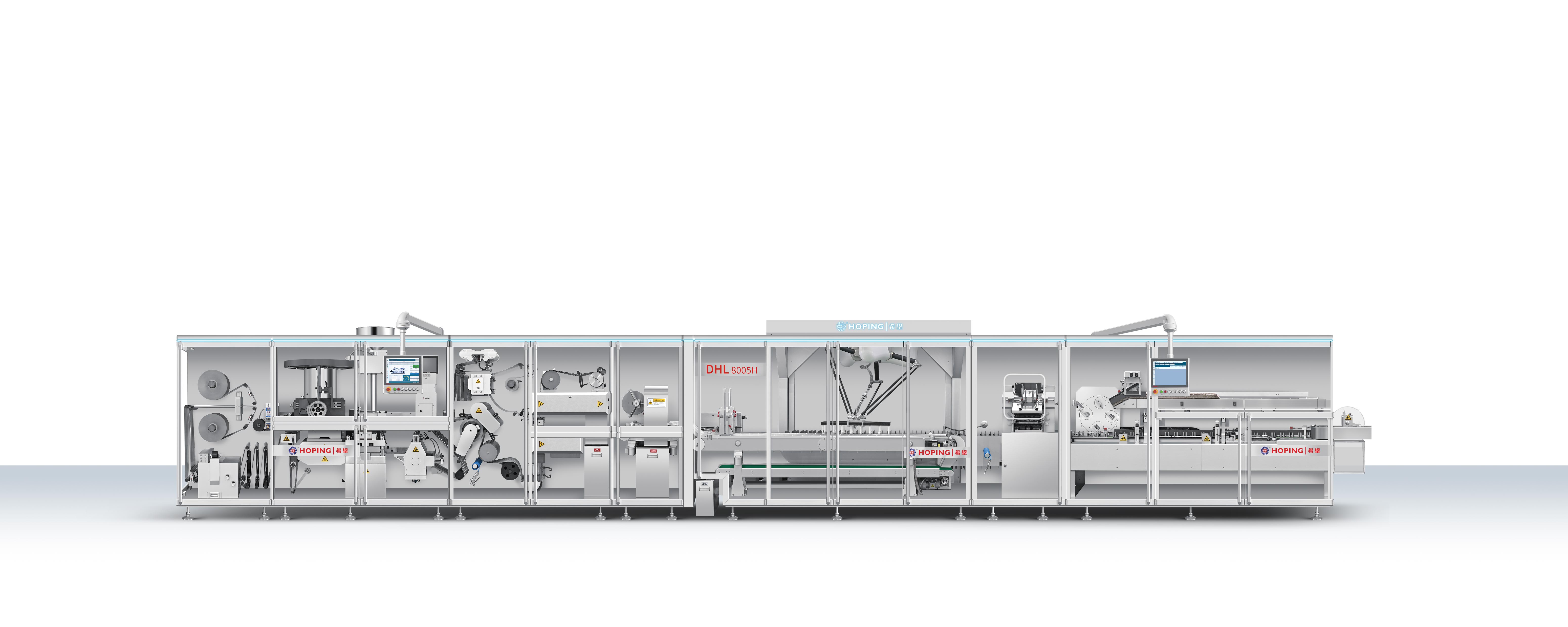
A fully servo blister-cartoning line is an integrated pharmaceutical packaging machine that combines blister forming and sealing with carton forming, leaflet insertion, and carton closing, while key motions are driven by servo motors and coordinated electronically. The DHL8005H from HOPING is a reference example: an intelligent fully servo high-speed blister-cartoner integrated machine described with a Beckhoff motion controller, a CP9315 industrial PC, a three-channel servo-driven independent replenishment system, and company-stated maximum capacities of up to 800 blisters per minute and 500 cartons per minute. This explainer focuses on what the term means, how the line is built, and which facts a pharma buyer or engineer should read carefully.
What “Fully Servo” Means on a Pharmaceutical Packaging Machine
In a fully servo blister-cartoning line, the main packaging motions are driven by servo motors rather than by a single mechanical main shaft that mechanically times every station. A motion controller coordinates the servo axes, and the machine’s HMI or industrial PC manages recipes, parameters, and operator interaction. The practical meaning is architectural: the line is designed around electronically synchronized servo motion, not around a fixed mechanical cam train alone.
On the DHL8005H, this architecture is visible in two supported descriptions. First, the model is classified as an intelligent fully servo high-speed blister-cartoner integrated machine. Second, the line is specified with servo-driven motion components and a three-channel servo-driven independent replenishment system. Those facts describe the drive and material-flow design; they do not, by themselves, guarantee a particular output, changeover time, or compliance status for every product format.
That distinction matters because “fully servo” is often used loosely. It should not be read as “all possible formats run at maximum speed” or “the line is automatically GMP-compliant.” It is better read as a machine-level design choice that affects how motions are coordinated, how recipes and format changes can be managed, and how the blister section and cartoner are linked.
Why Integration Changes the Blister-Cartoning Problem
A blister packaging machine forms pockets in a film, fills them with tablets or capsules, seals the lidding material, and cuts the blister cards. A cartoning machine opens a carton, inserts the blister card and leaflet, closes the carton, and may add coding or inspection. When these two functions are separate, the buffer between them absorbs speed differences and minor stops. When they are integrated into a blister-cartoning line, the buffer, transfer, and synchronization strategy become part of the machine design.
The DHL8005H is described as covering high-speed blister forming and sealing, transfer, leaflet handling, carton opening, insertion, coding and inspection, and connection to bundling, case packing, and palletizing equipment. That scope explains why the line is more than a blister machine with a cartoner bolted on. The transfer system, the replenishment system, and the control platform all sit between primary and secondary packaging.
The speed relationship is also a useful reality check. The DHL8005H is listed with a company-stated maximum of up to 800 blisters per minute and up to 500 cartons per minute. These are maximum figures for the model, not a promise that every blister format, carton size, leaflet, and material combination will sustain that balance. A line buyer should read them as an envelope to be validated against the actual product and acceptance criteria.
Inside the DHL8005H: Control, Replenishment, and Throughput
Beckhoff motion controller and CP9315 industrial PC
The DHL8005H is specified with a Beckhoff motion controller and a CP9315 industrial PC. In a fully servo line, the motion controller is the coordination layer for servo axes, while the industrial PC supports the machine-level computing environment. The exact axis count, cycle time, and software scope are not stated in the supplied facts, so those details should be confirmed in the technical agreement rather than assumed from the component names.
The use of a named motion controller and industrial PC is useful for buyers because it makes the control platform identifiable. It also means that spare-part planning, software support, and troubleshooting procedures can be discussed around specific hardware families. The DHL8005H is additionally described with mold-change and preset-memory functions, which belong to the same operational layer as recipe handling and format changeover.
Three-channel servo-driven independent replenishment
The DHL8005H uses a three-channel servo-driven independent replenishment system. “Independent replenishment” refers to separate material-supply channels within the line’s architecture; it is not a claim of unlimited autonomy or zero operator attention. The supported fact is the three-channel, servo-driven design. How those channels are loaded, how they interact with the blister format, and what replenishment interval is required in production should be defined for the specific project.
For a pharma packaging line, replenishment design matters because interruptions at the feeding stage can propagate into the cartoner. A line that is integrated at high speed needs a material-flow plan that matches the blister output, the transfer buffer, and the cartoner’s demand. The three-channel arrangement is one documented part of that plan on the DHL8005H.
Speed envelope and model context
The DHL8005H’s headline figures are up to 800 blisters per minute and up to 500 cartons per minute. The DHL7005H in the same family is listed at up to 700 blisters per minute and 500 cartons per minute, while the DHL1000/5H is listed at up to 1,000 blisters per minute and 500 cartons per minute. These are company-stated maximums for different models, not a ranking of overall line performance.
| Model | Company-stated maximum blister output | Company-stated maximum carton output | Motion control / HMI | Replenishment | Transfer / memory features |
|---|---|---|---|---|---|
| DHL8005H | Up to 800 blisters/min | Up to 500 cartons/min | Beckhoff motion controller; CP9315 industrial PC | Three-channel servo-driven independent replenishment | D3 intelligent top-loading parallel tracking transfer system; mold-change and preset-memory functions |
| DHL7005H | Up to 700 blisters/min | Up to 500 cartons/min | Siemens motion controller; TP900 HMI | Independent replenishment | Self-developed IRB24 intelligent transfer robot; mold-change support |
| DHL1000/5H | Up to 1,000 blisters/min | Up to 500 cartons/min | Beckhoff motion controller; high-bus industrial control system | Four-channel servo-driven independent replenishment | D3 intelligent top-loading parallel tracking transfer system; mold-change and recipe memory |
The table compares documented model characteristics only. It does not establish sustained output, OEE, reject rate, or superiority for a given product. Those values require format-specific trials and acceptance data.
GMP-Oriented Construction: What It Covers and What It Does Not
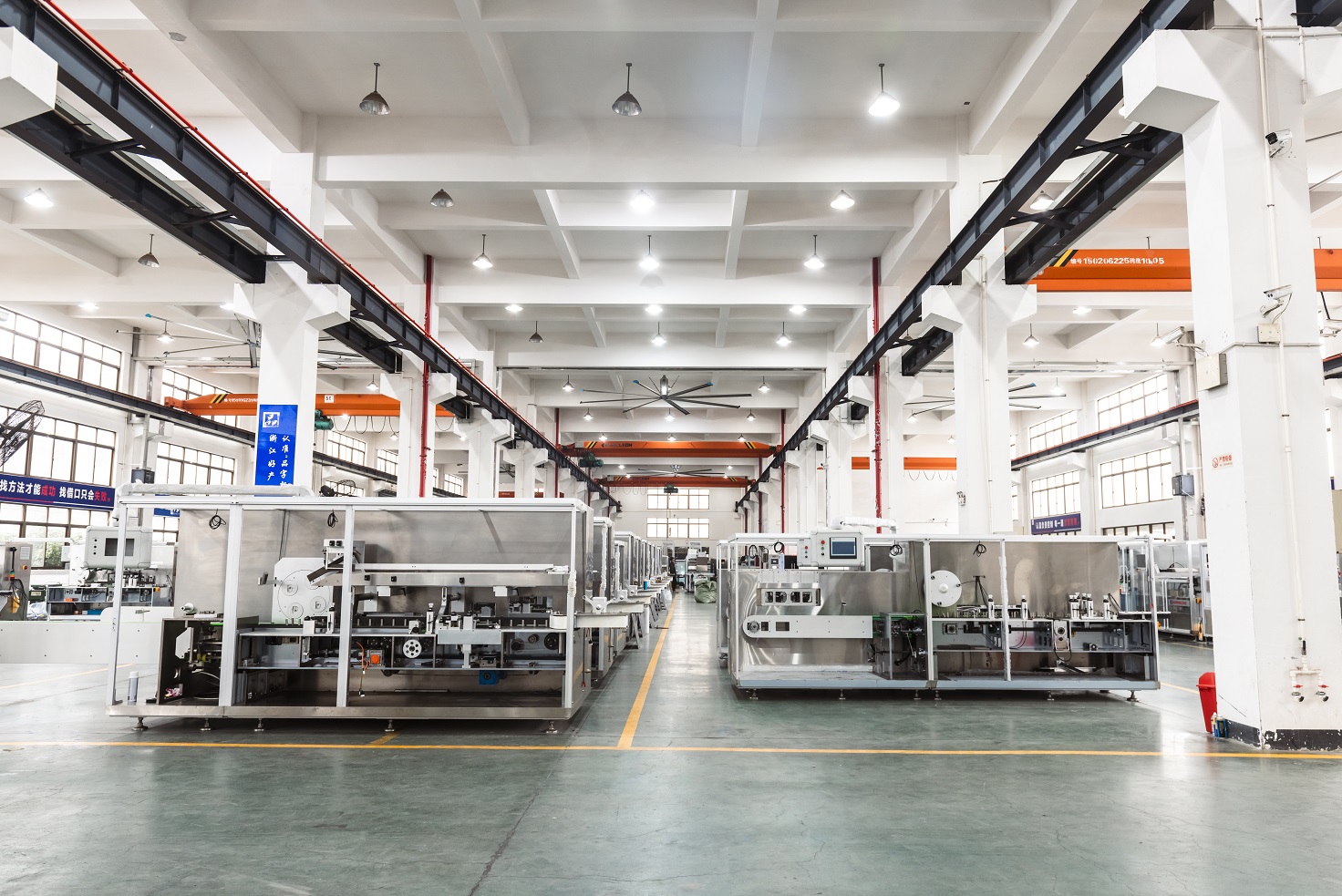
The DHL8005H is described with GMP-oriented line design, a stainless steel and aluminum-alloy machine structure, transparent guarding, and GMP-oriented product-contact parts and tooling according to the technical agreement. Those phrases are useful but they are not interchangeable with a certificate. “GMP-oriented construction” indicates that the line is designed with pharmaceutical production expectations in mind; it does not prove that every installed configuration, material, and documentation package meets a specific regulator’s requirements.
In pharmaceutical packaging, GMP expectations are broader than the machine frame. The FDA’s cGMP framework establishes a regulatory foundation for quality pharmaceuticals through production and process controls, and ISO 15378:2017 specifies GMP requirements for primary packaging materials for medicinal products. A packaging machine sits inside that wider quality system. Buyers therefore need to connect the machine’s construction and documentation to their own qualification, cleaning, maintenance, and change-control procedures.
For the DHL8005H, the supported construction facts point to three review areas. The stainless steel and aluminum-alloy structure is the base material statement. Transparent guarding addresses visibility and separation of the operating area. Product-contact parts and tooling are configured according to the technical agreement, which means the exact materials, finishes, and change parts must be confirmed for the blister format and carton being run. The supplied description does not establish a single universal contact-part specification for all products.
This is also where the difference between a CE certificate and a GMP-oriented design matters. CE marking concerns applicable European safety and conformity requirements for the product and scope covered by the certificate. GMP concerns pharmaceutical quality systems and process controls. One does not replace the other. The FAQ below addresses HOPING’s CE certificate records because that is the compliance question supplied for this article.
Step-by-Step: How a Fully Servo Blister-Cartoning Line Runs
The following sequence describes the DHL8005H’s supported scope in plain language. It is a functional walk-through, not a validated operating procedure for a specific product.
- Blister forming and sealing. The line forms blisters and seals the lidding material. The DHL8005H is listed with PVC/Alu foil auto splicing, so the material-supply design includes automatic splicing for those foil inputs.
- Product feeding. Tablets or capsules are fed into the blister pockets through one of the line’s multiple feeding methods. The exact feeder type and change parts depend on the product and format.
- Blister transfer. Formed and sealed blisters move to the cartoner through the D3 intelligent top-loading parallel tracking transfer system. This transfer is part of the integrated line rather than a separate manual operation.
- Leaflet handling. The line handles leaflets for insertion into the carton. Leaflet format and folding requirements are project-specific.
- Carton opening and insertion. In the secondary packaging line, the automatic cartoning machine opens the carton, inserts the blister card and leaflet, and closes the carton. The DHL8005H is described as covering carton opening, insertion, and cartoning within its integrated scope.
- Coding and inspection. Coding and inspection are included in the line scope. The exact coding method, inspection technology, and rejection logic are configured for the project and should be confirmed in the technical agreement.
- Downstream connection. The line can connect to bundling, a case packing machine, and palletizing equipment. That makes it part of a broader pharmaceutical packaging line and end of line packaging machine setup, not only a blister-cartoning island.
The sequence also shows why “fully servo” should be evaluated together with line balance. A servo-driven transfer can coordinate motion, but the cartoner, leaflet folder, and downstream case packer still have their own format and speed limits. The DHL8005H’s 800 blisters per minute and 500 cartons per minute are maximum model figures; the practical balance depends on the carton count per blister, leaflet, and downstream flow.
Use Cases and Application Boundaries
The DHL8005H is intended for pharmaceutical solid dosage production, capsule and tablet packaging, healthcare products, and food or cosmetic blister-cartoning projects where the format and configuration fit. Typical project types include a new solid dosage blister packaging line, an existing line upgrade, a high-capacity expansion, an intelligent packaging workshop retrofit, and a blister-cartoning-bundling or case-packing integration project.
For a tablet blister packaging machine or capsule blister packaging machine project, the line can be relevant when the feeding system, blister format, and tooling are configured for that product. The term “tablet blister packaging machine” or “capsule blister packaging machine” describes an application focus, not a different drive architecture. The same fully servo blister-cartoning line can be prepared for different solid dosage forms through format parts and feeding choices, subject to the technical agreement.
The wider HOPING range is documented as including flat-plate, roller-type aluminum-plastic, and aluminum-aluminum blister packaging machines; the DHL8005H project itself is configured through its own material and tooling scope. For an alu alu blister packaging machine comparison, confirm the forming material, lidding structure, and tooling set against the technical agreement rather than assuming that one blister format covers all barrier requirements.
The boundaries are equally important. A fully servo line is not automatically the right choice for every batch size, every carton style, or every downstream layout. Multi-format production requires mold-change and preset-memory support, but the number of formats, changeover procedure, and spare tooling set should be defined. A high-speed line also needs a material-flow and buffer plan that matches the factory’s batch scheduling and manual handling. Those are project decisions, not properties that can be inferred from the word “servo” alone.
Common Misunderstandings About Fully Servo Lines
- “Fully servo” means every format runs at the headline speed. The DHL8005H figures are company-stated maximums. Actual sustained output depends on blister format, material, carton, leaflet, inspection settings, and acceptance criteria.
- “GMP-oriented” means the line is certified for every market. GMP-oriented design is a construction and design description. Market access and conformity depend on the specific certificates, standards, and configuration.
- “Independent replenishment” means the line runs without operator attention. The DHL8005H has a three-channel servo-driven independent replenishment system. Loading, replenishment intervals, and operating procedures still belong to the production plan.
- “Integrated” means no line balancing is needed. Integration reduces manual transfer, but the blister section, transfer, cartoner, and downstream equipment still need a balanced capacity plan.
- “One CE certificate covers the whole line.” CE records are product- and scope-specific. The certificate number, standards, and covered product series must be checked against the actual machine configuration.
FAQ
CE certification should be checked at the certificate and product-scope level, not only at the brand level. HOPING’s supplied certificate records include a CE Certificate for the Carton Packing Machine Series (certificate UCN 900339024607, issued by Certify International Ltd, with standards EN 415-3:2000, 98/37/EC, and 98/79/EC), a CE Certificate for the Cartoning Machine Series (certificate HTT190102307L, issued by Shenzhen HTT Technology Co.,LTD., with standards EN60204-1:2006+A1:2009+AC:2010 and 2006/42/EC), and a CE Certificate for the Blister Packing Machine Series (certificate HTT190102306L, issued by Shenzhen HTT Technology Co., Ltd., with the Machinery Directive 2006/42/EC and EN 60204-1:2006+A1:2009+AC:2010). A buyer should confirm that the certificate scope matches the ordered model, configuration, and destination market.
It means the line’s main packaging motions are driven by servo motors and coordinated electronically, rather than relying only on a single mechanical main shaft for timing. On the DHL8005H, the description includes servo-driven motion components, a Beckhoff motion controller, a CP9315 industrial PC, and a three-channel servo-driven independent replenishment system.
The DHL8005H is listed with a company-stated maximum of up to 800 blisters per minute and up to 500 cartons per minute. These are maximum model figures. They should be read as a capacity envelope to be validated against the actual blister format, carton, leaflet, material, and acceptance test conditions.
The supported description includes a stainless steel and aluminum-alloy machine structure, transparent guarding, and GMP-oriented product-contact parts and tooling according to the technical agreement. That is a design and construction statement. It does not replace project-specific validation, material confirmation, or market certification.
The DHL8005H is described for pharmaceutical solid dosage production, capsule and tablet packaging, healthcare products, and food or cosmetic blister-cartoning projects where the format and configuration fit. Tablets and capsules are the clearest pharmaceutical examples in the supplied facts. The exact product, blister format, carton size, and leaflet must be reviewed with the tooling and feeding configuration.
The practical next step is a format-specific technical review: define the tablet or capsule, blister layout, lidding material, carton size, leaflet, coding, inspection, and downstream connection; then request the matching tooling and documentation scope. HOPING’s catalog can be downloaded here: Hoping Machinery Catalog. A sample or trial discussion can then be based on the confirmed format rather than on the headline speed alone.
Conclusion
A fully servo blister-cartoning line is best understood as an integrated pharmaceutical packaging machine whose main motions are servo-driven and electronically coordinated. The DHL8005H illustrates the concept with a Beckhoff motion controller, CP9315 industrial PC, three-channel servo-driven independent replenishment, D3 intelligent top-loading transfer, and company-stated maximum capacities of up to 800 blisters per minute and 500 cartons per minute. Its GMP-oriented construction, stainless steel and aluminum-alloy structure, transparent guarding, and project-specific contact parts and tooling belong to the same engineering picture.
The useful buyer takeaway is not that one architecture fits every project. It is that “fully servo,” “GMP-oriented,” and “up to 800 blisters per minute” are separate statements with separate evidence requirements. Read them together with the format, tooling, certificate scope, and acceptance plan. That is how a pharmaceutical packaging machine concept becomes a line that can be qualified for a real solid dosage product.
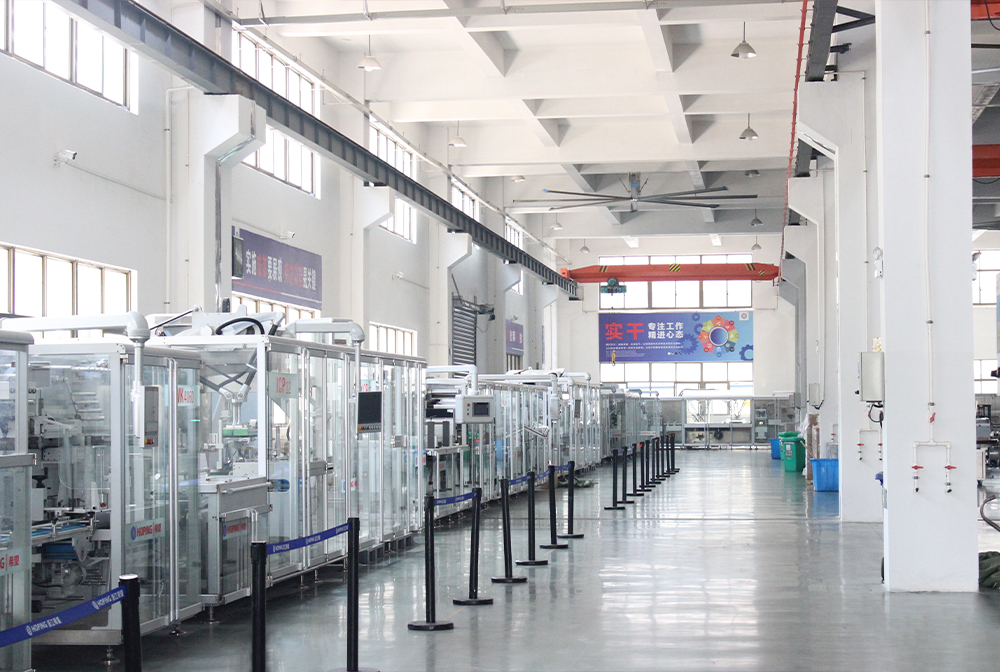
Next step: For format-specific questions on the DHL8005H fully servo blister-cartoning line, review the Hoping Machinery catalog or contact HOPING with the product, blister layout, carton, and leaflet details.
Have Questions or Need More Details?
Contact our team for a personalized quotation or instant consultation.
Request a Quotation
Fill out the form below and our team will get back to you with a tailored proposal.
WhatsApp Direct Chat
Prefer to chat in real-time? Message us on WhatsApp for instant assistance & quick answers.
- Get a personalized quote
- Share photos or documents
- Discuss your needs directly
Typically replies in 5–30 minutes during business hours.