
Supplier Evaluation for DHL8005H Blister-Cartoner Lines: Capability and Delivery Assurance
Evaluating a supplier for a DHL8005H-class automatic blister-cartoning line comes down to one question: can the manufacturer evidence, document by document and test by test, what it says the line will do on your product? Rated output, control architecture, replenishment design, splicing behaviour and construction materials are all checkable. So is delivery assurance — but only if it is written into the technical agreement and the acceptance criteria before the purchase order is signed.
This guide is written for the evaluation stage of a pharmaceutical packaging machine purchase, when two or three shortlisted manufacturers look similar on paper and the buyer has to separate documented capability from brochure language. It uses the HOPING DHL8005H Automatic Blister-Cartoning Line as the worked example because that model carries a set of specific, checkable claims: up to 800 blisters per minute and 500 cartons per minute, a Beckhoff motion controller with a CP9315 industrial PC, three-channel servo-driven independent replenishment, PVC/Alu foil auto splicing, GMP-oriented contact parts and tooling, and stainless steel / aluminium-alloy construction. Each of those claims can be converted into a verification request and an acceptance record.
Problem Definition: Why Blister-Cartoner Supplier Evaluation Usually Fails
A blister-cartoning line is a two-machine system with one handover, so a supplier evaluation has three separate surfaces to test: primary blister capability, secondary cartoning capability, and the transfer logic that connects them. Most evaluations test none of them properly because they compare adjectives instead of evidence.
Three failure patterns recur. The first is an output claim with no basis. A figure such as “high speed” or even a specific number is meaningless unless the format, cavity count, product type, forming material and carton size that produced it are stated. The second is a capability claim with no part number. Statements about servo drives, independent replenishment or automatic splicing describe a design intent; what the buyer actually receives is a bill of components and a machine behaviour that must be demonstrated. The third is delivery assurance reduced to a single lead-time number, which protects nobody when a format change reveals that the preset memory was never populated for the buyer’s SKUs.
The DHL8005H example is useful precisely because its claims are specific enough to be tested. A supplier that cannot convert its own marketing statements into test conditions on request is telling you something about how the project will run after the deposit is paid.
Industry Background: Documented Capability Now Outranks Stated Capability
The commercial context explains why buyers have become more demanding. Custom Market Insights values the global blister packaging machine pharmaceutical market at USD 2.57 billion in 2025, with Asia-Pacific reported as the fastest-growing region at an 8.87% CAGR to 2031 (SRC-0001). Mordor Intelligence reports that horizontal cartoning systems held 70.12% of the cartoning market in 2024 — the orientation that dominates integrated blister-cartoning architectures (SRC-0004). A separate commercial estimate puts the wider pharmaceutical packaging machinery market at USD 7.09 billion in 2026, growing at a 7.15% CAGR (SRC-0017); that figure is published without retrievable segment definitions, so it is context, not a benchmark for a single machine category.
The regulatory context pushes in the same direction. The U.S. FDA describes current Good Manufacturing Practice as the framework that establishes the foundation for quality pharmaceuticals through regulatory standards (SRC-0016). ISO 15378:2017 specifies GMP requirements for primary packaging materials for medicinal products (SRC-0003) — a standard aimed at the packaging material itself, which means a machine builder serving regulated customers must be able to show how contact parts, tooling and cleaning design support the material compliance the buyer’s dossier claims. Trade coverage of PMMI content also reports pharmaceutical manufacturers moving toward digitised data collection and integrated solutions to meet regulations and improve visibility (SRC-0019), which turns controller and data-interface questions into procurement questions rather than engineering afterthoughts.
The practical consequence: a buyer evaluating a blister packaging line in 2026 is evaluating documents, control architecture and test protocols as much as mechanics. That is the shift this evaluation framework is built around.
Detailed Solution: The Capability Baseline for a DHL8005H-Class Line
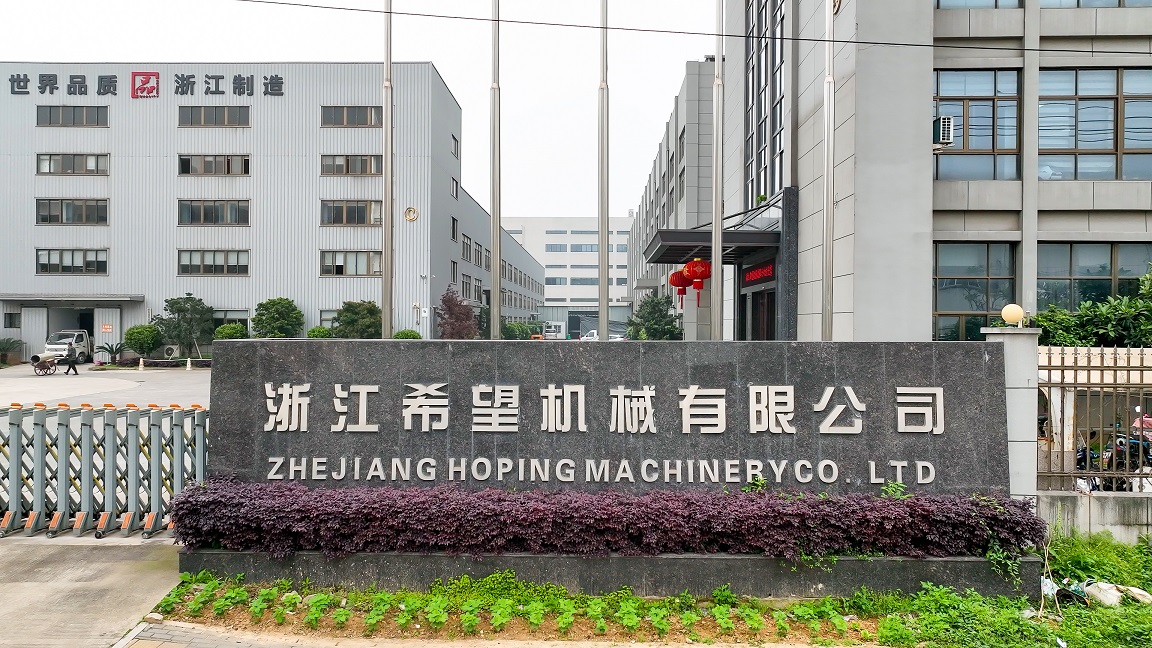
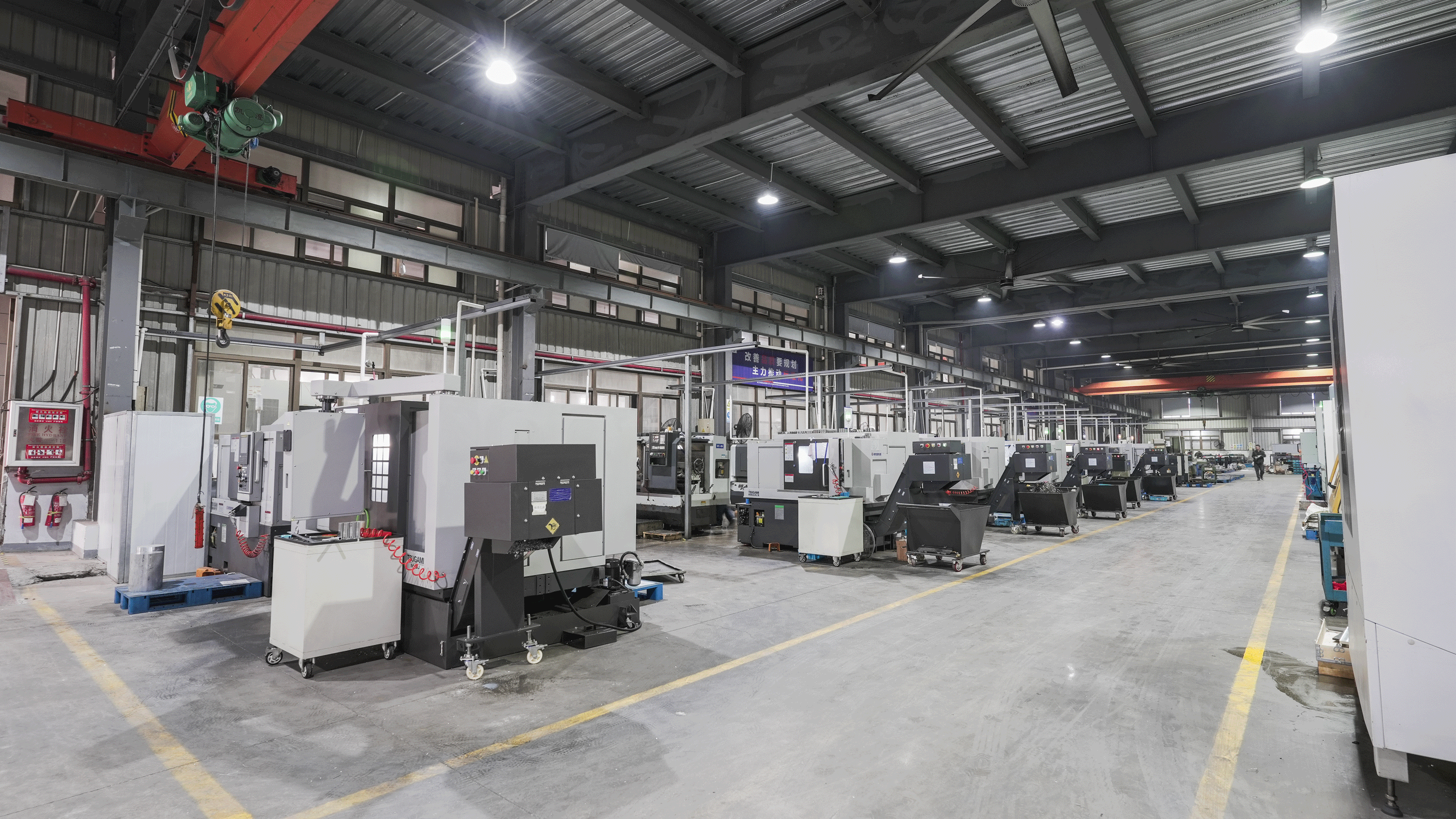
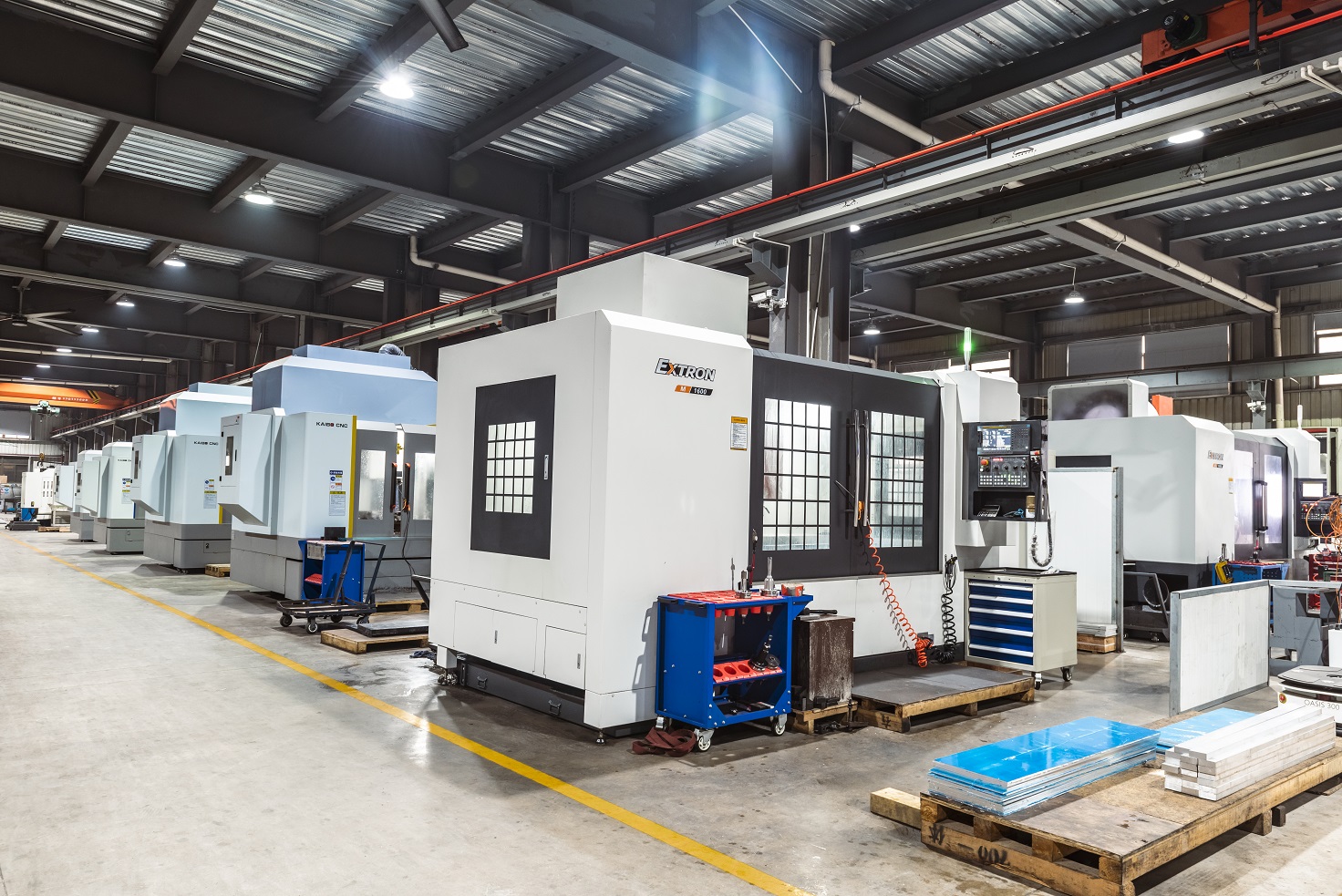
HOPING (Zhejiang Hoping Machinery Co., Ltd.) is a pharmaceutical packing machinery manufacturer established in 2001, with 300 employees, 56 engineers, a 28,800 m² facility and an annual output of 500 units. Its main product range covers blister packaging machines, cartoning machines, case packing machines and end-of-line packaging machines, with exports accounting for roughly 25% of output across Southeast Asia, the Middle East, Eastern Europe, South America and Africa. In the DHL8005H configuration, the line combines a high-speed blister former with an integrated cartoner in a single blister-to-carton flow. The five capability claims below are the ones a buyer should verify first, because they determine whether the line will run at the rate you are planning for.
1. Rated Output: 800 Blisters per Minute and 500 Cartons per Minute
The DHL8005H-class line is documented at up to 800 blisters per minute and up to 500 cartons per minute. Those are rated maximum figures, and the distinction between rated maximum and sustained output is the single most important thing to settle during evaluation. A maximum output is achieved under a defined set of conditions: a specific blister format, a specific cavity count and pitch, a defined dosing pattern, a defined forming material, a defined carton blank and a defined leaflet. Change any one of them and the number moves.
Buyers should also watch for cross-model confusion. HOPING’s public packaging-line page reports a maximum of 1,000 blisters per minute and 500 boxes per minute for a line configuration (SRC-0013), while the DHL8005H-class figures are 800 and 500. Both are manufacturer-stated maxima belonging to different configurations. A credible supplier will tell you which figure attaches to which model and format without prompting; a supplier that quotes the highest number in its catalogue for every project is giving you a number to negotiate with, not a capacity to plan with.
2. Control Architecture: Beckhoff Motion Controller and CP9315 IPC
The DHL8005H control platform is built on a Beckhoff motion controller with a CP9315 industrial PC. For an evaluator, this matters in three practical ways. First, it makes the control hardware traceable: the exact controller and IPC part numbers, the firmware and software version shipped, and the spare-part identity can all be listed in the technical agreement rather than discovered at the first breakdown. Second, the IPC is where recipe and preset data live, so preset-memory reliability is a function of backup and restore procedure, not of the hardware alone. Third, the machine’s interface language and data interface are configurable items — HOPING lists interface language, electrical component brand and data interface among its customization parameters — so the interface specification should be written down and agreed, not assumed.
3. Three-Channel Servo-Driven Independent Replenishment
Three-channel servo-driven independent replenishment means the feeding system is split into channels that are driven separately rather than mechanically linked. The evaluation question is what “independent” buys you in operation: whether a single channel can be adjusted, paused or cleared without stopping the other channels, and how the machine behaves when one channel runs empty. For a buyer running multiple tablets or capsules in the same blister format, this is a changeover and uptime question. Ask for the channel logic in writing and ask to see a three-channel run at the factory acceptance test with one channel deliberately interrupted.
4. PVC and Alu Foil Auto Splicing
Automatic splicing on both the PVC forming film and the aluminium lidding foil reduces the number of planned stops on a high-speed line, which is why it appears on machines rated at this speed. The evaluation question is what happens to the splice joint. A joint is a discontinuity in the packaging material, and the machine must either handle it through a defined sequence or reject the affected blisters. Ask the supplier to describe the splice sequence, the machine’s response at the splice point, and the reject logic that removes affected packs. Then ask for a splice trial during acceptance, with seal integrity checked on the packs either side of the joint.
5. GMP-Oriented Contact Parts, Tooling and Construction Materials
The line is built with GMP-oriented contact parts and tooling in stainless steel and aluminium-alloy construction. On a regulated pharmaceutical packaging machine, this claim translates into four documents: a contact-part list with material identification, a surface-finish specification for product-contact surfaces, a cleaning procedure that matches the accessible geometry, and confirmation that tooling can be removed and refitted without introducing contamination traps. ISO 15378:2017, which sets GMP requirements for primary packaging materials (SRC-0003), is the reference point a buyer’s quality team will use when reviewing whether the machine supports the material compliance declared in their own dossier.
Step-by-Step: Turning Capability Claims into Delivery Assurance
Delivery assurance is not a lead-time figure. It is the sum of a defined product/format scope, a component-level specification, a test protocol, an acceptance authority and a payment schedule tied to both. The eight steps below convert a capability evaluation into a contract that can be enforced.
- Fix the product and format matrix before requesting a quotation. List every SKU the line must run, with blister dimensions, forming material, product type (tablet, capsule, soft capsule), fill count, carton size, leaflet format and coding or inspection requirement. HOPING lists blister size, blister materials, quantity per carton, carton specification, leaflet format, coding/inspection method and feeding method among its customization parameters, which means each of these is a scope variable that changes the machine and the price. A quotation built on an undefined format matrix cannot be compared with another supplier’s.
- Convert every capability claim into a test condition. For each claim — output, replenishment, splicing, changeover — write down the product, format and speed at which it will be demonstrated. A claim that cannot be assigned a test condition should be removed from the specification, not carried into the contract as an expectation.
- Request the control architecture as an as-built list. Obtain the motion controller and CP9315 IPC part numbers, the software and firmware versions, the drive configuration, the interface list and the recipe backup and restore procedure. Confirm the interface language and data interface in writing, since both are configurable.
- Verify replenishment and splicing at speed, not at rest. Nominate the three-channel run and the splice trial as explicit factory acceptance test items, with the machine running at the rated output for the agreed format. Record the outcome in the test report, including any reject logic triggered.
- Verify contact parts and cleaning access. Obtain the contact-part material list, the surface specification and the tooling removal method. Walk the cleaning route on the machine before shipment and confirm that the areas your quality team will swab are reachable.
- Prove format change and preset memory with two SKUs. Ask for a timed changeover between two of your own formats, and ask what the preset memory stores (format parameters, speed, seal settings), where it stores it, how access is controlled and how the data is backed up.
- Bind delivery to milestones rather than to a date. HOPING states a typical lead time of 60–120 days after technical confirmation, subject to model, configuration, project complexity and contract terms, against a monthly capacity of 30–40 units. Treat that as a planning input and convert it into a milestone schedule: technical agreement signed, drawing approval, key component arrival, assembly complete, no-load trial run, material trial, FAT, pre-shipment inspection, shipment, installation and commissioning.
- Define acceptance and who signs it. The quality sequence HOPING documents runs through incoming material inspection, key component inspection, assembly inspection, electrical safety check, no-load trial run, material trial, FAT, customer witness acceptance and pre-shipment inspection. Each stage needs a named document, a named signatory and a link to a payment milestone, otherwise the sequence is a description rather than a control.
Format-Change and Preset-Memory Readiness: The Under-Tested Delivery Risk
Most delivery disputes on blister-cartoning lines do not concern the machine arriving late. They concern the machine arriving without validated recipes for the buyer’s formats. Preset memory is only useful if it has been populated, verified and backed up for the formats you actually run. During evaluation, ask four questions: how many format recipes can be stored, which parameters are captured, who has permission to edit them, and how the data is recovered if the IPC is replaced. Then require a two-SKU changeover demonstration before shipment. A supplier confident in its mold-change and preset-memory system will welcome the test; one that treats changeover as an operator skill rather than a machine function will negotiate it away.
Shortlisting Among Top Pharmaceutical Packaging Machine Manufacturers
Buyers searching for the top pharmaceutical packaging machine manufacturers usually encounter lists that rank companies without exposing the data that decides a project. A published ranking cannot tell you whether a supplier can name the IPC model it installs, whether it will accept a witness FAT on your product, or whether its preset memory will hold your carton dimensions. Shortlisting should therefore be built on evidence a supplier can produce on request, applied identically to every candidate.
- Model-specific output documentation. Does the supplier state which output figure belongs to which model and format, or does it repeat one headline number across its range?
- Component traceability. Can it name the motion controller, the industrial PC and the drive configuration at quotation stage, not at commissioning?
- Customization scope in writing. HOPING’s customization list covers blister size and materials, quantity per carton, carton specification, leaflet format, coding/inspection method, feeding method, downstream bundling, case-packing and palletizing connection, interface language, electrical component brand and data interface. A comparable supplier should produce a list of the same specificity.
- Acceptance framework. Look for a documented sequence ending in FAT with customer witness acceptance, not a machine that is “tested before shipment”.
- Production base and schedule credibility. A 28,800 m² facility, 300 employees, 56 engineers, 500 units of annual output and a stated monthly capacity of 30–40 units give a buyer something to test a promised schedule against.
- After-sales structure. Installation and commissioning, operator and maintenance training, remote video and phone support, spare-parts supply, process-parameter guidance and regular follow-up are the items to confirm in writing, with response expectations.
Use Cases: Where This Evaluation Framework Applies
New solid-dosage line for tablets and capsules
A large pharmaceutical manufacturer or solid-dosage production company building a new packaging line typically needs blister forming and cartoning connected in one flow, with the transfer between them automated rather than manual. HOPING’s reference profile for this application covers tablet and capsule blister packaging with automatic cartoning, sized at 5–10 lines for new line construction, capacity expansion or upgrading of existing packaging lines. The stated project objectives are improved packaging automation, reduced manual transfer, improved blister-to-carton connection efficiency, reduced wrong-insertion and missing-leaflet risk, and readiness for downstream automation integration. Customer names are disclosed only with authorization, so treat this as a project profile rather than a measured case result.
Capacity expansion on an existing blister line
Where a blister machine already exists and only secondary packaging is being added, the evaluation shifts to the handover: blister infeed geometry, buffering between machines, and whether the cartoner can accept the existing blister pitch. This is where the three-channel replenishment and the transfer logic deserve the most scrutiny.
Multi-SKU production in a contract manufacturing environment
A CMO or CDMO running many short batches should weight preset memory and changeover time far above headline output. Ask for the recipe count, the parameter set captured and a timed changeover between two of the formats that will actually run. HOPING lists modular configuration and multi-format compatibility among the line’s characteristics; the evaluation task is to convert those into a measured changeover time.
Downstream integration to case packing and end-of-line
Where the blister-cartoning line feeds a bundler, case packer or palletizer, the connection is a customization item and should be specified as such. Confirm the mechanical interface, the buffering strategy and the control handshake between the line and the downstream equipment before the order, because retrofit integration after installation is the most expensive way to discover an incompatibility.
Comparison Table: Capability Claim, Verification Method and Acceptance Evidence
| Capability item | Documented claim (DHL8005H-class) | What the buyer should request | Acceptance evidence |
|---|---|---|---|
| Rated output | Up to 800 blisters/min and 500 cartons/min | The format, cavity count, product type, forming material and carton size behind the figure; confirmation that the figure belongs to this model and not to another line configuration | FAT report recording output at the agreed format, with sustained-run data alongside the maximum |
| Control architecture | Beckhoff motion controller with CP9315 industrial PC | Controller and IPC part numbers, software and firmware version, drive list, interface language and data interface specification | As-built control list plus a recipe backup and restore demonstration |
| Replenishment | Three-channel servo-driven independent replenishment | Written description of channel logic and machine behaviour when one channel is interrupted or empty | Three-channel run at rated speed with one channel deliberately interrupted |
| Splicing | PVC and Alu foil auto splicing | Splice sequence, machine response at the joint, and reject logic for affected blisters | Splice trial during FAT with seal integrity checked either side of the joint |
| Construction and contact parts | GMP-oriented contact parts and tooling; stainless steel / aluminium-alloy construction | Contact-part material list, surface-finish specification, cleaning procedure, tooling removal method | Material documentation plus a cleaning-access walkthrough before shipment |
| Format change and preset memory | Preset memory and mold-change readiness | Number of stored recipes, parameters captured, access control, backup and recovery method | Timed changeover between two buyer SKUs, recorded in the FAT report |
| Commercial terms | MOQ 1 set or 1 complete line; typical lead time 60–120 days after technical confirmation; monthly capacity 30–40 units | A milestone schedule tied to drawing approval, assembly, trials, FAT, shipment and commissioning | Signed technical agreement with payment milestones linked to acceptance stages |
Certificate Records to Check, and to Check Again
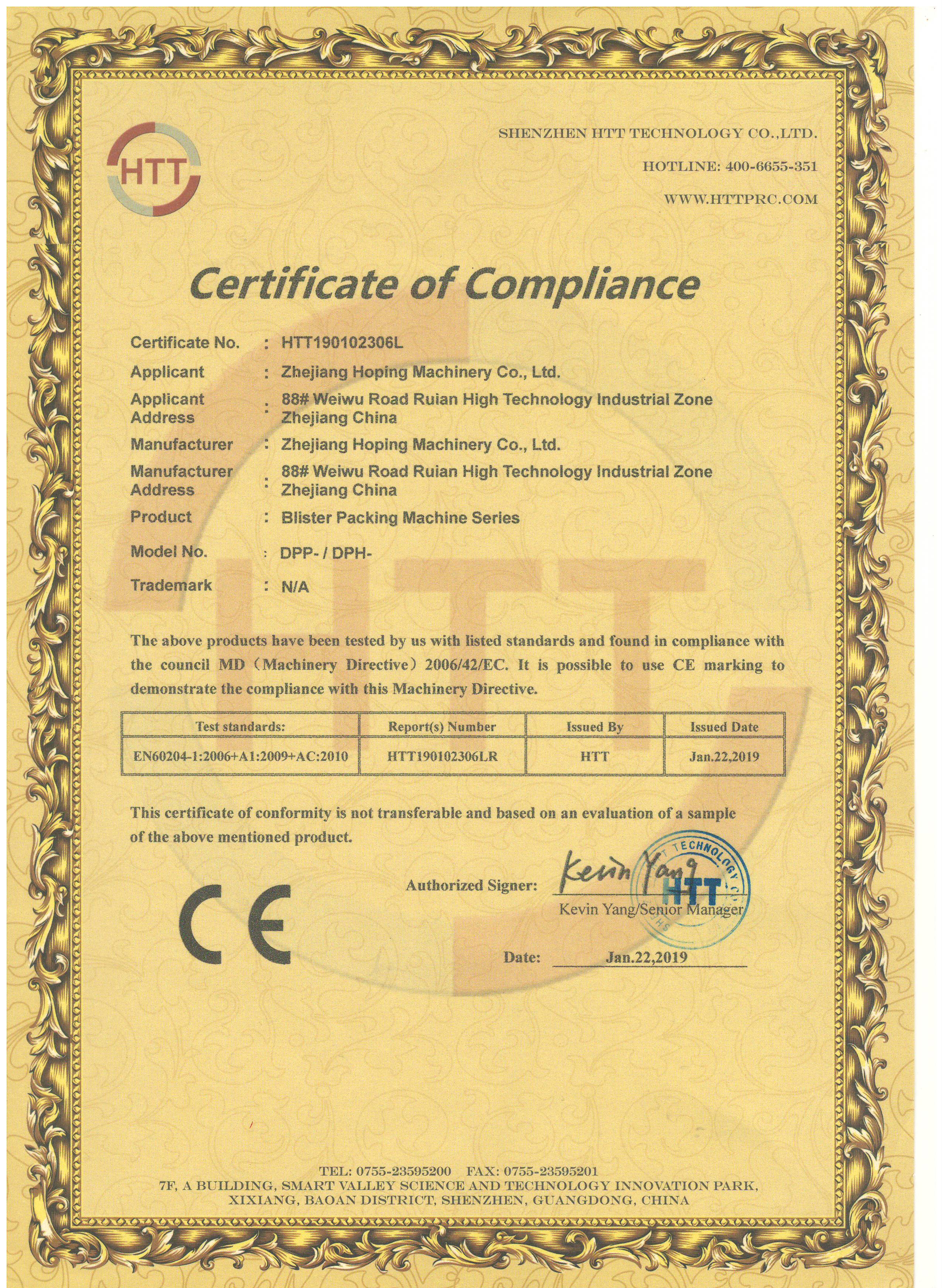
HOPING’s certificate records include CE documentation for cartoning and blister machine series. These are historical certificate records, not a blanket statement that every current model is certified, so two checks apply to every entry: does the certificate scope cover the exact model and design you are ordering, and is the copy you have been given current?
| Certificate | Number | Issued by | Issue date | Stated standards / scope |
|---|---|---|---|---|
| CE — carton packing machine series | UCN 900339024607 | Certify International Ltd | 2007-04-01 | EN 415-3:2000; 98/37/EC; 98/79/EC |
| CE — cartoning machine series | HTT190102307L | Shenzhen HTT Technology Co., Ltd. | 2019-01-22 | EN 60204-1:2006+A1:2009+AC:2010; 2006/42/EC |
| CE — blister packing machine series | HTT190102306L | Shenzhen HTT Technology Co., Ltd. | 2019-01-22 | Machinery Directive 2006/42/EC; EN 60204-1:2006+A1:2009+AC:2010 |
| CE — sample automatic blister packing machine | UCN 900175009261 | CELAB | 2006-11-06 | EN 60204-1:1997; EN 415-3:1999; 73/23/EEC; 93/68/EEC; 98/37/EC; 98/79/EC |
Validity discipline matters as much as the certificate itself. Management-system certificates usually run on multi-year cycles, so always check the expiry date on the copy supplied and request the renewal record if it has lapsed. For CE, confirm the certificate number matches the model in the quotation and ask for the declaration of conformity that accompanies the shipment.
FAQ
What GMP and CE documentation should a DHL8005H-class blister-cartoner supplier be able to show?
Three layers. First, the regulatory framework your own quality system applies: the U.S. FDA describes current Good Manufacturing Practice as the foundation for quality pharmaceuticals through regulatory standards (SRC-0016), and ISO 15378:2017 specifies GMP requirements for primary packaging materials for medicinal products (SRC-0003). Neither document states machine-specific design clauses in the form a buyer can simply hand to a supplier, so the buyer must translate them into contact-part, cleaning and documentation requirements. Second, CE records: HOPING’s certificate file includes CE documentation for the carton packing machine series (UCN 900339024607, Certify International Ltd, issued 2007-04-01), the cartoning machine series (HTT190102307L, issued 2019-01-22) and the blister packing machine series (HTT190102306L, issued 2019-01-22). Confirm that the scope covers the exact model and design you are ordering, and ask for the declaration of conformity with the shipment. Third, machine-level documents: contact-part material list, surface specification, cleaning procedure, electrical safety check record and the FAT report.
How do I verify that the line really reaches 800 blisters per minute and 500 cartons per minute?
Ask for the basis of the figure first: blister format, cavity count, product type, forming material, carton blank and leaflet. Then require a factory acceptance test that runs your own format at the agreed rate and records sustained output, not only the peak. Be aware that output claims are configuration-specific — HOPING’s packaging-line page cites up to 1,000 blisters per minute and 500 boxes per minute for a line configuration (SRC-0013), while the DHL8005H-class figures are 800 and 500. Both are manufacturer-stated maxima for different configurations, so the number must be pinned to the model and format in the technical agreement. A supplier that cannot state the basis of its own figure has not yet given you a capacity you can plan production against.
Which commercial terms should be fixed before the purchase order?
HOPING states a minimum order quantity of 1 set or 1 complete line, a typical lead time of 60–120 days after technical confirmation subject to model, configuration, project complexity and contract terms, and a monthly capacity of 30–40 units. Those are planning inputs, not guarantees. Convert them into a milestone schedule with payment linked to acceptance stages, and attach the customization list as a contract annex: blister size, blister materials, quantity per carton, carton specification, leaflet format, coding/inspection method, feeding method, downstream bundling, case-packing and palletizing connection, interface language, electrical component brand and data interface. Because scope varies this widely, quotation comparison only makes sense on an identical format matrix — a lower price usually reflects a narrower scope rather than a better machine.
Can we run our own tablets, capsules or cartons before shipment?
Yes, and it should be a contractual requirement rather than a courtesy. HOPING’s documented quality sequence includes a no-load trial run, a material trial, factory acceptance testing, customer witness acceptance and pre-shipment inspection, following incoming material, key component and assembly inspections plus an electrical safety check. Ask for the material trial report to record output at the agreed format, the reject pattern, seal parameters and the outcome of the splice trial, and ask for retained blister and carton samples from the run. Retained samples are what let you compare a machine’s behaviour at commissioning against the standard it met at the factory.
What lead time should we plan for, and what belongs in the technical agreement?
Plan on the stated 60–120 days after technical confirmation, then add factory acceptance testing, shipment, and on-site installation and commissioning — HOPING’s after-sales scope covers on-site installation and commissioning, operator and maintenance training, remote video and phone support, spare-parts supply, process-parameter guidance and regular follow-up. The technical agreement should carry the format matrix, the control as-built list including the Beckhoff motion controller and CP9315 IPC, the three-channel replenishment logic, the splicing and reject sequence, the contact-part material and cleaning specification, the preset-memory and changeover requirements, the acceptance protocol with named signatories, and the documentation package to be delivered with the machine. As a next step, request a sample run on your own product and a line proposal built on your format list — see the contact details below.
Conclusion
A DHL8005H-class blister-cartoning line is evaluated on evidence, not on adjectives. Rated output of up to 800 blisters per minute and 500 cartons per minute is only a capacity claim until it is attached to a format and demonstrated; a Beckhoff motion controller with a CP9315 IPC is only an advantage once the part numbers, software version and backup procedure are written into the agreement; three-channel servo-driven replenishment, PVC/Alu foil auto splicing and GMP-oriented stainless steel and aluminium-alloy construction are only assurance once they appear as factory acceptance test items with a named signatory.
Delivery assurance follows the same logic. Convert the stated 60–120 day lead time into milestones, tie payment to acceptance stages, prove mold-change and preset-memory readiness with two of your own SKUs, and confirm certificate scope and validity rather than accepting a document at face value. A supplier that supports that level of scrutiny is giving you a preview of how it will behave after installation — which is the part of the evaluation that a brochure can never answer.
Next Step: Test the Line on Your Own Product
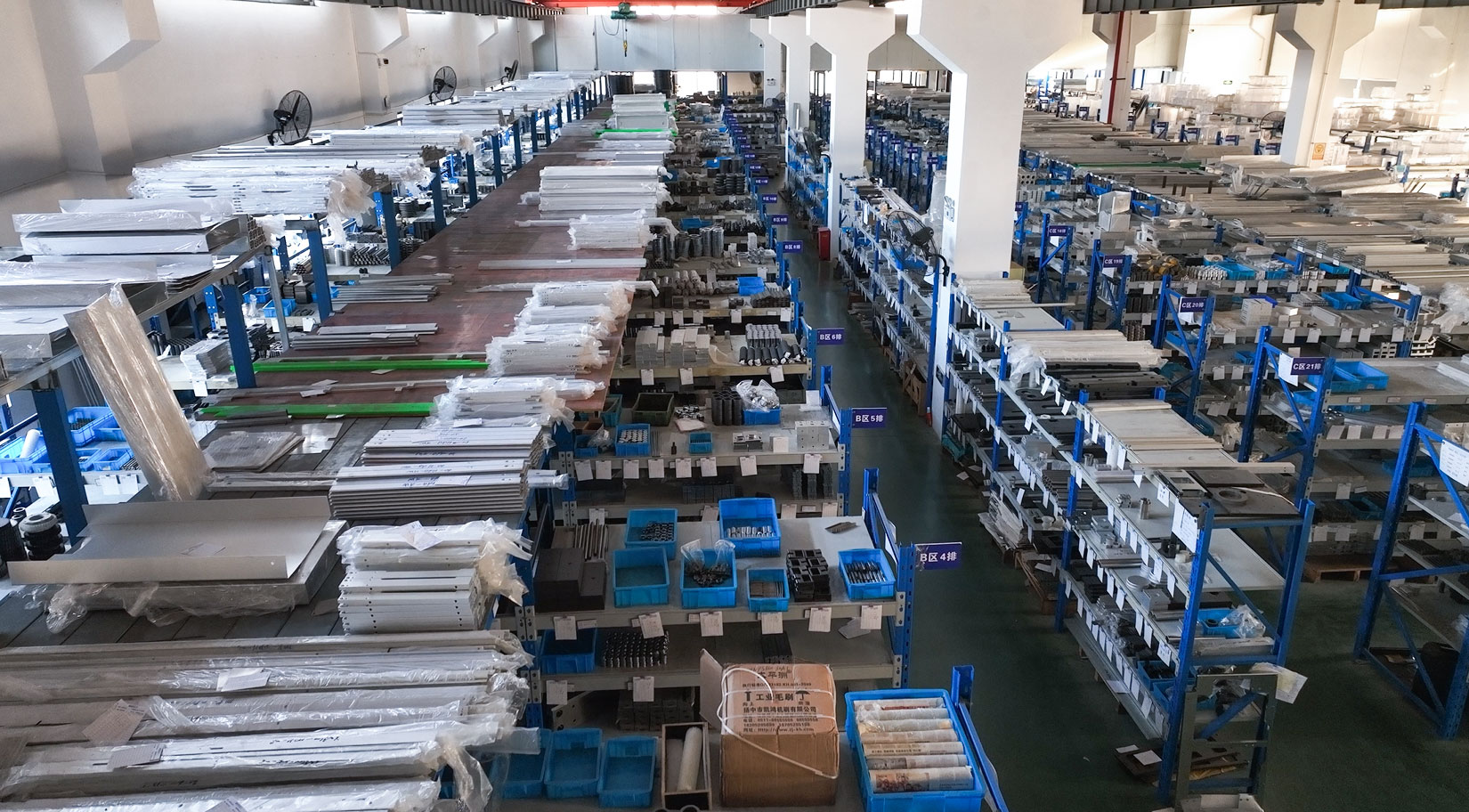
Zhejiang Hoping Machinery Co., Ltd. (HOPING) has manufactured pharmaceutical packing machinery since 2001 from a 28,800 m² facility in Ruian City, Zhejiang Province, China, with 300 employees, 56 engineers and an annual output of 500 units. For a DHL8005H-class blister-cartoning evaluation, the practical next step is a sample run on your tablet, capsule or carton format, followed by a line proposal built on your own format matrix.
Contact: Monica | Email: monica@xwbj.com | Tel / WhatsApp: +86 133-5610-5292 | Website: www.hopingcn.com | Address: 88th Weiwu Road, Nanbin Sub-district, Ruian City, Zhejiang Province, China
Download the full machine catalogue with specifications: Hoping Machinery Catalog (PDF)

Have Questions or Need More Details?
Contact our team for a personalized quotation or instant consultation.
Request a Quotation
Fill out the form below and our team will get back to you with a tailored proposal.
WhatsApp Direct Chat
Prefer to chat in real-time? Message us on WhatsApp for instant assistance & quick answers.
- Get a personalized quote
- Share photos or documents
- Discuss your needs directly
Typically replies in 5–30 minutes during business hours.