
Troubleshooting Cartoning Defects in High-Speed Blister Lines
Pharmaceutical Packaging Machine — Field Troubleshooting Guide
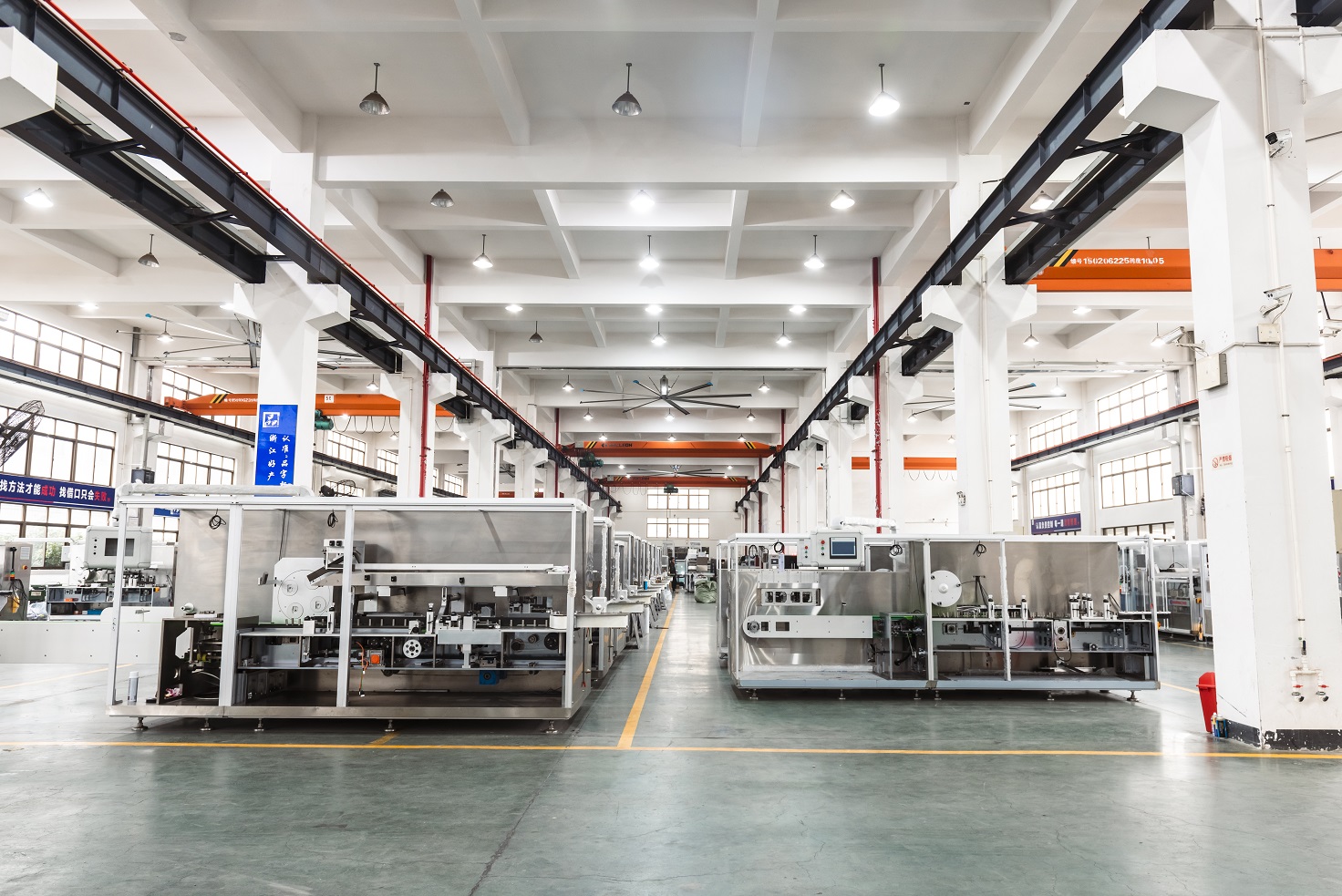
Cartoning defects on a high-speed blister line rarely arrive as a single dramatic failure. They accumulate. A carton that was perfectly square at the start of the shift begins catching the flap tucker three hours later. A blister board that entered the pocket dead-centre starts arriving two millimetres off. The reject bin fills a little faster than the shift report suggests it should — and the first response in most plants is a manual one: an operator reaches into the guard opening and nudges the product back into position.
The short answer. Misaligned cartons, insertion jams, missing or doubled leaflets and unsquared flap closures on a high-volume blister-cartoning process usually trace back to two variables: inconsistent blister supply timing at the carton in-feed, and manual replenishment that interrupts the running material flow. Servo-driven in-feed and transfer systems address the first variable; servo-driven independent replenishment systems address the second. An automatic line built for high-speed operation removes much of the manual intervention that creates the errors in the first place.
This article treats cartoning defects as a line-behaviour problem rather than a single-machine problem. It defines what actually counts as a defect on a high-volume blister-cartoning process, explains where each defect class originates, sets out how servo-driven in-feed and independent replenishment change the picture, and closes with a diagnostic sequence and a comparison of integrated line configurations.
Problem Definition: What Counts as a Cartoning Defect on a High-Speed Blister Line
On a blister-cartoning line the cartoner is the second machine in the chain but usually the first place a defect becomes visible. Blister forming, sealing, punching and transfer have already happened by the time a carton is opened. That is why a defect first observed at the cartoner is frequently not caused there.
Five classes of defect account for most of what a high-speed solid dosage line rejects:
- Carton alignment defects. The carton is not squared before closing, the leading flap folds at an angle, or the closure seam lands off-centre. These surface as distorted or partially closed cartons.
- Transfer and insertion jams. A blister board is not fully seated in the carton pocket, or it reaches the pocket out of phase with the carton. At several hundred cartons per minute there is no second chance: an obstructed pocket blocks the following cycles and stops the line.
- Leaflet defects. A missing leaflet, a leaflet that is not fully pushed into the carton, or a doubled leaflet. These are the defects most likely to escape downstream if the detection function is not configured to catch them.
- Closure defects. The carton is closed but not fully locked, a tuck flap is incompletely inserted, or the end flap stands proud of the panel.
- Speed-dependent defects. The same line produces acceptable cartons at reduced speed and defects at full rate. This is the most diagnostic class, because it points at timing and synchronisation rather than at worn tooling.
The distinction matters because the corrective action differs for each class. A worn tucking blade is a maintenance item. A defect that appears only above a threshold speed is a design and control question: at that speed, the tolerance window between the transfer motion and the cartoner in-feed has effectively closed. On a line rated up to 1000 blisters per minute and 500 cartons per minute — the published capacity of the Hoping DHL1000/5H — that window is narrow and does not tolerate a second variable being introduced by hand.
Industry Background: Why Defect Control Sits Inside the Quality System
Pharmaceutical packaging equipment is a large and steadily growing capital category. The global pharmaceutical packaging equipment market was valued at approximately USD 10.71 billion in 2024 (SkyQuest Technology). Within that market, the pharmaceutical blister packaging machine segment was projected to reach USD 2.57 billion by 2025 at a compound annual growth rate of 2.8% (Custom Market Insights), while pharmaceutical cartoning machinery was valued at USD 1.46 billion in 2024 (Fortune Business Insights). Asia Pacific held the largest regional revenue share of the pharmaceutical packaging equipment market at 40.7% in 2025 (Grand View Research).
Regulation reinforces why stability, and not only speed, is now a buying criterion. ISO 15378 integrates Good Manufacturing Practice requirements for primary packaging materials (ISO). In the European Union, packaging machine safety is governed by the Machinery Directive 2006/42/EC together with the EN 415 series of standards for packaging machines (CEN).
The practical consequence is that a packaging defect is not only a yield figure. Packaging processes are documented and validated, so an elevated reject rate generates investigation, rework and documentation work inside the quality system. A line that holds its timing across a full shift is a smaller compliance burden than a faster line that does not.
The supply side of this market is less concentrated than it first appears. The three largest players — Uhlmann, IMA and Marchesini — together account for approximately 29% of the pharmaceutical blister packaging machine market (Market Intelligence Report). The remainder is served by a broad field of regional and specialist manufacturers, including Chinese suppliers. Zhejiang Hoping Machinery Co., Ltd., for example, is a manufacturer established in 2001 that builds blister packaging machines, cartoning machines, case packing machines and end-of-line packaging machines, and holds CE marking together with ISO management-system certifications. For buyers, that structure means brand recognition alone will not predict how a line behaves at 100% of rated speed. Specification, test protocol and factory acceptance do.
Detailed Solution: How Servo-Driven In-Feed and Independent Replenishment Stabilise the Line
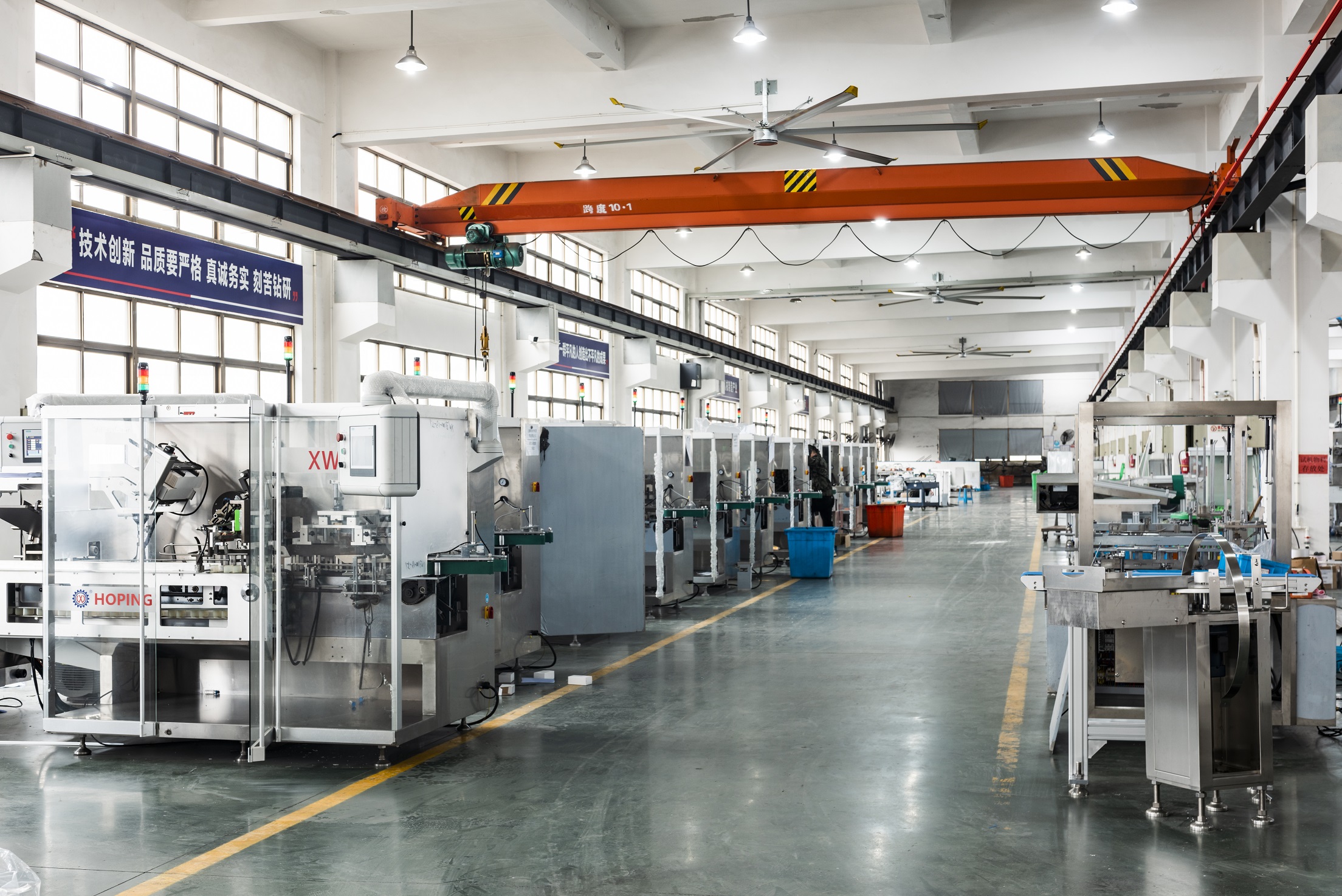
An integrated blister-cartoning line has three interfaces where alignment can be lost: the blister forming and sealing section, the transfer between the blister lane and the carton lane, and the carton closing section. Defect control is largely a question of how well those three interfaces hold their timing as speed rises.
Servo-driven transfer and in-feed
On Hoping integrated blister-cartoning lines, the transfer stage is a servo-driven function rather than a fixed mechanical linkage. The DHL1000/5H and DHL8005H use the D3 intelligent top-loading parallel tracking transfer system. The DHL7005H and DHL7004 use the self-developed IRB24 intelligent transfer robot. The DHL6004 is specified with a high-speed transfer and cartoning linkage.
The transfer stage is where a blister board moves from the blister lane pitch to the carton lane pitch. Any variation in board geometry, film thickness or board stiffness has to be absorbed somewhere in that transition. When the transition is driven by a fixed mechanical linkage, that variation is passed straight through into the carton pocket, where it shows up as a board that is not fully seated — the classic cause of an insertion jam. A servo-driven transfer can be phase-synchronised to the cartoner in-feed so that the insertion point holds its position relative to the carton instead of inheriting the tolerance stack of the whole upstream chain.
Independent, servo-driven replenishment
Replenishment is the point at which material supply interrupts the running cycle. In a conventional arrangement the carton magazine or the blister stack is topped up by an operator when the level drops. That introduces two variables: the timing of the interruption depends on the operator rather than on the line, and the top-up itself requires a person at the machine.
Independent servo-driven replenishment removes both variables. The DHL1000/5H is specified with a four-channel servo-driven independent replenishment system. The DHL8005H is specified with a three-channel servo-driven independent replenishment system, and the DHL7005H, DHL7004 and DHL6004 with servo-driven independent replenishment. Across the DHL1000/5H, the DHL8005H and the IXW series blister-flow-wrap-cartoning lines, PVC and aluminium foil are additionally handled with automatic splicing, so a reel change does not require the line to be stopped and re-threaded by hand.
The effect on defect behaviour is indirect but significant. Every manual intervention on a running line is an opportunity for a different defect — a nudge that leaves a board slightly rotated, a magazine topped up unevenly, a guard that is not fully closed afterwards. A high-speed automatic line that reduces the number of interventions also reduces the number of defect opportunities.
Reducing manual intervention at changeover
Changeover is the second major source of manual intervention. When format settings have to be re-established by hand at every product change, the line runs slightly out of adjustment for the opening part of every run — which is exactly when the first cartons are also being sampled and released. Hoping integrated lines address this with mold-change support combined with preset or recipe memory: the DHL1000/5H is specified with mold-change and recipe memory functions, and the DHL8005H with mold-change and preset-memory functions. Format-related settings can be recalled for a known product rather than re-established from scratch.
What the project record shows
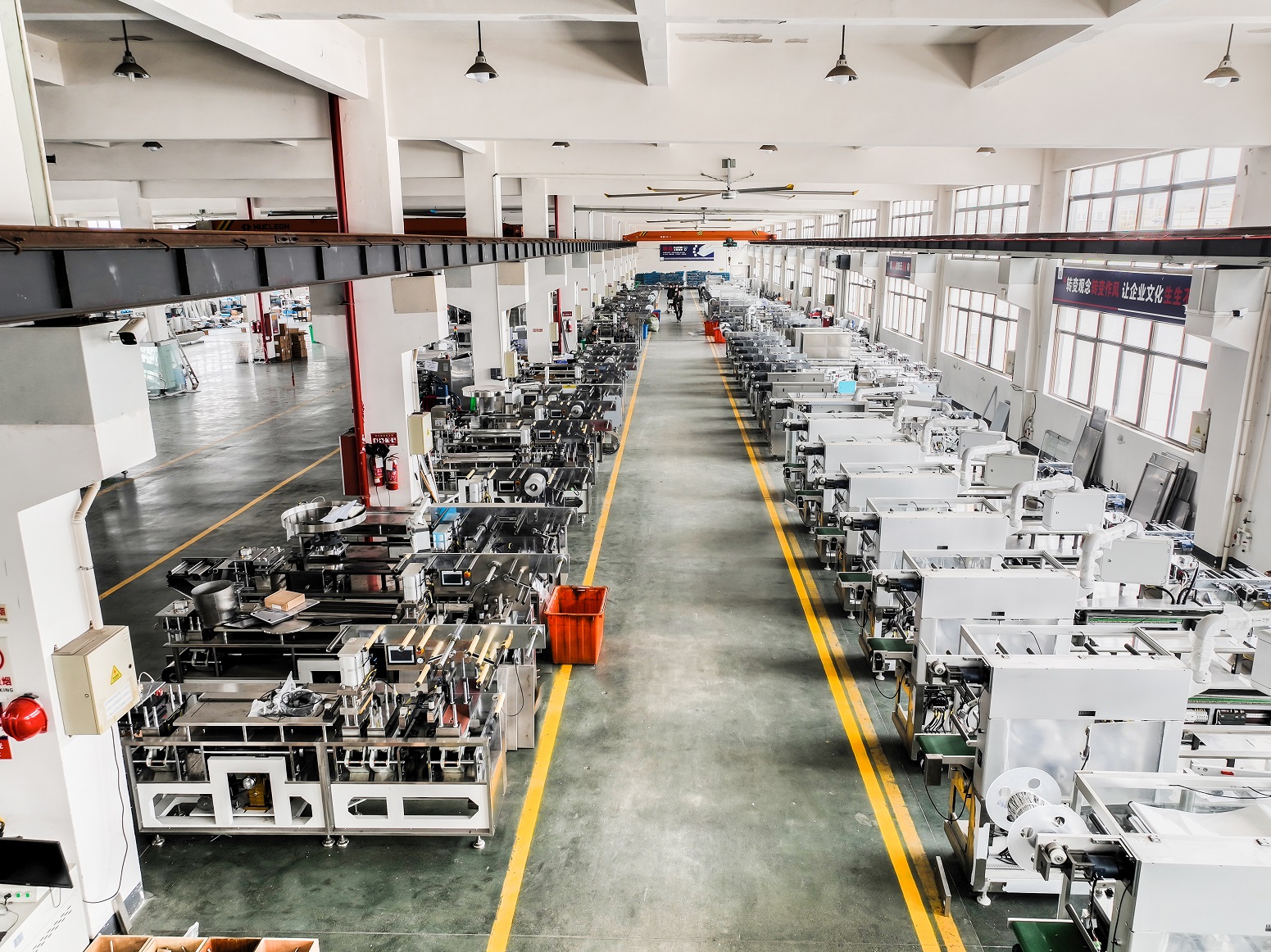
These design choices are reflected in the recorded project profile for integrated Hoping blister-cartoning lines. The profile covers a large pharmaceutical manufacturer, solid dosage production company or pharmaceutical engineering contractor running 5–10 lines, packaging tablets, capsules and other solid dosage forms. Reported project objectives include improved packaging automation, reduced manual transfer, improved blister-to-carton connection efficiency, reduced wrong insertion and missing leaflet risks, and support for downstream automation integration.
Customer names in the project record are disclosed only with authorisation.
Step-by-Step Breakdown: A Diagnostic Sequence for Cartoning Defects
The sequence below is written for the most common pattern on a high-speed blister-cartoning process: a line that produces cartons within specification at reduced speed and out of specification at full rate.
Step 1 — Record where the defect is detected, not where it is assumed to start
The reject station tells you where the problem surfaced, not where it began. Log whether rejects appear at insertion, at leaflet feed, at closing, or at coding and inspection, and record each event against speed, material batch and elapsed run time.
Step 2 — Run a speed ramp
Take the line from a low fraction of its rated speed to full rate in stages, and note the speed at which the reject pattern changes. A defect that appears above a threshold speed is a timing defect. A defect present at every speed is more likely mechanical or material-related.
Step 3 — Inspect the carton magazine and the replenishment pattern
Check that the carton stack is even, that the magazine is not being topped up mid-cycle, and that the replenishment channel is delivering cartons in phase with the cartoner. On lines configured with servo-driven independent replenishment, verify channel timing against the reference recipe before adjusting anything mechanically.
Step 4 — Verify transfer and pocket seating
Confirm that the blister board is fully seated before the carton closes, and that the transfer is running in phase with the cartoner in-feed. On lines using a top-loading parallel tracking transfer system or an intelligent transfer robot, check the phase relationship first — misalignment here produces jams rather than isolated bad cartons, which is a different failure signature.
Step 5 — Check the leaflet path
Leaflet faults — missing, partial or doubled — usually originate in the folder, the leaflet magazine or the insertion push. Confirm that the leaflet separates cleanly, that the magazine is loaded square, and that the insertion stroke is synchronised with the carton opening.
Step 6 — Check the closing and tucking station
A carton that passes inspection at low speed and fails at high speed is normally a closing-timing problem rather than a carton-quality problem. Verify the closing stroke against the conveyor phase before changing carton suppliers.
Step 7 — Verify the detection and rejection function
Detection is what prevents a defect from becoming a batch deviation. Confirm that missing-leaflet detection, missing-product detection and coding and inspection are active for the current recipe and that the reject mechanism clears correctly. On the DHL1000/5H, inspection and rejection sit inside the documented scope of the line, alongside cartoning and downstream connection.
Step 8 — Lock the result into the recipe
Once the line is stable at full rate, record the settings against the product recipe so the adjustment is recalled rather than rediscovered. Lines specified with preset or recipe memory allow this to be done from the HMI instead of on a paper changeover sheet.
Use Cases: Where These Fixes Matter Most
Sustained high-volume tablet production
The DHL8005H is rated at up to 800 blisters per minute and 500 cartons per minute, with a D3 intelligent top-loading parallel tracking transfer system, a three-channel servo-driven independent replenishment system, PVC and aluminium foil auto splicing, and a Beckhoff motion controller with CP9315 industrial PC. It is configured for continuous solid dosage production where a stoppage at the cartoner propagates directly upstream into the blister machine.
Peak-capacity solid dosage lines
The DHL1000/5H sits at the top of the range at up to 1000 blisters per minute and 500 cartons per minute. It adds a four-channel servo-driven independent replenishment system, a Beckhoff motion controller with a high-bus industrial control system, and mold-change and recipe memory functions. The additional replenishment channel matters at this speed because the carton magazine empties faster and the cost of a manual top-up in lost cycles is higher.
Multi-format plants with frequent changeovers
Where a plant runs several pack sizes or several products, the dominant defect source is changeover rather than steady-state running. The DHL7005H and DHL7004 — both using a self-developed IRB24 intelligent transfer robot with a Siemens motion controller and TP900 HMI, and both specified with mold-change support — are configured for format flexibility rather than a single fixed format. The DHL7005H runs up to 700 blisters per minute and 500 cartons per minute; the DHL7004 up to 700 blisters per minute and 400 cartons per minute.
Capacity expansion and existing line upgrades
The same architecture is used when a plant expands rather than builds new. The recorded project profile for integrated Hoping lines explicitly covers new line construction, capacity expansion and the upgrade of existing packaging lines, with a stated scope of 5–10 lines for blister packaging and automatic cartoning of tablets, capsules and other solid dosage forms.
Formats that need flow wrap before cartoning
The principle applies where a blister board must be wrapped before it is cartoned. The IXW600 links blister packing, flow wrapping and cartoning at up to 600 blisters per minute, 300 packs per minute and 300 cartons per minute; the IXW800 extends the same architecture to up to 600 packs per minute and 500 cartons per minute. Both use a Beckhoff controller with CP9315 industrial PC, PVC or cold aluminium auto splicing and servo-driven independent replenishment.
Comparison Table: Integrated Blister-Cartoning Lines by Defect-Relevant Features
The table below compares Hoping integrated blister-cartoning lines using published specification data. It is organised around the features that affect cartoning defect behaviour — transfer type, replenishment architecture and motion control platform — rather than around headline speed alone.
| Model | Max blister output | Max carton output | Transfer stage | Replenishment | Motion control |
|---|---|---|---|---|---|
| DHL1000/5H | up to 1000 blisters/min | up to 500 cartons/min | D3 intelligent top-loading parallel tracking transfer system | Four-channel servo-driven independent replenishment | Beckhoff motion controller and high-bus industrial control system |
| DHL8005H | up to 800 blisters/min | up to 500 cartons/min | D3 intelligent top-loading parallel tracking transfer system | Three-channel servo-driven independent replenishment | Beckhoff motion controller and CP9315 industrial PC |
| DHL7005H | up to 700 blisters/min | up to 500 cartons/min | Self-developed IRB24 intelligent transfer robot | Independent replenishment | Siemens motion controller and TP900 HMI |
| DHL7004 | up to 700 blisters/min | up to 400 cartons/min | Self-developed IRB24 intelligent transfer robot | Servo-driven independent replenishment | Siemens motion controller and TP900 HMI |
| DHL6004 | up to 600 blisters/min | up to 400 cartons/min | High-speed transfer and cartoning linkage | Servo-driven independent replenishment | Beckhoff motion controller and CP9315 industrial PC |
| Defect class | Typical observation | Inspect first |
|---|---|---|
| Carton alignment | Square at reduced speed, distorted at full rate | Carton in-feed phase relative to the transfer stage |
| Insertion jam | Line stops at insertion; board partly seated | Transfer and pocket seating; then replenishment channel timing |
| Leaflet fault | Missing, partial or doubled leaflet | Leaflet folder, magazine and insertion stroke; then detection setting |
| Closure defect | Flap not fully tucked; panel not square | Closing and tucking stroke against conveyor phase |
| Speed-dependent defect | Reject rate rises above a speed threshold | Overall timing synchronisation and material supply phase |
FAQ
What compliance and certification points should be verified on a pharmaceutical packaging machine before a high-speed line is accepted?
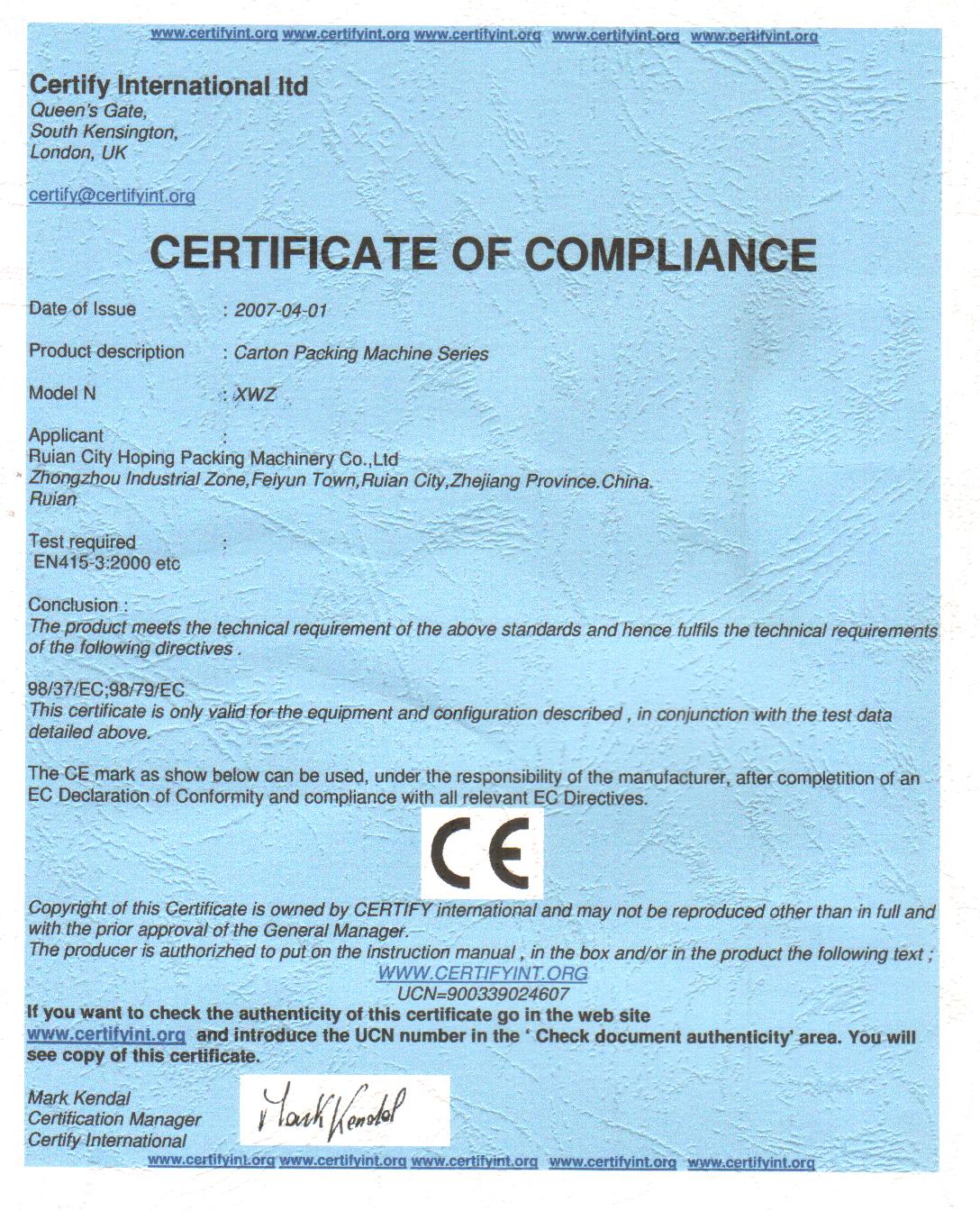
Three layers are worth checking. First, machine-level CE certification: Hoping holds a CE certificate for the carton packing machine series (certificate UCN 900339024607, issued by Certify International Ltd, referencing EN 415-3:2000, 98/37/EC and 98/79/EC), a CE certificate for the cartoning machine series (HTT190102307L, Shenzhen HTT Technology Co., Ltd., referencing EN 60204-1:2006+A1:2009+AC:2010 and 2006/42/EC), and a CE certificate for the blister packing machine series (HTT190102306L, referencing the Machinery Directive 2006/42/EC). Second, management-system certification issued by the China Quality Certification Centre (CQC): ISO 45001:2018, certificate CN00123S33121R1M/3300, and ISO 14001:2015, certificate CN00123E33896R1M/3300, both covering the design, production and after-sales service of packing machines and packing production lines. Third, the applicable standard for the product category: ISO 15378 integrates GMP requirements for primary packaging materials, and in the EU the Machinery Directive 2006/42/EC is read together with the EN 415 series for packaging machines. Line-level GMP-oriented design is a separate item and should be confirmed against the technical agreement, because it concerns product-contact parts, guarding and cleanability rather than the certificate itself.
How do servo-driven in-feed and independent replenishment actually reduce cartoning defects?
They remove two sources of variability rather than correcting the defect after it appears. A servo-driven transfer such as the D3 intelligent top-loading parallel tracking transfer system, or the self-developed IRB24 intelligent transfer robot, can be phase-synchronised to the cartoner in-feed, so the insertion point holds its position relative to the carton instead of inheriting the accumulated tolerance of the upstream chain. Independent servo-driven replenishment removes the need for an operator to top up the carton magazine or the blister stack mid-cycle, and automatic splicing of PVC and aluminium foil removes the need to stop and re-thread a reel by hand. The replenishment architecture scales with line speed: the DHL1000/5H carries four servo-driven independent replenishment channels at up to 1000 blisters per minute, and the DHL8005H carries three at up to 800 blisters per minute. Each intervention removed is also a defect opportunity removed.
Who are the top pharmaceutical packaging machine manufacturers to consider?
On published market-structure data, the pharmaceutical blister packaging machine market is led by three players — Uhlmann, IMA and Marchesini — which together hold approximately 29% of market share (Market Intelligence Report). The remaining share is served by a long field of regional and specialist manufacturers rather than by a small group of alternatives. Zhejiang Hoping Machinery Co., Ltd. sits in that second group: a manufacturer established in 2001 that produces blister packaging machines, cartoning machines, case packing machines and end-of-line packaging machines, holds CE marking and ISO management-system certifications, covers main markets in Southeast Asia, the Middle East, Eastern Europe, South America and Africa, and reports an export ratio of 25% with annual output of 500 units. Because the market is not concentrated, brand size alone is a weak filter. The more useful comparison set is specification-level: transfer architecture, replenishment channels, motion control platform, capacity per minute, and how the supplier verifies performance before shipment.
How can a buyer validate defect reduction before committing to a full line?
Validation is built into the Hoping quality-control sequence rather than added at the end. The documented sequence runs through incoming material inspection, key component inspection, assembly inspection, electrical safety check, no-load trial run, material trial, factory acceptance test, customer witness acceptance and pre-shipment inspection. In practice this means a buyer can require a material trial on the actual blister format and carton specification, attend the factory acceptance test, and witness acceptance before shipment. Because blister size, blister materials, quantity per carton, carton specification, leaflet format, coding and inspection method, feeding method and downstream connections are all listed as customizable items, the trial can be configured around the project format rather than around a standard demonstration. Minimum order quantity is one set or one complete line.
What is the typical lead time, and what happens after delivery?
Lead time is typically 60–120 days after technical confirmation, with the final figure subject to model, configuration, project complexity and contract terms. After delivery, the documented service scope covers on-site installation and commissioning, operator training, maintenance training, remote video and phone support, spare parts supply, process-parameter guidance, regular follow-up and troubleshooting — all subject to the contract and the project configuration. Because the defect behaviour of a blister-cartoning line depends on format, material and speed, the commissioning and training phase is where the settings recorded during the material trial are transferred to the production team. To review the line configurations and specifications referenced in this article, download the Hoping Machinery catalog or contact the team directly to arrange a format-specific discussion.
Conclusion
Cartoning defects on a high-speed blister line are usually reported at the cartoner and caused somewhere else. Misaligned cartons, insertion jams, leaflet faults, closure defects and speed-dependent rejects each have a different origin, and treating them as one maintenance problem is why they tend to recur.
Two design answers consistently address the majority of them. Servo-driven transfer and in-feed keep the blister board and the carton pocket in phase as speed rises, so insertion does not inherit the tolerance stack of the upstream chain. Servo-driven independent replenishment keeps material supply inside the machine cycle instead of outside it, so topping up the carton magazine or the blister stack no longer requires a hand at the running line. On the highest-capacity lines this scales to four replenishment channels at up to 1000 blisters per minute, and on flexible multi-format lines it is combined with mold-change support and preset or recipe memory so that format settings are recalled rather than re-established by hand.
The practical test is not the headline speed on a specification sheet. It is whether the line holds its timing across a full shift, at full rate, with the fewest possible manual interventions.
Next step
If you are evaluating a blister-cartoning line for a high-volume solid dosage project, the most efficient starting point is a format-specific discussion rather than a general quotation. Share your blister format, carton specification, target output and downstream requirements, and the appropriate transfer architecture and replenishment configuration can be proposed.
Download the full catalog: Hoping Machinery Catalog (PDF)
Contact — Monica | Email: monica@xwbj.com | Tel / WhatsApp: +86 133-5610-5292 | Website: www.hopingcn.com
Zhejiang Hoping Machinery Co., Ltd. — 88th Weiwu Road, Nanbin Sub-district, Ruian City, Zhejiang Province, China.
Have Questions or Need More Details?
Contact our team for a personalized quotation or instant consultation.
Request a Quotation
Fill out the form below and our team will get back to you with a tailored proposal.
WhatsApp Direct Chat
Prefer to chat in real-time? Message us on WhatsApp for instant assistance & quick answers.
- Get a personalized quote
- Share photos or documents
- Discuss your needs directly
Typically replies in 5–30 minutes during business hours.