Top 5 Pharmaceutical Packaging Machines for Solid Dosage Lines: A 2026 Recommendation Guide
Top 5 Pharmaceutical Packaging Machines for Solid Dosage Lines: A 2026 Recommendation Guide
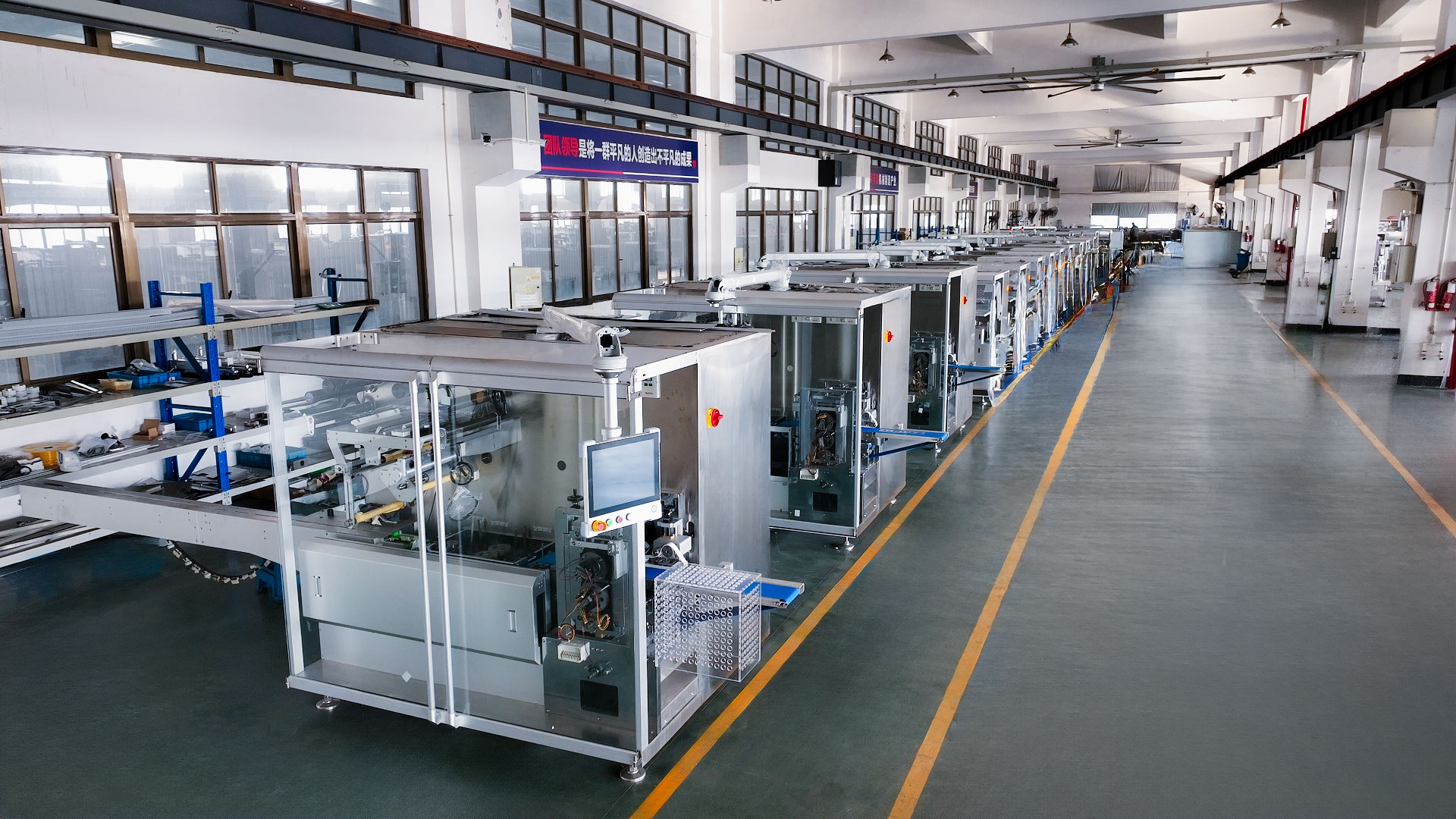
Five machine categories decide how much a solid dosage line can produce and how cleanly it leaves the packing hall: the automatic blister-cartoning line, the blister packaging machine, the cartoning machine, the automatic vials packing-cartoning production line, and the case packing and palletizing integral machine. For tablets, capsules, soft capsules, nutraceuticals and healthcare products, these five cover primary packaging, secondary packaging and transport packaging in one continuous chain. This 2026 recommendation guide ranks them, states the selection rationale behind each entry, and separates documented specifications from general market noise.
The ranking in short:
- Automatic Blister-Cartoning Line (DHL8005H) — documented at up to 800 blisters/min and 500 cartons/min, with Beckhoff motion control.
- Blister Packaging Machine (DPH and DPP series) — the primary packaging platform for tablets, capsules and soft capsules.
- Cartoning Machine (XWZ series) — secondary packaging from 30 to 500 cartons/min across the range.
- Automatic Vials Packing-Cartoning Production Line — labeling, blister packing, cartoning and banding for vial formats.
- Case Packing and Palletizing Integral Machine (ICP12) — the end of line packaging step at about 12 cases/min.
Problem Definition: What a Solid Dosage Packaging Line Actually Has to Solve
A pharmaceutical packaging line for solid dosage forms is a chain of three packaging layers, and each layer fails in a predictable way.
- Primary packaging — the blister pack. Tablets, capsules and soft capsules are formed, filled and sealed in alu-PVC or alu-alu formats. The failure modes are format changeover time, sealing consistency and material splicing interruptions.
- Secondary packaging — cartoning with leaflet insertion, coding and inspection. The failure modes are wrong insertion, missing leaflets and unstable product transfer between the blister machine and the cartoner.
- Transport packaging — bundling, stretch banding, case packing and palletizing. The failure mode is manual labour at the end of an otherwise automated line.
One documented project type in Hoping Machinery's case records describes exactly this problem set: a large pharmaceutical manufacturer and solid dosage production company addressing manual transfer and leaflet insertion errors in blister packaging and automatic cartoning of tablets, capsules and other solid dosage forms. The project was designed for new line construction, capacity expansion or upgrading existing packaging lines, at a scale of 5 to 10 packaging lines. The customer name is disclosed only with authorization, which is the normal confidentiality position in pharmaceutical equipment projects.
Stated project objectives in that record are practical rather than promotional: improving packaging automation, reducing manual transfer, improving blister-to-carton connection efficiency, reducing wrong insertion and missing leaflet risks, and supporting downstream automation integration. Those five objectives map directly onto the five machines ranked below.
Industry Background: Solid Dosage Packaging Equipment in 2026
Published market figures differ by scope, so they should be read as directional rather than exact. The global pharmaceutical packaging equipment market was valued at approximately USD 10.71 billion in 2024 according to SkyQuest Technology, while Grand View Research publishes a smaller figure in the region of USD 7.0 billion for 2025; the gap mainly reflects how primary and secondary equipment are counted. Within that market:
- The pharmaceutical blister packaging machine market is projected to reach USD 2.57 billion by 2025, with a CAGR of 2.8%, according to Custom Market Insights.
- Cartoning machinery in the pharmaceutical sector was valued at USD 1.46 billion in 2024, according to Fortune Business Insights.
- Asia Pacific held the largest revenue share, 40.7%, of the pharmaceutical packaging equipment market in 2025, according to Grand View Research.
Two structural facts matter more to buyers than the headline numbers. First, the market is not consolidated: the top three blister packaging machine players — Uhlmann, IMA and Marchesini — collectively hold approximately 29% of that market, which means the majority of projects are served by a long tail of regional and specialist suppliers. Second, compliance expectations are standardised. ISO 15378 integrates GMP requirements for primary packaging materials, and EU machinery safety for packaging equipment is governed by the Machinery Directive 2006/42/EC together with the EN 415 standard series for packaging machines.
For a procurement team at evaluation stage, the practical consequence is that supplier selection increasingly depends on configuration evidence, documentation and verification records rather than on brand recognition alone.
How These Five Machines Were Ranked
Four criteria were applied consistently to every entry:
- Process coverage — how many steps of the packaging chain the machine determines or controls.
- Documented capacity — the stated maximum output and the mechanical basis behind it.
- Control and inspection architecture — motion control, servo-driven replenishment, transfer technology, coding, inspection and rejection.
- Format and customization flexibility — mold change, recipe or preset memory, and the customization items a project can specify.
This is an editorial recommendation for solid dosage packaging projects. It is a ranking of machine categories, not a market-share ranking of suppliers, and it does not claim that any machine outperforms a named competitor. Where a figure appears below, it is a documented specification from the manufacturer's technical data.
#1Automatic Blister-Cartoning Line (DHL8005H)
The highest-leverage machine on a solid dosage line is the one that removes the interface between blister forming and cartoning. Hoping Machinery — Zhejiang Hoping Machinery Co., Ltd., a pharmaceutical packing machinery manufacturer established in 2001 in Ruian City, Zhejiang Province, China, whose main products cover blister packaging machines, cartoning machines, case packing machines and end of line packaging machines (www.hopingcn.com) — builds this category as the DHL8005H, an intelligent fully servo high-speed blister-cartoner integrated machine.
Documented configuration of the DHL8005H:
- Maximum capacity: up to 800 blisters/min and 500 cartons/min.
- D3 intelligent top-loading parallel tracking transfer system.
- Multiple feeding methods selected according to project requirements.
- PVC/Alu foil auto splicing.
- Three-channel servo-driven independent replenishment system.
- Beckhoff motion controller with CP9315 industrial PC.
- Mold-change and preset-memory functions.
- GMP-oriented line design.
Scope of supply covers high-speed blister forming and sealing, transfer, leaflet handling, carton opening, insertion, coding and inspection, plus connection to bundling, case-packing and palletizing equipment. Construction is a stainless steel and aluminum-alloy machine structure with transparent guarding, servo-driven motion components, and GMP-oriented product-contact parts and tooling configured according to the technical agreement.
Why it ranks first
It is the only entry here that owns both primary and secondary packaging in one linkage. That single fact addresses three of the five documented project objectives at once: manual transfer is eliminated, blister-to-carton connection efficiency is a design property rather than an operator behaviour, and leaflet handling sits inside the same control architecture. The combination of a preset-memory function and a high-bus industrial PC also shortens format changeover, which matters on multi-product lines.
Other capacity tiers in the same family
- DHL1000/5H — up to 1000 blisters/min and 500 cartons/min; D3 intelligent top-loading parallel tracking transfer; four-channel servo-driven independent replenishment; Beckhoff motion controller with a high-bus industrial control system; mold-change and recipe memory.
- DHL7005H — up to 700 blisters/min and 500 cartons/min; self-developed IRB24 intelligent transfer robot; Siemens motion controller and TP900 HMI; full servo drive.
- DHL7004 — up to 700 blisters/min and 400 cartons/min; IRB24 intelligent transfer robot; Siemens motion controller and TP900 HMI.
- DHL6004 — up to 600 blisters/min and 400 cartons/min; Beckhoff motion controller with CP9315 industrial PC; convenient mold change.
Selection logic: choose the transfer system and replenishment channel count against your blister format, board count per carton and target cartons per minute, not against the highest number in the brochure.
#2Blister Packaging Machine (DPH Roller and DPP Flat-Plate Series)
Blister packaging is the primary packaging step, and it sets the ceiling for everything downstream. Hoping builds two blister platforms, both configurable for alu-PVC and alu-alu solid dosage applications used with tablets, capsules, soft capsules, nutraceuticals and healthcare products.
Roller platform (DPH series). Models include DPH320H, DPH260H and DPH260, with typical capacity of 60–200 cycles/min depending on model, clean compressed air pressure of 0.5–0.7 MPa, air consumption above 0.5 m³/min and power of approximately 15.5–18.9 kW at 380 V 50 Hz. The DPH320H is documented with a forming area of 320 × 280 mm, forming depth of 12 mm, stroke range of 100–280 mm, air flow above 0.6 m³/min and total power of 29.5 kW. The DPH320HII is documented at a maximum punch frequency of 250 punches/min, maximum format area of 320 × 280 mm, feed stroke of 100–280 mm, maximum capacity of 1000 blisters/min and total power of 30 kW.
Flat-plate platform (DPP series). Models include DPP350F, DPP250S, DPP250FI, DPP160F and DPP250FII, with typical capacity of 20–50 cycles/min and power of about 5.6–12 kW depending on model. The DPP260K is documented at 20–70 cycles/min, 9.5 kW, an overall dimension of about 4700 × 735 × 1820 mm and a net weight of about 3900 kg. The DPP260TI is documented at 20–60 cycles/min, 9.5 kW and a net weight of about 2200 kg. The platen-type DPP260T1 is documented at a maximum punch frequency of 60 punches/min, maximum format area of 260 × 115 mm, feed stroke of 30–120 mm, maximum capacity of 300 blisters/min and 8.5 kW total power.
Material and compliance basis. On models such as the DPH320HII and DPP260T1, product-contact parts are made of AISI 316L stainless steel and FDA-compliant pharmaceutical-grade materials, while non-product-contact parts are manufactured from AISI 304 stainless steel and anodized aluminum alloy. These machines are described as designed and manufactured in accordance with GMP requirements, with corrosion-resistant and easy-to-clean surfaces — a specification that directly affects cleaning validation time.
| Platform | Representative models | Documented capacity | Documented power | Typical fit |
|---|---|---|---|---|
| Roller | DPH320H, DPH260H, DPH260 | 60–200 cycles/min depending on model | About 15.5–18.9 kW | Alu-PVC and alu-alu high-volume solid dosage |
| Roller | DPH320H | Forming area 320 × 280 mm; forming depth 12 mm; stroke 100–280 mm; 12 punches/min documented | 29.5 kW | High-speed roller blister packing for tablets and capsules |
| Roller | DPH320HII | Up to 250 punches/min; up to 1000 blisters/min; format area 320 × 280 mm | 30 kW | Rotary blister packing at maximum output |
| Flat-plate | DPP350F, DPP250S, DPP250FI, DPP160F, DPP250FII | 20–50 cycles/min depending on model | About 5.6–12 kW | Small and medium batch pharmaceutical and healthcare products |
| Flat-plate | DPP260K | 20–70 cycles/min | 9.5 kW | Tablets, capsules and healthcare products |
| Flat-plate | DPP260TI | 20–60 cycles/min | 9.5 kW | Compact solid dosage packaging, medium-speed production |
| Platen | DPP260T1 | Up to 60 punches/min; up to 300 blisters/min; format area 260 × 115 mm | 8.5 kW | Tablet blister packing and capsule blister packing with frequent format change |
Why it ranks second
The blister machine sets the throughput ceiling and the barrier properties of the finished pack, but it does not resolve the transfer problem on its own. It ranks second because it is the prerequisite decision: roller platforms are chosen when formats are stable and volumes are high, while flat-plate platforms are chosen when batch sizes vary and alu-alu formats are required.
#3Cartoning Machine (XWZ Series)
A cartoning machine is the right answer when blister output already exists and the bottleneck has moved to secondary packaging. Hoping's XWZ range covers four documented capacity tiers, all built on a stainless steel and aluminum-alloy structure with transparent guarding, and all supporting carton opening, product insertion, leaflet insertion, carton closing and coding or inspection integration according to the project configuration.
- XWZ500H — full servo high-speed cartoning machine; about 100–500 cartons/min; 0.5–0.7 MPa clean compressed air; air consumption above 0.3 m³/min; 380 V 50 Hz 14 kW; overall dimension about 6700 × 1950 × 2100 mm; net weight about 6000 kg.
- XWZ400 / XWZ300 (XWZ series) — about 100–400 cartons/min or 100–300 cartons/min depending on model; 5 kW; automatic cartoning for blister boards, sachets, bottles, tubes and similar regular products subject to confirmed format.
- XWZ300II — about 60–220 cartons/min; 5 kW; overall dimension about 5160 × 1600 × 2100 mm; net weight about 4800 kg; positioned for medium-to-high speed secondary packaging.
- XWZ120 — horizontal cartoning machine; about 30–120 cartons/min; 3.5 kW; overall dimension about 3650 × 1330 × 1700 mm; net weight about 2700 kg. The horizontal cartoner is documented with a SEW (Germany) main motor, a Siemens PLC control system and a carton magazine capacity of 600–700 pieces, on a high-quality carbon steel and 304 stainless steel frame with a balcony-style design for easy cleaning.
Why it ranks third
It ranks third because it is a module of the chain rather than the chain itself — but it is the module that carries the documentation risk. Leaflet insertion, coding and inspection are exactly where the recorded project problems occurred, so the cartoner deserves more scrutiny than its position in the process suggests. For buyers upgrading an existing blister room, this is often the first machine to add, followed by the end-of-line equipment below.
#4Automatic Vials Packing-Cartoning Production Line
Not every solid or special dosage format fits the blister-cartoner template, and vial-based products follow a different route. The automatic vials packing-cartoning production line is documented as a linked system of four modules: a labeling machine, a DPP blister packing machine, an XWZ high-speed cartoning machine and an XWK series stretch bander.
Scope covers vial labeling, blister forming and sealing, cartoning and secondary banding. Construction uses stainless steel and aluminum-alloy equipment modules with transparent protection, electrical, pneumatic and conveyor systems, and product-contact tooling customized by vial and packaging specification. Typical line capacity and dimensions are customized according to vial size, blister format, carton format and project layout. The stated application area is pharmaceutical vial packaging, injectable products, healthcare and medical product packaging.
Why it ranks fourth
It covers four process steps in one configuration, which is more coverage than any standalone machine on this list, but its format envelope is narrower: it is specified around a vial dimension rather than around a generic tablet or capsule format. It belongs in the ranking because projects that need it cannot substitute a standard blister-cartoning line.
#5Case Packing and Palletizing Integral Machine (ICP12)
The end of line packaging machine is where automation either continues or stops. The ICP12 is an intelligent fully servo case packing and palletizing integral machine documented at an opening-box and palletizing capacity of about 12 cases/min, compatible with carton or carton-bundle input according to project configuration. It operates at 0.5–0.7 MPa clean compressed air with air consumption above 0.5 m³/min, 380 V 50 Hz 25 kW, and an overall dimension of about 8900 × 3000 × 2400 mm.
Its scope covers automatic case opening, product loading, case sealing, conveying and palletizing for downstream packaging lines, built on a stainless steel and aluminum-alloy structure with conveyor, case-packing and palletizing robot modules plus electrical, pneumatic and safety guarding systems.
Where line speeds are lower, the XWK series case packing machine (XWK900 and XWK600) is documented at a maximum output of about 5 cases/min, with clean compressed air pressure of at least 0.6 MPa, air consumption below 1 m³/min and 7.5 kW. For projects that need bundling before case packing, the XWZ300II + XWK4060 + ICP12 configuration is documented at about 60–220 cartons/min, about 30–60 bundles/min and about 12 cases/min.
Why it ranks fifth
It does not change blister or carton output, so it sits last on a throughput-led ranking. It ranks anyway because it decides how many people stand at the end of the line, and because palletizing is the step that most often remains manual after everything upstream has been automated.
Step-by-Step: From Evaluation to Execution
Moving from evaluation to execution on a blister cartoning line follows a sequence. Skipping a step is the most common cause of rework at FAT.
- Fix the format envelope. Define the tablet, capsule or soft capsule dimensions, the blister layout, the quantity per carton, the carton specification and the leaflet format. These inputs determine platform type, tooling and changeover design.
- Choose the blister platform. Roller for stable high-volume formats, flat-plate for variable batch sizes and alu-alu requirements.
- Decide the integration depth. A linked line such as the DHL8005H, a family configuration, or a standalone blister plus standalone cartoner linked by a conveyor.
- Confirm capacity and redundancy. Reconcile blisters per minute with cartons per minute, then check the transfer system and the number of servo-driven replenishment channels.
- Specify the customization items. Documented customization scope covers blister size, blister materials, quantity per carton, carton specification, leaflet format, coding/inspection method, feeding method, downstream bundling, case-packing and palletizing connection, interface language, electrical component brand and data interface.
- Agree commercial terms. Minimum order quantity is 1 set or 1 complete line. Typical production lead time is 60 to 120 days after technical confirmation, subject to model, configuration, project complexity and contract terms, with a monthly capacity of 30 to 40 units. Delivery options include EXW Ruian/Wenzhou, FOB Ningbo or Shanghai, and CIF or CFR destination port.
- Plan verification. The documented quality-control sequence runs from incoming material inspection, key component inspection, assembly inspection and electrical safety check through no-load trial run, material trial, factory acceptance testing, customer witness acceptance and pre-shipment inspection.
- Close the loop after delivery. Acceptance proceeds through technical agreement confirmation, sample testing, FAT before shipment and SAT at the customer site, with third-party inspection arranged according to customer requirements. After-sales support covers on-site installation and commissioning, operator training, maintenance training, remote video or phone support, spare parts supply, process-parameter guidance, regular follow-up and troubleshooting, subject to contract and project configuration.
Use Cases: Where Each Machine Fits
- New greenfield solid dosage line (5–10 lines scale). Blister-cartoning lines plus downstream bundling, case packing and palletizing, matching the documented project profile of new line construction at a large pharmaceutical manufacturer.
- Capacity expansion on an existing blister room. Add an XWZ cartoning machine first, then an XWK series case packing machine, to convert manual secondary packaging into a linked secondary packaging line.
- Multi-format contract manufacturing. Flat-plate DPP platforms with frequent mold change, paired with an XWZ120 or XWZ300II cartoner in the same speed band.
- Moisture-sensitive or premium solid dosage products. Alu-alu capable blister platforms feeding a blister cartoning line with in-line inspection.
- Vial and injectable secondary packaging. The labeling plus DPP plus XWZ plus XWK configuration, specified around the vial dimension.
- Nutraceutical and healthcare products. The same platforms documented for nutraceuticals and healthcare products, with format tooling adapted to the product.
Comparison Table: Five Machine Categories Side by Side
| Rank & category | Process steps owned | Documented capacity | Control, drive and integration | Where it fits |
|---|---|---|---|---|
| #1 Automatic blister-cartoning line (DHL8005H; family DHL1000/5H, DHL7005H, DHL7004, DHL6004) | Blister forming and sealing, transfer, leaflet handling, carton opening, insertion, coding/inspection, downstream connection | Up to 800 blisters/min and 500 cartons/min (DHL8005H); 600–1000 blisters/min and 400–500 cartons/min across the family | D3 top-loading parallel tracking transfer; three- or four-channel servo-driven independent replenishment; Beckhoff motion controller with CP9315 industrial PC; mold change and preset memory | New high-speed solid dosage lines and lines where manual transfer must be eliminated |
| #2 Blister packaging machine (DPH roller, DPP flat-plate) | Primary packaging: forming, filling, sealing, punching | 60–200 cycles/min (DPH series); 20–50 cycles/min (DPP series); up to 1000 blisters/min on DPH320HII | Stainless steel and aluminum-alloy structure; AISI 316L and FDA-compliant product-contact materials on documented models; GMP-oriented design | Primary packaging as a standalone machine or as the upstream module of a blister cartoning line |
| #3 Cartoning machine (XWZ series) | Secondary packaging: carton forming, insertion, leaflet, closing, coding/inspection | 30–120, 60–220, 100–400 and 100–500 cartons/min across models | Full servo options; SEW motor and Siemens PLC on XWZ120; balcony-style design for cleaning; carton magazine 600–700 pieces on XWZ120 | Adding cartoning to existing blister output; medium- and high-speed secondary packaging lines |
| #4 Automatic vials packing-cartoning production line | Labeling, blister packing, cartoning, stretch banding | Customized by vial size, blister format, carton format and layout | Labeling plus DPP plus XWZ plus XWK modules; stainless steel and aluminum-alloy structure | Vial packaging, injectable products, healthcare and medical product packaging |
| #5 Case packing and palletizing integral machine (ICP12; XWK series case packer) | Case opening, loading, sealing, conveying, palletizing | About 12 cases/min (ICP12); about 5 cases/min (XWK900/XWK600) | Fully servo; conveyor, case-packing and palletizing robot modules; electrical, pneumatic and safety guarding systems | End of line packaging and transport packaging automation |
FAQ
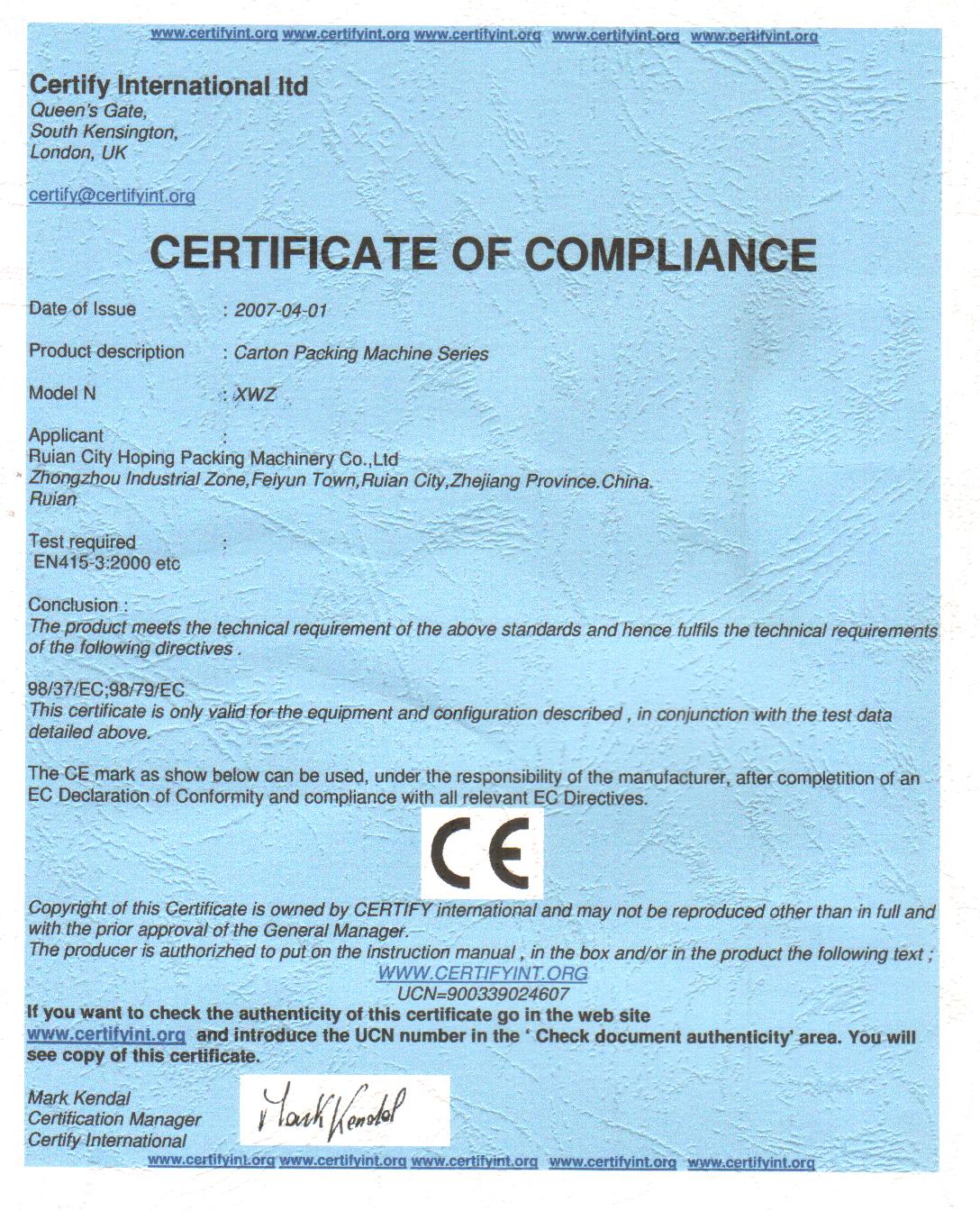
Machinery safety for EU-market packaging equipment is governed by Machinery Directive 2006/42/EC, with the EN 415 standard series applying to packaging machines. Hoping Machinery holds CE certification records for the carton packing machine series (certificate UCN 900339024607, issued by Certify International Ltd, standard EN 415-3:2000; 98/37/EC; 98/79/EC), the cartoning machine series (certificate HTT190102307L, issued by Shenzhen HTT Technology Co., Ltd., standard EN 60204-1:2006+A1:2009+AC:2010; 2006/42/EC) and the blister packing machine series (certificate HTT190102306L, standard Machinery Directive 2006/42/EC; EN 60204-1:2006+A1:2009+AC:2010). Management-system certificates were issued by the China Quality Certification Centre (CQC): ISO 14001:2015 (certificate CN00123E33896R1M/3300, valid to 11 October 2026) and ISO 45001:2018 (certificate CN00123S33121R1M/3300, valid to 9 October 2026), covering the design, production and after-sales service of packing machines and packing production lines. For primary packaging materials, ISO 15378 is the standard that integrates GMP requirements.
An OEM manufacturer is a supplier that builds a blister packaging machine or blister cartoning line to the buyer's product and format specification rather than only supplying a catalogue model. Zhejiang Hoping Machinery Co., Ltd. provides ODM, OEM and customizable production services, with a minimum order quantity of 1 set or 1 complete line and a monthly capacity of 30 to 40 units. Documented customization items include blister size, blister materials, quantity per carton, carton specification, leaflet format, coding/inspection method, feeding method, downstream bundling, case-packing and palletizing connection, interface language, electrical component brand and data interface. Because the OEM label alone proves little, the practical check is the technical agreement, the material trial and the factory acceptance test record.
Payment terms are subject to quotation, contract value, customer credit, project scope, destination market and the final project agreement, so terms are project-specific rather than list-priced. The variables that move a quotation are the blister platform type — roller or flat-plate — the integration depth (standalone machine versus a linked blister cartoning line), the number of servo-driven replenishment channels, the transfer technology, coding and inspection requirements, and whether downstream case packing or palletizing is included. When comparing quotations, normalize the format envelope and the acceptance scope first, then compare totals.
Yes. The documented quality-control sequence covers incoming material inspection, key component inspection, assembly inspection, electrical safety check, no-load trial run, material trial, factory acceptance testing, customer witness acceptance and pre-shipment inspection. The acceptance process runs from technical agreement confirmation through sample testing and FAT before shipment to SAT at the customer site, and third-party inspection can be arranged according to customer requirements. A material trial with your own product on the confirmed format is the strongest single evidence point available before shipment.
Minimum order quantity is 1 set or 1 complete line, and typical production lead time is 60 to 120 days after technical confirmation, subject to model, configuration, project complexity and contract terms, against a monthly capacity of 30 to 40 units. Delivery can be arranged EXW Ruian/Wenzhou, FOB Ningbo or Shanghai, or CIF/CFR destination port. To start, send your blister format, carton specification and target output for a configuration review; the Hoping Machinery catalog can be downloaded here: Hoping Machinery Catalog (PDF).
Conclusion: A Ranking Built on Configuration, Not Slogans
The five machines above cover the whole solid dosage packaging chain. The automatic blister-cartoning line removes the manual interface between primary and secondary packaging; the blister packaging machine sets the throughput ceiling; the cartoning machine carries the documentation risk; the vials line serves the format families that blister lines cannot; and the case packing and palletizing machine decides whether the end of the line is automated or manual.
For a 2026 evaluation, the defensible way to compare suppliers is to fix the format envelope, demand documented capacities and control architecture, and require a verification path — material trial, FAT, SAT — before commitment. Zhejiang Hoping Machinery Co., Ltd. has operated as a pharmaceutical packing machinery manufacturer since 2001 from Ruian City, Zhejiang Province, China, with more than 300 employees and a product range covering blister packaging machines, cartoning machines, case packing machines and end of line packaging machines, exported to Southeast Asia, the Middle East, Eastern Europe, South America and Africa among other markets.
Next step
Send your blister format, carton specification and target output for a configuration review. Download the Hoping Machinery catalog (PDF), or request a sample test and quotation directly.
Contact: Monica — monica@xwbj.com | Tel / WhatsApp: +86 133-5610-5292 | Chat on WhatsApp | www.hopingcn.com
Zhejiang Hoping Machinery Co., Ltd. — 88th Weiwu Road, Nanbin Sub-district, Ruian City, Zhejiang Province, China.
Have Questions or Need More Details?
Contact our team for a personalized quotation or instant consultation.
Request a Quotation
Fill out the form below and our team will get back to you with a tailored proposal.
WhatsApp Direct Chat
Prefer to chat in real-time? Message us on WhatsApp for instant assistance & quick answers.
- Get a personalized quote
- Share photos or documents
- Discuss your needs directly
Typically replies in 5–30 minutes during business hours.