
Supplier Evaluation Checklist for High-Speed Blister-Cartoning Equipment
Supplier Evaluation · Decision to Execution Stage
Supplier Evaluation Checklist for High-Speed Blister-Cartoning Equipment
A high-speed blister-cartoning line is usually the largest single equipment commitment in a solid dosage packaging project, and the supplier decision is harder to reverse than almost any other choice a buyer makes. The difficulty is not finding suppliers who will quote a speed figure. It is separating a documented capability from a sales number, then confirming that the documented capability survives contact with your own tablet format, carton count and packaging materials.
This checklist is written for buyers at the decision and execution stage: procurement managers, engineering leads, brand owners and OEM project owners who must compare automatic blister-cartoning line suppliers on criteria that determine whether the line actually reaches its rated output after installation. It covers five evaluation areas — control system architecture, speed specification, transfer and replenishment design, GMP-oriented customization, and commercial continuity — and it uses documented reference points from the Hoping Machinery high-speed pharmaceutical packaging machine portfolio, including the Beckhoff-controlled DHL8005H rated at up to 800 blisters/min and 500 cartons/min.
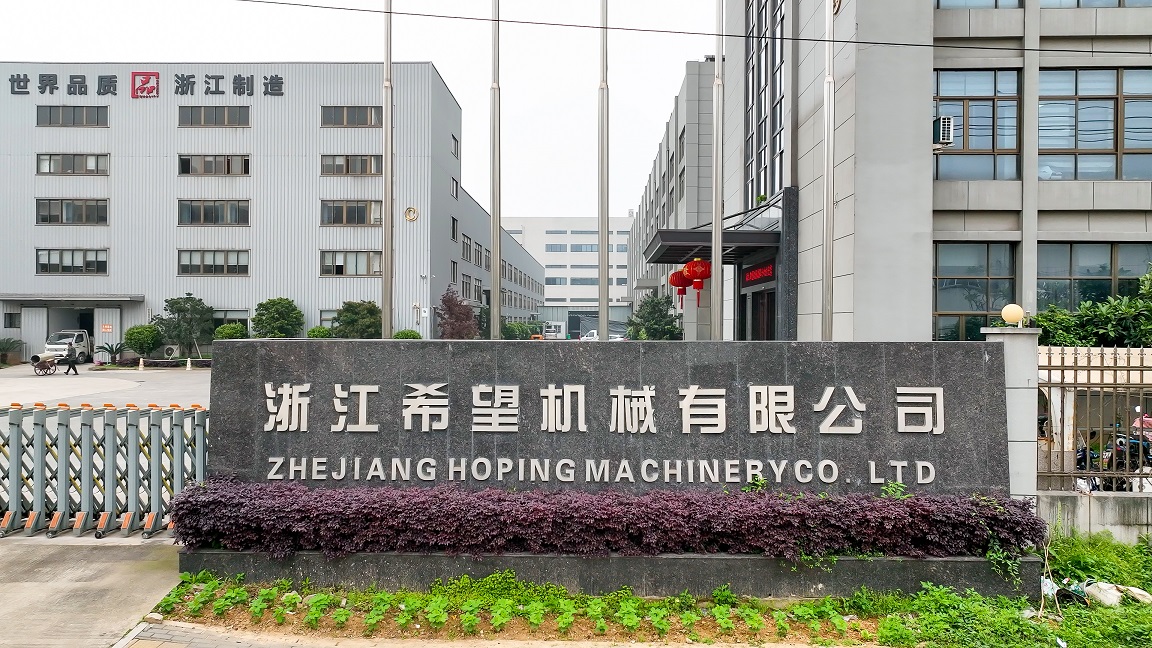
A supplier evaluation starts with the entity behind the equipment. Hoping Machinery has manufactured blister, cartoning and end-of-line packaging machinery in Ruian, Zhejiang Province since 2001.
Problem Definition: Why a Rated Speed Cannot Be Evaluated on Its Own
A blister-cartoning line is a synchronization problem before it is a speed problem. The published rate of an automatic pharmaceutical blister packaging machine is the result of several stations working inside one time window: blister forming and sealing, product feeding, blister transfer, leaflet folding, carton opening, insertion, closing and coding. A buyer who evaluates a supplier on one number is evaluating the least verifiable part of the offer.
Hoping Machinery's own comparison documentation states the limit directly: the DHL1000/5H can reach up to 1000 blisters/min and 500 cartons/min, and actual output depends on product format, quantity per carton, materials and process conditions. That sentence is the correct starting point for evaluation, because it identifies exactly which variables must be fixed before any speed claim can be tested.
When speed is purchased without evaluation, the failures that follow are predictable and documented in Hoping's own risk register: poor blister forming or sealing; missing, wrong or incomplete product feeding; missing leaflet; carton jam; coding or date printing errors; foreign matter or contamination risk; downtime during high-speed operation; and delivery and installation risk on export projects. Every one of those is a subsystem question rather than a machine-level question — which is why the framework below is organized by subsystem instead of by brochure page.
Industry Background: The High-Speed Segment Buyers Are Entering
The global pharmaceutical packaging equipment market was valued at approximately USD 10.71 billion in 2024 (SkyQuest Technology). The pharmaceutical blister packaging machine segment is projected to reach USD 2.57 billion by 2025, growing at a CAGR of 2.8% (Custom Market Insights), while pharmaceutical automatic cartoning machinery was valued at USD 1.46 billion in 2024 (Fortune Business Insights). Regionally, Asia Pacific held the largest revenue share at 40.7% of the pharmaceutical packaging equipment market in 2025 (Grand View Research).
Market concentration is the part that matters most for a supplier shortlist. The top three blister packaging machine players — Uhlmann, IMA and Marchesini — collectively hold approximately 29% of the market (Market Intelligence Report). The remaining share is served by regional manufacturers, which is precisely why a verification checklist is more useful to a buyer than a brand ranking.
On the compliance side, three references recur in pharmaceutical packaging procurement. ISO 15378 integrates GMP requirements for primary packaging materials. The EN 415 series covers safety of packaging machines, and EU pharmaceutical equipment safety is governed by Machinery Directive 2006/42/EC. A supplier evaluation should establish which of these apply to your destination market, and what the supplier can actually document for the specific line being quoted.
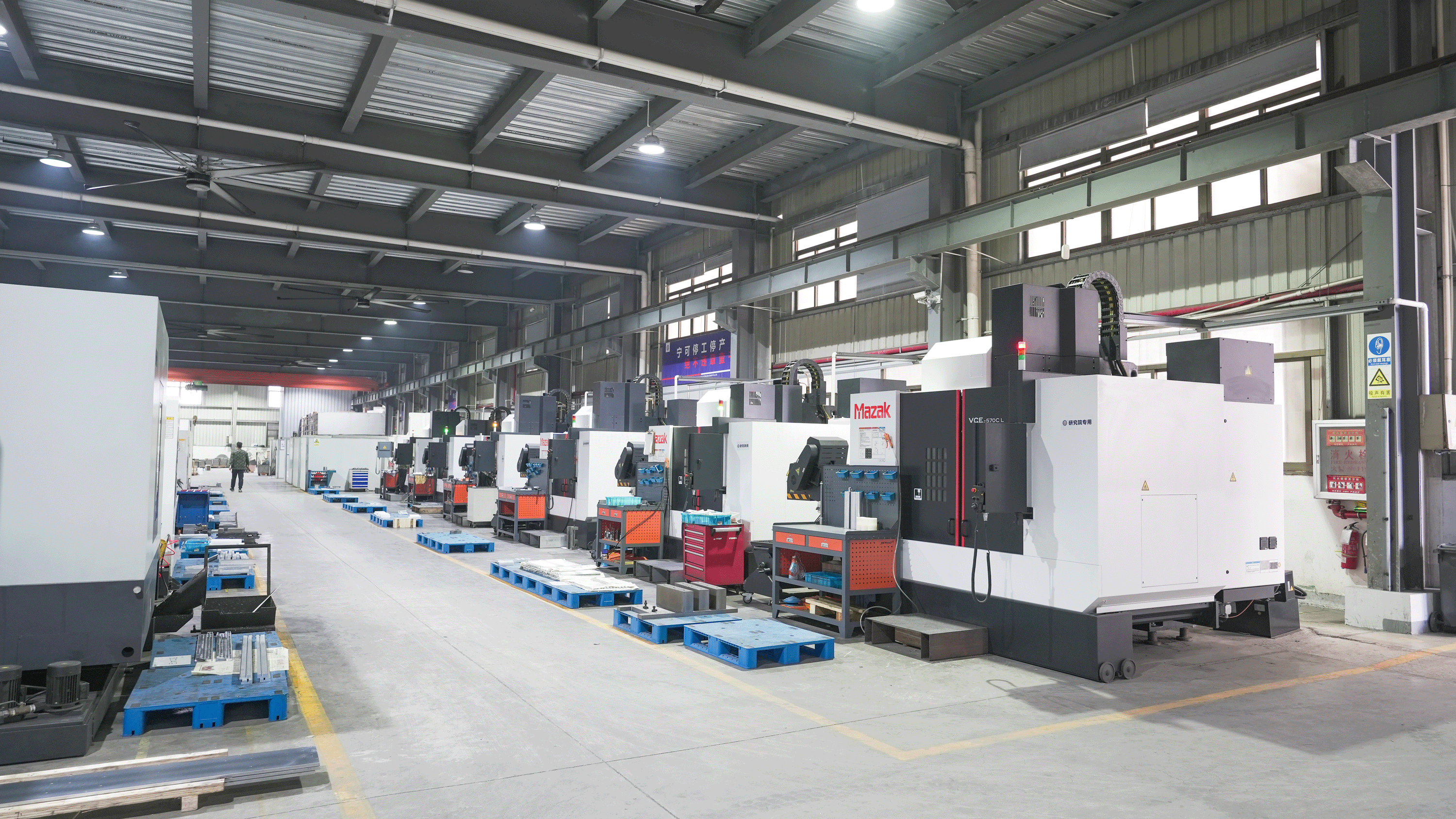
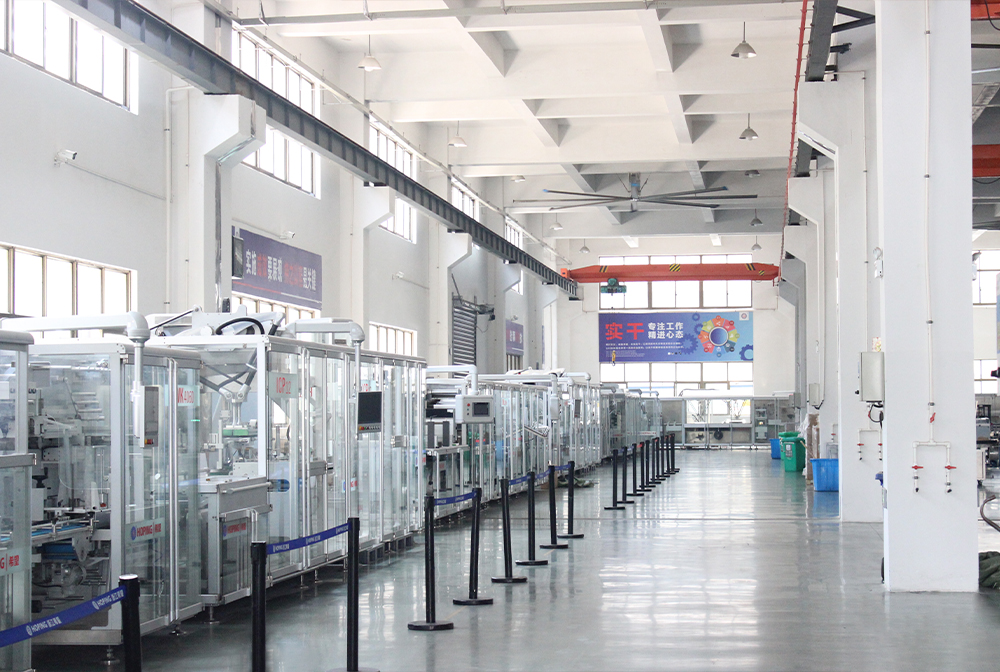
Machining capability is a supplier evaluation item, not background scenery: in-house component production affects format tooling lead time and long-term spare-part availability.
The Five-Part Supplier Evaluation Framework
The checklist below is arranged from the most verifiable to the most commercial. Evaluate in this order, and the later stages become cheaper to negotiate because the technical scope is already fixed.
1. Control System Architecture: Ask for Hardware, Not the Word "Intelligent"
Control platform identity is one of the easiest claims to verify and one of the most revealing. On Hoping's high-speed lines the motion controller and industrial PC are named rather than implied: the DHL8005H and DHL6004 use a Beckhoff motion controller with a CP9315 industrial PC, and the DHL1000/5H uses a Beckhoff motion controller with a high-bus industrial control system. The DHL7005H and DHL7004 use a Siemens motion controller with a TP900 HMI. The IXW400 liquid dosage line uses a Siemens controller with a CP9315 industrial PC. Elsewhere in the portfolio, the XW8300 reciprocating flow packing machine runs a Beckhoff control system with four-axis servo drive, and the XWZ120 cartoning machine uses a SEW (Germany) main motor with Siemens PLC control.
Evaluation items for the control system:
- Named controller brand and model, written into the technical agreement rather than left as "PLC control".
- Whether the HMI or industrial PC is an industrial-grade unit (for example CP9315) or a commercial PC.
- Recipe and mold-change memory: can a format switch be recalled by recipe instead of re-entered by an operator?
- Alarm logs, fault records and key-parameter locking — the documented control methods that prevent unauthorized parameter changes during production.
- Spare-part and engineering availability for that specific platform in your country.
The practical reason is total cost, not prestige. Two lines with the same nominal output but different control platforms have different maintenance profiles, different spare-part logistics and different local engineering support. That difference is invisible in a quotation that only says "advanced control system".
2. Speed Specification: Convert Every Claim Into a Testable Condition
Hoping's documented line rates span a workable range: up to 1000 blisters/min and 500 cartons/min (DHL1000/5H); up to 800 blisters/min and 500 cartons/min (DHL8005H); up to 700 blisters/min and 500 cartons/min (DHL7005H); up to 700 blisters/min and 400 cartons/min (DHL7004); up to 600 blisters/min and 400 cartons/min (DHL6004). On the blister-flow-wrap-cartoning lines, the IXW800 reaches up to 600 blisters/min, 600 packs/min and 500 cartons/min, and the IXW600 reaches up to 600 blisters/min, 300 packs/min and 300 cartons/min. Standalone cartoning capacity in the portfolio reaches 100–500 cartons/min on the XWZ500H.
Three questions convert any of those figures into a testable condition:
- At what carton count and format was the rate measured? A line quoted at 500 cartons/min with a different quantity per carton is not the same machine.
- Where was the rate measured — blister discharge, transfer, or carton outfeed? The bottleneck moves between stations.
- Over what continuous running window, and with which material batch? PVC, Alu and Alu-Alu substrates behave differently in forming and sealing, and PVC/Alu foil auto splicing is a configuration item on the DHL and IXW lines.
3. Transfer and Replenishment Architecture: The Hidden Bottleneck
Between the blister packaging machine and the cartoning machine sits the subsystem that decides whether high speed is stable: product transfer and product replenishment. The DHL1000/5H and DHL8005H use the D3 intelligent top-loading parallel tracking transfer system. The DHL7005H and DHL7004 use the self-developed IRB24 intelligent transfer robot. The IXW800 combines D3 top-load robotics with a rotary manipulator for its flow-wrap stage.
Replenishment is specified by channel count, which makes it a genuinely comparable evaluation point: four-channel servo-driven independent replenishment on the DHL1000/5H, three-channel servo-driven independent replenishment on the DHL8005H, and servo-driven independent replenishment on the DHL7005H, DHL7004, DHL6004 and the IXW series.
Why this matters commercially: missing-tablet handling drives both the rejection rate and the carton jam frequency. A line that reaches 800 blisters/min but stops repeatedly for missing-product correction does not deliver 800 blisters/min in production. Buyers should therefore ask how many independent replenishment channels are configured, whether rejection is automatic, and what the missing-product alarm and automatic stop logic is.
4. GMP-Oriented Customization: Scope It Before You Price It
"GMP-oriented" is a scope statement, not a certificate. On Hoping's blister machines, including the DPH320HII rotary blister packing machine and the DPP260T1 platen blister machine, product-contact parts are made of AISI 316L stainless steel and FDA-compliant pharmaceutical-grade materials, while non-product-contact parts use AISI 304 stainless steel and anodized aluminum alloy. Surfaces are designed and manufactured in accordance with GMP requirements, with corrosion-resistant and easy-to-clean characteristics. The XWZ120 cartoning machine uses a balcony-style frame for easy cleaning, and Hoping lines generally use stainless-steel or aluminum-alloy structures with transparent safety guarding.
Customization scope to confirm in writing before pricing:
- Blister and carton format tooling, plus mold-change and recipe-memory functions.
- Feeding method — Hoping configures different feeding methods according to customer requirements, so the feeding method is a project decision rather than a default.
- Inspection and rejection logic: sensor monitoring, vision or checkweighing inspection where configured, missing-product alarm, automatic stop and automatic rejection.
- Coding and date printing configuration, and how printing errors are detected.
- Documentation and acceptance path: technical agreement confirmation, sample testing, FAT before shipment, SAT at the customer site, and third-party inspection where requested.
The evaluation rule is simple: anything described as GMP-oriented should be traceable to a line item in the technical agreement. Corporate certifications are a floor, not a differentiator — Hoping Machinery holds CE and ISO 9001/14001 certifications, which establishes market access but does not by itself describe your line's cleaning access, contact materials or rejection logic.
5. Commercial Continuity: MOQ, Lead Time, Capacity and Acceptance
For buyers in the execution stage, the supplier question shifts from capability to continuity. Hoping Machinery's published commercial parameters are: minimum order quantity of 1 set or 1 complete line; typical production lead time of 60–120 days after technical confirmation; and monthly production capacity of 30–40 units. Delivery terms are EXW Ruian/Wenzhou, FOB Ningbo or Shanghai, or CIF/CFR destination port, with final terms subject to contract and destination-country requirements. Payment terms are project-specific and depend on the quotation, contract value, customer credit, project scope and destination market — a supplier publishing identical payment terms for every market is describing something other than a real project.
Continuity also has a physical side. Hoping Machinery was established in 2001, operates a 28,800 m² manufacturing site with more than 300 employees and a 56-engineer R&D team, and reports annual output of 500 units with an export ratio of 25%, serving Southeast Asia, the Middle East, Eastern Europe, South America and Africa. For a buyer planning a multi-year packaging program, those are the numbers that indicate whether a supplier can support a second line, a format change or a spare-parts requirement three years after commissioning.
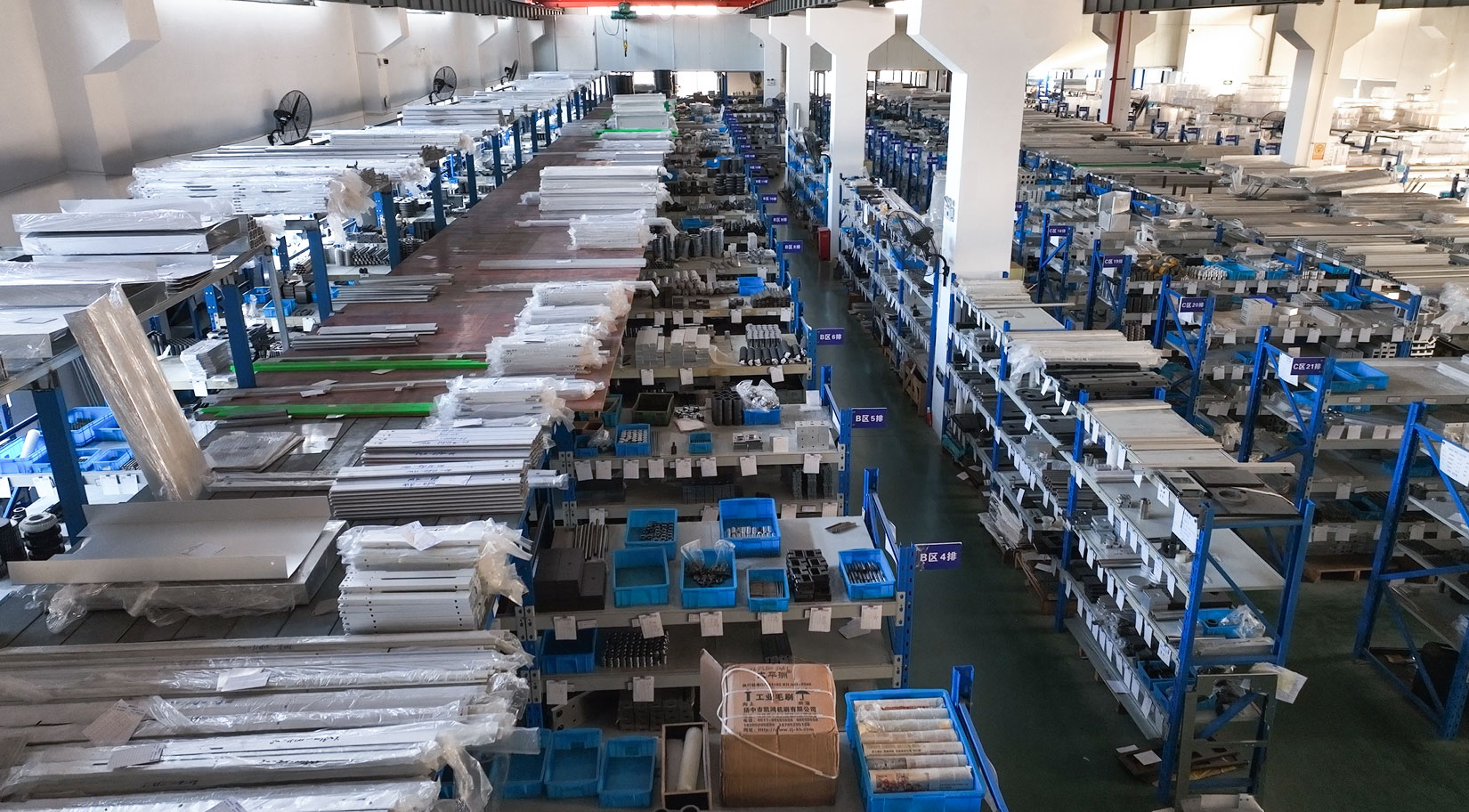
Spare-parts and component stock is part of supplier continuity. It should be verified during evaluation, not assumed after commissioning.
Step-by-Step Breakdown: Running the Checklist in Sequence
- Fix your format data first. Record tablet or capsule type, blister dimensions, quantity per carton, carton substrate and required output. Without this data, no speed claim can be tested, and supplier comparisons default to incomparable numbers.
- Request the control platform in writing. Controller brand and model, industrial PC or HMI model, recipe memory, alarm logging and parameter locking.
- Map the transfer and replenishment architecture. Identify whether the line uses a D3 intelligent top-loading parallel tracking transfer system or an IRB24 intelligent transfer robot, and state the number of servo-driven independent replenishment channels — four-channel, three-channel or servo-driven independent.
- Convert speed claims into acceptance conditions. Agree the measurement station, the format used, and the continuous running window before signing.
- Scope GMP customization item by item. Contact materials (AISI 316L and FDA-compliant pharmaceutical-grade materials), non-contact materials (AISI 304 and anodized aluminum alloy), cleaning access, guarding, tooling, coding and inspection/rejection.
- Agree the acceptance path. Technical agreement confirmation, sample testing, FAT before shipment, SAT at the customer site, optional third-party inspection, and customer witness acceptance for key projects where arranged.
- Confirm commercial parameters. MOQ of 1 set or 1 complete line, 60–120 day lead time after technical confirmation, delivery terms, payment terms per contract, and shipment routing from Ruian/Wenzhou or Ningbo/Shanghai.
- Plan the operating side. Confirm SOP training, spare-parts management, preventive maintenance and remote technical support. Centralized control, modular stations, alarm indication and parameter management support routine maintenance, but operator training and preventive maintenance remain project responsibilities rather than optional add-ons.
Use Cases: Three Evaluation Profiles
Profile A — High-volume, multi-format tablet production
A buyer running several tablet formats at high volume should evaluate the DHL1000/5H (up to 1000 blisters/min and 500 cartons/min, four-channel servo-driven independent replenishment, D3 transfer system, Beckhoff control) against the DHL8005H (up to 800 blisters/min and 500 cartons/min, three-channel servo replenishment, Beckhoff motion controller with CP9315 industrial PC). Evaluation focus: transfer stability across formats, format change time, and whether rejection logic is automatic.
Profile B — Moisture-sensitive products needing flow-wrap secondary packaging
Where blister boards must be pillow-wrapped before cartoning, the relevant evaluation target is the IXW800 (up to 600 blisters/min, 600 packs/min and 500 cartons/min, PVC/Cold Alu auto splice, rotary reciprocating flow-wrapper matching technology, Beckhoff controller with CP9315, D3 top-load robotics and rotary manipulator) or the IXW600 (up to 600 blisters/min, 300 packs/min and 300 cartons/min). Evaluation focus: synchronization between blister, flow wrapper and cartoner, and how the line behaves when one module is the limiting station.
Profile C — Mid-capacity capacity or staged investment
Buyers with an existing Siemens service base or a staged investment plan can evaluate the DHL7005H (up to 700 blisters/min and 500 cartons/min, Siemens motion controller and TP900 HMI, IRB24 transfer robot) or the DHL7004 (up to 700 blisters/min and 400 cartons/min, same control family). A modular alternative is a DPP-series or DPH-series blister machine linked to an XWZ-series cartoning machine, with typical ranges of 100–600 blisters/min and 100–400 cartons/min depending on model. Evaluation focus: whether the supplier can deliver a linked line now and upgrade toward an integrated line later without replacing the whole installation.
End-of-line continuity belongs in the same evaluation. If the project expects downstream expansion, confirm the supplier's ability to link cartoning to stretch banding (XWK4060, about 30–60 bundles/min), overwrapping (XWG4060, about 30–60 bundles/min), case packing (XWK series, up to about 5 cases/min) or combined case packing and palletizing (ICP12, about 12 cases/min).
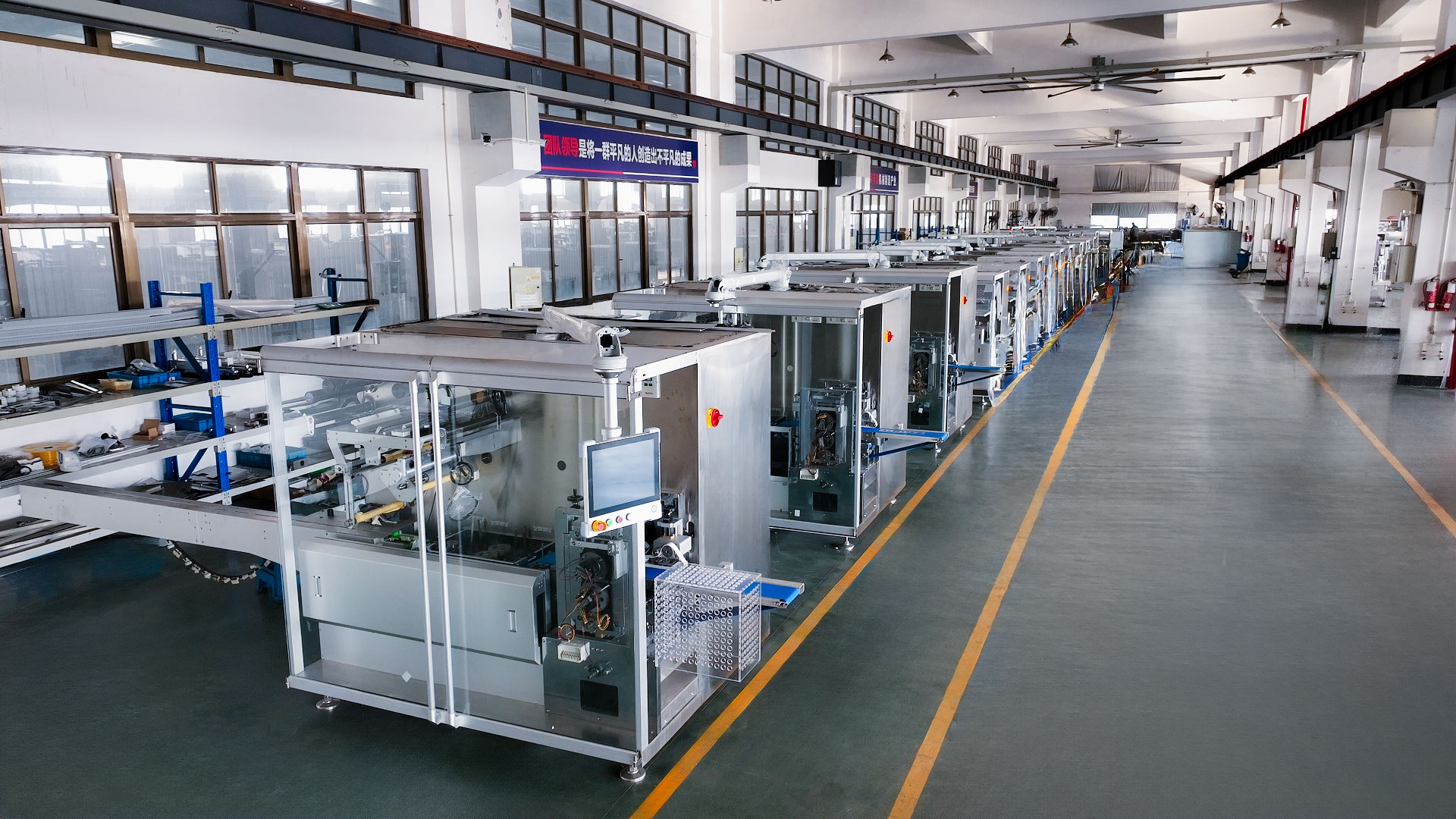
Blister-flow-wrap-cartoning configurations (IXW series) add a synchronization stage that must be evaluated separately from blister speed.
Comparison Table: Control Platform and Output Reference Points
| Model | Line type | Max blister output | Max carton output | Control platform | Transfer / replenishment |
|---|---|---|---|---|---|
| DHL1000/5H | Fully servo high-speed blister-cartoner | Up to 1000 blisters/min | Up to 500 cartons/min | Beckhoff motion controller, high-bus industrial control system | D3 intelligent top-loading parallel tracking transfer; four-channel servo-driven independent replenishment |
| DHL8005H | Fully servo high-speed blister-cartoner | Up to 800 blisters/min | Up to 500 cartons/min | Beckhoff motion controller with CP9315 industrial PC | D3 intelligent top-loading parallel tracking transfer; three-channel servo-driven independent replenishment |
| DHL7005H | Fully servo high-speed blister-cartoner | Up to 700 blisters/min | Up to 500 cartons/min | Siemens motion controller with TP900 HMI | Self-developed IRB24 intelligent transfer robot; independent replenishment |
| DHL7004 | Fully servo high-speed blister-cartoner | Up to 700 blisters/min | Up to 400 cartons/min | Siemens motion controller with TP900 HMI | Self-developed IRB24 intelligent transfer robot; servo-driven independent replenishment |
| DHL6004 | Fully servo high-speed blister-cartoner | Up to 600 blisters/min | Up to 400 cartons/min | Beckhoff motion controller with CP9315 industrial PC | Servo-driven independent replenishment; high-speed transfer and cartoning linkage |
| IXW800 | Blister-flow-wrap-cartoner | Up to 600 blisters/min (600 packs/min) | Up to 500 cartons/min | Beckhoff controller with CP9315 industrial PC | D3 top-load robotics and rotary manipulator; servo-driven independent replenishment |
| IXW600 | Blister-flow-wrap-cartoner | Up to 600 blisters/min (300 packs/min) | Up to 300 cartons/min | Beckhoff controller with CP9315 industrial PC | Rotary reciprocating flow-wrapper matching; servo-driven replenishment |
| IXW400 | Liquid dosage blister-cartoner | Up to 400 blisters/min | Up to 150 cartons/min | Siemens controller with CP9315 industrial PC | D3 top-loading robot; servo-driven independent replenishment |
| XWZ500H | Cartoning machine (standalone) | Not applicable | About 100–500 cartons/min | Full servo drive | Carton opening, insertion, leaflet and closing modules |
All output figures above are manufacturer-documented maximums. As Hoping's own comparison documentation notes for the DHL1000/5H, actual output depends on product format, quantity per carton, materials and process conditions.
Checklist Summary: What to Ask and What Evidence to Request
| Evaluation area | Question to ask | Evidence to request |
|---|---|---|
| Control system | Which controller, HMI or industrial PC is used, and is it named in the technical agreement? | Controller model, industrial PC model, recipe and mold-change memory function, alarm and parameter-locking description |
| Speed | At what format, carton count and running window was the rate measured? | Agreed test conditions, sample testing results, FAT documentation |
| Transfer and replenishment | Which transfer system is used, and how many servo-driven replenishment channels are configured? | D3 or IRB24 transfer configuration, channel count, rejection and automatic stop logic |
| GMP customization | Which parts are product-contact, and what cleaning access is designed in? | Material specification (AISI 316L, FDA-compliant materials, AISI 304), guarding and cleaning design, format tooling list |
| Compliance and acceptance | Which standards apply to my destination market, and what is the acceptance path? | ISO 15378, EN 415 and Machinery Directive 2006/42/EC applicability; CE and ISO 9001/14001 documentation; FAT/SAT plan |
| Commercial continuity | MOQ, lead time, monthly capacity, delivery terms and payment basis? | 1 set or 1 complete line MOQ, 60–120 day lead time after technical confirmation, 30–40 units monthly capacity, delivery and payment terms per contract |
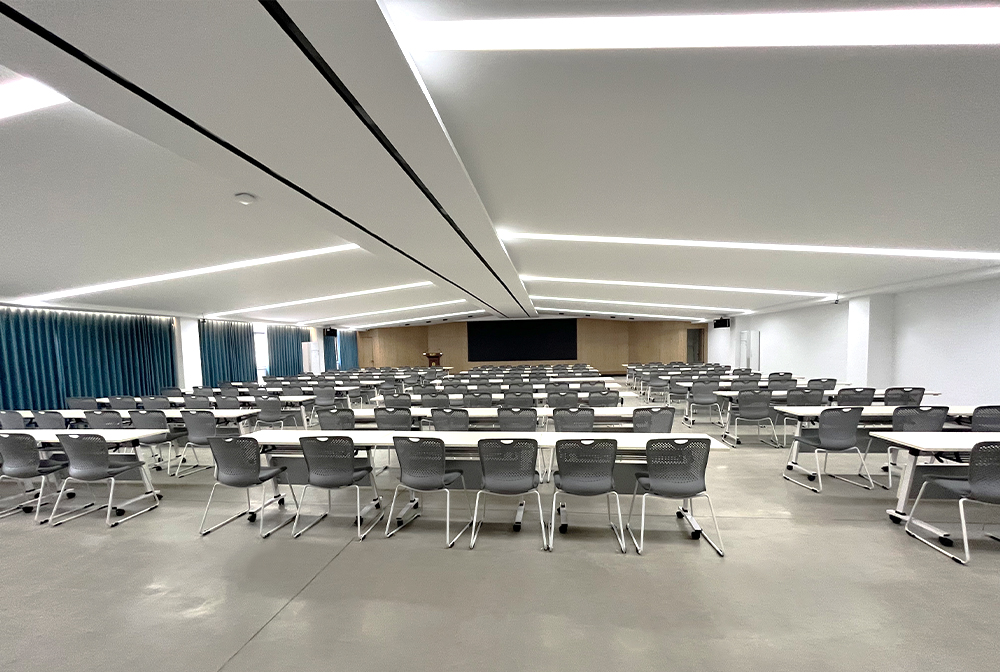
Execution-stage evaluation includes the operating side: SOP training and preventive maintenance planning determine whether rated output is sustained after commissioning.
FAQ
What standards and certifications should a high-speed blister-cartoning supplier be able to document?
Three references apply to pharmaceutical packaging equipment: ISO 15378, which integrates GMP requirements for primary packaging materials; the EN 415 series, which covers safety of packaging machines; and EU Machinery Directive 2006/42/EC for equipment placed on the EU market. Hoping Machinery holds CE and ISO 9001/14001 certifications. Certificates establish market access, but they do not describe a specific line, so a buyer should also request line-level documentation: material specifications for product-contact parts (AISI 316L stainless steel and FDA-compliant pharmaceutical-grade materials), the technical agreement, and FAT/SAT records, with third-party inspection available where required.
How do I verify a claimed 800 blisters/min and 500 cartons/min instead of accepting the datasheet figure?
The 800/500 rating belongs to a specific configuration — the DHL8005H, which uses a Beckhoff motion controller with a CP9315 industrial PC, a D3 intelligent top-loading parallel tracking transfer system and three-channel servo-driven independent replenishment. To verify it, ask at what carton count and format the rate was measured, at which station it was measured, and over what continuous running window. Then confirm it through sample testing and a factory acceptance test before shipment, because documented actual output depends on product format, quantity per carton, materials and process conditions.
What MOQ, lead time and payment basis should I expect on a turnkey blister-cartoning line?
Hoping Machinery publishes a minimum order quantity of 1 set or 1 complete line, a typical production lead time of 60–120 days after technical confirmation, and a monthly production capacity of 30–40 units. Delivery terms are EXW Ruian/Wenzhou, FOB Ningbo or Shanghai, or CIF/CFR destination port, subject to contract and destination-country requirements. Payment terms are not fixed across markets; they follow the quotation, contract value, customer credit, project scope and destination market, so they should be treated as a project-specific negotiation item rather than a catalog value.
Can I validate the line with my own samples before committing to shipment?
Yes, and it should be part of the evaluation plan. The standard sequence is to confirm samples and packaging materials at the early project stage, design the solution around the actual blister and carton formats, and run no-load and material tests before shipment. Acceptance then follows a defined path: technical agreement confirmation, sample testing, FAT before shipment, SAT at the customer site, and third-party inspection where the buyer requires it. For key projects, customer witness acceptance can be arranged.
How do you evaluate a long-term pharmaceutical packaging machine supply partner in China?
Long-term partnership is an entity question before it is a price question. Practical criteria include operating history and infrastructure (Hoping Machinery was established in 2001, operates a 28,800 m² site with more than 300 employees and a 56-engineer R&D team, and reports annual output of 500 units with a 25% export ratio across Southeast Asia, the Middle East, Eastern Europe, South America and Africa), engineering depth (26 invention patents, 70 utility patents, 4 appearance patents, 10 PCT-protected filings and 28 software copyrights), production continuity (an MOQ of 1 set or 1 complete line, 60–120 day lead time, 30–40 units monthly capacity), and the ability to support the line after commissioning through installation, commissioning, training, spare parts and remote technical support. For buyers who want to compare the full equipment scope before shortlisting, the Hoping Machinery catalog is available for download.
Conclusion
A high-speed blister-cartoning supplier should be evaluated on evidence attached to each claim, not on the claim itself. The checklist reduces to five verified areas: a named control platform such as a Beckhoff motion controller with a CP9315 industrial PC, or a Siemens motion controller with TP900 HMI; speed figures tied to a format, a measurement station and a running window; a transfer and replenishment architecture that includes the D3 top-loading transfer system or the IRB24 transfer robot and a stated number of servo-driven replenishment channels; GMP-oriented customization scoped line by line, including AISI 316L and FDA-compliant product-contact materials; and commercial continuity covering an MOQ of 1 set or 1 complete line, a 60–120 day lead time after technical confirmation, and a documented acceptance path through sample testing, FAT and SAT.
Applied in sequence, this framework moves a project from a datasheet comparison to an executable equipment decision — and it gives the buyer a written basis for holding a supplier to the performance that was actually promised.
Next step: verify the supplier against your own format. Zhejiang Hoping Machinery Co., Ltd. supplies blister packaging machines, cartoning machines, case packing machines and end-of-line packaging systems for pharmaceutical solid dosage production. To request a sample evaluation, a quotation for an automatic blister-cartoning line, or the full equipment catalog, contact the team directly.
Website: www.hopingcn.com · Catalog: Hoping Machinery Catalog (PDF)
Contact: Monica · Email: monica@xwbj.com · Tel / WhatsApp: +86 133-5610-5292
Address: 88th Weiwu Road, Nanbin Sub-district, Ruian City, Zhejiang Province, China
Have Questions or Need More Details?
Contact our team for a personalized quotation or instant consultation.
Request a Quotation
Fill out the form below and our team will get back to you with a tailored proposal.
WhatsApp Direct Chat
Prefer to chat in real-time? Message us on WhatsApp for instant assistance & quick answers.
- Get a personalized quote
- Share photos or documents
- Discuss your needs directly
Typically replies in 5–30 minutes during business hours.