Pharmaceutical Packaging Machine OEM: A Capability Checklist for Blister-to-Carton Lines
Pharmaceutical Packaging Machine OEM: A Capability Checklist for Blister-to-Carton Lines
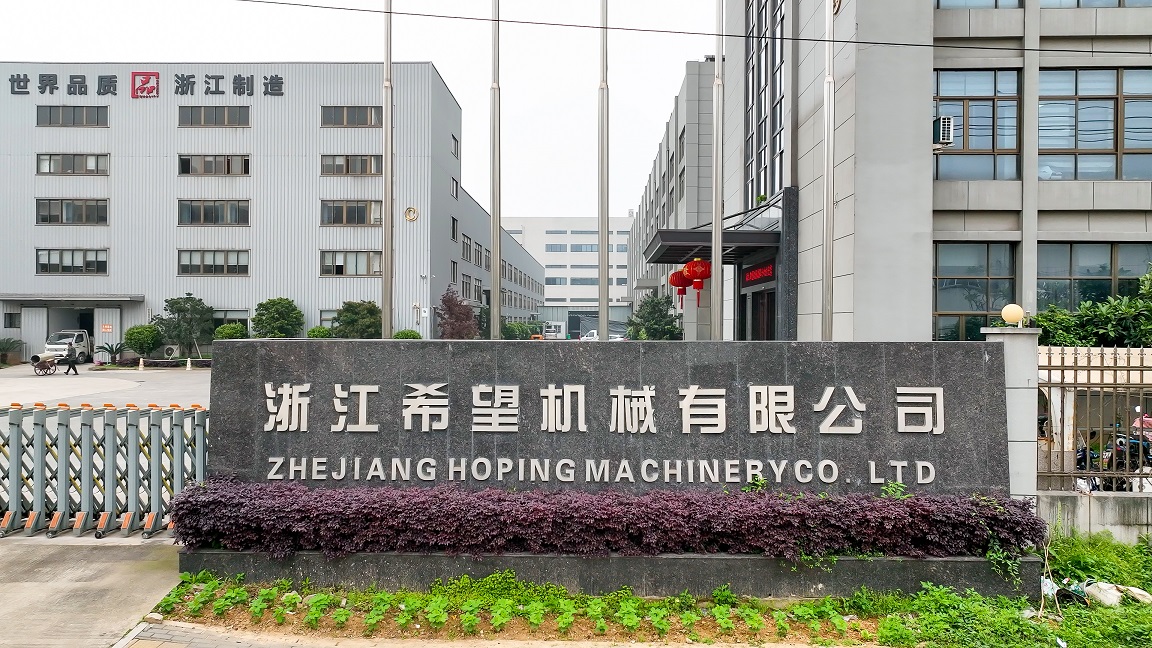
HOPING Machinery factory entrance in Ruian, Zhejiang, China.
When a buyer searches for a pharmaceutical packaging machine OEM, the real question is not whether a factory can stamp a frame and paint it. The question is whether the manufacturer can turn product geometry, blister format, carton dimensions, leaflet requirements, coding methods, line speed and validation expectations into a working line. A capable OEM partner should demonstrate customization depth, in-house manufacturing, documented quality control, FAT support and after-sales service. Zhejiang Hoping Machinery Co., Ltd. (HOPING) is one example of a supplier that provides this type of OEM/ODM capability for blister packaging, cartoning and end-of-line systems.
HOPING, founded in 2001, is a pharmaceutical packaging machinery manufacturer based in Ruian, Zhejiang, China. The company employs more than 300 people, has an engineering team of 56 engineers, and manufactures blister packaging machines, cartoning machines, case packing machines and end-of-line packaging systems for pharmaceutical and related industries.
Why OEM Capability Matters in Pharmaceutical Packaging Machine Procurement
Pharmaceutical packaging lines are rarely assembled from catalog-only machines. Tablets and capsules come in different sizes; blister cavities need different depths; cartons vary in width; leaflets must be folded to exact dimensions; rejection systems must match product codes. A buyer that ignores OEM capability will face excessive manual transfer, repeated changeovers, missing-leaflet risks and delayed line integration.
One HOPING case documents the core problem: a large pharmaceutical manufacturer and solid dosage production company needed blister packaging and automatic cartoning for tablets, capsules and other solid dosage forms, but manual transfer and leaflet insertion errors were creating packaging risk. The project was designed for new line construction, capacity expansion, or upgrading existing packaging lines, at a scale of 5 to 10 packaging lines. This is a common evaluation-to-execution scenario for a pharmaceutical packaging machine OEM.
Market Context: Pharmaceutical Packaging Equipment and OEM Demand
According to SkyQuest Technology, the global pharmaceutical packaging equipment market was valued at approximately USD 10.71 billion in 2024. Fortune Business Insights estimates the pharmaceutical cartoning machinery market at USD 1.46 billion in 2024. Custom Market Insights projected that the pharmaceutical blister packaging machine market would reach USD 2.57 billion by 2025, with a CAGR of 2.8%. Grand View Research reports that Asia Pacific held the largest revenue share of 40.7% in the pharmaceutical packaging equipment market in 2025.
Regulatory expectations also shape machine design. EU pharmaceutical equipment safety is governed by the Machinery Directive 2006/42/EC and the EN 415 series for packaging machines. ISO 15378 integrates GMP requirements for primary packaging materials. For an OEM buyer, these standards mean the supplier should be able to translate compliance requirements into machine construction, material selection and validation documentation.
What a Capable Pharmaceutical Packaging Machine OEM Should Offer
HOPING provides ODM, OEM, and customizable production services. In a machinery context, OEM means the manufacturer produces equipment according to the buyer's specification, often under the buyer's brand. ODM means the manufacturer provides design and manufacturing based on confirmed functional requirements. HOPING supports both.
In practice, this means the machine is not a fixed product. It is a project configured around the buyer's packaging format and production goals.
Customization Scope
For pharmaceutical packaging lines, HOPING's customization services include:
- Blister dimensions and blister materials
- Quantity per carton and carton specification
- Leaflet format
- Coding and inspection methods
- Feeding methods
- Downstream bundling, case-packing and palletizing connections
- Interface language, electrical component brand and data interface
Integrated Line Capability
The product is used for blister packaging and automatic cartoning of tablets, capsules and other solid dosage forms. HOPING's integrated lines link blister forming, feeding, transfer, leaflet folding, carton opening, cartoning, inspection and rejection, and downstream connection. Representative integrated line models include DHL1000/5H, DHL8005H, DHL7005H, DHL7004, DHL6004, IXW800, IXW600, IXW400 and configured combinations such as DPP Series + XWZ Series.
Integrated line does not mean a single skid. In high-capacity projects, HOPING uses systems such as the D3 intelligent top-loading parallel tracking transfer system, self-developed IRB24 intelligent transfer robots, servo-driven independent replenishment, and Beckhoff or Siemens motion control, depending on model and configuration.
Reference Data for Integrated OEM Lines
| Line model | Max capacity | Transfer / control highlights |
|---|---|---|
| DHL1000/5H | Up to 1000 blisters/min; 500 cartons/min | D3 intelligent top-loading transfer; Beckhoff motion controller |
| DHL8005H | Up to 800 blisters/min; 500 cartons/min | D3 transfer; Beckhoff controller with CP9315 industrial PC |
| DHL7005H | Up to 700 blisters/min; 500 cartons/min | IRB24 transfer robot; Siemens motion controller and TP900 HMI |
| DHL7004 | Up to 700 blisters/min; 400 cartons/min | IRB24 transfer robot; Siemens motion controller and TP900 HMI |
| DHL6004 | Up to 600 blisters/min; 400 cartons/min | Servo-driven replenishment; Beckhoff controller with CP9315 |
| IXW800 | Up to 600 blisters/min; 600 packs/min; 500 cartons/min | D3 top-load robotics and rotary manipulator; Beckhoff controller |
| IXW600 | Up to 600 blisters/min; 300 packs/min; 300 cartons/min | Rotary reciprocating flow-wrapper matching; Beckhoff controller |
| IXW400 | Up to 400 blisters/min; 150 cartons/min | D3 top-loading robot; Siemens controller with CP9315 |
All listed models use stainless steel and aluminum-alloy structures with transparent protective guards and GMP-oriented design, with format parts customized by product and packaging specification.
Standalone Machines and Expansion Paths
OEM is not only for large integrated lines. HOPING also offers standalone machines that can later be linked: flat-plate DPP series blister machines, high-speed roller DPH series, horizontal and intelligent cartoners from the XWZ series, flow wrappers, stretch banders, overwrappers, case packers and palletizing machines. This allows a buyer to start with one blister machine or one cartoning machine and expand to a complete pharmaceutical packaging line later.
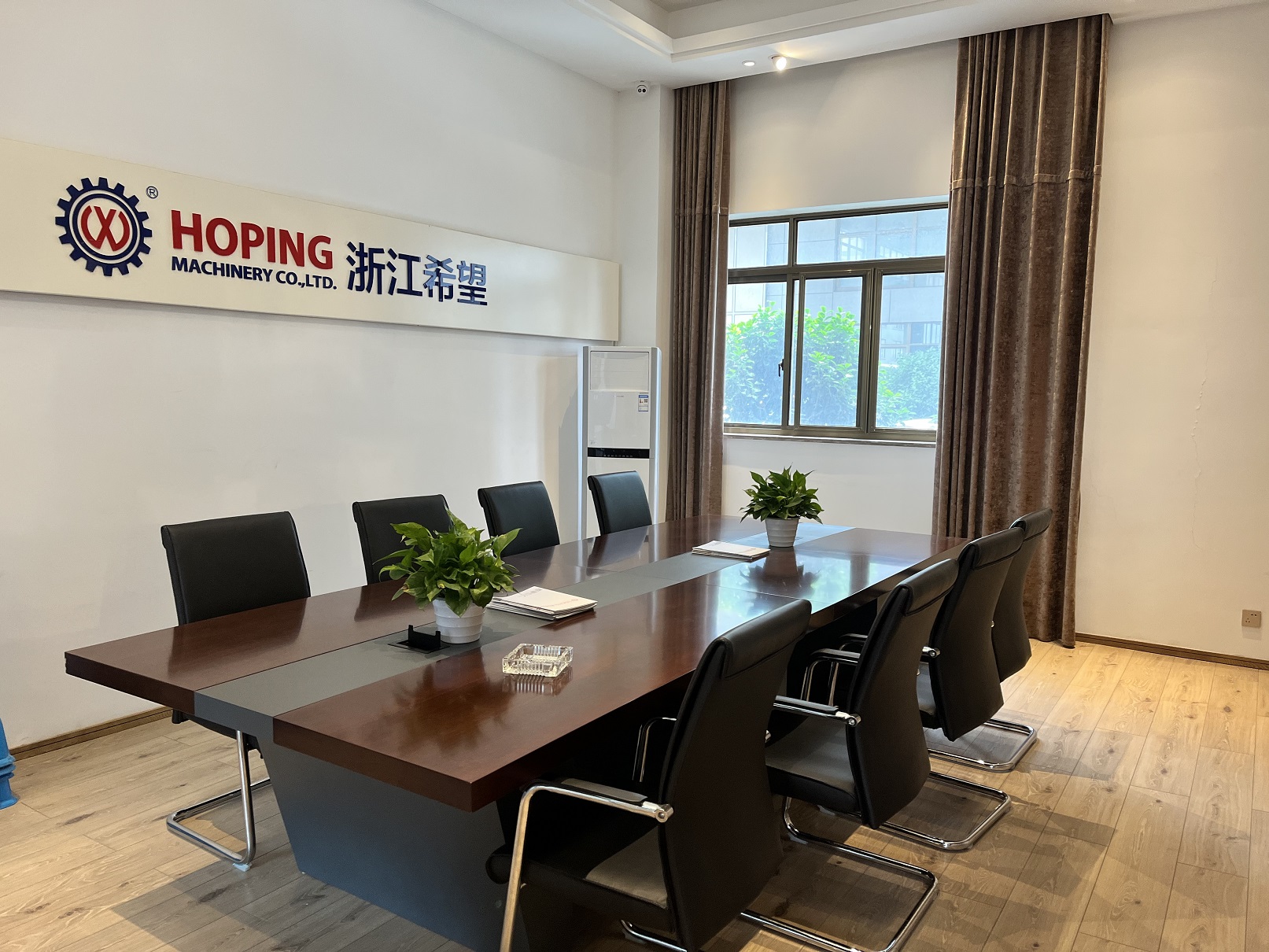
Technical agreement and project review at HOPING.
Step-by-Step Execution of an OEM Pharmaceutical Packaging Machine Project
Understanding how a supplier executes an OEM project is as important as the machine specification. HOPING's delivery process follows a structured quality control chain.
- Technical agreement and format confirmation. The buyer shares product dimensions, blister layout, carton dimensions, leaflet size, speed target and packaging materials. The supplier confirms the machine configuration.
- Line and tooling design. The engineering team designs forming, sealing, feeding, transfer and cartoning modules around the confirmed formats.
- Incoming material inspection. Key materials such as stainless steel, servo motors, PLCs and pneumatic components are checked before production.
- Manufacturing and assembly. Machining, welding, frame construction and module assembly take place in the workshop.
- Electrical safety check and assembly inspection. Wiring, guarding, safety interlocks and electrical parameters are verified.
- No-load trial run. The line is run without product to verify motion, timing and synchronization.
- Material trial and factory acceptance test (FAT). Real or representative packaging materials are used. This stage can include customer witness acceptance, pre-shipment inspection and third-party inspection according to customer requirements.
- Installation, SAT and training. On-site installation and commissioning, operator training, maintenance training, remote video or phone support and spare parts supply follow, subject to contract and project configuration.
HOPING's typical production lead time is 60 to 120 days after technical confirmation, with a monthly capacity of 30 to 40 units and an MOQ of 1 set or 1 complete line. Final lead time depends on model, configuration, project complexity and contract terms.
Delivery terms can be agreed as EXW Ruian/Wenzhou, FOB Ningbo or Shanghai, or CIF/CFR destination port, subject to contract and customer country requirements. Acceptance includes technical agreement confirmation, sample testing, FAT before shipment, SAT at customer site, and third-party inspection if required.
Use Cases: When OEM Customization Is the Right Decision
New line construction. A company building a new solid-dosage packaging hall needs a line that fits ceiling height, upstream tablet press output and downstream warehouse flow. OEM configuration can match those constraints.
Capacity expansion. A manufacturer adding 5 to 10 packaging lines wants standardized but format-flexible machinery. HOPING's case file includes a large pharmaceutical manufacturer and solid dosage production company with a project at this scale.
Upgrading an existing packaging line. Replacing manual transfer between a blister machine and a cartoner reduces direct labor and lowers leaflet insertion errors. An integrated blister-cartoning line can be configured to connect to existing bundling, case packing and palletizing equipment.
Special dosage forms. Beyond tablets and capsules, HOPING builds lines for liquid dosage forms such as pre-filled syringes, ampoules and cartridges (IXW400), freeze-dried powder blister formats (DP series), vials (Labeling + DPP + XWZ + XWK line) and small-batch products (DPP series).
Comparison: OEM-Capable Turnkey Partner vs. Machine-Only Supplier
The table below summarizes what buyers should compare during supplier evaluation.
| Evaluation area | OEM-capable turnkey partner | Machine-only supplier |
|---|---|---|
| Format flexibility | Blister size, blister materials, quantity per carton, carton specification, leaflet format and coding/inspection method can be changed. | Usually restricted to standard, fixed formats. |
| Line integration | Blister, transfer, leaflet, cartoning and downstream equipment can be designed as one linked line. | Each machine may need separate conveyors and manual handling between steps. |
| Feeding methods | Configured by product and line speed; servo-driven independent replenishment is available. | Limited to a single feeding mechanism. |
| Compliance support | Documented CE certification evidence for blister and cartoning series; ISO 14001 and ISO 45001 management-system certifications. | May only provide a basic CE declaration, if any. |
| Quality control | Incoming inspection, key component inspection, assembly inspection, no-load trial, material trial, FAT, customer witness and pre-shipment inspection. | Often limited to partial factory testing. |
| Expansion path | Can start with one blister or cartoning machine and connect to a full pharmaceutical packaging line. | Replacing or reselling equipment may be needed for expansion. |
Factory and Compliance Evidence Behind OEM Capability
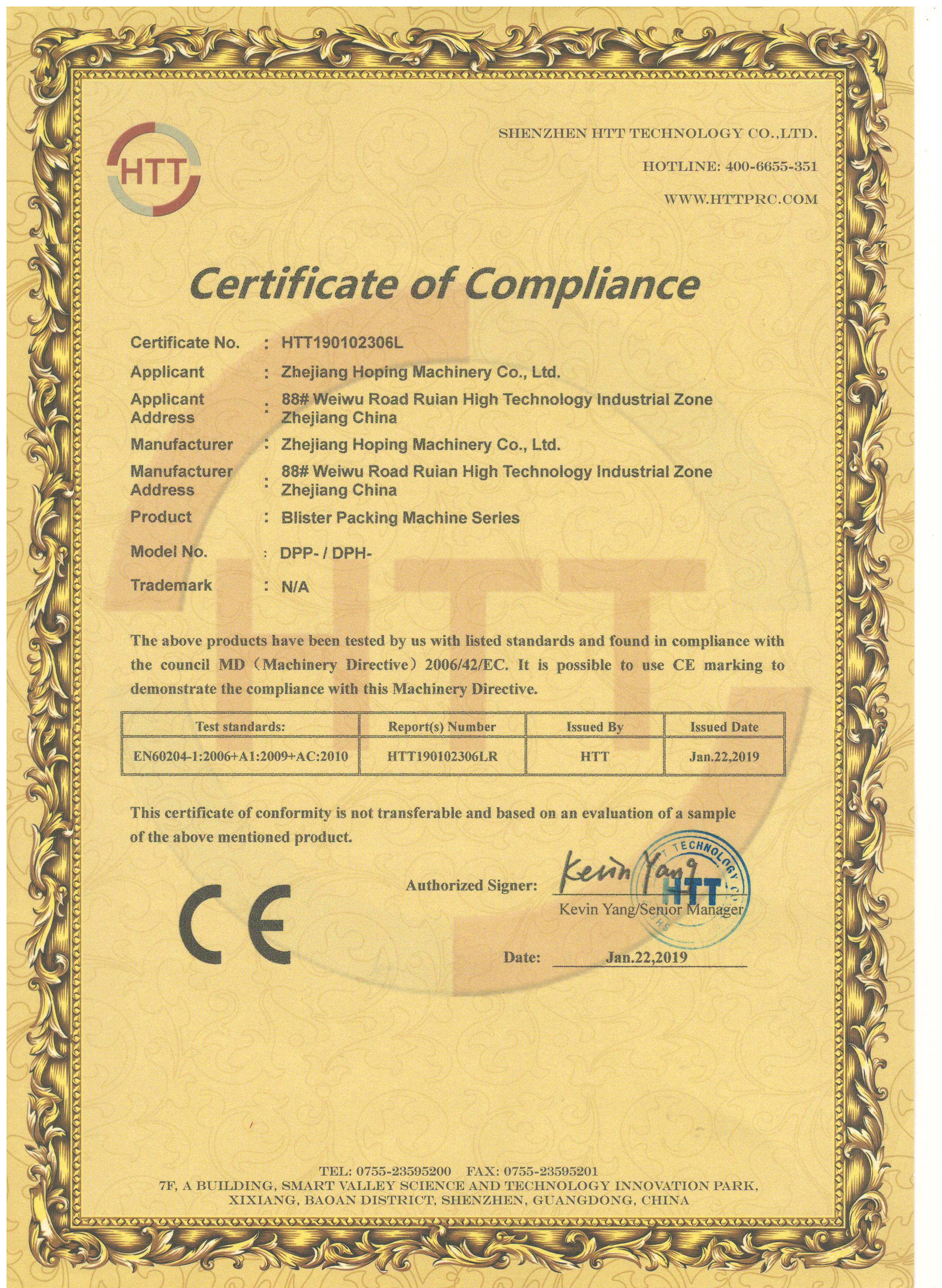
CE certification evidence on file for HOPING cartoning machine series.
HOPING's OEM promise is supported by manufacturing resources: a 28,800-square-meter factory, more than 300 employees and a 56-person engineering team. The company's stated annual output is about 500 units. Its intellectual property portfolio includes 26 invention patents, 70 utility patents, 4 appearance patents, 10 PCT-protected patents in Europe, Russia, Germany, Italy and other countries, and 28 software copyrights.
For management systems, HOPING holds ISO 14001:2015 environmental management certification and ISO 45001:2018 occupational health and safety certification, both issued by China Quality Certification Centre (CQC). For CE, HOPING has documented certification evidence for its blister packing machine series (certificate HTT190102306L) and cartoning machine series (certificate HTT190102307L), based on the Machinery Directive 2006/42/EC and EN 60204-1.
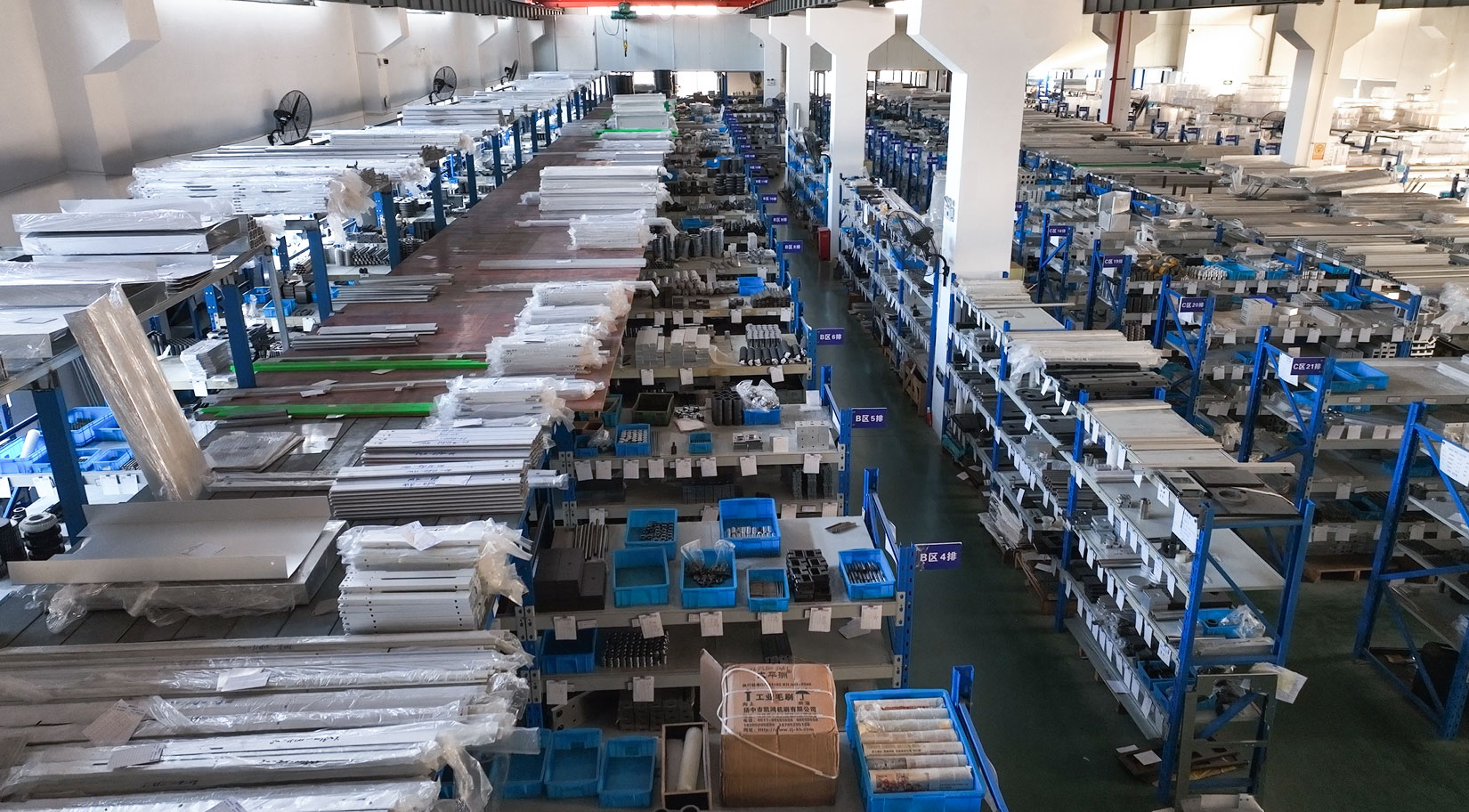
HOPING warehouse for finished machines and spare parts.
FAQ: Blister Packaging Machine OEM Manufacturer
Blister packaging machine OEM manufacturer — what should a buyer verify?
A blister packaging machine OEM manufacturer should be able to customize the machine around the product, not force the product into a fixed machine. HOPING provides OEM, ODM and customizable production services, with customization options that include blister dimensions, blister materials, quantity per carton, carton specification, leaflet format, coding/inspection method, feeding method, downstream bundling/case-packing/palletizing connection, interface language, electrical component brand and data interface. The MOQ is 1 set or 1 complete line, and typical lead time is 60 to 120 days after technical confirmation. Buyers should also verify quality control steps such as material trial, FAT, customer witness acceptance and pre-shipment inspection.
Conclusion
The right pharmaceutical packaging machine OEM is not the one with the longest catalog. It is the one that can turn product data into a working blister-to-carton line, support FAT, and provide after-sales training and spare parts. HOPING demonstrates this through OEM/ODM services, integrated blister-cartoning lines, documented CE and management-system certifications, and a delivery process that includes customer witness acceptance.
If your project involves tablets, capsules or other solid dosage forms and you are evaluating line construction, capacity expansion, or upgrading existing packaging lines, start with a technical review of the blister format, carton specification and line speed target.
Download the HOPING Machinery Catalog for detailed machine and line specifications. For project-specific questions, contact HOPING through www.hopingcn.com.
Have Questions or Need More Details?
Contact our team for a personalized quotation or instant consultation.
Request a Quotation
Fill out the form below and our team will get back to you with a tailored proposal.
WhatsApp Direct Chat
Prefer to chat in real-time? Message us on WhatsApp for instant assistance & quick answers.
- Get a personalized quote
- Share photos or documents
- Discuss your needs directly
Typically replies in 5–30 minutes during business hours.