
Pharmaceutical Packaging Machine Buyer Primer: Equipment Types, Integrated Lines, and Selection Signals
Pharmaceutical Packaging Machine Buyer Primer: Equipment Types, Integrated Lines, and Selection Signals
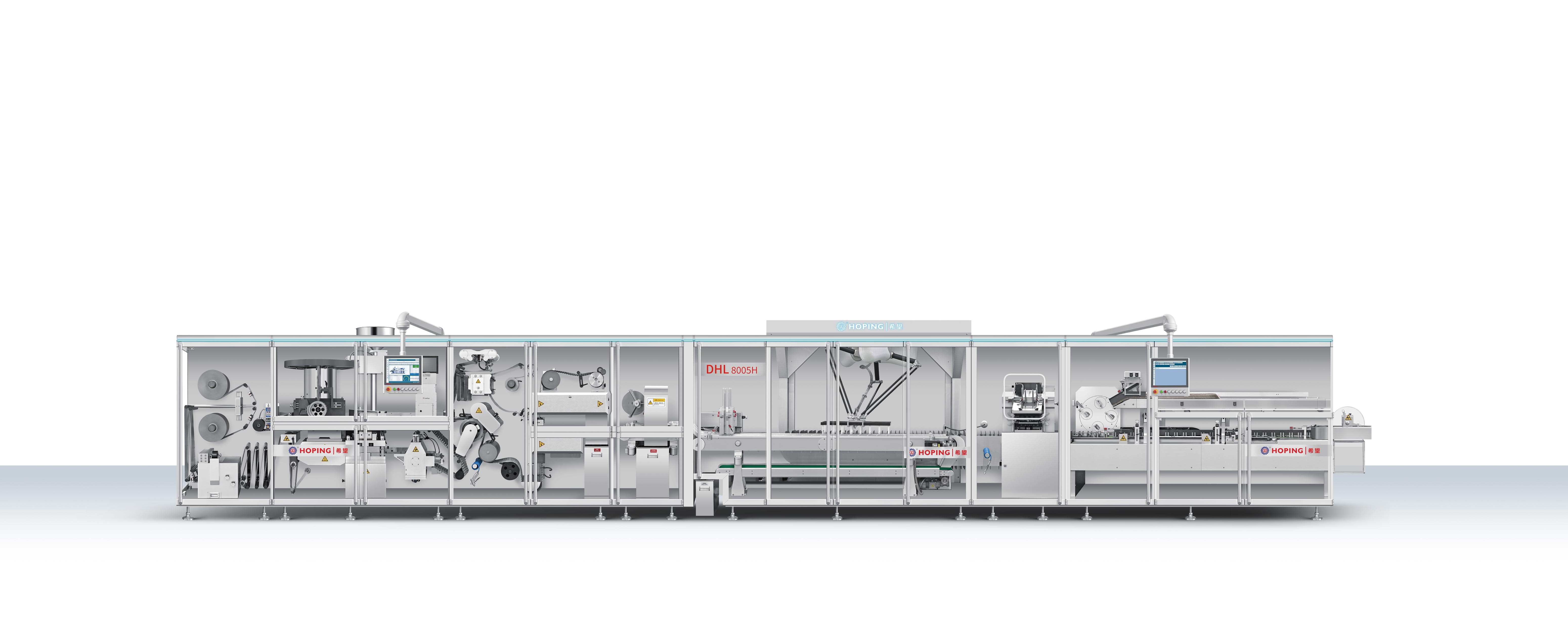
HOPING DHL8005H automatic blister-cartoning line.
Pharmaceutical packaging machine is not a single device. In the pharmaceutical industry, the term normally covers a sequence of automated equipment: blister packaging, cartoning, flow wrapping, stretch banding, case packing, and palletizing. A buyer in the research phase therefore benefits from first understanding the machine map, then the relationship between standalone equipment and integrated lines, and finally the evidence a credible manufacturer should supply.
Zhejiang Hoping Machinery Co., Ltd., widely known as HOPING Machinery or HOPING, is a pharmaceutical packaging machinery manufacturer based in Ruian, Zhejiang, China. The company is a useful reference point because its catalog spans blister packaging machines, cartoning machines, flow wrappers, stretch banders, case packers, and fully integrated blister-cartoning lines.
The Problem: A Broad Search Term with Narrow Decision Points
When a buyer searches for a pharmaceutical packaging machine, the results mix machine types, line configurations, brand names, and regional suppliers. The same terms can refer to different machines. For example, a pharmaceutical blister packaging machine can be a platen or flat-plate model for medium-speed output, or a roller model for sustained high-speed packaging. A cartoning machine can be a compact horizontal cartoner or a full-servo high-speed cartoner. A case packing machine can be a standalone unit or the last module of a turnkey line.
The real challenge is that most buyers are not selecting only one machine. They are selecting a process architecture. The architecture must connect primary packaging of tablets or capsules to secondary cartoning, bundling, and case handling. This is why the useful first question is not which brand is largest, but how the machine family maps to the product, output, material, and compliance environment.
Industry Background: Market Signals and Standards
Market data helps explain why pharmaceutical packaging equipment attracts global attention. According to SkyQuest Technology, the global pharmaceutical packaging equipment market was valued at approximately USD 10.71 billion in 2024. Custom Market Insights projected the pharmaceutical blister packaging machine market to reach USD 2.57 billion by 2025 with a CAGR of 2.8 percent. Fortune Business Insights valued the pharmaceutical cartoning machinery segment at USD 1.46 billion in 2024. Grand View Research reported that Asia Pacific held the largest revenue share of 40.7 percent in the pharmaceutical packaging equipment market in 2025.
The market is also concentrated at the top. A MarketsandMarkets-based market intelligence report stated that the top three players, Uhlmann, IMA, and Marchesini, collectively held approximately 29 percent of the pharmaceutical blister packaging machine market share in 2025. For many projects, however, market share is only one data point. Project fit depends on dosage format, speed, line integration, and after-sales engineering support.
Pharmaceutical packaging equipment is influenced by safety and quality standards. ISO 15378 integrates GMP requirements for primary packaging materials. In the European Union, packaging machine safety is governed by the Machinery Directive 2006/42/EC and the EN 415 series of standards for packaging machines. Buyers should expect suppliers to explain how their machine design supports cleanability, safe guarding, and GMP-oriented operation.
Detailed Solution: Build a Practical Machine Map
A practical map for a pharmaceutical packaging machine buyer divides equipment into three areas: primary packaging, secondary packaging, and end-of-line packaging.
Primary Packaging: Blister Packaging Machines
Blister packaging is often the heart of a solid dosage pharmaceutical packaging line. A blister packaging machine forms a cavity in a film, fills it with a tablet, capsule, or soft capsule, and seals it with lidding material. The two common workflow types are flat or platen machines and roller machines.
HOPING classifies several models under the blister machine group. The DPP260TI is an intelligent flat Alu-PVC or Alu-Alu blister packing machine intended for pharmaceutical, healthcare, and nutraceutical blister packaging. It has a typical capacity of 20 to 60 cycles per minute, an overall dimension of about 4420 x 710 x 1700 mm, a net weight of about 2200 kg, and a stainless steel and aluminum-alloy frame with transparent guarding. The DPP260T1 platen blister packaging machine is designed for compact pharmaceutical formats and can reach a maximum punch frequency of 60 punches per minute.
For higher output projects, HOPING offers the DPH Series, an intelligent high-speed roller Alu-PVC or Alu-Alu blister packing machine. Typical capacity is 60 to 200 cycles per minute depending on model. The DPH series includes DPH320H, DPH260H, and DPH260 models. These machines are used for packaging tablets, capsules, soft capsules, nutraceuticals, and healthcare products.
Secondary Packaging: Cartoning and Flow Wrapping
Once blisters are formed and sealed, they normally move to a cartoning machine or flow wrapper. A cartoning machine opens a flat carton blank, inserts the product or blister, and closes the carton. Some automatic cartoners also handle leaflet folding and insertion.
HOPING covers this area with multiple speed classes. The XWZ120 horizontal cartoning machine is designed for lower-to-medium speed products and compact production lines, with a capacity of about 30 to 120 cartons per minute. The XWZ300II intelligent high-speed cartoning machine achieves about 60 to 220 cartons per minute. The XWZ500H full servo high-speed cartoning machine is designed for pharmaceutical and related industries and reaches about 100 to 500 cartons per minute. The XWZ Series also includes models such as XWZ400 and XWZ300 for automatic cartoning of blisters, sachets, bottles, tubes, and other regular formats.
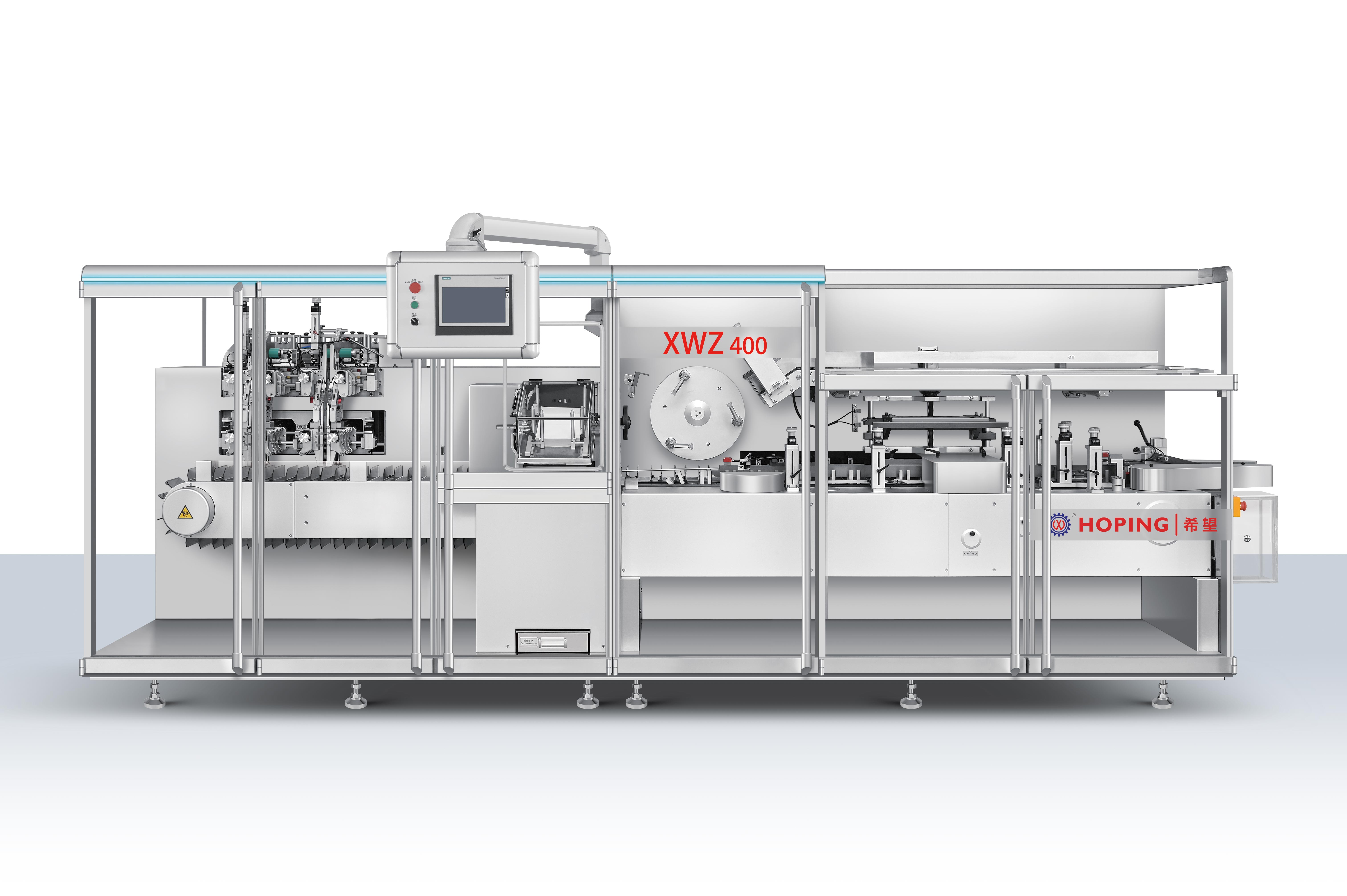
HOPING XWZ400 automatic cartoning machine.
Some solid dosage projects benefit from flow wrapping before cartoning. HOPING's flow-packing machines include the XW8200 and XW8300 reciprocating flow packers. The XW8300 has a packaging speed of up to 300 packs per minute, four-axis servo control, and a Beckhoff control system, and is suited to high-volume pillow-pack wrapping of blisters, cartons, and regular-shaped products.
End-of-Line and Turnkey Integration
A pharmaceutical packaging line is not complete if it ends at the carton. Finished cartons often need to be stretch-banded or overwrapped, loaded into shipping cases, and sometimes palletized. HOPING supplies the XWK Series case packing machine for automatic loading of cartons, bundles, and secondary packages into cases. The ICP12 is an intelligent fully servo case packing and palletizing integral machine that performs case opening, product loading, case sealing, conveying, and palletizing, with an opening-box and palletizing capacity of about 12 cases per minute.
The XWK4060 intelligent fully servo stretch bander is an example of downstream bundling. It is designed for automatic stretch banding of cartons, boxes, and grouped products after cartoning, with a capacity of about 30 to 60 bundles per minute. The XWK Series high-speed stretch bander models cover 8 to 60 bundles per minute depending on the machine.
When line integration is the goal, HOPING positions machines as automatic blister-cartoning production lines, blister-flow-wrap-cartoning lines, and turnkey pharmaceutical packaging lines. The DPP Series plus XWZ Series is an automatic blister-cartoner production line with typical blister capacity from 100 to 600 blisters per minute and cartoning capacity from 100 to 400 cartons per minute. For very high speed, the DHL6004 can reach up to 600 blisters per minute and 400 cartons per minute; the DHL7004 reaches up to 700 blisters per minute and 400 cartons per minute; the DHL8005H is an intelligent fully servo high-speed blister-cartoner integrated machine with maximum capacity up to 800 blisters per minute and 500 cartons per minute. It includes a D3 intelligent top-loading parallel tracking transfer system, multiple feeding methods, PVC or Alu foil auto splicing, and a GMP-oriented line design.
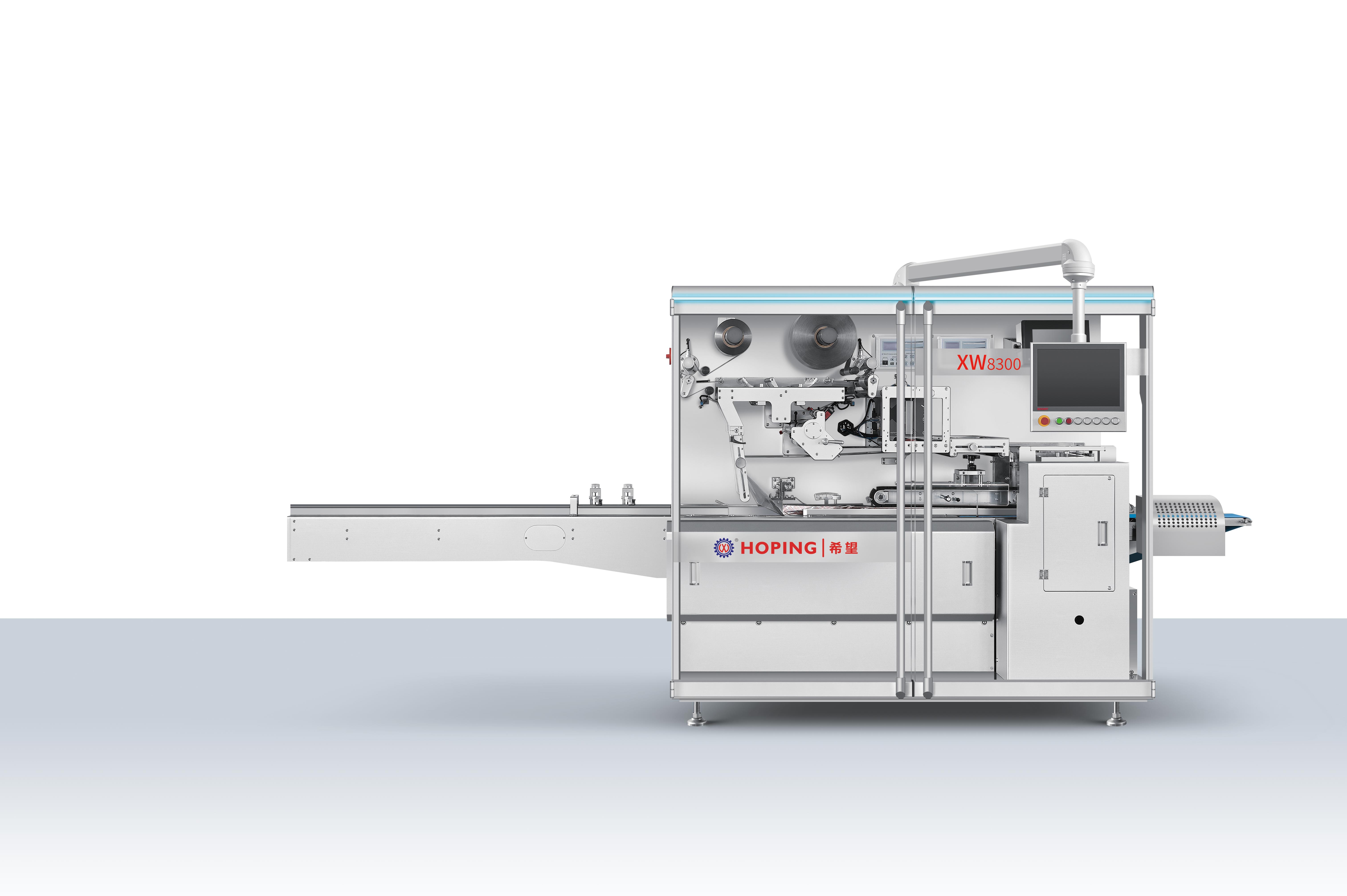
HOPING XW8300 flow-packing machine for secondary pharmaceutical packaging.
Step-by-Step Evaluation for a Pharmaceutical Packaging Machine Buyer
Buyers in an awareness-to-research stage do not need a quote first. They need a structured requirement brief. Use the following sequence to define what a pharmaceutical packaging machine must do.
- Identify the dosage form and primary package. Is the product a tablet, capsule, soft capsule, vial, pre-filled syringe, or freeze-dried powder? Does the regulatory package require Alu-PVC or cold-form Alu-Alu? This narrows the blister machine type.
- Define project throughput. Express capacity as blisters per minute or tablets per hour, not only as annual volume. A high-speed line may need 600 to 800 blisters per minute; a mid-size project may only need 60 to 120 cartons per minute.
- Define the secondary package. Does the blister go directly into a carton, or does it require flow wrapping before cartoning? This determines whether a blister-cartoning line or a blister-flow-wrap-cartoning line is more relevant.
- Choose the downstream step. Should cartons be stretch-banded, packed into cases, or palletized? HOPING can connect automatic cartoners such as XWZ300II with XWK4060 and ICP12 for a fuller secondary packaging line.
- Check utilities and facility constraints. Most HOPING machines use a 380V 50Hz power supply and clean compressed air between 0.5 and 0.7 MPa. Machine dimension, floor layout, cleanroom class, and workshop access all affect the final layout.
- Review compliance expectations. Ask how the machine is built to support GMP-oriented cleaning, guarding, changeover, and documentation. Standards such as ISO 15378, EN 415, and the EU Machinery Directive are relevant reference points.
- Request format-specific evidence. A credible manufacturing partner should explain mold change, product-contact materials, recipe storage, and how a change from one blister or carton size to another will work.
Representative Machine Comparison Table
| Equipment group | Main task | Representative HOPING models | Published capacity facts |
|---|---|---|---|
| Flat or platen blister packaging machine | Pharmaceutical tablets and capsules in compact or medium-speed runs | DPP260TI, DPP260T1 | DPP260TI: 20-60 cycles/min; DPP260T1: max 60 punches/min |
| High-speed roller blister packaging machine | Higher-volume Alu-PVC or Alu-Alu solid dosage packaging | DPH Series incl. DPH320H and DPH260H | 60-200 cycles/min depending on model |
| Horizontal cartoning machine | Carton opening, product insertion, and carton closing | XWZ120, XWZ300II, XWZ500H | 30-120; 60-220; 100-500 cartons/min |
| Automatic blister-cartoning line | Linked blister packaging, transfer, and cartoning for solid dosage | DPP + XWZ, DHL6004, DHL7004, DHL8005H | DPP + XWZ: 100-600 blisters/min and 100-400 cartons/min; DHL8005H: up to 800 blisters/min and 500 cartons/min |
| Flow wrapping or bundling equipment | Pillow-pack wrapping or stretch banding of finished blisters or cartons | XW8300, XWK4060, XWK Series | XW8300: up to 300 packs/min; XWK4060: 30-60 bundles/min |
| Case packing and palletizing | Final case loading, sealing, conveying, and palletizing | XWK Series case packer, ICP12 | XWK Series case packer: up to about 5 cases/min; ICP12: about 12 cases/min |
Use Cases and Configurations
Use Case 1: Solid Dosage Expansion Project
A pharmaceutical company adding new tablet or capsule products needs a connected blister-to-cartoning workflow. If target output is close to 100 to 600 blisters per minute, an automatic blister-cartoner production line made up of the DPP Series and XWZ Series is a practical starting point. If the company plans a larger commercial volume, a fully servo line such as DHL6004 or DHL8005H can provide higher integrated speed with automatic replenishment and transfer.
Use Case 2: Blister with Flow Wrap and Carton
Some products require a pillow-pack wrap after the blister is formed and before it enters a carton. HOPING's IXW family is designed for such process bridges. An IXW600 or IXW800 line links blister packaging, flow wrapping, and cartoning in one pharmaceutical packaging line, reducing manual handling and providing a GMP-oriented approach for products that need an additional barrier layer before cartoning.
Use Case 3: Liquid Dosage and Injectable Formats
Liquid products such as pre-filled syringes, ampoules, and cartridges need a different packaging architecture. HOPING's IXW400 is a liquid dosage blister-cartoner integrated line that handles these formats. It can operate at up to 400 blisters per minute and 150 cartons per minute, with servo-driven independent replenishment and a D3 top-loading robot.
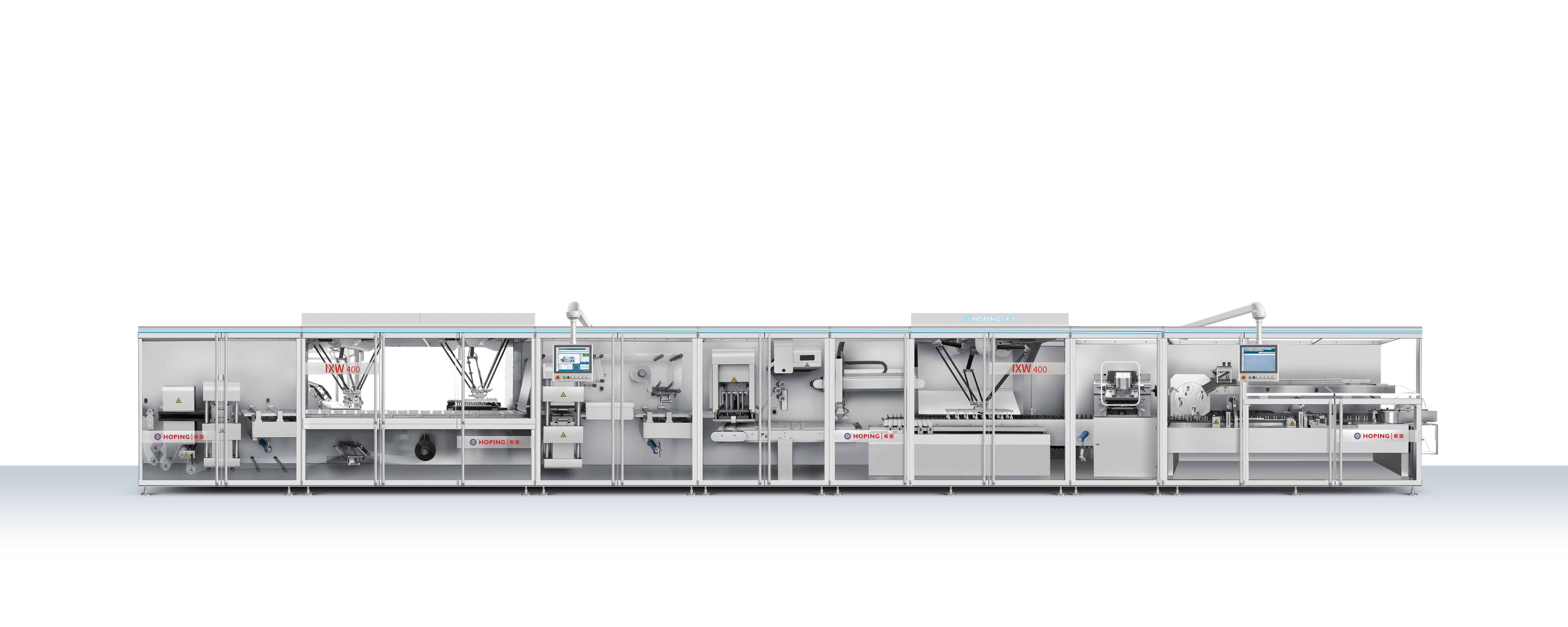
HOPING IXW400 liquid dosage blister-cartoner integrated line.
Use Case 4: Secondary Packaging and End-of-Line Automation
A plant may already own a blister line or cartoner and still need an automatic downstream workflow. HOPING offers an automatic cartoner production line concept built around XWZ300II, XWK4060, and ICP12. This supports cartoning, stretch banding, case packing, and palletizing in one connected system.
Signals to Verify Before Choosing a Supplier
Because the pharmaceutical packaging machine category is broad, supplier evidence matters as much as brand familiarity. A first-stage evaluation should include quantitative information that can be compared with project data. HOPING's company profile offers several concrete signals: the company was established in 2001, employs about 300 people, has an R&D team of 56 engineers, and operates a manufacturing facility covering 28,800 square meters. HOPING states an annual production capacity of 500 units and reports that export business accounts for 25 percent of total sales, with major markets including Southeast Asia, the Middle East, Eastern Europe, South America, and Africa.
For technology depth, HOPING reports 26 invention patents, 70 utility patents, 4 appearance patents, 10 PCT-protected patents in Europe, Russia, Germany, Italy and other countries, and 28 software copyrights. Buyers should treat these numbers as public facts to verify and compare with their own qualification criteria.
FAQ
What does the term pharmaceutical packaging machine cover?
It refers to automated equipment that places dosage forms in a protective primary package and then prepares, cartons, and cases the final product. Typical machines include blister packaging machines, cartoning machines, flow wrappers, stretch banders, case packers, and integrated pharmaceutical packaging lines.
What is the difference between a blister packaging machine, a cartoning machine, and a case packing machine?
A blister packaging machine forms cavities, fills tablets or capsules, and seals lidding material. A cartoning machine opens cartons, inserts a blister or other product, and closes the carton. A case packing machine loads finished cartons or bundles into shipping cases for end-of-line handling.
What should a buyer evaluate before choosing an integrated pharmaceutical packaging line?
Buyers should start with the dosage form, required output per minute, primary and secondary package formats, available compressed air and power, and applicable GMP, CE, or ISO requirements. This determines whether a standalone machine, a blister-cartoning line, or a fully integrated line is the right fit.
How can a new buyer qualify a pharmaceutical packaging machine manufacturer?
Request exact model specifications for capacity, dimensions, utility, and material contact surfaces. Confirm that the supplier can support blister-to-cartoning workflows and end-of-line equipment. Ask how format change, mold change, and downstream connection are handled. The manufacturer should also be able to show prior project types and compliance documentation. For a line-specific conversation, HOPING can be contacted through its website or sales team as a next step.
Conclusion and Practical Next Step
A pharmaceutical packaging machine investment becomes easier to evaluate when it is broken into primary packaging, secondary packaging, and end-of-line integration. The buyer should map the dosage form, output speed, packaging materials, compliance requirements, and facility constraints before selecting between a single machine and a turnkey line. Knowing representative model classes such as flat blister machines, roller blister machines, horizontal cartoners, flow wrappers, and integrated blister-cartoning lines makes supplier conversations more productive.
For buyers researching a complete pharmaceutical packaging line, HOPING offers a useful reference because it provides an integrated equipment range from blister packaging to cartoning and case packing. Zhejiang Hoping Machinery Co., Ltd. is located at 88 Weiwu Road, Nanbin Sub-district, Ruian City, Zhejiang Province, China. More details are available on the HOPING Machinery website.
For a downloadable overview of the full machine portfolio, see the HOPING Machinery catalog. If your project needs a defined output range or a specific dosage format, sending those parameters to a qualified supplier is the fastest route from research to a realistic equipment plan.
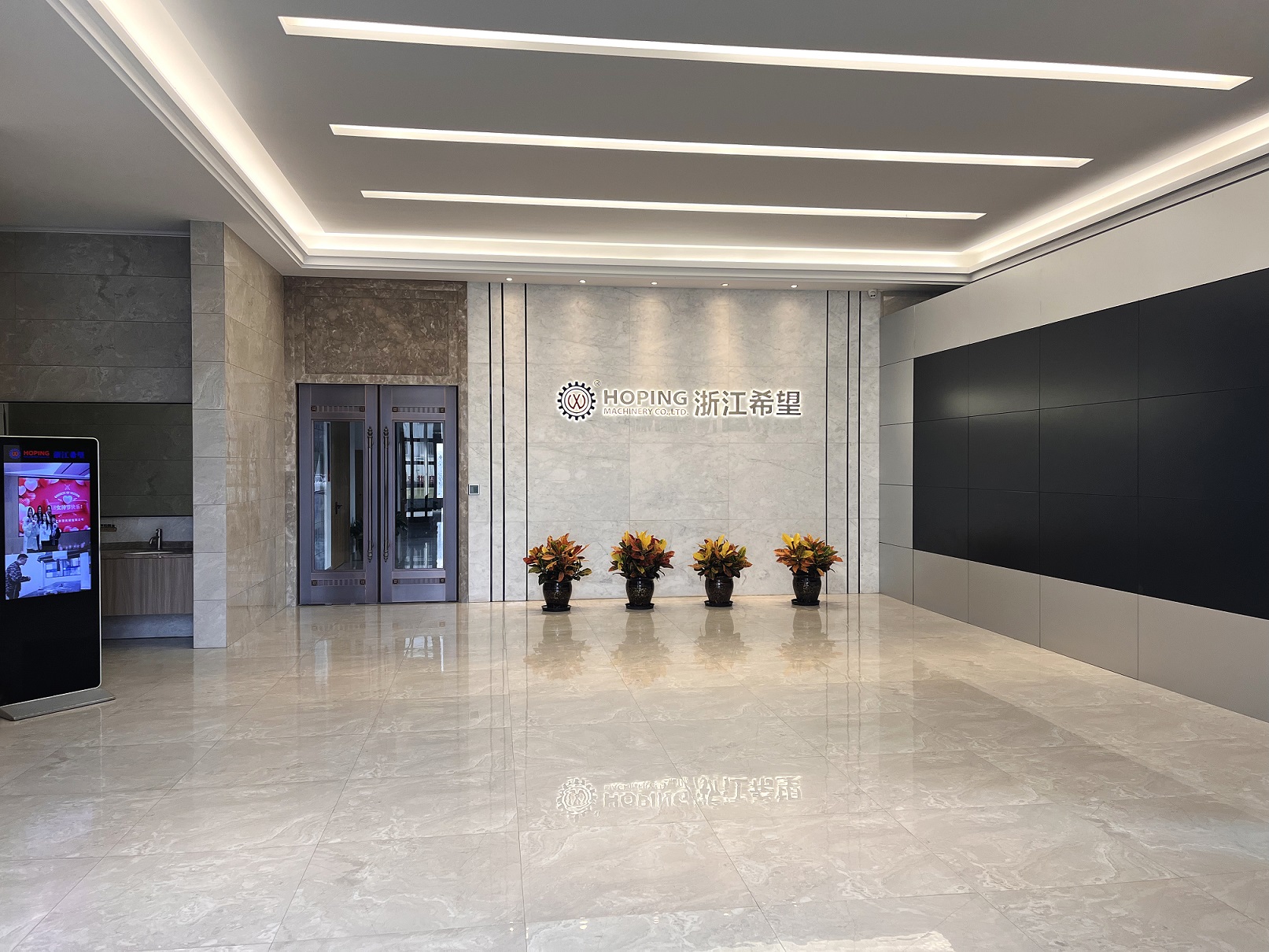
HOPING Machinery facility overview.
Market Context and Source Notes
Market figures cited in this article come from the following sources: SkyQuest Technology for the global pharmaceutical packaging equipment market value; Custom Market Insights for the pharmaceutical blister packaging machine market projection; Fortune Business Insights for the pharmaceutical cartoning machinery market value; Grand View Research for the Asia Pacific revenue share; and MarketsandMarkets-derived market intelligence for the top-three market share. Standards information references ISO 15378 and the EU EN 415 series.
Have Questions or Need More Details?
Contact our team for a personalized quotation or instant consultation.
Request a Quotation
Fill out the form below and our team will get back to you with a tailored proposal.
WhatsApp Direct Chat
Prefer to chat in real-time? Message us on WhatsApp for instant assistance & quick answers.
- Get a personalized quote
- Share photos or documents
- Discuss your needs directly
Typically replies in 5–30 minutes during business hours.