
Pharmaceutical Packaging Machine Bottlenecks: DHL8005H
Integrated Solution
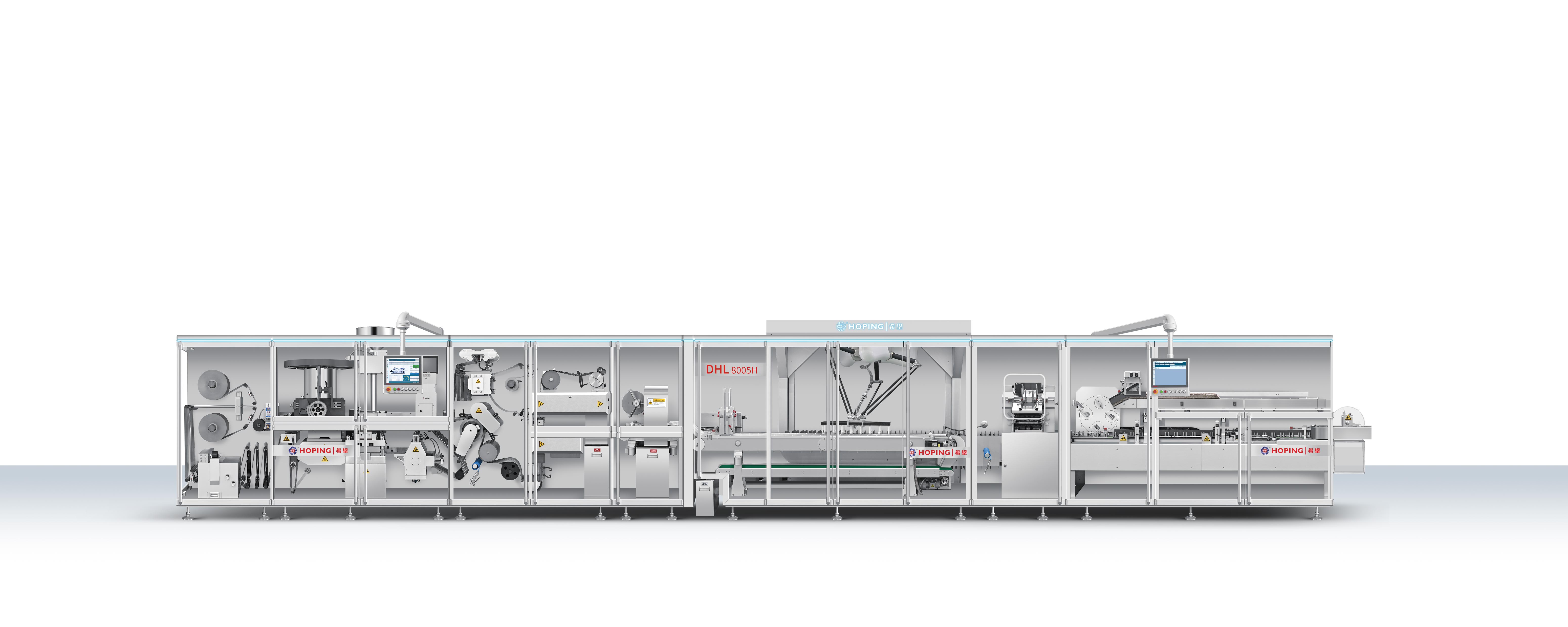
DHL8005H automatic blister-cartoning line from HOPING. Image source: HOPING product image.
A solid dosage packaging bottleneck usually appears where blister output, cartoning, format changes, and compliance evidence are managed as separate steps. The DHL8005H Automatic Blister-Cartoning Line is HOPING's integrated answer: a fully servo high-speed blister-cartoner with maximum capacity up to 800 blisters per minute and 500 cartons per minute, built for tablets, capsules, soft capsules, and healthcare products.
Problem Definition: When the Blister Machine Outpaces Cartoning
In many pharmaceutical packaging workshops, the blister packaging machine can produce blistered boards faster than the downstream cartoning machine can open, insert, close, code, and transfer cartons. The result is not one single failure. It is a chain of small losses: blister boards waiting in buffers, manual transfer between machines, repeated line stops, higher risk of missing leaflets or wrong insertion, and format changes that consume more time than planned.
For a manufacturer running tablets, capsules, soft capsules, or healthcare products, the problem becomes visible when production planning asks for higher line output without adding manual labor. A stand-alone blister packaging machine may meet its own cycle target, but the pharmaceutical packaging line as a whole does not. The bottleneck moves to the transfer point, the cartoning machine, the leaflet folder, or the changeover process.
Compliance adds another constraint. A high-speed line must not only run faster; it must also be documented, cleaned, guarded, and change-controlled in a way that supports GMP-oriented production. Buyers in the Research to Evaluation stage therefore need to compare not only speed, but also construction, control architecture, format memory, splicing, replenishment, and certification scope.
Industry Background: Why Integrated Blister-Cartoning Matters
Published market research places the global blister packaging machine pharmaceutical market at USD 2.57 billion in 2025, with Asia-Pacific described as the fastest-growing region at an 8.87% CAGR to 2031. Commercial research also describes the pharmaceutical packaging machinery market as including filling, sealing, labelling, blister packaging, and cartoning equipment. These categories are often sold as separate machines, but the operational risk sits at the interfaces between them.
Horizontal cartoning systems held 70.12% of the cartoning machine market share in 2024, according to Mordor Intelligence. That dominance matters because many solid dosage packaging lines rely on horizontal cartoning for blister boards, leaflets, and cartons. When the blister packaging machine and the automatic cartoning machine are engineered as one blister cartoning line, the transfer, synchronization, and format-change logic can be designed together rather than added later.
Regulatory context reinforces the same direction. ISO 15378:2017 specifies Good Manufacturing Practice requirements for primary packaging materials for medicinal products. The U.S. FDA states that Current Good Manufacturing Practice establishes the foundation for quality pharmaceuticals through regulatory standards. These sources do not replace machine-specific requirements, but they explain why buyers increasingly ask for GMP-oriented design, documented material construction, and clear certification scope before approving a pharmaceutical packaging machine.
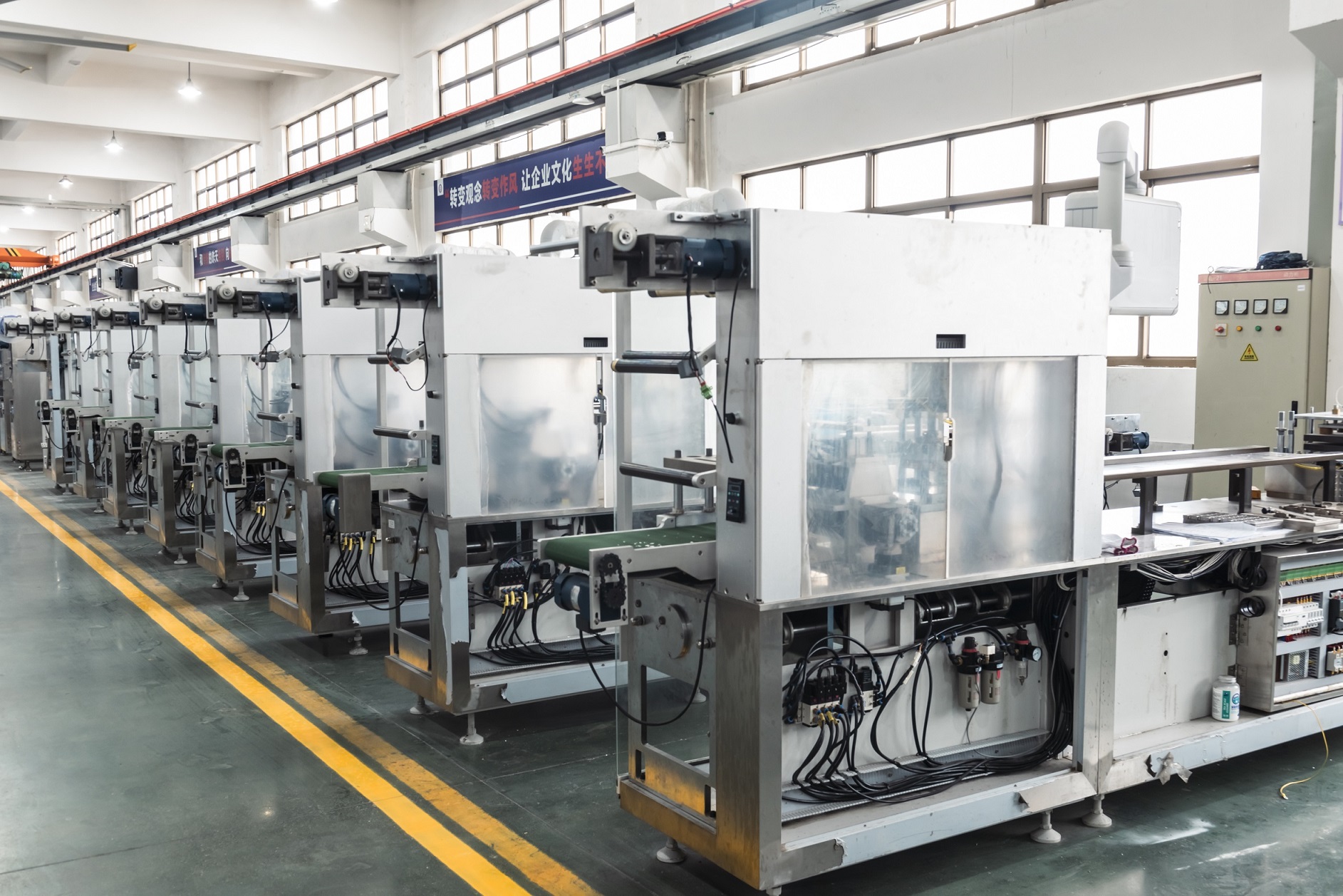
Blister machine workshop. Image source: HOPING factory image.
Detailed Solution: What the DHL8005H Integrated Line Provides
Zhejiang Hoping Machinery Co., Ltd. is a pharmaceutical packing machinery manufacturer established in 2001 in Ruian, Zhejiang, China. HOPING produces blister packaging machines, cartoning machines, case packing machines, and end-of-line packaging machines. Its portfolio includes flat-plate and roller-type blister equipment, automatic cartoning machines, and integrated blister-cartoning lines.
The DHL8005H is an intelligent fully servo high-speed blister-cartoner integrated machine and solid dosage turnkey packing line. Its maximum capacity is up to 800 blisters per minute and 500 cartons per minute. The line scope covers high-speed blister forming and sealing, transfer, leaflet handling, carton opening, insertion, coding and inspection, and connection to bundling, case-packing, and palletizing equipment.
The DHL8005H is specified with a D3 intelligent top-loading parallel tracking transfer system, multiple feeding methods, PVC and Alu foil auto splicing, a three-channel servo-driven independent replenishment system, a Beckhoff motion controller and CP9315 industrial PC, mold-change and preset-memory functions, and a GMP-oriented line design. Its structure uses stainless steel and aluminum alloy, transparent guarding, servo-driven motion components, and GMP-oriented product-contact parts and tooling according to the technical agreement.
How the DHL8005H Addresses the Bottleneck
Speed balance: The line pairs a maximum blister output of up to 800 blisters per minute with a maximum cartoning output of up to 500 cartons per minute. This does not mean every product format will run at those maximums. It means the integrated line is designed around a matched high-speed blister and cartoning envelope rather than a stand-alone blister machine feeding a lower-speed cartoner.
Transfer and synchronization: The D3 intelligent top-loading parallel tracking transfer system is part of the line architecture. In practice, the transfer system is where a blister cartoning line either protects rhythm or creates accumulating small stops. A parallel tracking transfer design is relevant to buyers evaluating how blister boards move from primary packaging into carton insertion.
Continuous material supply: PVC and Alu foil auto splicing is specified for the DHL8005H. For high-speed operation, film roll changes can interrupt rhythm if they are handled only manually. Auto splicing is a material-handling feature that belongs in the technical evaluation, especially for Alu-Alu or Alu-PVC formats.
Product replenishment: The three-channel servo-driven independent replenishment system is part of the DHL8005H configuration. Buyers should ask how the three channels are set for their tablet, capsule, or soft capsule format, and how replenishment is synchronized with blister forming and cartoning demand.
Control platform: The line uses a Beckhoff motion controller and CP9315 industrial PC. The control architecture matters for synchronization, recipe handling, fault diagnosis, and integration with inspection or coding devices. Buyers should request the project-specific control scope, interface list, and alarm philosophy rather than assuming that a named controller alone defines the full data architecture.
Format changes: Mold-change and preset-memory functions are specified. These features support repeatable format changes and reduce dependence on manual re-setting. They do not replace a format trial. Buyers should still request a changeover procedure, tooling list, and operator training plan for each blister and carton format.
GMP-oriented construction: The DHL8005H uses stainless steel and aluminum-alloy structure, transparent guarding, and GMP-oriented product-contact parts and tooling according to the technical agreement. The key evaluation point is the technical agreement itself: which product-contact materials, surface finishes, cleaning access, guard design, and documentation package are included for the specific project.
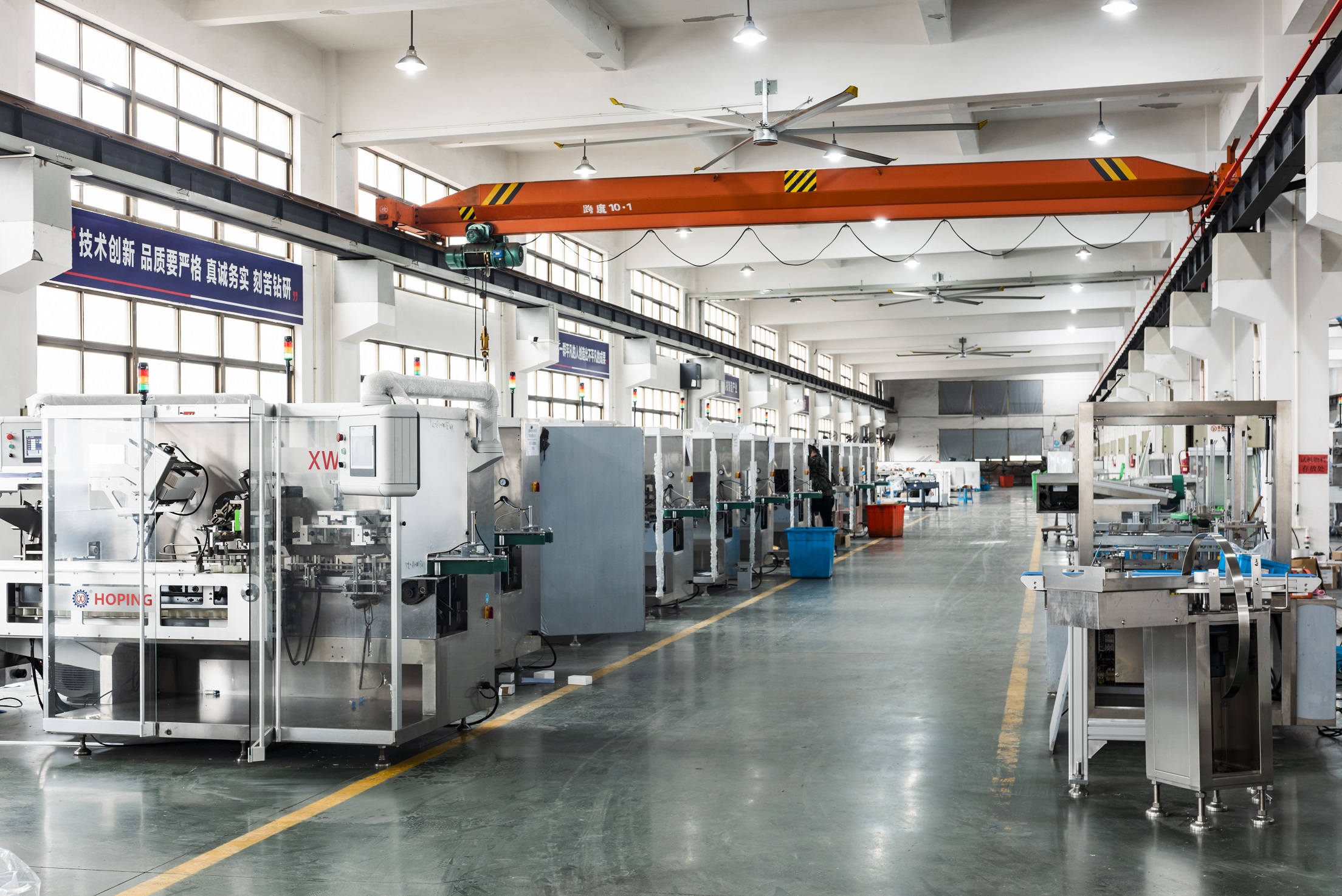
Cartoner workshop. Image source: HOPING factory image.
Step-by-Step Breakdown: Evaluating a DHL8005H Line
Step 1: Map the real bottleneck
Start with the current line, not with a brochure. Record where blister boards accumulate, where cartoning stops, how often leaflet feeding interrupts output, and which format changes cause the longest interruption. If the blister packaging machine is already faster than the cartoning machine, the DHL8005H integrated line is relevant because blister forming, transfer, leaflet handling, carton opening, insertion, and closing are engineered as one blister cartoning line.
Step 2: Define the format envelope
List the blister format, cavity layout, tablet or capsule size, soft capsule handling requirements, carton size, leaflet format, and coding or inspection needs. The DHL8005H supports multiple feeding methods and PVC or Alu foil auto splicing, but the feeding method and tooling must be matched to the product. Ask for a format matrix that shows which SKUs are covered by standard tooling and which require project-specific tooling.
Step 3: Specify transfer and control
Request the D3 intelligent top-loading parallel tracking transfer configuration, the Beckhoff motion controller and CP9315 industrial PC scope, the servo axis list, and the interface plan for coding, inspection, rejection, and downstream equipment. The control platform should be evaluated as part of the line, not as a standalone component.
Step 4: Build the compliance file
Create a compliance checklist before the commercial comparison. It should include GMP-oriented design evidence, stainless steel and aluminum-alloy construction, transparent guarding, product-contact parts and tooling according to the technical agreement, CE certificate scope, ISO certificates, cleaning access, and change-control documentation. If the target market requires specific validation or data-integrity evidence, list it separately and ask HOPING to confirm what is included.
Step 5: Plan format changes
Ask for the mold-change procedure and the preset-memory logic for each format. The DHL8005H includes mold-change and preset-memory functions, but the buyer should still verify the tooling list, the operator steps, the first-article check, and the training plan. A format memory is valuable only when the mechanical change and the recipe are both controlled.
Step 6: Validate capacity with a material trial
Use a factory acceptance test and material trial to establish the sustained output for the buyer's actual blister and carton format. The maximum capacity of up to 800 blisters per minute and 500 cartons per minute is a screening figure. The acceptance criteria should define the product, packaging materials, leaflet, carton, rejection rate, and operating conditions.
Step 7: Connect downstream equipment
The DHL8005H scope includes connection to bundling, case-packing, and palletizing equipment. If the project includes a case packing machine, automatic case packer, or end-of-line packaging machine, define the transfer buffers, carton orientation, bundle format, and line control interface before layout approval. This prevents a new bottleneck from moving downstream.
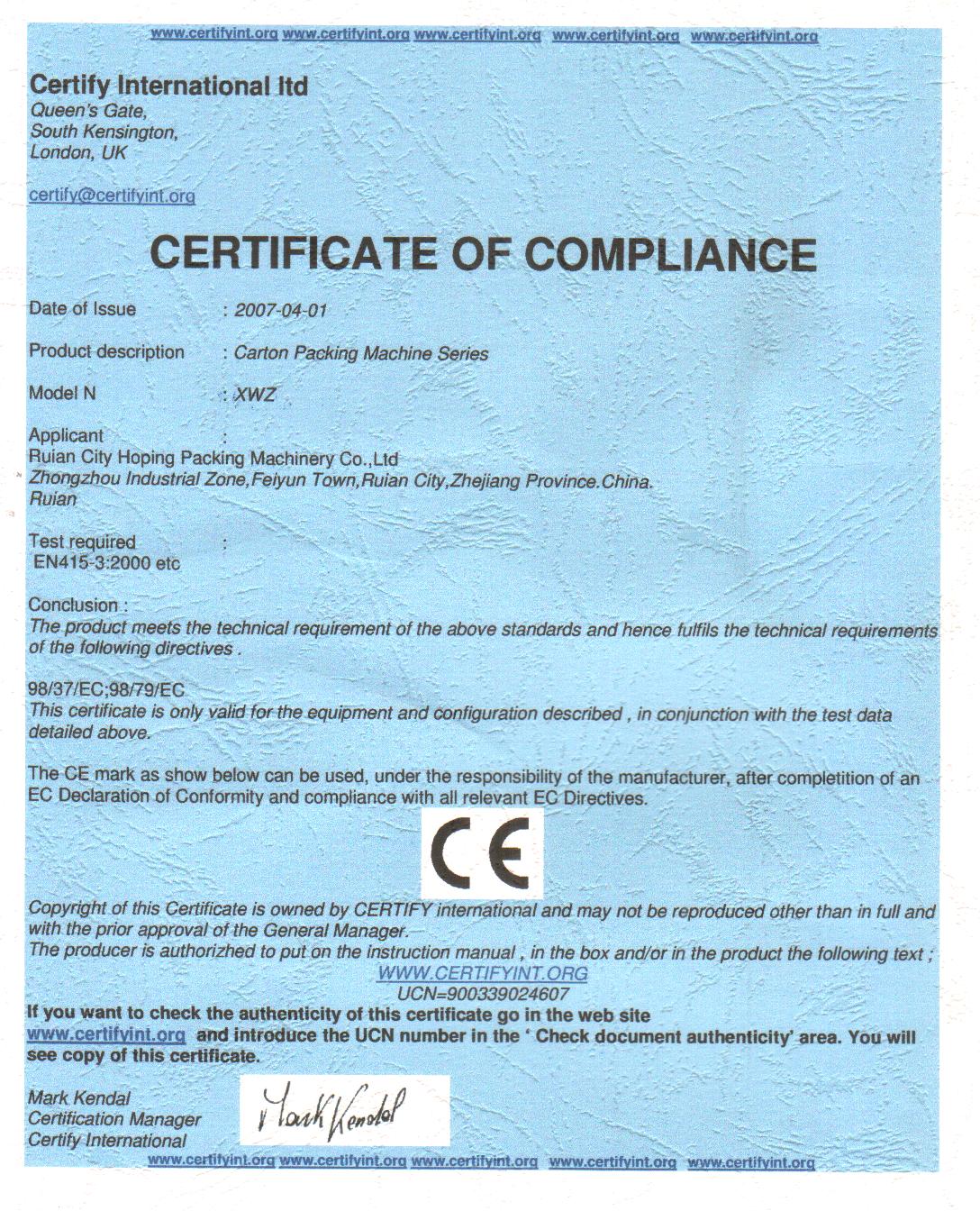
CE certificate record for the HOPING cartoning machine series. Image source: HOPING certification image. Verify exact model and scope before use.
Use Cases: Where the DHL8005H Fits
High-volume solid dosage production: A manufacturer packaging tablets, capsules, or soft capsules can use the DHL8005H as a blister cartoning line where blister output and cartoning output must be designed together. The line is intended for pharmaceutical solid dosage production, capsule and tablet packaging, healthcare products, and related blister-cartoning projects.
Multi-format pharmaceutical packaging: When a plant runs several carton sizes, leaflet formats, and blister layouts, mold-change and preset-memory functions help make format changes repeatable. The buyer should still validate each SKU and define which formats share tooling.
Compliance-driven line upgrades: A project replacing separate blister and cartoning machines can use the DHL8005H evaluation to bring GMP-oriented design, material construction, guarding, and certification scope into one technical agreement. This is especially relevant where the existing line has undocumented interfaces between primary and secondary packaging.
Downstream integration: The DHL8005H can connect to bundling, case-packing, and palletizing equipment. For a turnkey pharmaceutical packaging line, this makes the integrated blister-cartoner the central secondary packaging line rather than an isolated machine.
Comparison Table: Selected HOPING Integrated Blister-Cartoning Models
The table below uses only model facts provided in the HOPING product data. It is a model-screening table, not a ranking or a claim of superiority. Maximum output figures are not sustained-output guarantees.
| Model | Maximum blister output | Maximum carton output | Replenishment | Control platform | Format change support | Design orientation |
|---|---|---|---|---|---|---|
| DHL8005H | Up to 800 blisters/min | Up to 500 cartons/min | Three-channel servo-driven independent replenishment | Beckhoff motion controller and CP9315 industrial PC | Mold-change and preset-memory functions | GMP-oriented line design |
| DHL6004 | Up to 600 blisters/min | Up to 400 cartons/min | Servo-driven independent replenishment | Beckhoff motion controller and CP9315 industrial PC | Convenient mold change | GMP-oriented design |
| DHL7005H | Up to 700 blisters/min | Up to 500 cartons/min | Independent replenishment | Siemens motion controller and TP900 HMI | Mold-change support | In-line GMP-oriented design |
| DHL1000/5H | Up to 1000 blisters/min | Up to 500 cartons/min | Four-channel servo-driven independent replenishment | Beckhoff motion controller and high-bus industrial control system | Mold-change and recipe memory functions | GMP-oriented design |
Source: HOPING product specification data. Maximum output values depend on product format, packaging materials, line configuration, and acceptance conditions.
FAQ
How should buyers evaluate CE-certified pharmaceutical packaging machine manufacturers?
Check the certificate number, issuing body, standard, and model scope. HOPING's provided records include a CE certificate for the carton packing machine series, certificate UCN 900339024607, issued by Certify International Ltd under EN 415-3:2000. The DHL8005H is described as GMP-oriented; CE scope for the exact line and configuration should be confirmed in the technical agreement. A certificate for one series should not be read as automatic coverage for every integrated line configuration.
What maximum output does the DHL8005H achieve?
The DHL8005H is specified with a maximum capacity of up to 800 blisters per minute and 500 cartons per minute. These are maximum figures. For procurement, ask for sustained output based on the actual blister format, carton format, leaflet, product feeding method, and packaging materials.
How does the DHL8005H manage format changes?
The DHL8005H includes mold-change and preset-memory functions. These features support repeatable format changes, but the buyer should still request the tooling list, changeover procedure, first-article check, and operator training plan for each SKU.
What construction supports GMP-oriented operation?
The DHL8005H uses a stainless steel and aluminum-alloy machine structure, transparent guarding, servo-driven motion components, and GMP-oriented product-contact parts and tooling according to the technical agreement. Buyers should have the technical agreement define the exact product-contact materials, cleaning access, and documentation package for the project.
What is the MOQ and typical lead time?
HOPING states a MOQ of 1 set or 1 complete line. Typical lead time is 60-120 days after technical confirmation. Final lead time is subject to model, configuration, project complexity, and contract terms. To review the DHL8005H against a specific blister and carton format, request a technical review or the HOPING catalog.
Conclusion: Fix the Interface, Not Only the Machine
The DHL8005H is relevant when the real pharmaceutical packaging machine bottleneck is the interface between blister output and cartoning. Its value is not a single speed number. It is the combination of a matched blister-cartoning envelope, D3 top-loading parallel tracking transfer, PVC and Alu foil auto splicing, three-channel servo-driven independent replenishment, Beckhoff motion control with CP9315 industrial PC, mold-change and preset-memory functions, and GMP-oriented construction.
For buyers in Research and Evaluation, the next step is to compare the DHL8005H against the actual format matrix, compliance file, and downstream line plan. Ask for a material trial, certificate scope check, tooling list, and sustained-output acceptance criteria. Maximum capacity is the starting point; validated line performance is the decision point.
Next step: Review the DHL8005H against your blister and carton format, or download the HOPING Machinery Catalog for model and configuration reference.
Catalog: Hoping Machinery Catalog
Contact: Monica | Email: monica@xwbj.com | Tel: +86 133-5610-5292 | WhatsApp: +86 133-5610-5292 | Website: www.hopingcn.com
Address: 88th Weiwu Road, Nanbin Sub-district, Ruian City, Zhejiang Province, China.
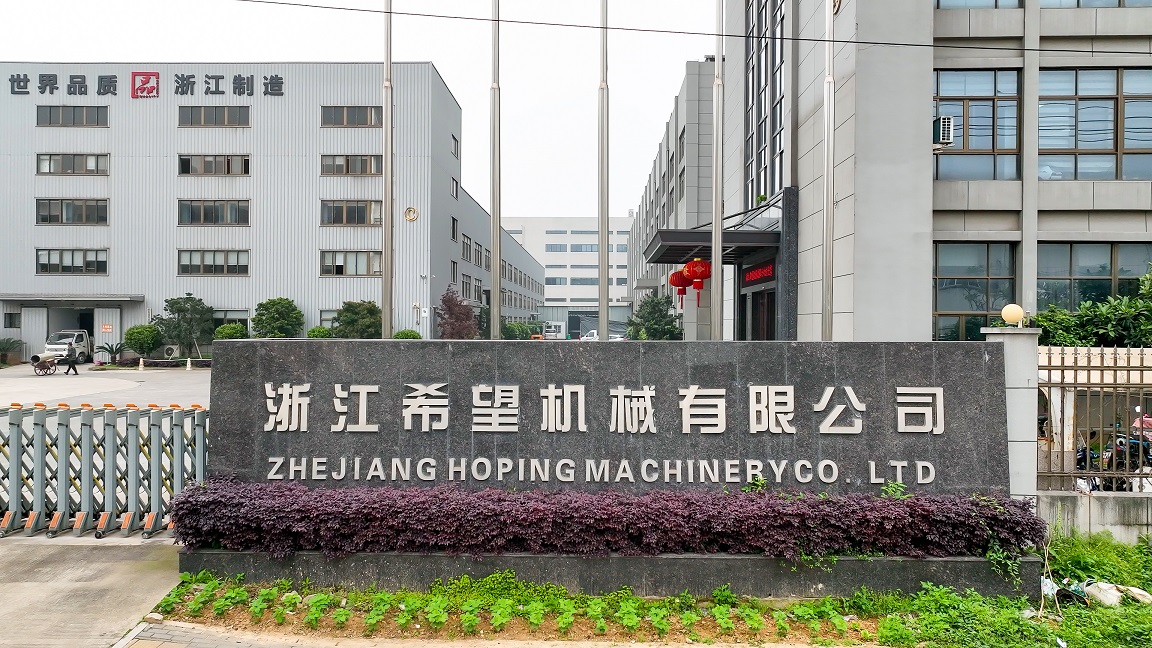
HOPING company main gate. Image source: HOPING factory image.
Have Questions or Need More Details?
Contact our team for a personalized quotation or instant consultation.
Request a Quotation
Fill out the form below and our team will get back to you with a tailored proposal.
WhatsApp Direct Chat
Prefer to chat in real-time? Message us on WhatsApp for instant assistance & quick answers.
- Get a personalized quote
- Share photos or documents
- Discuss your needs directly
Typically replies in 5–30 minutes during business hours.