
Machine Format Memory in Pharma Packaging: The Value of Preset-Memory and Mold-Change Systems
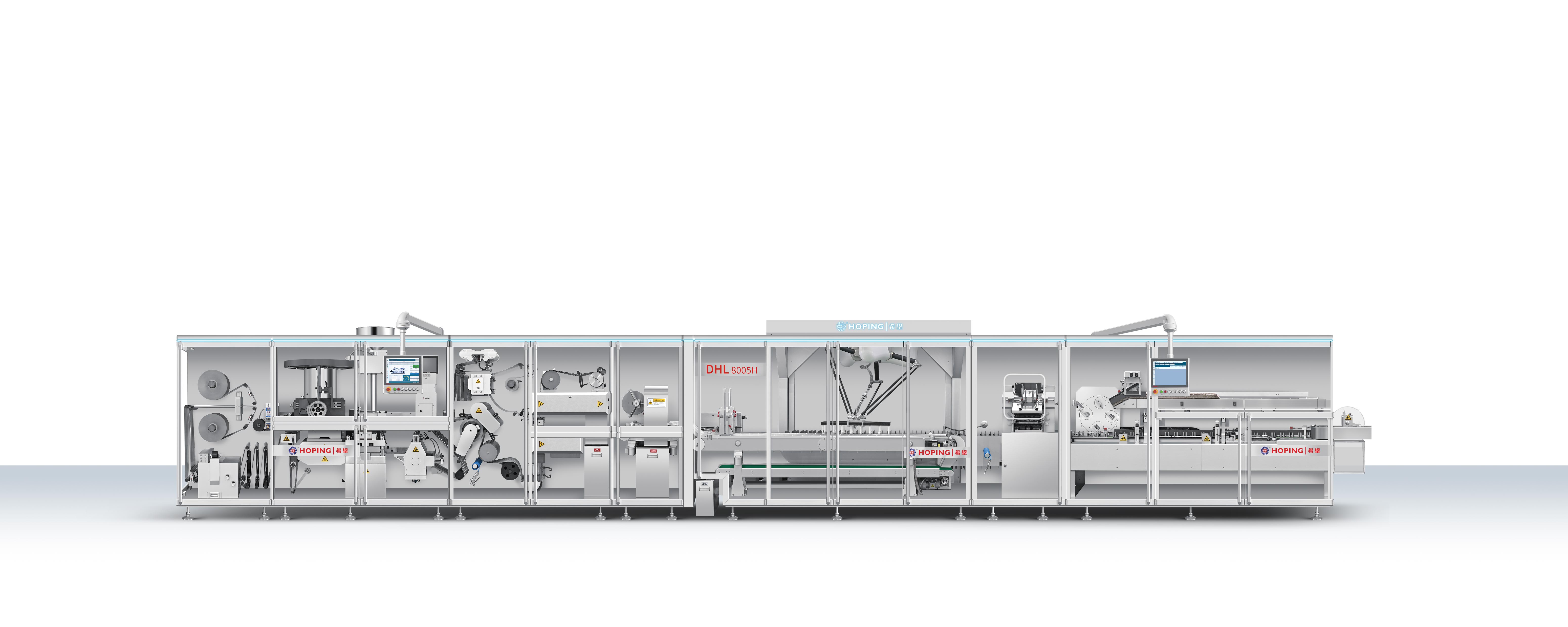
A blister-cartoning line rarely loses output because it runs slowly. It loses output because it has to stop and become a different line. Machine format memory — the pairing of a mold-change system with a preset-memory function — is the part of a pharmaceutical packaging machine that decides how long that transformation takes. On the HOPING DHL8005H, both functions appear in the published specification alongside a maximum output of 800 blisters/min and 500 cartons/min.
Format memory is the ability of a packaging line to store the machine settings that belong to one specific blister and carton format, and to recall them the next time that format is scheduled. Without it, every changeover is rebuilt from scratch by an operator reading a paper setting sheet and adjusting positions by hand. With it, the physical tooling change and the control-side parameter change become two coordinated, repeatable steps.
HOPING (Zhejiang Hoping Machinery Co., Ltd.) is a pharmaceutical packing machinery manufacturer established in 2001 in Ruian City, Zhejiang Province, China. The company produces blister packing machines, cartoning machines, case packing machines, and end-of-line packaging equipment. The DHL8005H is the 800-blisters/min fully servo blister-cartoner model in its integrated line range, and it is the reference point for this article because mold-change and preset-memory functions are both named in its own specification.
What Changeover Actually Costs on a High-Speed Blister Line
Changeover cost is usually described as downtime. That description is incomplete in a pharmaceutical context, because three separate losses occur at once, and only one of them is visible on the shift report.
- Physical downtime. The line is stopped while forming molds, sealing molds, punch tools, and carton-format parts are removed and replaced. At any capacity, this is lost machine time.
- Parameter rebuild. After the tooling is in place, the machine still has to be told how to run: forming temperature, sealing dwell, transfer timing, cam positions, carton erecting sequence, leaflet fold geometry. Rebuilding these by hand is where hidden hours accumulate — and where the machine is most exposed to operator-to-operator variation.
- Verification and scrap. The first blisters and first cartons after a rebuild must be checked, and the material consumed during those checks is scrap. If a parameter was set slightly wrong, that scrap scale grows.
On a line running at several hundred blisters per minute, the second and third items are not minor. The machine's raw speed is fixed by its servo architecture and forming station; the recoverable time is in the transition, not in the running speed.
Why Format Flexibility Became a Procurement Criterion
Solid dosage production is rarely a single-format operation. A pharmaceutical packaging machine in a tablet, capsule, or soft capsule facility usually serves several SKUs, several pack counts, and often several market-specific carton designs. Each combination is a distinct format, and each format needs its own tooling and its own machine settings.
The commercial backdrop supports the same direction. One commercial research publisher reports the global pharmaceutical packaging machinery market at USD 7.09 billion in 2026, growing at a 7.15% CAGR toward USD 10.02 billion, with a product scope that explicitly includes blister packaging and cartoning equipment. The same publisher's blister-specific analysis identifies Asia-Pacific as the fastest-growing region, at an 8.87% CAGR to 2031. These are single-source commercial estimates rather than official statistics, and they should be read as directional context rather than as a validated benchmark. What they describe, however, is consistent with what buyers already experience: more equipment capacity being added in regions where multi-SKU production is the norm.
Regulatory expectations pull in the same direction. FDA documentation of current Good Manufacturing Practice establishes the framework through which pharmaceutical quality is maintained, and ISO 15378:2017 specifies GMP requirements for primary packaging materials for medicinal products. Neither standard dictates a specific changeover method, and neither should be read as a machine-level requirement. But both reinforce a practical point: returning a line to a documented, validated state after a format change is a controlled activity, not an improvised one. A machine that recalls stored parameters supports that control; a machine that requires manual re-entry invites variability.
Inside the DHL8005H: What the Specification States
The DHL8005H is described by HOPING as an intelligent fully servo high-speed blister-cartoner integrated machine and solid dosage turnkey packing line. Its published parameters are specific and worth reading in full, because they show how format management sits inside the wider architecture rather than as a standalone feature.
- Maximum capacity: up to 800 blisters/min and 500 cartons/min
- D3 intelligent top-loading parallel tracking transfer system
- Multiple feeding methods, configured to customer requirements
- PVC / Alu foil auto splicing
- Three-channel servo-driven independent replenishment system
- Beckhoff motion controller and CP9315 industrial PC
- Mold-change and preset-memory functions
- GMP-oriented line design
Scope of supply covers high-speed blister forming and sealing, transfer, leaflet handling, carton opening, insertion, coding and inspection, and connection to downstream bundling, case packing, and palletizing equipment. Material construction is stainless steel and aluminum alloy with transparent guarding; product-contact parts and tooling are configured according to the technical agreement.
What the preset-memory function does
The preset-memory function is the control-side half of format management. In a servo blister-cartoner, the machine's behaviour is defined by motion profiles and position targets held in the controller — where the forming station indexes, when the sealing station closes, how the transfer system hands a blister to the cartoner, where the carton erecting arm stops. The memory function stores the set that belongs to a given format so it can be called up instead of re-entered.
Two consequences follow for a buyer. First, the changeover becomes repeatable: the same format should produce the same machine state regardless of which operator performs the change. Second, the changeover becomes recordable: a named recipe can be referenced in a batch record or a change-control document, which is materially easier to defend than a handwritten setting sheet.
The published DHL8005H specification does not state how many format recipes can be stored, what parameter set each recipe contains, or how recipe access is permission-controlled. Those are legitimate questions for a technical clarification and should be answered in writing before purchase, and confirmed during factory acceptance testing.
What the mold-change system does
The mold-change system is the mechanical half. Blister packaging depends on matched tooling: the forming mold that shapes the cavity, the sealing tool that closes the lidding material, and the punching or cutting tool that separates the finished blister. The cartoner side has its own format parts — carton magazine guides, product buckets, insertion elements, leaflet folding plates. A format change is only complete when every one of these has been exchanged and seated correctly.
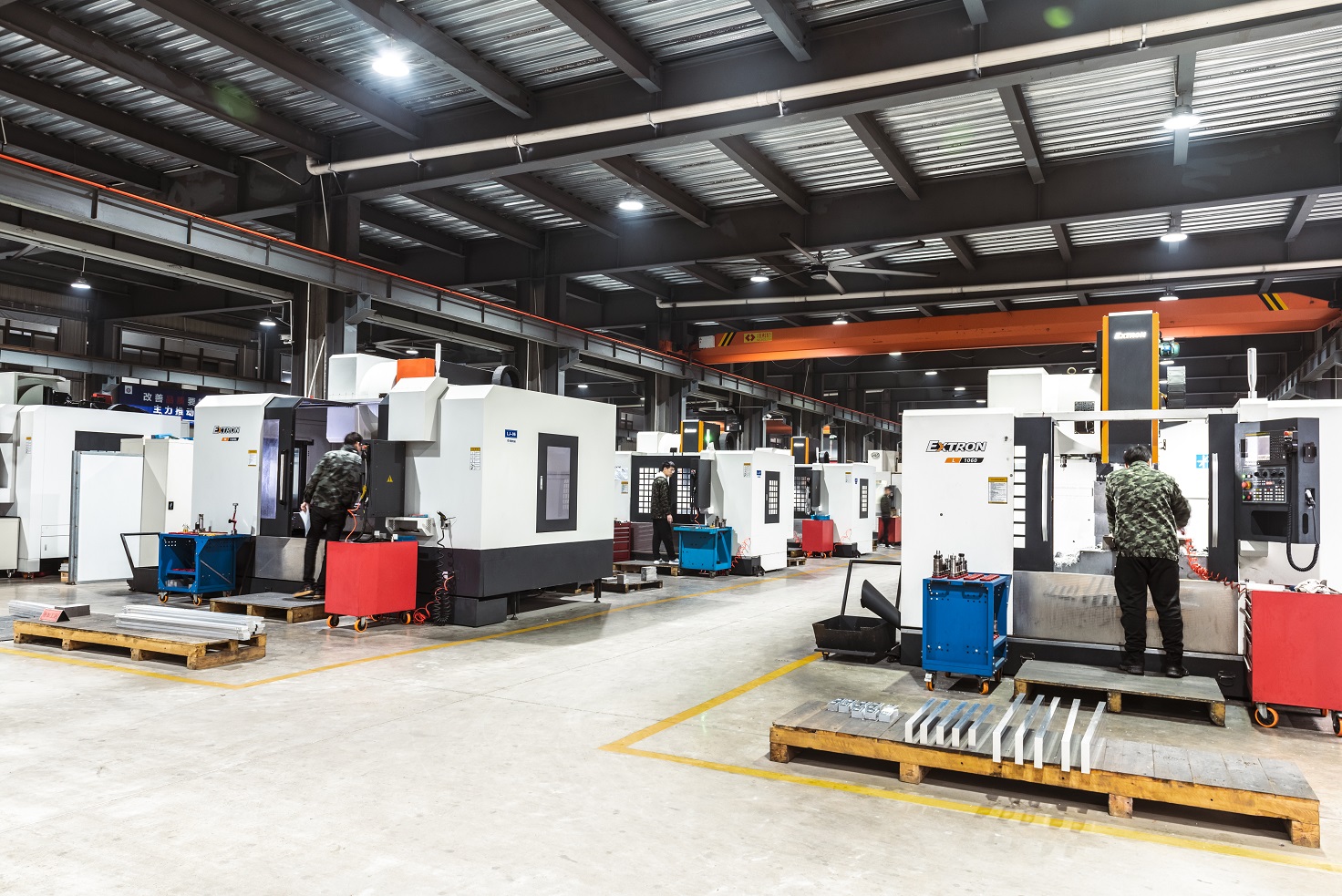
Changeover speed therefore depends on locating strategy as much as on fastening strategy. A format part that locates on a machined register and requires a short sequence of locking actions will move in and out quickly. A part that must be measured into position will not, regardless of how the controller behaves. This is why mold-change capability is best evaluated on the workshop floor rather than from a datasheet alone.
How the surrounding systems protect the changeover
Three further DHL8005H systems interact with format memory in ways that matter during a real changeover.
The PVC / Alu foil auto splicing function reduces the need to stop the line for material reel changes. Passive reel changes interrupt production regardless of format; auto splicing removes part of that interruption from the changeover window.
The three-channel servo-driven independent replenishment system governs how product reaches the blister cavities. Independent servo channels allow different replenishment behaviour across lanes, which becomes relevant when the new format uses a different cavity count or a different tablet or capsule geometry.
The D3 intelligent top-loading parallel tracking transfer system is the bridge between blister output and carton input. A memory recall that resets blister-side timing without a corresponding transfer-side reference would produce mis-phased handover, so the preset-memory function has to cover the transfer relationship, not only the primary forming station.
Step-by-Step: A Format Change with Preset Memory
The practical sequence below reflects how a memory-equipped blister-cartoner is normally operated. It is a process description, not a claim about a measured changeover duration — the DHL8005H specification does not publish a changeover time figure, and buyers should obtain one under their own format set during acceptance testing.
- Confirm the target format and verify tooling availability. Select the scheduled blister and carton format, confirm the matching tooling set is on site and complete, and confirm the corresponding recipe exists in the controller.
- Bring the line to a defined stop state. End the current batch at a controlled point, clear product from the transfer and cartoning sections, and record the closing state of the outgoing format.
- Exchange blister-side tooling. Remove the forming, sealing, and punching tools and install the incoming set using the mold-change system's locating arrangement. Confirm seating before proceeding.
- Exchange cartoner-side format parts. Change carton magazine guides, product buckets, insertion elements, and leaflet fold plates to match the new carton.
- Load the new packaging materials. Bring in the specified PVC and lidding foil; the auto splicing function carries the reel transition. Load the new carton blanks and leaflet stock.
- Recall the stored recipe. Call up the preset-memory entry for the format and let the controller restore forming, sealing, transfer, and cartoning parameters rather than adjusting them manually.
- Run the first-article check. Produce the first blisters and cartons, inspect cavity formation, seal integrity, cut quality, leaflet presence, and carton closure, and compare against the format specification.
- Release and record. Record the recipe identifier and the first-article result against the batch, then hand the line back to production.
Steps 3 and 4 are the visible part of the changeover. Step 6 is where the memory function earns its place, because it is the step that converts an operator-dependent activity into a repeatable one.
Where Format Memory Pays Back
Multi-strength tablet portfolios
A tablet facility producing the same molecule at several strengths often runs different blister cavity layouts and different carton counts. Each variation is a format. When changeovers are short and repeatable, small batches become economically viable and the line can respond to demand rather than to campaign scheduling.
Capsule and soft capsule production
Capsules and soft capsules bring their own handling considerations: capsule geometry affects cavity design and feeding behaviour, and soft capsules require attention to sealing conditions. Because these parameters differ meaningfully between products, the value of a stored recipe is higher than on a single-product line — there is more to remember, and more to get wrong.
Contract manufacturing and clinical supply
Contract manufacturers and clinical supply operations change format more often than dedicated commercial lines. Their constraint is not maximum speed but the ability to switch without rebuilding the machine from first principles. A line that stores format parameters shortens the interval between campaigns and makes short runs less disruptive to the wider schedule.
Downstream integration
Because the DHL8005H is specified for connection to bundling, case packing, and palletizing equipment, a format change propagates beyond the blister and cartoner. If the downstream bundler or case packer also carries format parts, the whole line has to come back into phase. Getting the primary and secondary stages returned to a known state quickly is what keeps the end-of-line from extending the changeover.
Comparing Mold-Change and Memory Functions Across the DHL Range
Not every model in the HOPING blister-cartoner range documents the same level of format management. The table below uses only the published parameters for each model; where a memory function is not stated in the specification, the table says so rather than inferring it.
| Model | Max blister output | Max carton output | Mold-change / memory | Control platform | Replenishment |
|---|---|---|---|---|---|
| DHL1000/5H | 1,000 blisters/min | 500 cartons/min | Mold-change and recipe-memory functions | Beckhoff motion controller, high-bus industrial control system | Four-channel servo-driven independent |
| DHL8005H | 800 blisters/min | 500 cartons/min | Mold-change and preset-memory functions | Beckhoff motion controller, CP9315 industrial PC | Three-channel servo-driven independent |
| DHL7005H | 700 blisters/min | 500 cartons/min | Mold-change support; memory function not stated in published specification | Siemens motion controller, TP900 HMI | Independent replenishment |
| DHL7004 | 700 blisters/min | 400 cartons/min | Convenient mold change; memory function not stated in published specification | Siemens motion controller, TP900 HMI | Servo-driven independent |
| DHL6004 | 600 blisters/min | 400 cartons/min | Convenient mold change; memory function not stated in published specification | Beckhoff motion controller, CP9315 industrial PC | Servo-driven independent |
Three observations follow directly from the table. First, format management is documented most explicitly at the top of the range, where changeover economics matter most. Second, the control platform differs across models — Beckhoff on the DHL1000/5H, DHL8005H, and DHL6004; Siemens with a TP900 HMI on the DHL7005H and DHL7004 — which is relevant if a plant standardises on one control environment. Third, carton output is capped at 500 cartons/min on three models, so blister-side capacity above that figure does not automatically translate into higher finished-carton throughput.
Selection logic in brief. Where the priority is maximum blister throughput and recipe memory, the DHL1000/5H is the highest-capacity option in the documented range. Where 800 blisters/min matches the production plan and preset memory is required, the DHL8005H is the specified match. Where a Siemens control environment is the plant standard, the DHL7005H and DHL7004 document mold-change support. Where 600 blisters/min is sufficient, the DHL6004 documents convenient mold change.
In every case, the memory function is only useful if the tooling that pairs with it is complete and correctly located; the two halves are bought together or not at all.
What to Verify Before You Commit
Format memory is easy to claim and harder to prove. A buyer evaluating any blister-cartoner — including the DHL8005H — should convert the claim into specific verification items during technical clarification and factory acceptance testing.
- Recipe scope. Ask which parameters a stored recipe actually covers: forming temperature, sealing dwell and pressure, transfer phase, cartoner erecting positions, leaflet fold geometry, inspection thresholds. A recipe that covers only part of the chain still leaves manual work.
- Recipe count and management. Ask how many formats can be stored, how recipes are named, who can edit them, and how a change to a stored recipe is controlled and recorded.
- Tooling completeness. Confirm the full tooling set for each intended format, including cartoner format parts, and confirm how each part locates.
- Measured changeover. Ask for a changeover demonstration using your own blister and carton formats, timed from line stop to first accepted carton, and repeated at least twice to show repeatability.
- Downstream behaviour. If bundling, case packing, or palletizing is included, verify that the whole line returns to phase, not only the blister-cartoner.
HOPING's stated quality process supports this kind of verification. It covers incoming material inspection, key component inspection, assembly inspection, electrical safety check, no-load trial run, material trial, factory acceptance testing, customer witness acceptance, and pre-shipment inspection. A buyer can therefore request a material trial and a witnessed acceptance run using their own formats rather than accepting a demonstration on the supplier's reference product.
Frequently Asked Questions
How do mold-change and preset-memory functions fit a GMP-oriented blister-cartoning line?
They support repeatability rather than constituting a compliance claim in themselves. FDA documentation describes current Good Manufacturing Practice as the framework that establishes the foundation for quality pharmaceuticals, and ISO 15378:2017 specifies GMP requirements for primary packaging materials for medicinal products. Within that framework, a format change is a controlled event that must return the line to a documented state. A preset-memory function helps because the target machine state is named and recallable instead of manually re-entered, and a mold-change system helps because tooling seating becomes a defined operation rather than an adjustment. HOPING describes the DHL8005H as a GMP-oriented line design, but buyers should still verify changeover control, recipe access, and first-article records during qualification rather than treating the feature as a compliance substitute.
Which HOPING models document mold-change or memory functions?
Based on published specifications, the DHL1000/5H lists mold-change and recipe-memory functions with a maximum output of up to 1,000 blisters/min and 500 cartons/min. The DHL8005H lists mold-change and preset-memory functions with up to 800 blisters/min and 500 cartons/min. The DHL7005H documents mold-change support at up to 700 blisters/min and 500 cartons/min, and the DHL7004 and DHL6004 document convenient mold change at up to 700 and 600 blisters/min respectively. For the DHL7005H, DHL7004, and DHL6004, a memory function is not stated in the published specification and should be confirmed during technical clarification if it is a requirement.
What determines the cost of a pharmaceutical packaging machine configured with preset memory?
Cost is driven by configuration rather than by the memory function alone. HOPING's stated customization scope covers blister size, blister materials, quantity per carton, carton specification, leaflet format, coding and inspection method, feeding method, downstream bundling, case-packing and palletizing connection, interface language, electrical component brand, and data interface. Each of these changes the engineering content. Minimum order quantity is one set or one complete line, and monthly capacity is stated at 30 to 40 units. A project-specific quotation is required; no list price is published, so any figure should come from a written offer that states the included tooling sets and the verification scope.
Can a buyer validate a format change before shipment?
Yes, and it should be made a contractual milestone. HOPING's quality process includes no-load trial run, material trial, factory acceptance testing, customer witness acceptance, and pre-shipment inspection. The most useful validation is a witnessed changeover performed with the buyer's own blister film, lidding foil, carton blanks, and leaflets, timed from line stop to first accepted carton and repeated to demonstrate repeatability. Running the same demonstration on a supplier reference product does not establish that the buyer's formats will behave the same way.
How should buyers shortlist top pharmaceutical packaging machine manufacturers?
Shortlisting works better as a structured comparison than as a search for a ranking. Four checks carry most of the weight. First, confirm the manufacturer documents the specific format-management capability you need — mold change and memory function should both appear in the published specification, not only in a sales conversation. Second, confirm the capacity pairing suits your plan, since blister output above the carton-side ceiling does not increase finished-carton throughput. Third, confirm the verification route: material trial, factory acceptance testing, and witnessed acceptance with your own formats. Fourth, confirm the commercial timeline — HOPING states a typical lead time of 60 to 120 days after technical confirmation, subject to model, configuration, project complexity, and contract terms.
HOPING's after-sales scope covers on-site installation and commissioning, operator and maintenance training, remote video and phone support, spare parts supply, process-parameter guidance, and regular follow-up, per contract and project configuration. Buyers who want to move from comparison to specification can request the HOPING Machinery catalog or arrange a technical discussion on a DHL8005H configuration for their own format set.
Conclusion
Machine format memory is not a convenience feature bolted onto a high-speed line. It is the mechanism that separates a changeover from a rebuild. The mold-change system handles the physical side — exchanging forming, sealing, punching, and carton-format tooling so that the geometry matches the new product. The preset-memory function handles the control side — restoring the motion profiles and process parameters that belong to that format so the machine returns to a defined state rather than an operator's approximation.
On the HOPING DHL8005H, both are named in the published specification, alongside an 800-blisters/min, 500-cartons/min capacity, a D3 top-loading parallel tracking transfer system, PVC and Alu foil auto splicing, three-channel servo-driven independent replenishment, and a Beckhoff motion controller with CP9315 industrial PC. The DHL1000/5H extends blister output to 1,000 blisters/min with recipe-memory functions, and the DHL7005H, DHL7004, and DHL6004 document mold-change support at lower capacities.
The practical test for any buyer is the same regardless of model: ask for the changeover to be demonstrated with your own formats, timed, and repeated. A format memory system that has never been measured on your product is still an assumption.
Next Step
Review the full HOPING pharmaceutical packaging machine range, including blister packers, cartoners, case packers, and end-of-line equipment, in the downloadable catalog.
Download the HOPING Machinery Catalog (PDF)
For a format-specific discussion on the DHL8005H, contact Monica at monica@xwbj.com or +86 133-5610-5292.
Have Questions or Need More Details?
Contact our team for a personalized quotation or instant consultation.
Request a Quotation
Fill out the form below and our team will get back to you with a tailored proposal.
WhatsApp Direct Chat
Prefer to chat in real-time? Message us on WhatsApp for instant assistance & quick answers.
- Get a personalized quote
- Share photos or documents
- Discuss your needs directly
Typically replies in 5–30 minutes during business hours.