
Integrated vs. Modular Blister-Cartoning Lines: A Head-to-Head Decision
Integrated vs. Modular Blister-Cartoning Lines: A Head-to-Head Decision
The head-to-head question between an integrated blister-cartoning line and a modular set of standalone blister and cartoning machines is not settled by catalogue speed figures. It is settled by three tests: floor space, changeover efficiency, and how consistently the line holds its rated output when blister production and carton intake have to stay matched.
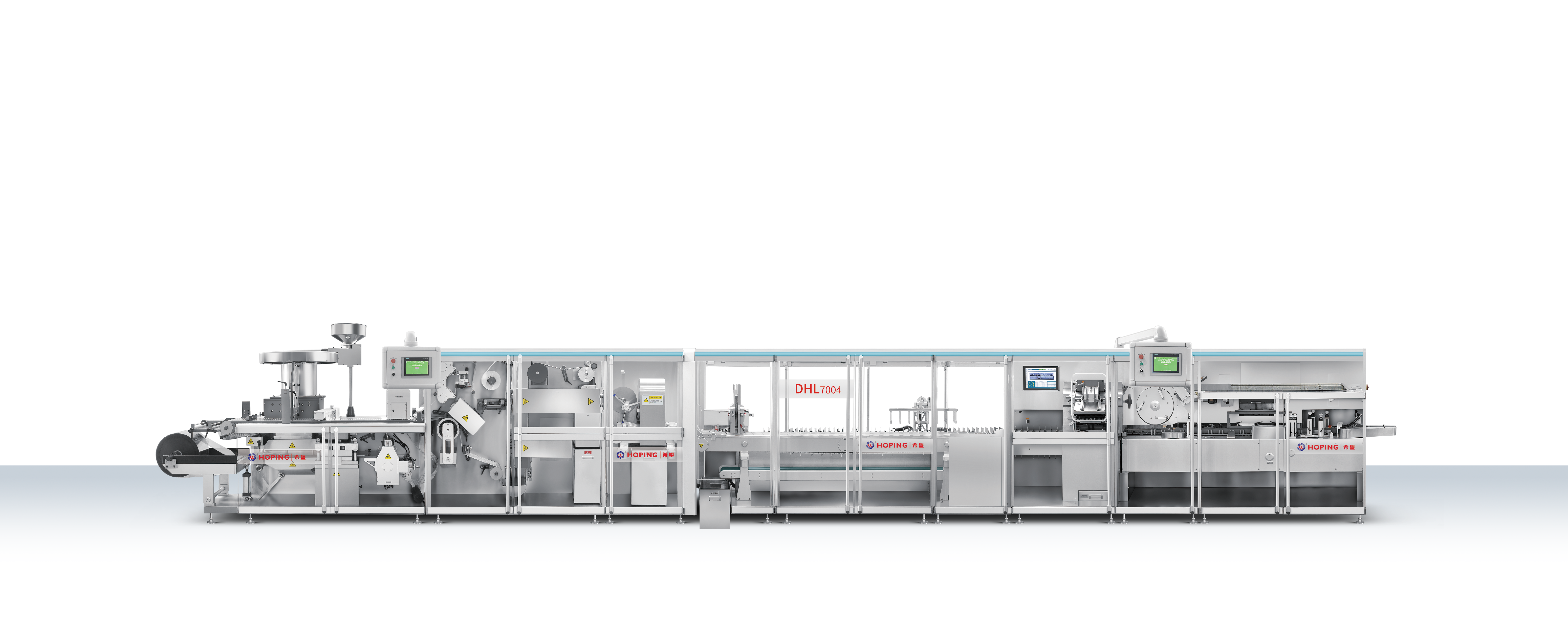
An integrated machine performs blister forming and sealing, blister transfer, leaflet handling, carton opening, insertion and coding/inspection inside one linked frame. The DHL8005H is the clearest example in this product family: it is rated at up to 800 blisters per minute and 500 cartons per minute. A modular configuration keeps those processes in separate machines \u2014 for example a DPP Series flat blister machine at 20\u201350 cycles per minute feeding an XWZ Series cartoner at 100\u2013400 cartons per minute \u2014 joined by a transfer that has to be engineered, synchronised and maintained as part of the project.
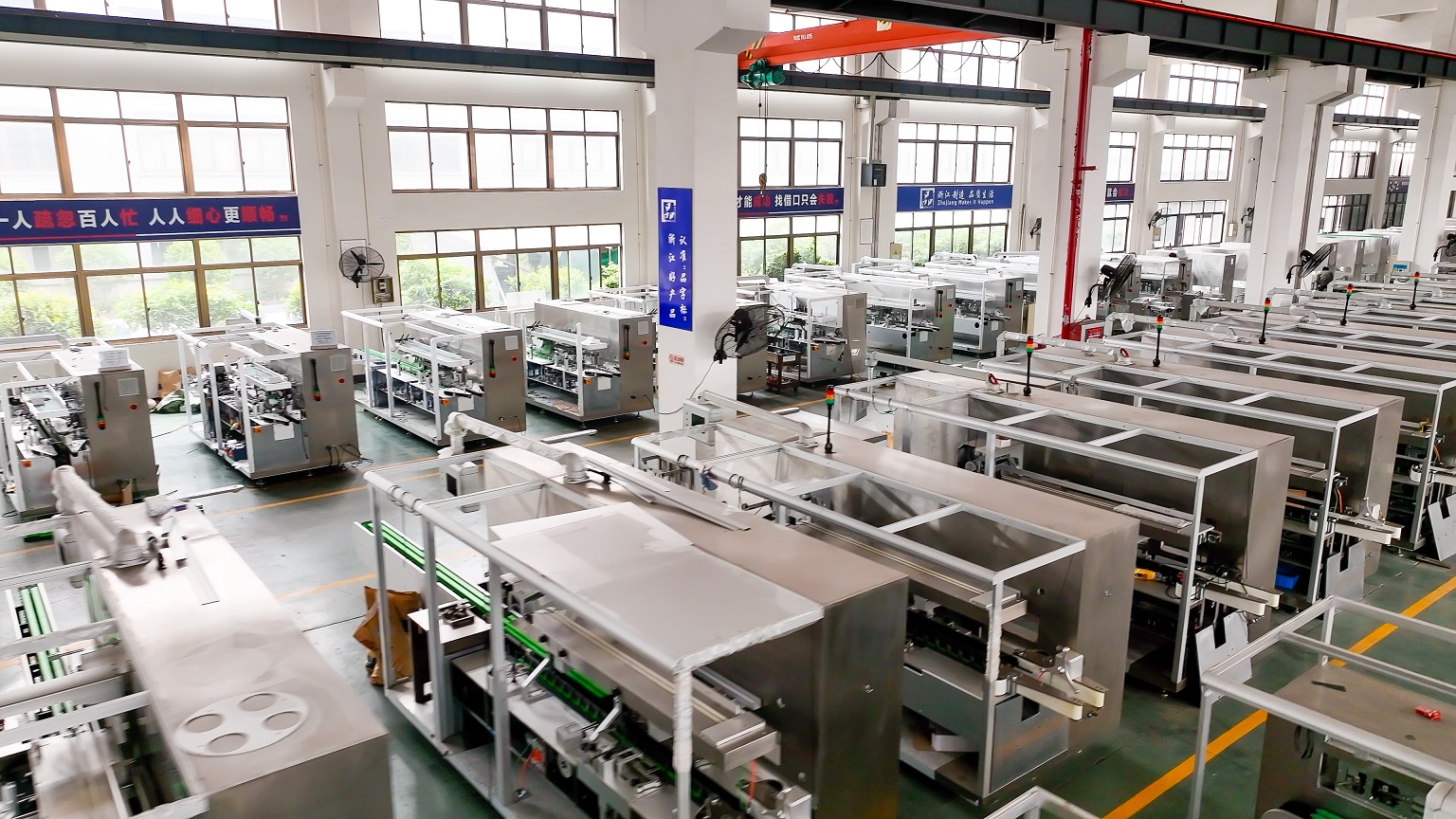
Zhejiang Hoping Machinery Co., Ltd. (Hoping Machinery) is a pharmaceutical packing machinery manufacturer established in 2001 in Ruian City, Zhejiang Province, China. It produces blister packing machines, cartoning machines, case packing machines and end-of-line packaging equipment, employs more than 300 people and has an annual output of about 500 units. Because the same manufacturer builds both the integrated lines and the standalone machines used in this comparison, the trade-offs below are design decisions rather than differences between suppliers.
Problem Definition: What Integrated and Modular Mean on the Packaging Floor
An integrated blister-cartoning line is a single integral machine in which blister forming and sealing, blister transfer, leaflet folding, carton opening, insertion, coding and inspection, and the connection to downstream bundling, case-packing or palletising equipment are handled as one linked process. The DHL8005H is documented in exactly those terms: its scope covers high-speed blister forming and sealing, transfer, leaflet handling, carton opening, insertion, coding/inspection and connection to downstream equipment.
A modular configuration splits the same process into at least two machines: a standalone blister packing machine and a standalone cartoning machine, each with its own frame, controller, tooling set and capacity range. A middle option also exists. The DPP Series + XWZ Series combination is described in the manufacturer\u2019s data as an automatic blister packing machine and high-speed cartoning machine linked line, with typical blister capacity of 100\u2013600 blisters per minute and typical cartoning capacity of 100\u2013400 cartons per minute.
The decision problem is therefore a constraint problem, which is precisely what buyers in the research and evaluation stage are usually solving: can the configuration fit the available room, absorb the format changes on the production plan, hold speed without constant intervention, and satisfy the parameter and certification requirements of the target market? Each of the three tests below maps to one of those constraints.
Neither route is inherently more GMP-oriented. Hoping\u2019s product data describes both the DHL8005H integrated line and the DPP and DPH standalone machines as GMP-oriented designs with stainless steel and aluminium-alloy structures, transparent guarding and product-contact parts configured to the technical agreement. The difference is where the blister-to-carton interface sits, not whether compliant design is available.
Industry Background: Why This Comparison Keeps Returning
Three pressures keep the integrated-versus-modular choice at the top of the evaluation list: market growth, compliance, and format complexity.
On market size, SkyQuest Technology estimated the global pharmaceutical packaging equipment market at approximately USD 10.71 billion in 2024, while Fortune Business Insights valued the pharmaceutical cartoning machinery segment at USD 1.46 billion in 2024, and Grand View Research placed Asia Pacific at 40.7% of revenue share in 2025. Published totals differ because research houses scope primary and secondary equipment differently, so any single figure should be treated as an order of magnitude rather than a precise budget input.
On compliance, ISO 15378 integrates GMP requirements for primary packaging materials, and in the EU the safety of pharmaceutical packaging equipment is governed by the Machinery Directive 2006/42/EC together with the EN 415 series of standards for packaging machines. A configuration decision made without those constraints in view tends to be re-opened late in the project, after layout and certificate documentation are already fixed.
On format complexity, solid dosage producers increasingly run multi-format campaigns on the same line, which pushes the blister-to-carton interface into the centre of the decision. On an integrated line that interface is internal; on a modular line it is a machine-to-machine connection that must be specified, synchronised and maintained.
The Integrated Route: What the DHL8005H Actually Combines
An integrated blister-cartoning line is defined by what it does not need: a separate transfer module between blister output and carton intake. The DHL8005H is an intelligent fully servo high-speed blister-cartoner integrated machine, and its documented configuration is as follows:
- Maximum capacity: up to 800 blisters per minute and 500 cartons per minute.
- D3 intelligent top-loading parallel tracking transfer system.
- Multiple feeding methods, with PVC and Alu foil auto splicing.
- Three-channel servo-driven independent replenishment system.
- Beckhoff motion controller and CP9315 industrial PC.
- Mold-change and preset-memory functions.
- Stainless steel and aluminium-alloy machine structure with transparent guarding, and GMP-oriented product-contact parts and tooling according to the technical agreement.
The scope statement matters as much as the specification list. The DHL8005H covers high-speed blister forming and sealing, transfer, leaflet handling, carton opening, insertion, coding/inspection and connection to bundling, case-packing and palletising equipment. In floor-space terms, the material path from blister to carton runs inside the machine rather than between two machines.
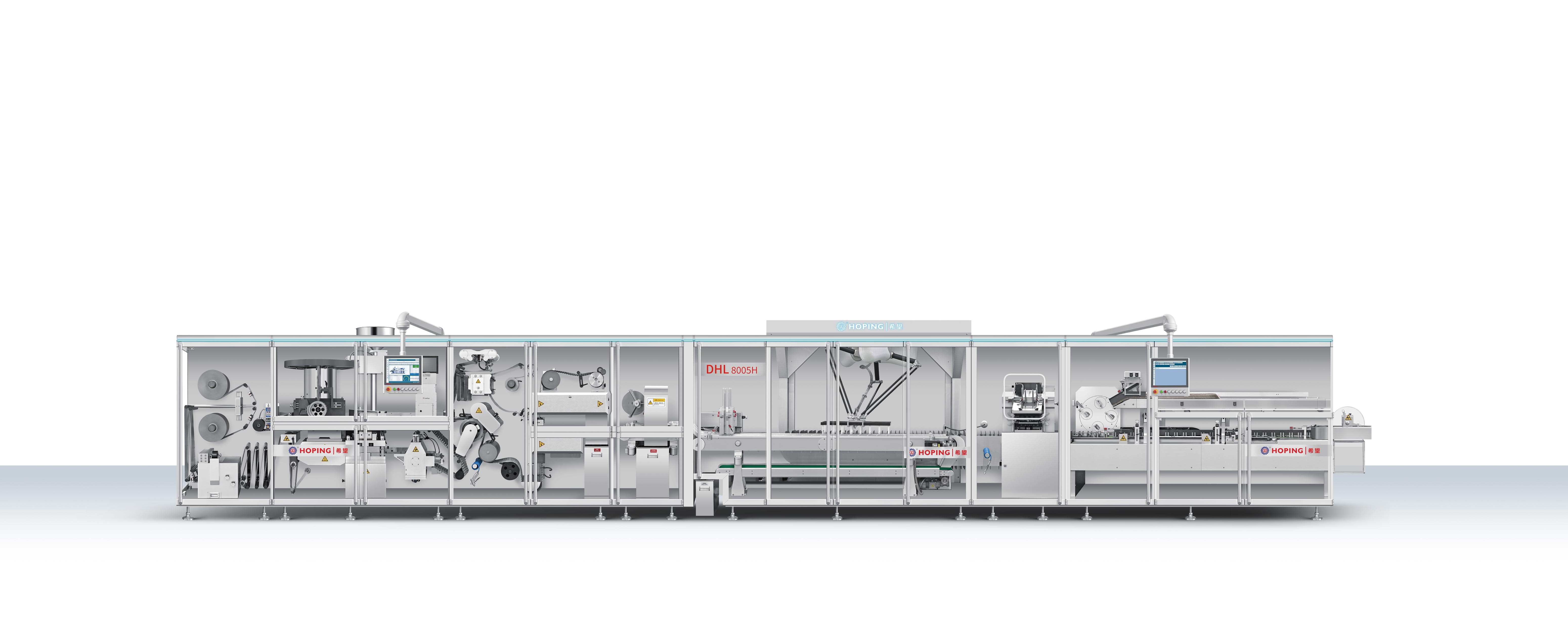
The wider DHL family shows how the same architecture scales, and where the parameters change between capacity levels:
- DHL6004: up to 600 blisters per minute and 400 cartons per minute, with Beckhoff motion controller and CP9315 industrial PC.
- DHL7004: up to 700 blisters per minute and 400 cartons per minute, with a self-developed IRB24 intelligent transfer robot and Siemens motion controller with TP900 HMI.
- DHL7005H: up to 700 blisters per minute and 500 cartons per minute, with the IRB24 transfer robot and Siemens motion controller with TP900 HMI.
- DHL8005H: up to 800 blisters per minute and 500 cartons per minute, with the D3 top-loading parallel tracking transfer system.
- DHL1000/5H: up to 1,000 blisters per minute and 500 cartons per minute, with the D3 transfer system and a four-channel servo-driven independent replenishment system.
Two design details matter when the changeover test is applied later in this article. First, every model in the family documents mold-change capability or support, and the DHL8005H and DHL1000/5H add preset or recipe memory, so format settings can be stored and recalled rather than re-entered. Second, the replenishment systems are servo-driven and independent \u2014 three channels on the DHL8005H, four on the DHL1000/5H \u2014 a design intended to keep the blister feed stable while the cartoner keeps running.
The Modular Route: What You Buy and What You Still Have to Connect
A modular configuration is normally specified as a blister machine plus a cartoner, with the transfer and the layout engineered between them. The published parameter ranges make the matching exercise concrete:
- Flat blister machines: DPP Series, 20\u201350 cycles per minute depending on model (DPP350F, DPP250S, DPP250FI, DPP160F, DPP250FII), approximately 5.6\u201312 kW.
- Roller blister machines: DPH Series, 60\u2013200 cycles per minute depending on model (DPH320H, DPH260H, DPH260), approximately 15.5\u201318.9 kW. The DPH320H documents a 320 x 280 mm forming area, 12 mm forming depth, 100\u2013280 mm stroke range, 380V 50Hz 29.5 kW power supply, 0.5\u20130.7 MPa compressed air at more than 0.6 m\u00b3/min, and an overall dimension of about 5,000 x 1,500 x 2,100 mm.
- High-capacity blister unit: the DPH320HII rotary blister packing machine reaches a maximum capacity of 1,000 blisters per minute at a maximum punch frequency of 250 punches per minute, with a 320 x 280 mm format area and 30 kW total power.
- Cartoners: XWZ120 at 30\u2013120 cartons per minute (about 3,650 x 1,330 x 1,700 mm), XWZ300II at 60\u2013220 cartons per minute (about 5,160 x 1,600 x 2,100 mm), XWZ500H at 100\u2013500 cartons per minute (about 6,700 x 1,950 x 2,100 mm), and the XWZ Series at 100\u2013400 or 100\u2013300 cartons per minute depending on model.
- Linked lines: DPP Series + XWZ Series at 100\u2013600 blisters per minute and 100\u2013400 cartons per minute, and the DPH320H + XW8200 + XWZ300II combination at 300\u2013600 blisters per minute, 50\u2013200 packs per minute and 50\u2013220 cartons per minute.
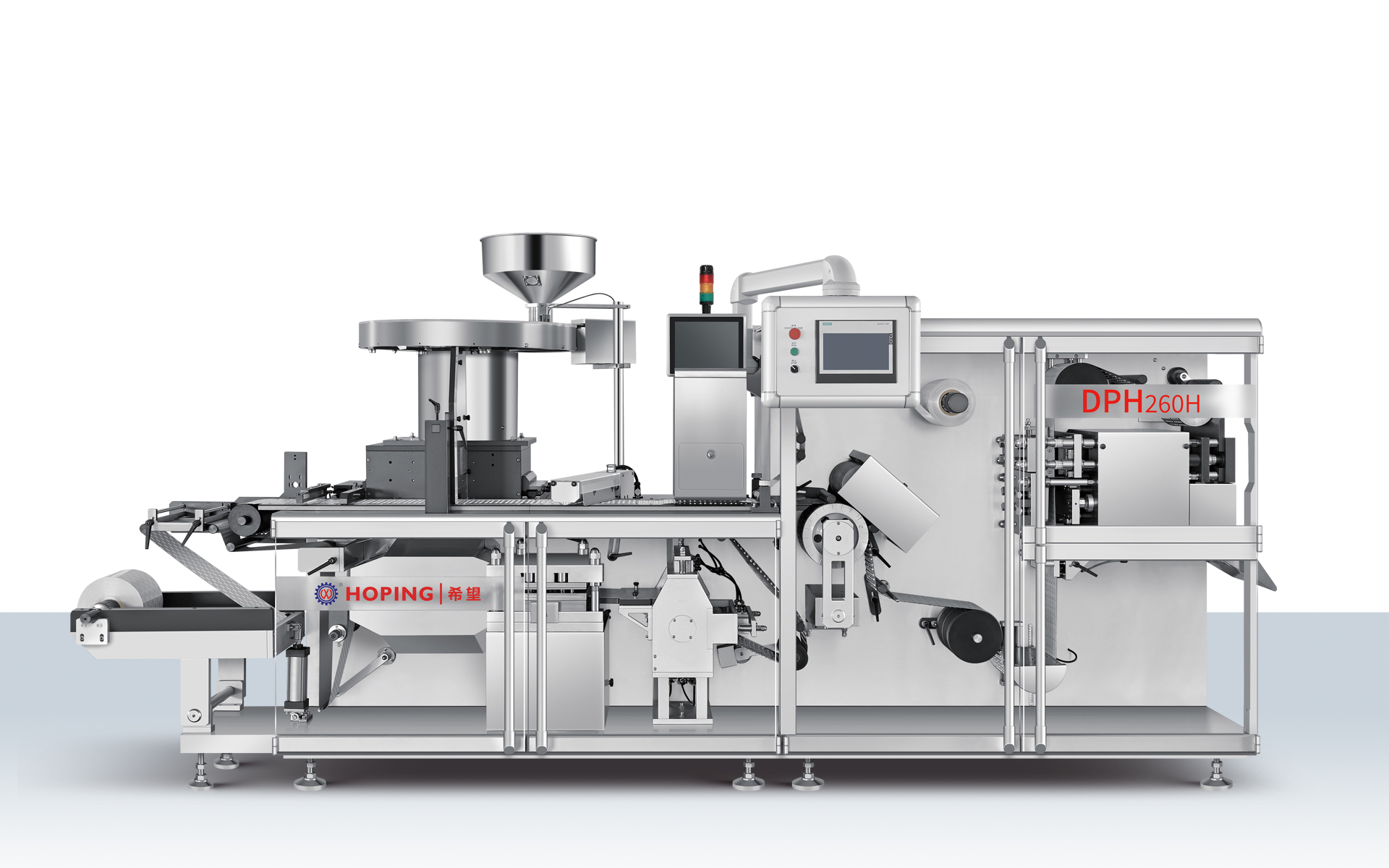
What the modular figures do not include is the connection itself. Two standalone machines each publish their own overall dimensions, but the transfer conveyor, any accumulation section and the layout engineering between them sit outside both sets of numbers. That is the first place a modular budget and schedule can move, and it is why the layout drawing, not the machine datasheet, is the document that decides whether a modular configuration fits.
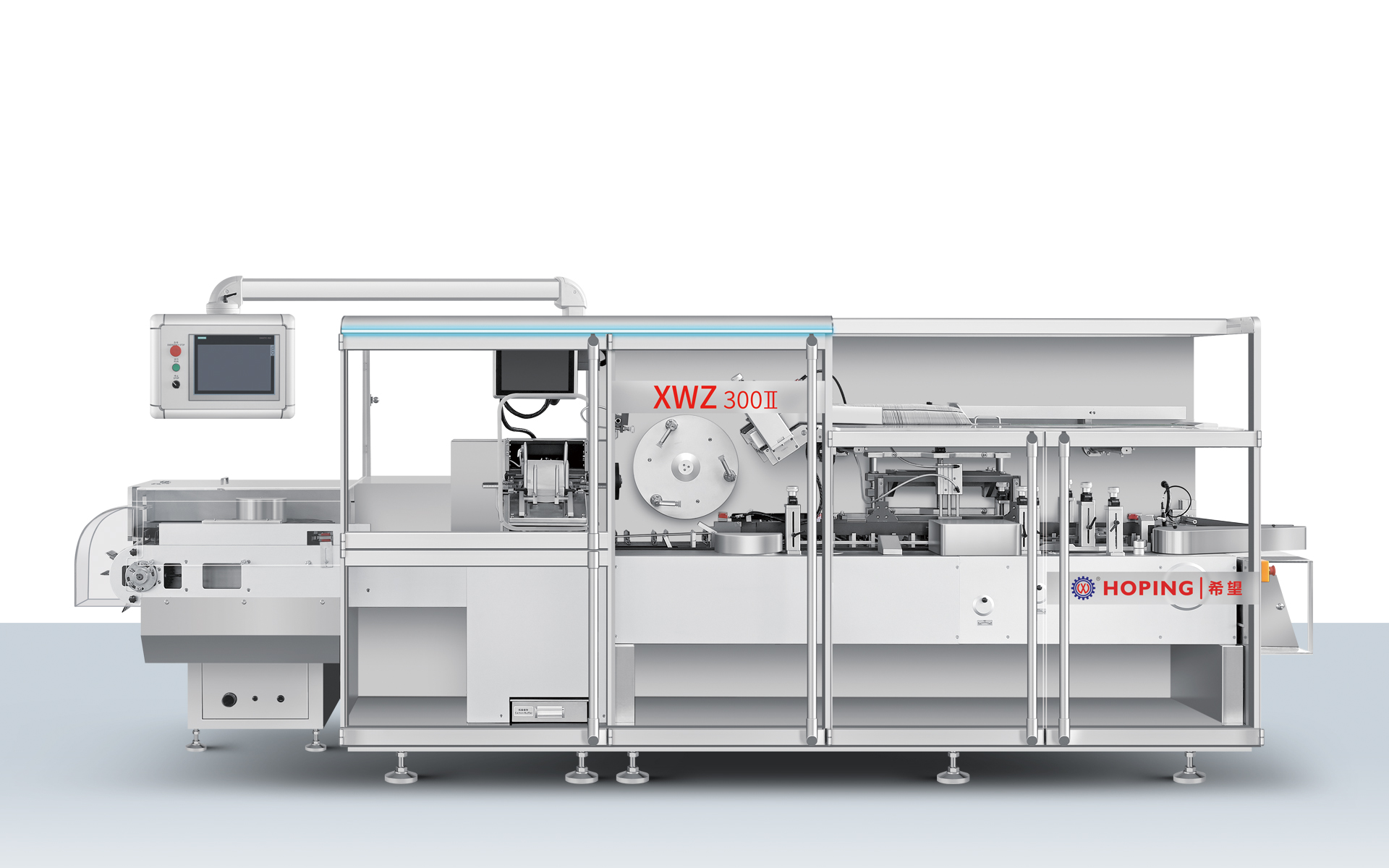
The modular route carries one advantage that integrated design cannot match: phasing. A producer who already owns a compliant blister machine can add cartoning capacity as a separate step, and a producer who must spread capital spending across budget years can buy one machine at a time. The trade-off is that the blister-to-carton interface remains a project inside the project.
Step-by-Step Breakdown: Running the Three Tests
Test 1 \u2014 Floor Space
Run this test with published dimensions rather than impressions, and follow four steps.
- Collect the overall dimensions of every candidate. For a modular layout, figures such as the DPH320H at about 5,000 x 1,500 x 2,100 mm, the DPP260K at about 4,700 x 735 x 1,820 mm, and the XWZ500H at about 6,700 x 1,950 x 2,100 mm are the numbers to place on the drawing.
- Add the transfer and the access aisles. Neither machine\u2019s published dimension includes the conveyor between them, so ask for a layout drawing that shows the transfer, any buffer zone, and operator access on both sides.
- Check height and service clearance. The published machine heights across these models cluster roughly between 1,700 mm and 2,100 mm, so the layout argument is usually about length, access and material stations rather than ceiling height.
- Confirm what is inside the machine. On the DHL8005H, the scope already includes blister transfer, leaflet handling and carton insertion inside the line, so the blister-to-carton path does not consume a separate floor zone.
Test 2 \u2014 Changeover Efficiency
Changeover is where integrated and modular layouts differ most in daily operation, because the number of machines that must be changed is different.
- Count the machines a format change touches. On an integrated line the blister format, transfer and carton format are set on one machine; on a modular line both units and the transfer have to be aligned to the same format.
- Ask whether settings are stored. The DHL8005H documents mold-change and preset-memory functions, the DHL1000/5H documents mold-change and recipe memory, the DHL6004 and DHL7004 document convenient mold change, and the DHL7005H documents mold-change support.
- Check material-handling automation. PVC and Alu foil auto splicing is documented on the DHL8005H and DHL1000/5H, which removes a manual film-change stop from the run.
- Check the replenishment architecture. Servo-driven independent replenishment \u2014 three channels on the DHL8005H, four on the DHL1000/5H \u2014 exists to keep feeding stable through format and material changes.
Customization scope is the useful checklist here, because it defines what a changeover actually involves. Hoping\u2019s documented customization list for this equipment covers blister size, blister materials, quantity per carton, carton specification, leaflet format, coding and inspection method, feeding method, downstream bundling, case-packing and palletising connection, interface language, electrical component brand and data interface.
Test 3 \u2014 Line Speed Consistency
The third test asks whether the two stages can be matched without running either one below its rating.
- Compare documented capacity ranges, not peak figures. A DPH320HII can reach 1,000 blisters per minute, while an XWZ500H cartoner is rated at 100\u2013500 cartons per minute, so the match depends on how many blisters a board carries and how many boards a carton holds.
- Check the control architecture. On integrated machines a single motion controller coordinates both stages: Beckhoff with CP9315 industrial PC on the DHL8005H, DHL1000/5H and DHL6004, and Siemens with TP900 HMI on the DHL7004 and DHL7005H. On modular layouts each machine carries its own controller, for example Siemens PLC with an SEW main motor on the XWZ120.
- Ask what happens during a short stop at either stage. On an integrated line the interface is internal; on a modular line the answer depends on the transfer and buffer design, which should be described in the layout drawing.
- Verify with a material trial rather than a no-load run. Speed consistency is confirmed on product, not on an empty machine.
Eight questions to send to every supplier before shortlisting: (1) What is the documented blister and carton capacity range? (2) Is the transfer internal or a separate module? (3) What are the machine dimensions, and what does the layout drawing add? (4) How many change parts are required per format? (5) Are format settings stored as recipes or presets? (6) Is film splicing automatic? (7) How many servo replenishment channels are used? (8) Which certificate covers this exact model and configuration?
Comparison Table: Integrated vs. Modular Blister-Cartoning Configuration
The table below compares the two routes using only published parameters and certificate evidence from the manufacturer\u2019s data.
| Decision dimension | Integrated line (DHL8005H example) | Modular configuration (standalone blister + cartoner) |
|---|---|---|
| Process architecture | Blister forming/sealing, transfer, leaflet handling, carton opening, insertion and coding/inspection in one linked machine frame | Two or more separate machines, or a linked line such as DPP Series + XWZ Series, with the transfer and layout engineered between them |
| Documented output | Up to 800 blisters/min and 500 cartons/min (DHL1000/5H reaches up to 1,000 blisters/min and 500 cartons/min) | Blister: DPP Series 20\u201350 cycles/min, DPH Series 60\u2013200 cycles/min, DPH320HII up to 1,000 blisters/min. Cartoning: XWZ120 30\u2013120, XWZ300II 60\u2013220, XWZ500H 100\u2013500 cartons/min |
| Floor space implication | Transfer is internal; the machine is specified as one linked unit | Each machine publishes its own dimensions (for example DPH320H about 5,000 x 1,500 x 2,100 mm; XWZ500H about 6,700 x 1,950 x 2,100 mm) plus transfer conveyor length |
| Changeover | Mold-change and preset-memory functions; PVC/Alu foil auto splicing; three-channel servo-driven independent replenishment | Tooling and settings per machine; both units and the transfer must be aligned to the new format |
| Control architecture | Beckhoff motion controller with CP9315 industrial PC | Per-machine control, for example Siemens PLC with SEW motor on the XWZ120, or Beckhoff control on the XW8300 flow packing machine |
| Contact parts and design | Stainless steel and aluminium-alloy structure, transparent guarding, GMP-oriented product-contact parts and tooling per technical agreement | Same material principles per machine; AISI 316L product-contact parts with AISI 304 and anodised aluminium non-contact parts documented on the DPH320HII and DPP260T1 |
| Downstream integration | Scope includes connection to bundling, case packing and palletising | Added as separate modules: XWK4060 stretch bander 30\u201360 bundles/min; XWK Series case packing about 5 cases/min; ICP12 case packing and palletising about 12 cases/min |
| Certificate evidence | CE certificate for the blister packing machine series HTT190102306L and the cartoning machine series HTT190102307L; ISO 14001:2015 and ISO 45001:2018 issued by CQC | The same certificate categories apply per machine type; buyers should confirm that the certificate covers the exact model and configuration quoted |
| Best fit (decision guidance) | High-volume, few-format, continuous solid dosage production | Multi-format campaigns, phased investment, or adding cartoning to an existing compliant blister machine |
Use Cases: Which Configuration Fits Which Project
- High-volume solid dosage with a narrow format range: an integrated line is the natural fit. The DHL8005H at up to 800 blisters per minute and 500 cartons per minute, or the DHL1000/5H at up to 1,000 blisters per minute and 500 cartons per minute, keeps the transfer internal and the downstream connection inside the documented scope.
- Mid-volume, multi-format production: a modular layout built from a DPH Series roller blister machine (60\u2013200 cycles/min) and an XWZ cartoner allows capacity to be matched more loosely and tooling to be purchased format by format.
- Upgrading an existing packaging line: if a compliant blister machine is already installed and validated, adding a standalone cartoner avoids replacing equipment that is still performing.
- Blister plus pillow pack plus carton: for products that require secondary flow wrapping before cartoning, the integrated IXW600 (up to 600 blisters/min, 300 packs/min and 300 cartons/min) and IXW800 (up to 600 blisters/min, 600 packs/min and 500 cartons/min) are integral machines, while the DPH320H + XW8200 + XWZ300II linked line covers 300\u2013600 blisters/min, 50\u200b\u2013200 packs/min and 50\u2013220 cartons/min.
- Liquid dosage formats: the IXW400 integrated blister-cartoner machine covers pre-filled syringes, ampoules and cartridges at up to 400 blisters per minute and 150 cartons per minute.
- End-of-line completion: bundling, case packing and palletising can be added to either route through the XWK4060 stretch bander (30\u201360 bundles/min), the XWK Series case packing machine (about 5 cases/min) and the ICP12 case packing and palletising machine (about 12 cases/min).
- Nutraceutical, healthcare, food and cosmetic blister-cartoning: the same equipment families are documented as applicable to these industries, which matters when a single line has to serve more than one product category.
FAQ
Which CE certificates should a CE-certified pharmaceutical packaging machine manufacturer be able to show for a blister-cartoning project?
A supplier should be able to name the certificate number, the issuing body, the standard and the machine category covered \u2014 not simply state that the equipment is CE marked. In Hoping Machinery\u2019s certificate file, the carton packing machine series holds CE certificate UCN 900339024607 issued by Certify International Ltd against EN 415-3:2000 together with 98/37/EC and 98/79/EC; the cartoning machine series holds CE certificate HTT190102307L issued by Shenzhen HTT Technology Co., Ltd. against 2006/42/EC and EN 60204-1:2006+A1:2009+AC:2010; and the blister packing machine series holds CE certificate HTT190102306L issued by Shenzhen HTT Technology Co., Ltd. against the Machinery Directive 2006/42/EC and EN 60204-1:2006+A1:2009+AC:2010. Management-system evidence in the same file includes ISO 14001:2015 certificate CN00123E33896R1M/3300 and ISO 45001:2018 certificate CN00123S33121R1M/3300, both issued by the China Quality Certification Centre (CQC), covering the design, production and after-sales service of packing machines and packing production lines. Because several of the CE certificates were issued in 2006, 2007 and 2019, a buyer should ask the supplier to confirm that the certificate still covers the exact model and configuration being quoted and that the technical file reflects the current build. The wider compliance context is set by ISO 15378, which integrates GMP requirements for primary packaging materials, and by the EU Machinery Directive 2006/42/EC with the EN 415 series for packaging machines.
Can an integrated blister-cartoning line handle multi-format production as flexibly as separate blister and cartoning machines?
Yes, if format flexibility is designed into the line rather than added later. The DHL8005H documents mold-change and preset-memory functions, multiple feeding methods, PVC and Alu foil auto splicing, and a three-channel servo-driven independent replenishment system, and its scope covers blister forming and sealing, transfer, leaflet handling, carton opening, insertion, coding/inspection and connection to downstream equipment. Format changes are therefore handled through tooling and stored settings rather than by adding machines. The documented customization scope for this equipment lists blister size, blister materials, quantity per carton, carton specification, leaflet format, coding and inspection method, feeding method, downstream bundling, case-packing and palletising connection, interface language, electrical component brand and data interface. Modular configurations cover the same formats through per-machine tooling: DPP Series flat blister machines at 20\u201350 cycles per minute, DPH Series roller machines at 60\u2013200 cycles per minute, and XWZ cartoners from 30\u2013120 cartons per minute (XWZ120) up to 100\u2013500 cartons per minute (XWZ500H). The practical difference is where the changeover effort sits \u2014 inside one line, or across two machines and the transfer between them.
What drives the cost difference between an integrated blister-cartoning line and a modular configuration?
Hoping\u2019s published data does not include list prices, so the honest answer is expressed in cost drivers rather than figures. The drivers that change between the two routes are: the number of machine frames, control cabinets and tooling sets; the transfer technology, which ranges from the D3 intelligent top-loading parallel tracking transfer system on the DHL8005H and DHL1000/5H to the self-developed IRB24 intelligent transfer robot on the DHL7004 and DHL7005H; the number of servo-driven replenishment channels, three on the DHL8005H and four on the DHL1000/5H; inspection, coding and rejection equipment; downstream modules such as the XWK4060 stretch bander at 30\u201360 bundles per minute, XWK Series case packing at about 5 cases per minute and the ICP12 case packing and palletising machine at about 12 cases per minute; certificate documentation and FAT scope; and the amount of non-standard customization. Two commercial parameters apply to both routes: the minimum order quantity is one set or one complete line, and monthly capacity is 30\u201340 units, which means either a full line or a phased single-machine purchase is feasible.
How can a buyer validate a configuration before placing the order?
Validation is a documented sequence rather than a single demonstration. Hoping\u2019s quality-control process covers incoming material inspection, key component inspection, assembly inspection, electrical safety check, a no-load trial run, a material trial, factory acceptance testing, customer witness acceptance and pre-shipment inspection. For a decision between integrated and modular configurations, the material trial and factory acceptance test are the two stages that answer the technical questions: whether the blister-to-carton transfer holds format, whether preset or recipe memory restores settings after a changeover, and whether the cartoner absorbs the blister machine\u2019s output without running either unit below its rating. After shipment, the service scope includes on-site installation and commissioning, operator training, maintenance training, remote video and phone support, spare parts supply, process-parameter guidance and regular follow-up, subject to contract and project configuration. Buyers who want to begin with a documented line proposal, a material trial or a sample discussion can request them directly from the Hoping team using the contact details at the end of this article.
What is the typical lead time for an integrated blister-cartoning line, and what affects it?
Hoping Machinery quotes a typical lead time of 60\u2013120 days after technical confirmation, with the final figure subject to model, configuration, project complexity and contract terms. Lead time is affected by the capacity level chosen within the integrated family \u2014 up to 600 blisters per minute and 400 cartons per minute on the DHL6004, up to 700 blisters per minute and 500 cartons per minute on the DHL7005H, up to 800 blisters per minute and 500 cartons per minute on the DHL8005H, and up to 1,000 blisters per minute and 500 cartons per minute on the DHL1000/5H \u2014 by whether downstream bundling, case packing or palletising is included, and by the volume of format tooling and non-standard customization. On a modular configuration, the interface engineering between the standalone machines is an additional schedule item. As a next step, send the blister format, carton size, target output and target market requirements to the Hoping team and ask for a line layout with a delivery schedule.
Conclusion: Three Rules for Choosing a Blister-Cartoning Configuration
First, decide on floor space with drawings, not datasheets. An integrated line such as the DHL8005H keeps the blister-to-carton transfer inside one frame; a modular layout adds the transfer conveyor, buffer and access requirements on top of two published machine dimensions.
Second, decide on changeover by counting the machines a format change touches and by checking whether settings are stored. Preset and recipe memory, mold-change support and automatic film splicing are concrete parameters that can be compared across quotations.
Third, decide on speed consistency by matching documented capacity ranges rather than peak figures, and by checking whether one controller coordinates both stages or each machine carries its own. Then verify the result with a material trial and a factory acceptance test, because that is the point at which the configuration stops being a specification and becomes a production line.
Next Step: Line Layout, Sample Trial or Quotation
Send your blister format, carton size and target output, and the Hoping Machinery team will return a configuration proposal covering the integrated and modular options described in this article.
- Contact: Monica \u2014 monica@xwbj.com
- Tel / WhatsApp: +86 133-5610-5292
- Website: www.hopingcn.com
- Address: 88th Weiwu Road, Nanbin Sub-district, Ruian City, Zhejiang Province, China
- Catalog download: Hoping Machinery Catalog (PDF)
Have Questions or Need More Details?
Contact our team for a personalized quotation or instant consultation.
Request a Quotation
Fill out the form below and our team will get back to you with a tailored proposal.
WhatsApp Direct Chat
Prefer to chat in real-time? Message us on WhatsApp for instant assistance & quick answers.
- Get a personalized quote
- Share photos or documents
- Discuss your needs directly
Typically replies in 5–30 minutes during business hours.