
Integrated Blister-Cartoner vs. Standalone Cartoner: Making the Call
Choosing between an integrated blister-cartoner and a standalone cartoner is not a contest between two machines. It is a decision about where blister packs become cartons, which system owns that transfer, and how much floor space, buffer stock and manual handling the plant is prepared to carry.
This guide compares both architectures for end-to-end solid dosage pharmaceutical packaging and works through the three factors that decide most projects: floor space, material handling and synchronisation. The integrated reference point is the DHL8005H, an intelligent fully servo high-speed blister-cartoner integrated machine from Zhejiang Hoping Machinery Co., Ltd. (Hoping Machinery) — a pharmaceutical packing machinery manufacturer established in 2001 in Ruian City, Zhejiang Province, China — rated at up to 800 blisters/min and 500 cartons/min.
Short answer: an integrated blister-cartoner suits a project where the blister format and the carton format are stable, the required output is high, and one linked system should own the blister-to-carton transfer. A standalone cartoner suits a plant where the cartoner must be matched to a blister machine that already exists, where upstream product formats vary independently of carton formats, or where only the cartoning stage is being upgraded. The deciding variables are floor space, material handling and synchronisation — not catalogue speed alone.
What the Integrated vs Standalone Decision Actually Settles
An integrated blister-cartoner line completes high-speed blister forming and sealing, transfer, leaflet handling, carton opening, insertion, coding and inspection, and the connection to bundling, case-packing and palletising equipment within one linked system. A standalone cartoner begins at carton forming or opening and ends at carton closing: it receives product from an external infeed and has no blister-forming scope of its own.
That boundary difference moves five project variables at once:
- Where the transfer happens. On an integrated line the blister-to-carton transfer is a machine function, implemented by a top-loading transfer system or an intelligent transfer robot. With two separate machines, the transfer sits between two frames and must be engineered as an infeed arrangement.
- Buffer and work in progress. Separate units generally need a buffer so that a stop on one does not immediately stop the other; an integrated line reduces the amount of product held between blister packing and cartoning.
- Floor area and access aisles. A standalone cartoner publishes a fixed footprint, but the blister machine, the transfer section, the carton and leaflet staging area and operator access all sit outside that footprint.
- Cleanroom zoning and personnel flow. Integrated transfer keeps the product path inside one guarded enclosure; a two-machine layout creates an additional interface to be documented, cleaned and monitored.
- Acceptance and validation scope. One linked system means one specification, one trial run and one factory acceptance test covering blister and carton output together.
Industry Background: Why Line Architecture Is a Current Question
The commercial context supports both directions. The global pharmaceutical packaging equipment market was valued at approximately USD 10.71 billion in 2024 (SkyQuest Technology). The pharmaceutical cartoning machinery segment was valued at USD 1.46 billion in 2024 (Fortune Business Insights), and the blister packaging machine market is projected to reach USD 2.57 billion by 2025 at a CAGR of 2.8% (Custom Market Insights). Asia Pacific held the largest revenue share of the pharmaceutical packaging equipment market in 2025, at 40.7% (Grand View Research).
Published figures should be read with care: SkyQuest's 2024 estimate of about USD 10.71 billion and Grand View Research's 2025 estimate of approximately USD 7.0 billion describe overlapping but not identical scopes, because definitions of primary versus secondary packaging equipment differ between studies.
Supply is concentrated at the top and broad below it. The three largest blister packaging machine suppliers — Uhlmann, IMA and Marchesini — hold approximately 29% of that market (Market Intelligence Report). For buyers, the practical consequence is that the comparison between an integrated and a standalone architecture usually runs across a wide field of suppliers rather than only the three largest.
Compliance expectations are the second driver. ISO 15378 integrates GMP requirements for primary packaging materials, and in the EU, packaging machinery safety is governed by Machinery Directive 2006/42/EC together with the EN 415 series for packaging machines. These requirements apply to either architecture, but they change how many interfaces have to be documented, cleaned and validated.
In project terms, the architecture question surfaces most often in five situations: a new solid dosage blister packaging line, an upgrade of an existing packaging line, a high-capacity expansion, an intelligent packaging workshop retrofit, and a blister-cartoning-bundling or case-packing downstream integration project.
What Each Configuration Contains
Inside an integrated blister-cartoner line
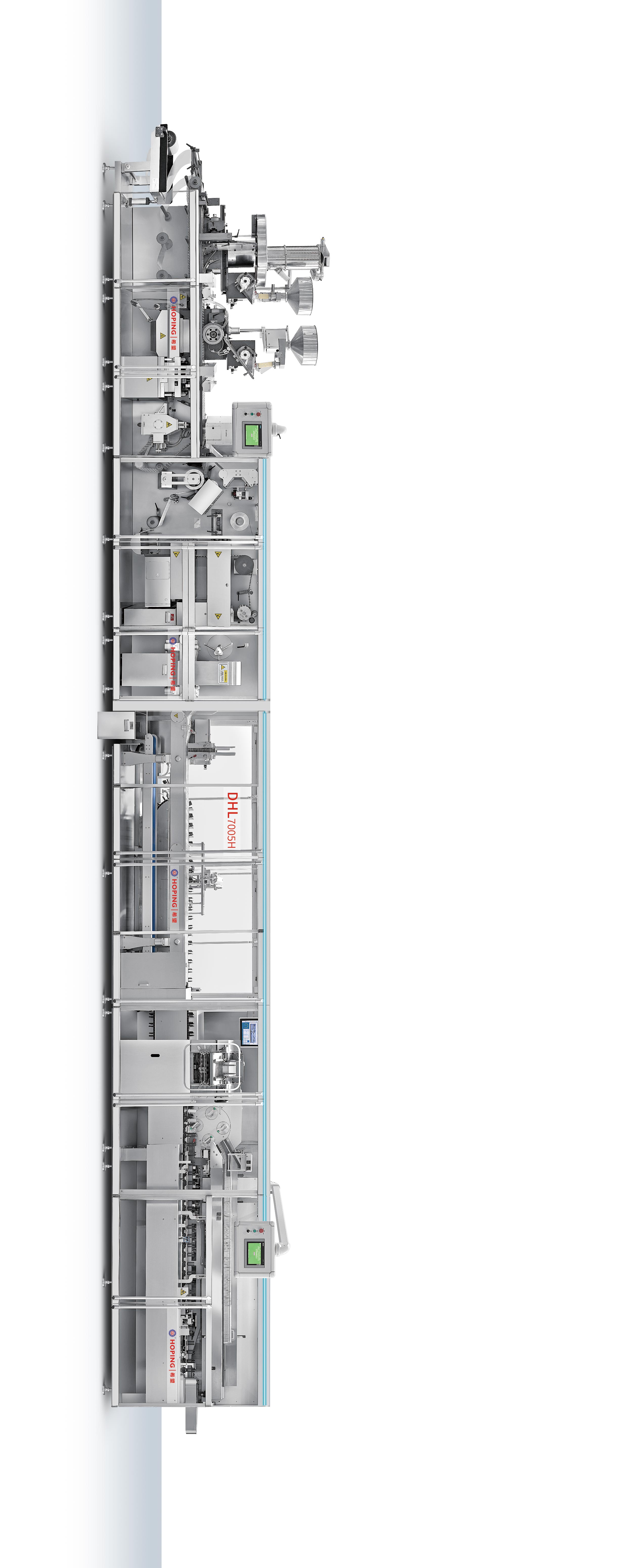
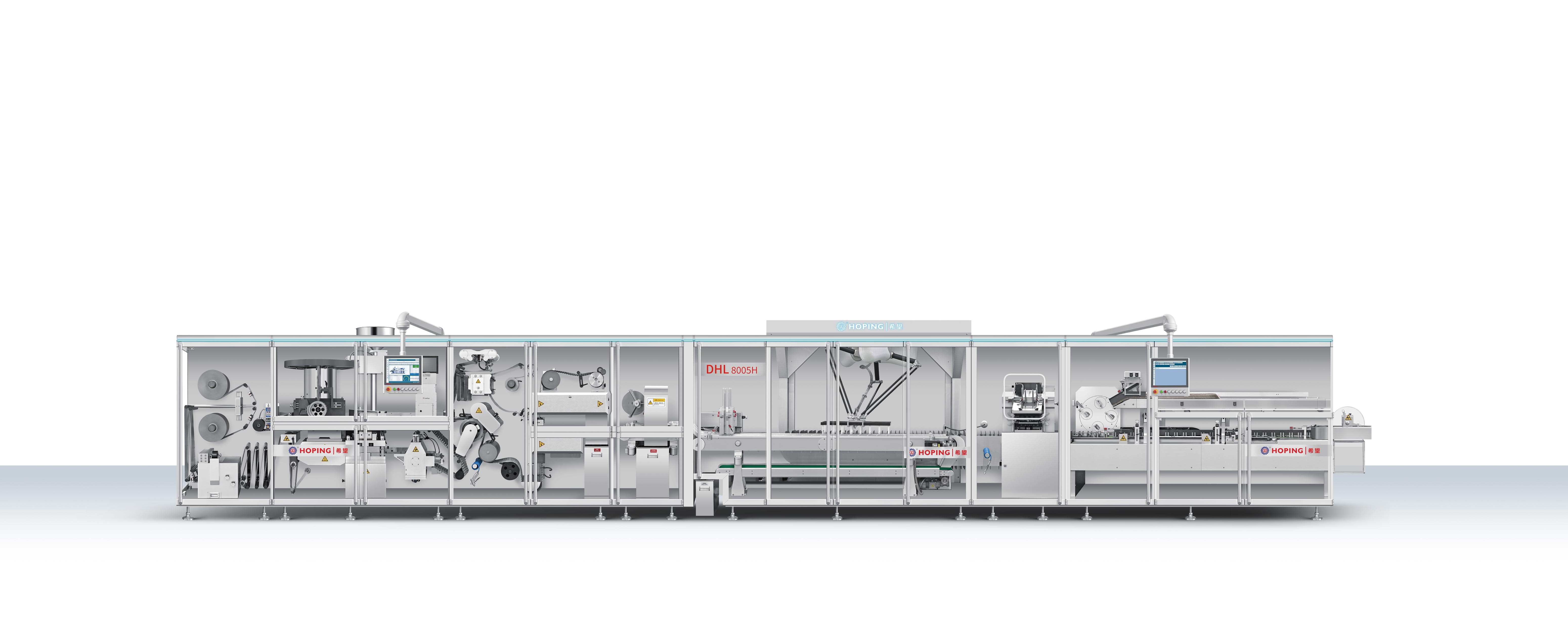
The DHL8005H is a useful benchmark because its specification describes integration in concrete terms. It is an intelligent fully servo high-speed blister-cartoner integrated machine with a maximum capacity of up to 800 blisters/min and 500 cartons/min. Its scope covers high-speed blister forming and sealing, transfer, leaflet handling, carton opening, insertion, coding and inspection, and connection to bundling, case-packing and palletising equipment.
Its integration elements include a D3 intelligent top-loading parallel tracking transfer system, multiple feeding methods, PVC and aluminium foil auto splicing, a three-channel servo-driven independent replenishment system, a Beckhoff motion controller with a CP9315 industrial PC, mould-change and preset-memory functions, and a GMP-oriented line design. The machine structure is stainless steel and aluminium alloy with transparent guarding and servo-driven motion components.
The same family shows how the architecture scales. The DHL1000/5H reaches up to 1,000 blisters/min and 500 cartons/min with the D3 transfer system and a four-channel servo-driven independent replenishment system. The DHL7005H reaches up to 700 blisters/min and 500 cartons/min with a self-developed IRB24 intelligent transfer robot and a Siemens motion controller with a TP900 HMI. The DHL6004 is rated up to 600 blisters/min and 400 cartons/min with a Beckhoff motion controller and CP9315 industrial PC, and the DHL7004 up to 700 blisters/min and 400 cartons/min with the IRB24 transfer robot and Siemens control platform.
Inside a standalone cartoner
A standalone cartoner is a second-packaging machine, not a line. Hoping's range illustrates the granularity available:
- XWZ500H — full servo high-speed cartoning machine, about 100–500 cartons/min, 380V 50Hz 14 kW, overall dimension about 6,700 × 1,950 × 2,100 mm, net weight about 6,000 kg. Scope: high-speed carton opening, product insertion, leaflet insertion, carton closing, and coding/inspection integration according to project configuration.
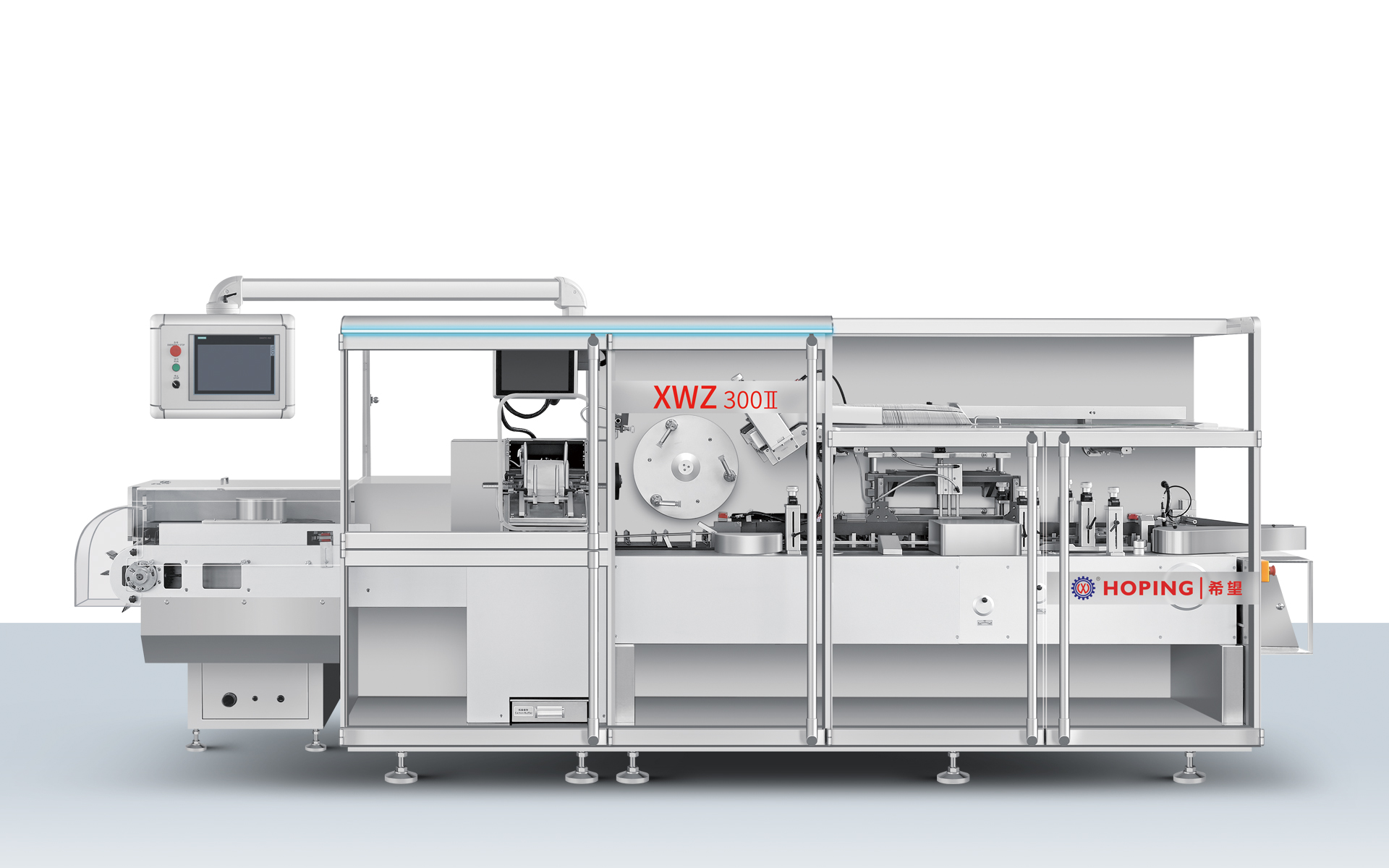
- XWZ300II — intelligent high-speed cartoning machine, about 60–220 cartons/min, 5 kW, about 5,160 × 1,600 × 2,100 mm, net weight about 4,800 kg. Scope: automatic carton forming/opening, insertion and closing for medium-to-high speed secondary packaging.
- XWZ120 — horizontal cartoning machine, about 30–120 cartons/min, 3.5 kW, about 3,650 × 1,330 × 1,700 mm, net weight about 2,700 kg, for lower-to-medium speed products and compact production lines. The model is also specified with a Siemens PLC control system, an SEW main motor and a carton magazine capacity of 600–700 pieces, with a balcony-style frame design for easier cleaning.
- XWZ Series — XWZ400 and XWZ300 models at about 100–400 or 100–300 cartons/min, accepting blister boards, sachets, bottles and tubes subject to confirmed format.
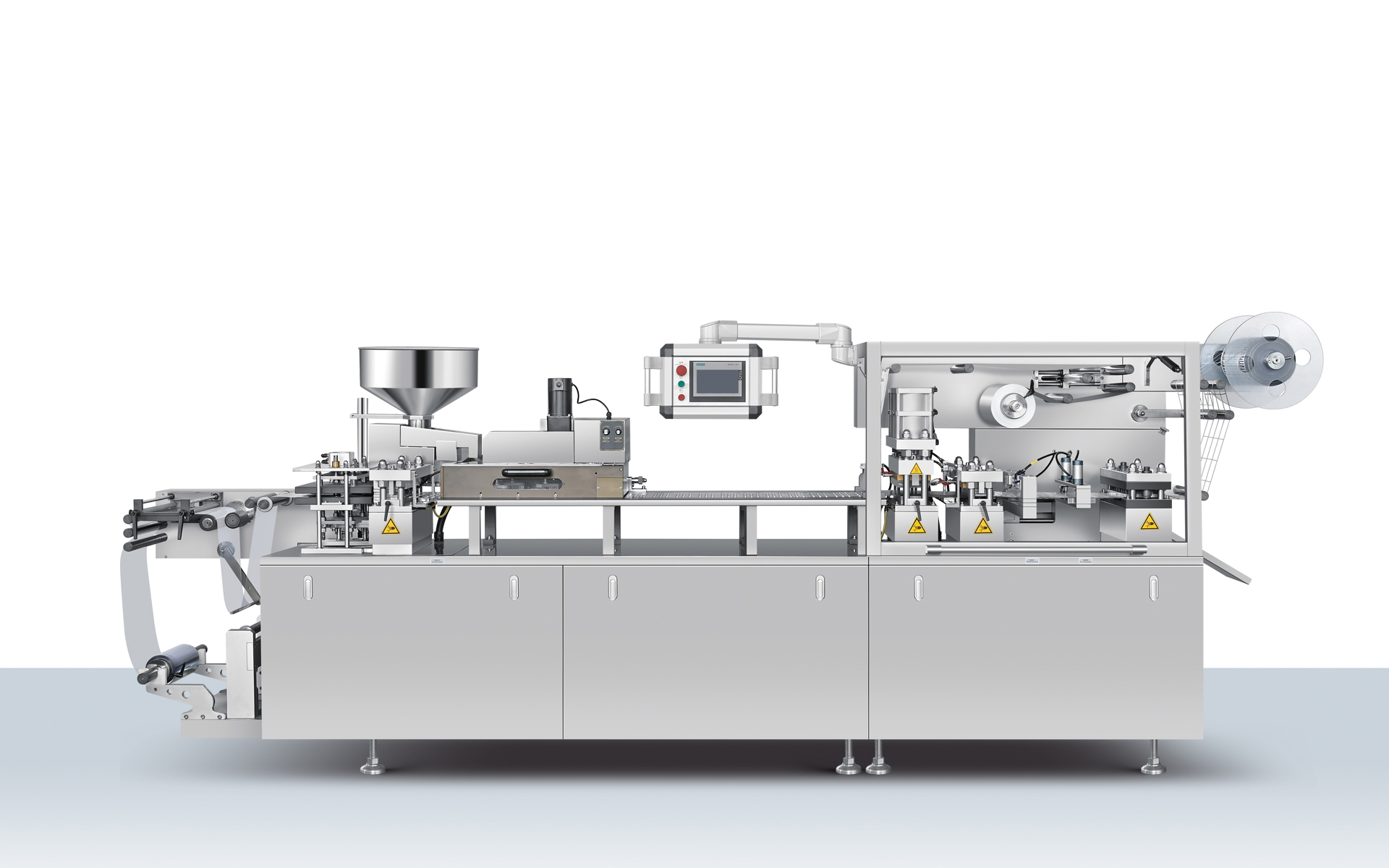
What none of these machines includes is a blister-forming section or a blister-to-carton transfer. In a standalone configuration that work is provided by the upstream blister machine — for example a DPP260T1 platen blister packaging machine with a maximum capacity of 300 blisters/min — plus the linking conveyor or buffering arrangement between the two units.
How the Two Architectures Compare in Practice
Floor space and layout
Standalone cartoners publish fixed footprints: the XWZ120 at about 3,650 × 1,330 × 1,700 mm and about 2,700 kg, the XWZ300II at about 5,160 × 1,600 × 2,100 mm and about 4,800 kg, and the XWZ500H at about 6,700 × 1,950 × 2,100 mm and about 6,000 kg. Those numbers describe the cartoner alone. The blister machine, the transfer arrangement between the two units, carton and leaflet staging, and operator access aisles all sit outside that figure, so the layout work moves to the plant or the line integrator.
On an integrated line, layout is a project deliverable. Blister size, blister materials, quantity per carton, carton specification, leaflet format, coding and inspection method, feeding method, and the downstream bundling, case-packing or palletising connection are all confirmed before the line is built. The result is a layout that is less predictable on paper and more predictable on the floor, because blister-to-carton transfer and product staging happen inside the machine frame rather than in the aisle.
Material handling and replenishment
The DHL8005H specifies a D3 intelligent top-loading parallel tracking transfer system, multiple feeding methods, PVC and aluminium foil auto splicing, and a three-channel servo-driven independent replenishment system; the DHL1000/5H uses the same D3 transfer architecture with four replenishment channels. In a standalone arrangement, the cartoner's infeed, product orientation and buffer are physically separate from the blister machine, so blister boards must be transferred and, in most layouts, accumulated between two frames.
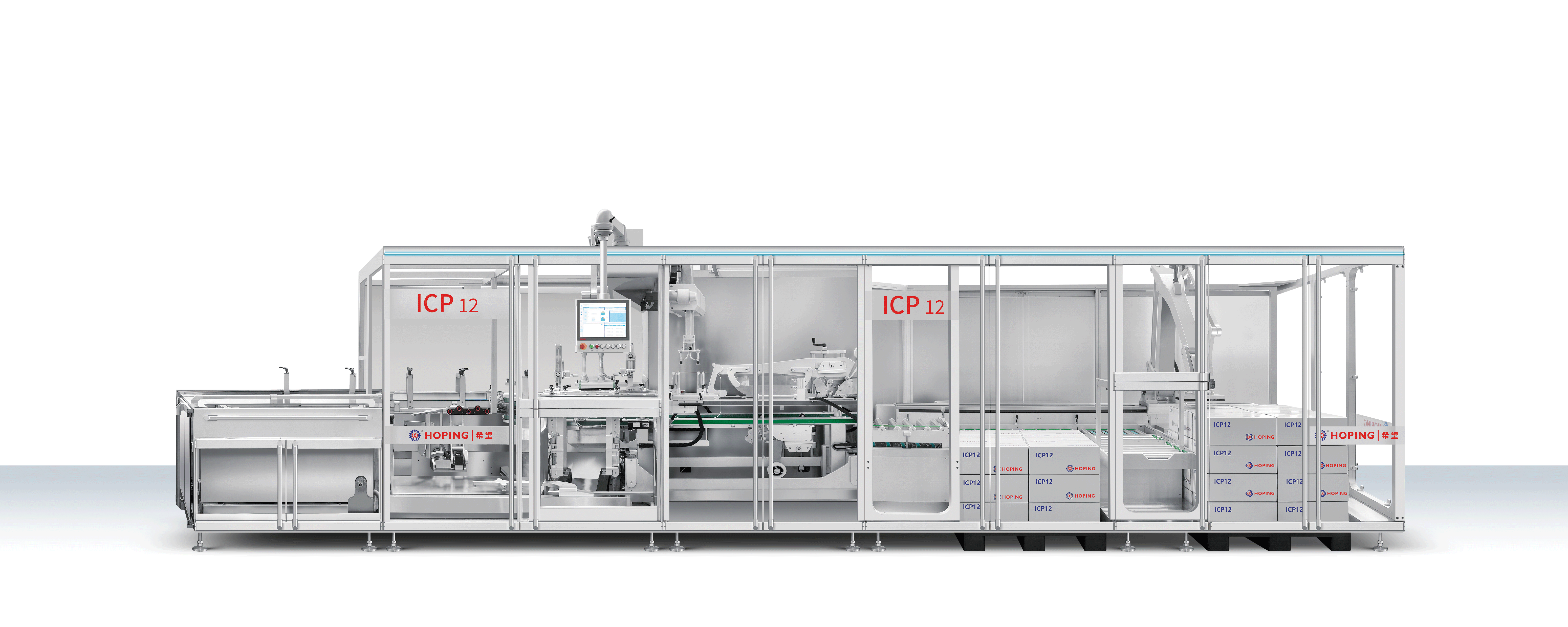
Downstream, both architectures end in the same place. Hoping's end-of-line modules include the XWK4060 stretch bander at about 30–60 bundles/min, the XWK Series case packing machine at about 5 cases/min, and the ICP12 case packing and palletising integral machine at about 12 cases/min. The difference is how many mechanical, electrical and control interfaces must be coordinated to reach them.
Synchronisation and control
An integrated line runs in fully servo-linked operation with a PLC/HMI interface and synchronised multi-station control. On the DHL8005H, a Beckhoff motion controller with a CP9315 industrial PC coordinates blister, transfer and cartoning motion, supported by mould-change and preset-memory functions; the DHL7005H uses a Siemens motion controller with a TP900 HMI. Alarm stop, fault indication, recipe storage and format changeover are supported according to configuration, and an ERP/MES data interface can be specified where the project requires it.
With two separate machines, each unit keeps its own control system — the XWZ120, for example, is specified with a Siemens PLC and an SEW main motor — and matching blister output to carton input becomes a commissioning task that has to be maintained over the life of the line. That is not a defect of standalone cartoning. It is the trade-off that buys flexibility when the cartoner has to serve more than one product stream.
Step-by-Step Breakdown: Making the Call
- Fix the format envelope first. Define blister size, blister materials, quantity per carton, carton specification and leaflet format before discussing architecture. Every capacity figure in a catalogue is conditional on these inputs.
- Convert the target into two rates. Work out the required blisters/min and the required cartons/min, then compare them with rated ranges: DHL8005H up to 800 blisters/min and 500 cartons/min; XWZ500H about 100–500 cartons/min; XWZ300II about 60–220 cartons/min; XWZ120 about 30–120 cartons/min.
- Measure the space before signing. Add the cartoner footprint, the upstream blister machine footprint, the transfer and buffer zone, carton and leaflet staging and operator access. On an integrated line, ask the supplier to fix the layout against the technical agreement.
- Choose the transfer logic. A top-loading parallel tracking transfer system with multiple feeding methods is the integrated route; an engineered infeed and buffer between two frames is the standalone route. This is the single decision that most changes daily operation.
- Choose the control and data layer. Confirm whether the line will run on a Beckhoff motion controller with a CP9315 industrial PC, a Siemens motion controller with a TP900 HMI, or another platform, and whether an ERP/MES data interface is required.
- Design the end of line at the same time. Bundling with an XWK4060 stretch bander (about 30–60 bundles/min), case packing with an XWK Series machine (about 5 cases/min) or combined case packing and palletising with an ICP12 (about 12 cases/min) should be specified together with the primary packaging decision.
- Define the acceptance test. Hoping's quality-control sequence runs from incoming material inspection and key component inspection through assembly inspection, electrical safety check, no-load trial run, material trial, factory acceptance test, customer witness acceptance and pre-shipment inspection.
- Confirm commercial and support terms. MOQ is 1 set or 1 complete line, and lead time is typically 60–120 days after technical confirmation, subject to model, configuration, project complexity and contract terms.
Use Cases: Which Configuration Fits Which Project
New high-volume tablet or capsule line. Where one product family runs continuously and the carton format is stable, an integrated line such as the DHL8005H (up to 800 blisters/min and 500 cartons/min) or the DHL1000/5H (up to 1,000 blisters/min and 500 cartons/min) keeps the transfer inside the machine and gives one acceptance boundary for blister and carton output.
Capacity expansion on an existing site. If the blister machine is still in service and only the cartoning stage has become the constraint, a standalone XWZ300II or XWZ500H adds cartoning capacity without replacing the upstream equipment.
Multi-format portfolios. Where the cartoner has to handle blister boards alongside sachets, bottles or tubes, the XWZ Series is specified as an independent unit rather than as part of a fixed link.
Middle path: linked separate machines. A DPP Series blister machine linked with an XWZ Series cartoner forms an automatic blister-cartoner production line at typically 100–600 blisters/min and 100–400 cartons/min — two machines with a defined interface rather than one integral frame.
Nutraceutical, healthcare and soft-capsule production. The DHL series applies to pharmaceutical tablets, capsules, soft capsules, nutraceuticals and healthcare products, as well as food and cosmetic blister-cartoning projects.
Liquid dosage and special formats. The same architectural decision exists outside solid dosage: the IXW400 blister-cartoner integrated line is rated up to 400 blisters/min and 150 cartons/min for pre-filled syringes, ampoules and cartridges.
Retrofit and downstream integration projects. For intelligent packaging workshop retrofits and blister-cartoning-bundling/case-packing projects, the integrated route reduces the number of interfaces between primary and secondary packaging.
Comparison Table: Integrated Blister-Cartoner vs Standalone Cartoner
| Decision criterion | Integrated blister-cartoner line | Standalone cartoner |
|---|---|---|
| Scope in the packaging flow | Blister forming/sealing, transfer, leaflet handling, carton opening, insertion, coding/inspection and connection to bundling, case-packing and palletising in one linked system. | Carton forming/opening, product insertion, leaflet insertion and carton closing as a separate machine, fed by an upstream blister machine. |
| Rated capacity (reference models) | DHL8005H up to 800 blisters/min and 500 cartons/min; DHL1000/5H up to 1,000 blisters/min and 500 cartons/min; DHL7005H up to 700 blisters/min and 500 cartons/min. | XWZ500H about 100–500 cartons/min; XWZ300II about 60–220 cartons/min; XWZ120 about 30–120 cartons/min. |
| Blister-to-carton transfer | D3 intelligent top-loading parallel tracking transfer system (DHL8005H, DHL1000/5H); IRB24 intelligent transfer robot (DHL7005H, DHL7004). | Handled by an external infeed arrangement; the cartoner scope begins at carton forming or opening. |
| Feeding and replenishment | Multiple feeding methods; PVC/Alu foil auto splicing; three-channel servo-driven independent replenishment (DHL8005H) or four-channel (DHL1000/5H). | Accepts blister boards, sachets, bottles and tubes subject to confirmed format (XWZ Series). |
| Control platform | Beckhoff motion controller with CP9315 industrial PC (DHL8005H); Siemens motion controller with TP900 HMI (DHL7005H). | Siemens PLC with SEW main motor (XWZ120); servo, electrical and pneumatic modules (XWZ300II). |
| Format changeover | Mould-change and preset-memory functions; alarm stop, fault indication and recipe storage according to configuration. | Carton magazine capacity 600–700 pieces and balcony-style frame design for easier cleaning (XWZ120). |
| Footprint data | Line layout, feeding method and downstream connection are configured per project. | XWZ120 about 3,650 × 1,330 × 1,700 mm / 2,700 kg; XWZ300II about 5,160 × 1,600 × 2,100 mm / 4,800 kg; XWZ500H about 6,700 × 1,950 × 2,100 mm / 6,000 kg. |
| Downstream options | Direct connection to bundling, case packing and palletising; XWK4060 stretch bander about 30–60 bundles/min; ICP12 case packing and palletising about 12 cases/min. | Downstream modules specified separately; XWK Series case packing machine about 5 cases/min; ICP12 about 12 cases/min. |
| Typical project fit | New solid dosage blister packaging lines, existing line upgrades, high-capacity expansion, intelligent workshop retrofit, and blister-cartoning-bundling/case-packing downstream integration projects. | Automatic horizontal cartoning for lower-to-medium speed products and compact production lines. |
FAQ
Does an integrated blister-cartoner line change the GMP or compliance scope compared with a standalone cartoner?
Compliance scope is set by documentation and product-contact requirements rather than by whether the machines are separate. ISO 15378 integrates GMP requirements for primary packaging materials, and in the EU, packaging machinery safety is governed by Machinery Directive 2006/42/EC with the EN 415 series. Hoping builds blister-cartoning lines with GMP-oriented design, stainless steel and aluminium-alloy structures, transparent guarding, and product-contact parts and tooling defined in the technical agreement; Hoping states CE and ISO 9001/14001 certifications for its equipment. Either way, agree the documentation and acceptance scope in the technical agreement before purchase.
What should a pharmaceutical packaging machine manufacturer for blister lines be able to demonstrate?
For blister lines, the manufacturer should cover blister packing, cartoning and end-of-line modules as one project scope. Hoping Machinery, established in 2001, produces blister packing machines, cartoners, case packers and end-of-line packaging machines with an R&D team of 56 engineers, an annual output of about 500 units and a monthly capacity of 30–40 units. Its portfolio includes 26 invention patents, 70 utility patents, 4 appearance patents, 10 PCT-protected items in Europe, Russia, Germany, Italy and other countries, and 28 software copyrights. Customisation covers blister size, blister materials, quantity per carton, carton specification, leaflet format, coding/inspection method, feeding method, downstream bundling/case-packing/palletising connection, interface language, electrical component brand and data interface.
What drives the budget difference between an integrated blister-cartoner and a standalone cartoner?
Budget planning starts from the configured scope of supply rather than from a headline capacity number. The specification items that change that scope include blister size and materials, quantity per carton, carton specification, leaflet format, coding and inspection method, feeding method, the downstream bundling, case-packing or palletising connection, interface language, electrical component brand and data interface. On the integrated side, transfer architecture, foil auto splicing, replenishment channels and the control platform are among the defining choices; on the standalone side, the carton rate range and the product infeed arrangement are. Hoping's MOQ is 1 set or 1 complete line. Compare quotations on an identical scope — same capacity, same feeding method, same inspection scope, same downstream connection — rather than on catalogue speed alone.
Can we run a material trial or factory acceptance test before shipment?
Yes. Hoping's quality-control sequence covers incoming material inspection, key component inspection, assembly inspection, electrical safety check, no-load trial run, material trial, factory acceptance test, customer witness acceptance and pre-shipment inspection. This sequence applies whether the project is a complete integrated blister-cartoner line or a standalone cartoner. On site, the scope can include installation and commissioning, operator training and maintenance training, subject to contract and project configuration.
What is the lead time for an integrated blister-cartoner line, and what support follows installation?
Lead time is typically 60–120 days after technical confirmation; the final lead time is subject to model, configuration, project complexity and contract terms. Support after delivery can include on-site installation and commissioning, operator and maintenance training, remote video and phone support, spare parts supply, process-parameter guidance, regular follow-up and troubleshooting, subject to contract and project configuration. To discuss a specific line layout, contact Monica at monica@xwbj.com or +86 133-5610-5292, or download the Hoping Machinery catalog from the link below.
Conclusion: Making the Call with Confidence
The integrated versus standalone decision reduces to four questions. Is the blister format stable enough to be linked to a fixed carton format? Is the required output high enough to justify a fully servo-linked line? Does the plant have the aisle space and material flow to support a two-machine interface, or does it need the transfer inside the machine frame? And who should own the blister-to-carton interface over the life of the line?
Answer those four questions and the architecture usually selects itself. Integrated lines such as the DHL8005H, DHL1000/5H and DHL7005H concentrate transfer, feeding, replenishment and cartoning under one motion controller and one acceptance boundary. Standalone cartoners such as the XWZ120, XWZ300II and XWZ500H remain the more flexible choice when the cartoner must serve formats and product streams independently.
Hoping Machinery has built pharmaceutical packaging equipment since 2001, with more than 300 employees, an R&D team of 56 engineers, an export share of about 25% and main markets in Southeast Asia, the Middle East, Eastern Europe, South America and Africa. Its product range covers blister packaging machines, cartoning machines, case packing machines and end-of-line packaging machines, which means the blister-cartoner-bundler-case packer decision can be handled inside a single scope of supply.
More information is available at www.hopingcn.com.
Next Step: Match the Architecture to Your Project
If you are planning a new solid dosage blister packaging line, upgrading an existing packaging line, expanding capacity, or retrofitting an intelligent packaging workshop, both configurations can be quoted against the same format envelope so the comparison is commercial as well as technical.
Catalog: Download the Hoping Machinery Catalog (PDF)
Contact: Monica — monica@xwbj.com — Tel / WhatsApp: +86 133-5610-5292. Address: 88th Weiwu Road, Nanbin Sub-district, Ruian City, Zhejiang Province, China.
Have Questions or Need More Details?
Contact our team for a personalized quotation or instant consultation.
Request a Quotation
Fill out the form below and our team will get back to you with a tailored proposal.
WhatsApp Direct Chat
Prefer to chat in real-time? Message us on WhatsApp for instant assistance & quick answers.
- Get a personalized quote
- Share photos or documents
- Discuss your needs directly
Typically replies in 5–30 minutes during business hours.