
How Blister-Cartoning Lines Fit Nutraceutical Production Workflows
How Blister-Cartoning Lines Fit Nutraceutical Production Workflows
Short answer: A blister-cartoning line fits a nutraceutical workflow when blister forming and sealing, blister-to-carton transfer, leaflet handling, carton closing, coding and inspection run as one synchronized, servo-driven process — and when that process can hold dosage-count accuracy across tablets, capsules and soft gels while still changing format quickly. On integrated lines such as the DHL series and the IXW800 from Zhejiang Hoping Machinery, the deciding variables are blister format flexibility, transfer technology, replenishment control, contact-part material and documented compliance evidence, not headline speed alone.
Nutraceutical packaging sits in an unusual position: in many markets the product is regulated more like food, yet the packaging expectations — dosage counting, tamper evidence, batch coding, leaflet insertion and audit-ready documentation — look much closer to pharmaceutical practice. That is precisely why the blister-cartoning line, rather than a standalone blister packaging machine plus a separate cartoner, has become the reference architecture for high-volume nutraceutical solid dosage production.
This guide explains how an automatic blister-cartoning line actually fits that workflow. It covers where separated equipment fails, the market and standards background behind current buying decisions, how an integrated pharmaceutical packaging line is configured for soft gels, tablets and capsules, a step-by-step specification sequence, model-level comparison data, and the compliance evidence buyers should verify before committing to a turnkey pharmaceutical packaging line.
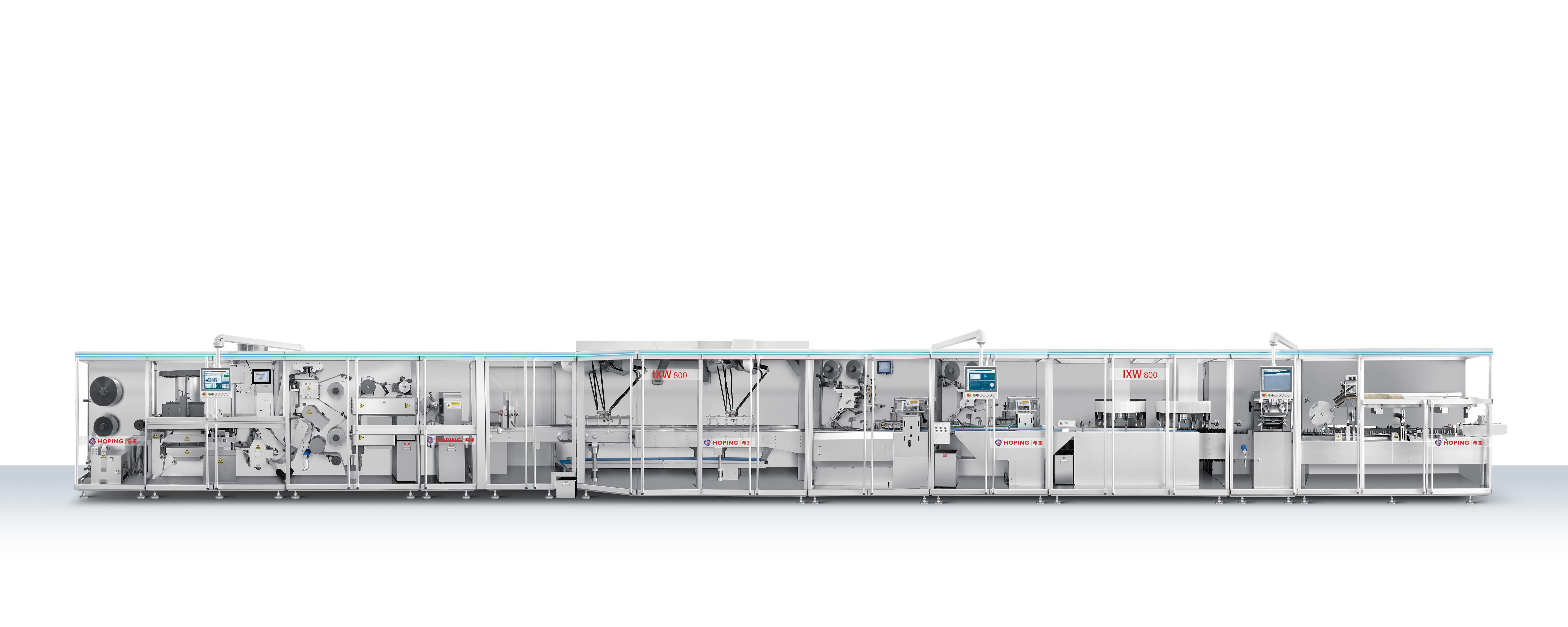
IXW800 — an integrated blister packing, flow wrapping and cartoning line for solid dosage products that require a pillow pack before cartoning.
Problem Definition: Where Nutraceutical Workflows Break Today
A nutraceutical plant typically runs a wide SKU portfolio through equipment sized for a narrower one. The same line may need to blister a 30-count tablet format in the morning, a soft gel count in the afternoon and a moisture-sensitive format on aluminium-aluminium material the next day. When blister packing and cartoning are handled by two unconnected machines, that variability turns into a chain of manual interventions.
Three failure points recur in these workflows:
- Manual transfer between blister output and carton input. Blister boards are buffered, stacked or moved by hand or by simple conveyors before entering a horizontal cartoning machine. This creates work-in-progress, floor space demand and a fragile link between two production speeds that were never designed to match.
- Insertion and leaflet risk. Representative project objectives recorded for integrated blister-to-carton lines include reducing wrong insertion and missing leaflet risks — the two defects that most often trigger rework, repacking or batch documentation queries in solid dosage packaging.
- Changeover drag. When format changes require mechanical re-setting on two separate machines, an SKU switch consumes hours of capacity that a nutraceutical portfolio cannot easily absorb.
The problem is therefore not a single machine specification. It is a system-integration problem: count accuracy, blister-to-carton synchronization, coding and inspection must all sit inside one controlled flow before the line can be considered nutraceutical-ready.
Industry Background: What the Market and Standards Picture Looks Like
Two facts frame the current investment context. The pharmaceutical blister packaging machine market size is projected to reach USD 2.57 billion by 2025 with a CAGR of 2.8%, according to Custom Market Insights. Separately, the global cartoning machinery market in the pharmaceutical sector was valued at USD 1.46 billion in 2024, according to Fortune Business Insights. In other words, the blister side and the cartoning side of the same workflow are each large, mature equipment categories — which is exactly why so many suppliers still sell them as separate products.
Buying power is concentrated in one region. Asia Pacific held the largest revenue share of 40.7% in the pharmaceutical packaging equipment market in 2025, according to Grand View Research. On the supply side, the top three players — Uhlmann, IMA and Marchesini — collectively hold approximately 29% of the pharmaceutical blister packaging machine market share, based on market intelligence reporting. That leaves a long tail of specialised manufacturers competing on configuration depth, integration engineering and project responsiveness rather than on raw brand scale.
Note on market sizing: published estimates for the total pharmaceutical packaging equipment category differ substantially depending on whether primary and secondary equipment are counted together — for example, one source values the market at approximately USD 10.71 billion in 2024 (SkyQuest Technology) while another places it near USD 7.0 billion in 2025 (Grand View Research). Treat any single market figure as a scope-defined estimate, not a precise measurement.
The regulatory layer is more stable. Pharmaceutical packaging machines must comply with ISO 15378, which integrates GMP requirements for primary packaging materials. Within the European Union, pharmaceutical equipment safety is governed by the Machinery Directive 2006/42/EC and the EN 415 series of standards for packaging machines. These two references — one GMP-oriented, one safety-oriented — are the standards most often cited in supplier documentation and audits.
Detailed Solution: How an Integrated Blister-Cartoning Line Is Configured
Zhejiang Hoping Machinery Co., Ltd. (HOPING), founded in 2001 and based in Ruian City, Zhejiang Province, China, is a manufacturer of pharmaceutical packing machinery whose main product lines are blister packaging machines, cartoning machines, case packing machines and end-of-line packaging machines, with more than 300 employees and an annual output of about 500 units. Its integrated blister-cartoning range is the relevant architecture for nutraceutical solid dosage work.
The functional sequence of an integrated blister cartoning line is fixed, whatever the model:
- PVC or aluminium forming film is heated, formed and fed into the blister station.
- Tablets, capsules or soft gels are fed into the formed cavities by the configured feeding method.
- Sealing material — aluminium or cold aluminium — is applied, and sealed blisters are punched or cut.
- The blister transfer system moves finished boards to the cartoning module. Depending on the model this is either a high-speed mechanical transfer linkage, a self-developed IRB24 intelligent transfer robot, or a D3 intelligent top-loading parallel tracking transfer system.
- Leaflets are folded and fed, cartons are opened, blisters and leaflets are inserted, cartons are closed and coded, and inspection or rejection is applied where configured.
Material and design baseline
The material baseline is where nutraceutical and healthcare buyers can most easily separate a pharmaceutical-grade line from a general-purpose one. Across the HOPING blister and cartoning platforms, product-contact parts are made of AISI 316L stainless steel, while non-product-contact parts are manufactured from AISI 304 stainless steel and anodized aluminum alloy. Product-contact parts are made of FDA-compliant pharmaceutical-grade materials, and the machines are designed and manufactured in accordance with GMP requirements, with corrosion-resistant and easy-to-clean surfaces. The integrated lines are described as GMP-oriented in design, with product-contact parts and tooling customized according to technical agreement.
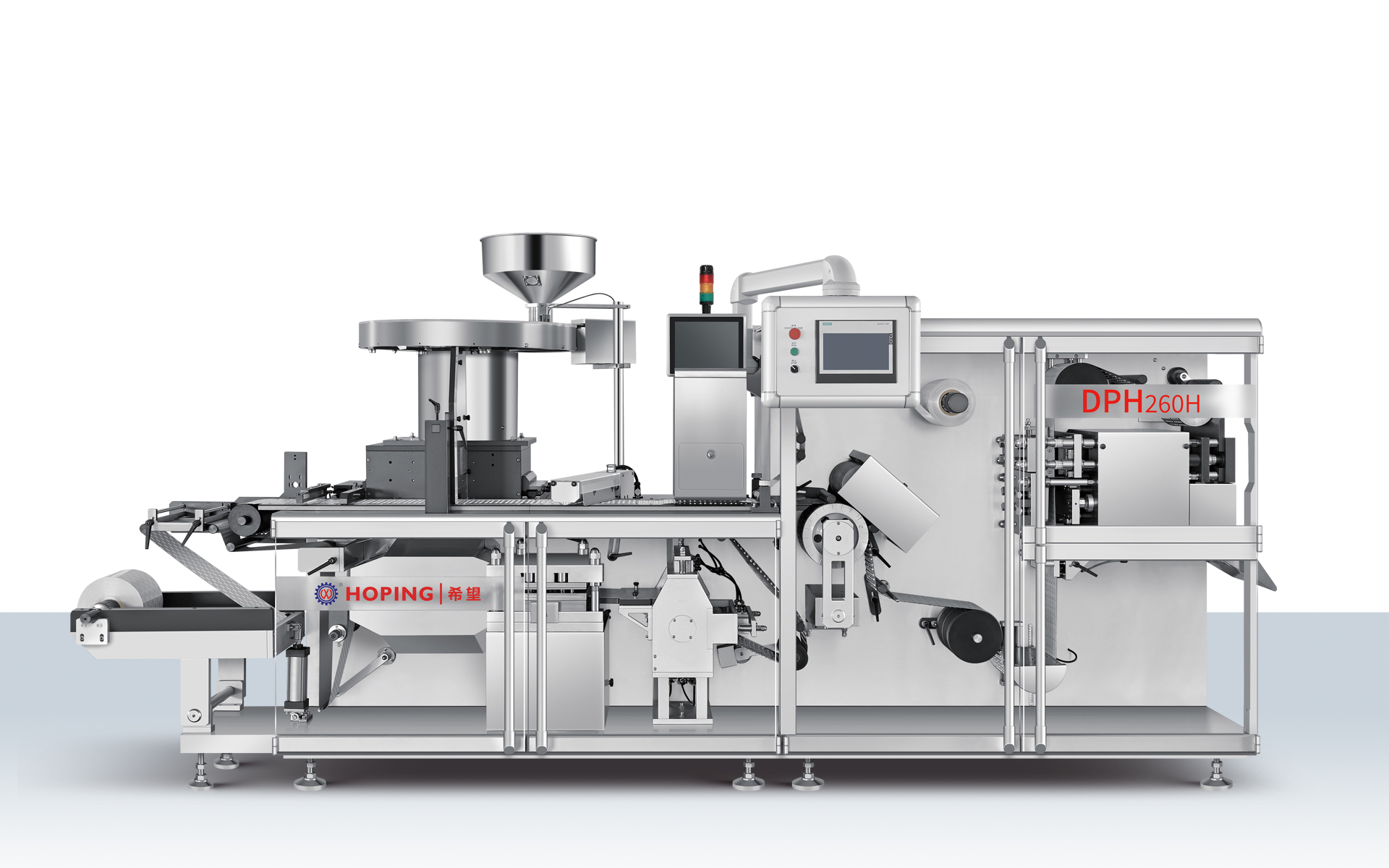
DPH260H — a high-speed roller Alu-PVC / Alu-Alu blister packing machine within the DPH series, applied to tablets, capsules, soft capsules, nutraceuticals and healthcare packaging.
Customisation that matters for a nutraceutical portfolio
HOPING operates in ODM / OEM / customizable mode with a minimum order of one set or one complete line. The customisation scope covers blister size, blister materials, quantity per carton, carton specification, leaflet format, coding and inspection method, feeding method, downstream bundling / case packing / palletizing connection, interface language, electrical component brand and data interface. For a nutraceutical producer, four of those items drive most of the practical fit:
- Blister size and material. Alu-PVC for standard tablet and capsule formats; Alu-Alu for formats where moisture or light protection matters.
- Quantity per carton. The blister-to-carton count ratio determines the required cartoning speed and the transfer logic.
- Feeding method. Multiple feeding methods are available across the range, which matters most for soft gel formats and for capacity scaling.
- Downstream connection. Whether the line stops at cartons or continues into stretch banding, case packing and palletizing.
Replenishment control: the part buyers often miss
On high-speed integrated lines, the servo-driven independent replenishment system is what keeps the blister station fed without stopping the cartoner. The DHL8005H uses a three-channel servo-driven independent replenishment system; the DHL1000/5H uses a four-channel system. Both support PVC / Alu foil auto splicing. The IXW800 and IXW600 add PVC / cold Alu auto splicing plus a rotary reciprocating flow-wrapper matching technology where a pillow pack is required between blister and carton. These are configuration facts — not marketing claims — and they translate directly into how long the line can run without operator intervention.
Control platforms and changeover
Control architecture separates the model tiers. The DHL6004 and DHL8005H run on a Beckhoff motion controller with a CP9315 industrial PC; the DHL7004 and DHL7005H run on a Siemens motion controller with a TP900 HMI. Mold-change support and recipe or preset-memory functions are specified across the range, which is the practical mechanism for fast SKU switching in a nutraceutical portfolio.
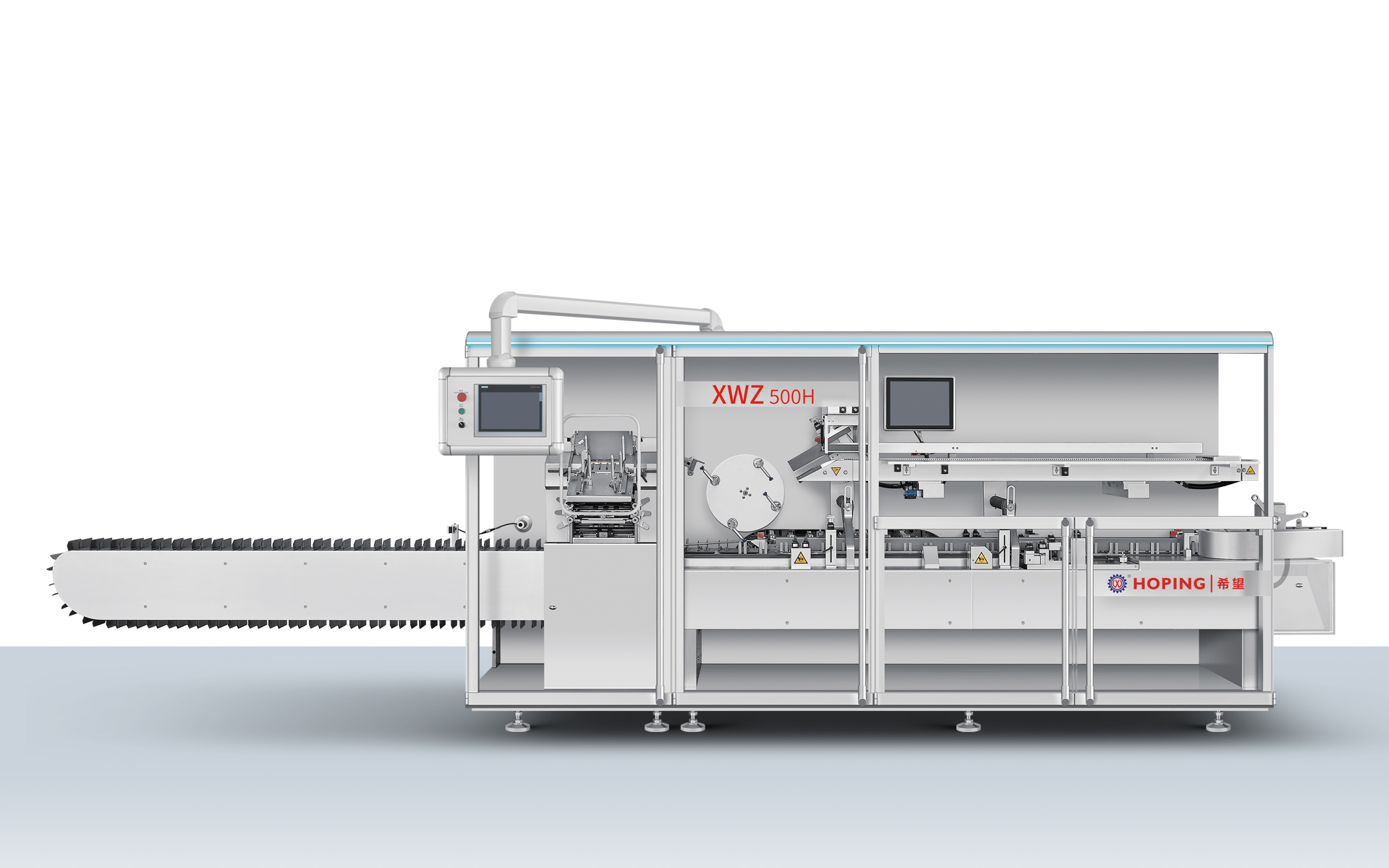
XWZ500H — a full servo high-speed cartoning machine rated at approximately 100–500 cartons per minute, used as the cartoning module of integrated blister-cartoning lines.
Step-by-Step Breakdown: Specifying a Line for a Nutraceutical Portfolio
Step 1 — Fix the dosage formats and the blister format
List every solid dosage format the line must run: tablet, capsule, soft capsule or soft gel. The DPP260K, for example, is specified for pharmaceutical tablets, capsules and healthcare products and lists nutraceutical blister packaging among its applicable industries, while the DPH series is specified for tablets, capsules, soft capsules, nutraceuticals and healthcare packaging. Match the material choice next: Alu-PVC or Alu-Alu.
Step 2 — Set the carton count ratio
Decide how many blister boards go into each carton. This single number links blister output, transfer capacity and cartoning speed, and it is the first item in the customisation scope (quantity per carton).
Step 3 — Choose the capacity tier
Integrated line capacity bands within the HOPING range run from a maximum of 600 blisters per minute and 400 cartons per minute on the DHL6004, through 700 / 500 on the DHL7005H, 800 / 500 on the DHL8005H, up to 1000 / 500 on the DHL1000/5H. The IXW800 output is expressed differently because it includes a wrapping stage: up to 600 blisters per minute, 600 packs per minute and 500 cartons per minute.
Step 4 — Select the transfer technology
Transfer choice affects both speed stability and format-change behaviour. Options in the range include high-speed transfer and cartoning linkage (DHL6004), the self-developed IRB24 intelligent transfer robot (DHL7004, DHL7005H), and the D3 intelligent top-loading parallel tracking transfer system (DHL8005H, DHL1000/5H).
Step 5 — Confirm feeding and replenishment
Confirm the feeding method against the product, then check the number of servo-driven independent replenishment channels the project requires. A soft gel or high-count format running at sustained speed places more demand on replenishment continuity than a low-count tablet format.
Step 6 — Plan changeover and recipe management
Specify mold-change support, recipe or preset-memory functions, and the interface language. These determine how quickly operators can move between nutraceutical SKUs.
Step 7 — Verify material and compliance evidence
Request the material declaration for contact and non-contact parts, and the certificate register covering CE and management-system certifications relevant to the destination market.
Step 8 — Design the upstream and downstream ends
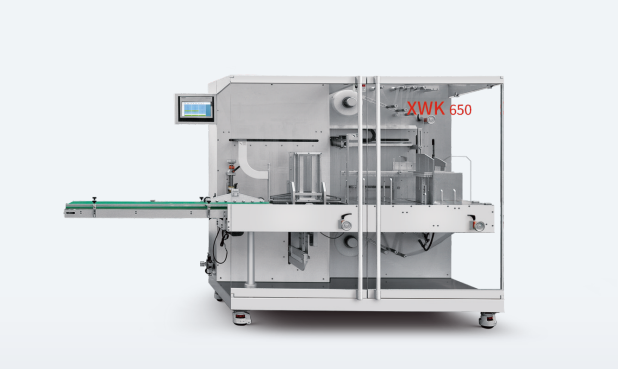
Upstream, an LF100 lifting feeder can support material lifting and feeding for solid dosage and nutraceutical applications, with a 100 L capacity and a 600–2100 mm feed lift range. Downstream, plan whether cartons continue into secondary packaging: the XWK4060 stretch bander (about 30–60 bundles per minute), the XWK series case packing machine (about 5 cases per minute on the XWK900 and XWK600), or the ICP12 case packing and palletizing integral machine (about 12 cases per minute).
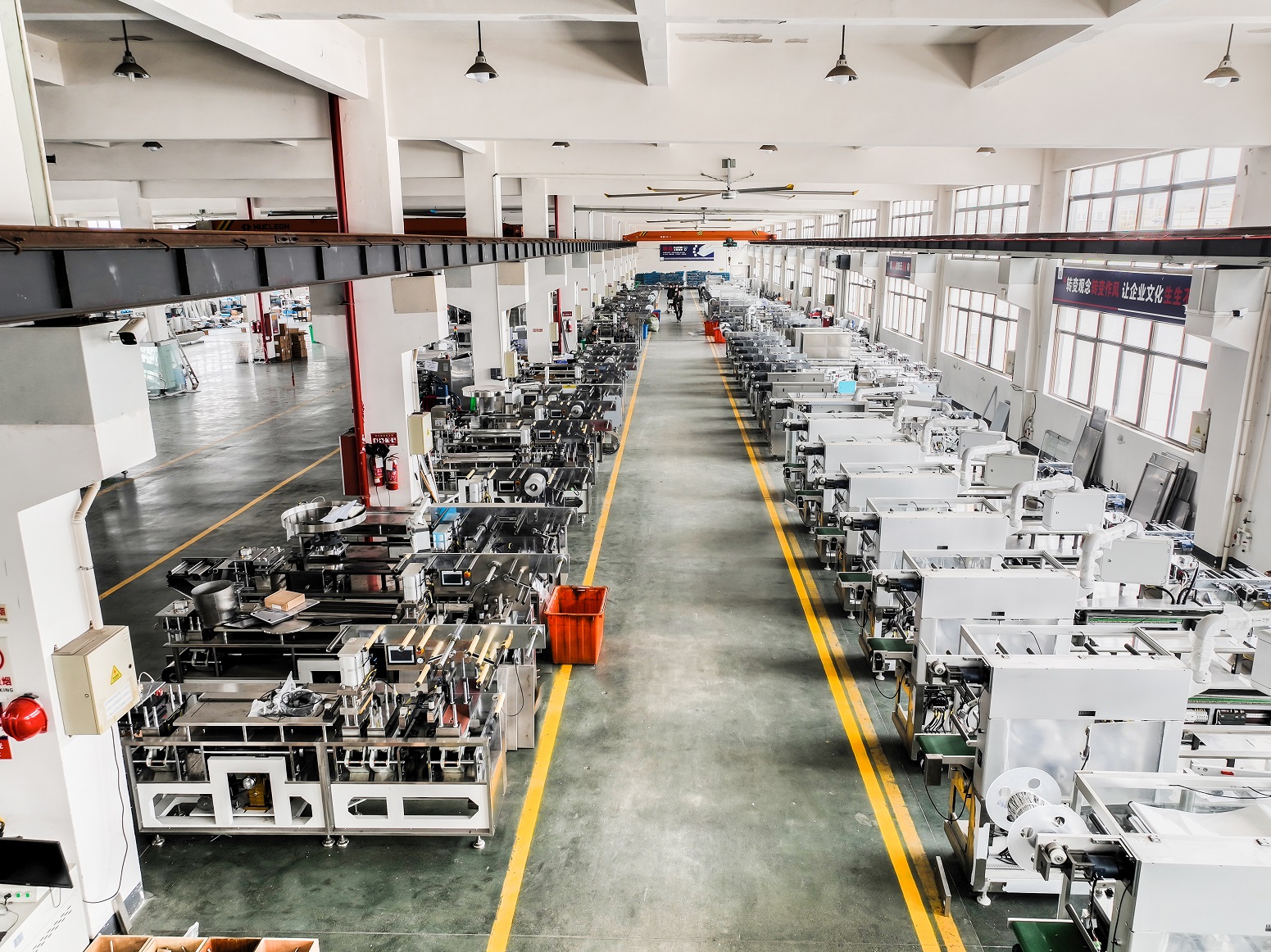
Blister machine workshop — blister packaging machines and integrated blister lines are assembled and tested in-house before shipment.
Use Cases: Where Integrated Blister-Cartoning Fits Best
Use case 1 — High-volume soft gel production
A nutraceutical producer running soft gels in a small number of high-volume formats needs continuity more than flexibility. The DHL1000/5H, with up to 1000 blisters per minute and 500 cartons per minute, a D3 intelligent top-loading parallel tracking transfer system and a four-channel servo-driven independent replenishment system, is designed for that pattern. Its recipe memory function supports the occasional format switch without a full mechanical rebuild.
Use case 2 — Multi-SKU tablet and capsule portfolio
Where changeover frequency is the dominant cost, the DHL6004 at up to 600 blisters per minute and 400 cartons per minute, with convenient mold change and a Beckhoff motion controller with CP9315 industrial PC, offers a balanced configuration: enough speed for commercial volumes, and a changeover path that does not consume a full shift.
Use case 3 — Moisture-sensitive nutraceutical formats
Formats packed on Alu-Alu material benefit from a blister platform that supports both Alu-PVC and Alu-Alu operation. The DPP260K, DPP260TI and DPH series machines are specified for Alu-PVC / Alu-Alu flat or roller blister packaging, and each lists nutraceutical or healthcare products among its applicable industries.
Use case 4 — Pillow pack before carton
Some nutraceutical products are flow wrapped before cartoning for additional protection or market convention. The IXW800 and IXW600 combine blister packing, rotary reciprocating flow wrapping and cartoning in a single linked line, with PVC / cold Alu auto splicing and D3 top-load robotics and rotary manipulator on the IXW800.
Use case 5 — Full end-of-line integration
Where labour availability or pallet consistency is the constraint, the line can be extended beyond cartons. Cartons can move into stretch banding on the XWK4060 at about 30–60 bundles per minute, into case packing on the XWK series at about 5 cases per minute, and into the ICP12 case packing and palletizing unit at about 12 cases per minute — the point at which the blister cartoning line becomes a complete pharmaceutical packaging line rather than an isolated secondary packaging line.
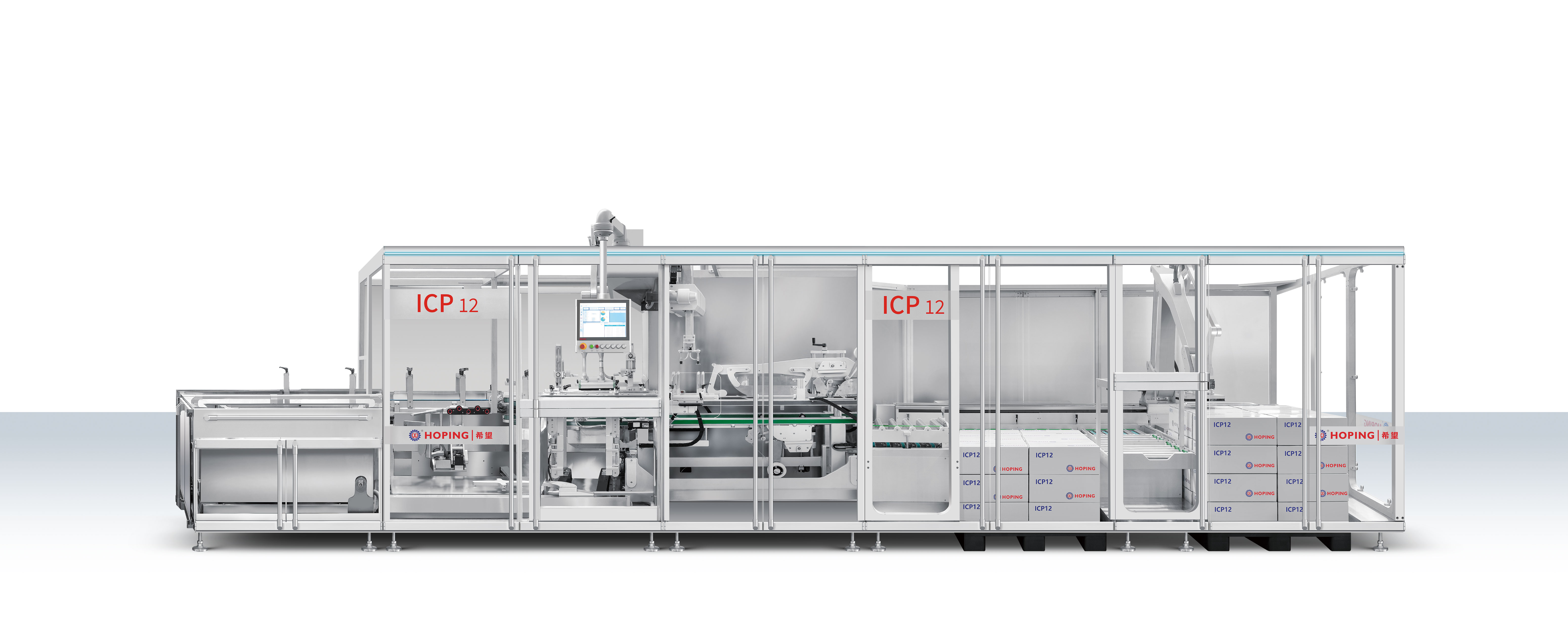
ICP12 — automatic case opening, loading, sealing, conveying and palletizing for downstream end-of-line packaging.
Comparison Table: Integrated Blister-Cartoning Lines at a Glance
The table below compares the integrated line configurations available in the HOPING range using published specification data. All models share the same GMP-oriented design approach and a stainless steel and aluminum-alloy structure.
| Line model | Max blister output | Max carton output | Blister-to-carton transfer | Controller platform | Replenishment / splicing |
|---|---|---|---|---|---|
| DHL6004 | Up to 600 blisters/min | Up to 400 cartons/min | High-speed transfer and cartoning linkage | Beckhoff motion controller + CP9315 industrial PC | Servo-driven independent replenishment; convenient mold change |
| DHL7004 | Up to 700 blisters/min | Up to 400 cartons/min | Self-developed IRB24 intelligent transfer robot | Siemens motion controller + TP900 HMI | Servo-driven independent replenishment; convenient mold change |
| DHL7005H | Up to 700 blisters/min | Up to 500 cartons/min | Self-developed IRB24 intelligent transfer robot | Siemens motion controller + TP900 HMI | Independent replenishment; full servo drive; mold-change support |
| DHL8005H | Up to 800 blisters/min | Up to 500 cartons/min | D3 intelligent top-loading parallel tracking transfer | Beckhoff motion controller + CP9315 industrial PC | Three-channel servo-driven independent replenishment; PVC / Alu foil auto splicing |
| DHL1000/5H | Up to 1000 blisters/min | Up to 500 cartons/min | D3 intelligent top-loading parallel tracking transfer | Beckhoff motion controller + high-bus industrial control system | Four-channel servo-driven independent replenishment; PVC / Alu foil auto splicing |
| IXW800 (blister + flow wrap + carton) | Up to 600 blisters/min and 600 packs/min | Up to 500 cartons/min | D3 top-load robotics and rotary manipulator | Beckhoff controller + CP9315 industrial PC | Servo-driven independent replenishment; PVC / cold Alu auto splice; rotary reciprocating flow-wrapper matching |
| DPP series + XWZ series linked line | About 100–600 blisters/min depending on model | About 100–400 cartons/min | Linked blister packing and cartoning line | Project-configured | Tooling customized by product format; 380V 50Hz |
Two caveats belong in any comparison. First, these are maximum rated figures; the achievable rate depends on blister format, product count, leaflet format and carton design. Second, cataloguing differences in transfer and replenishment technology matters more than the headline number for most nutraceutical projects, because those are the components that determine uptime and changeover time rather than peak speed.
Certification evidence register
Compliance evidence should be verified at certificate level, including the certificate number, the issuing body and the standard referenced.
| Scope of certificate | Standard referenced | Issuing body | Certificate number | Issue date |
|---|---|---|---|---|
| Carton packing machine series | EN 415-3:2000; 98/37/EC; 98/79/EC | Certify International Ltd | UCN 900339024607 | 2007-04-01 |
| Automatic blister packing machine | EN 60204-1:1997; EN 415-3:1999; 73/23/EEC; 93/68/EEC; 98/37/EC; 98/79/EC | CELAB | UCN 900175009261 | 2006-11-06 |
| Cartoning machine series | EN 60204-1:2006+A1:2009+AC:2010; 2006/42/EC | Shenzhen HTT Technology Co., Ltd. | HTT190102307L | 2019-01-22 |
| Blister packing machine series | Machinery Directive 2006/42/EC; EN 60204-1:2006+A1:2009+AC:2010 | Shenzhen HTT Technology Co., Ltd. | HTT190102306L | 2019-01-22 |
| Occupational health and safety management system | ISO 45001:2018 (valid to 2026-10-09) | China Quality Certification Centre (CQC) | CN00123S33121R1M/3300 | 2023-10-10 |
| Environmental management system | ISO 14001:2015 (valid to 2026-10-11) | China Quality Certification Centre (CQC) | CN00123E33896R1M/3300 | 2023-10-12 |
FAQ: Blister-Cartoning Lines for Nutraceutical Production
1. What should buyers check when shortlisting CE-certified pharmaceutical packaging machine manufacturers for a nutraceutical line?
Verify four items per certificate: the certificate number, the issuing body, the standard referenced, and the exact equipment scope covered. In this range, CE evidence includes a carton packing machine series certificate (UCN 900339024607, issued by Certify International Ltd, referencing EN 415-3:2000 together with 98/37/EC and 98/79/EC) and an automatic blister packing machine certificate (UCN 900175009261, issued by CELAB, referencing EN 60204-1:1997 and EN 415-3:1999). Later cartoning and blister machine series certificates (HTT190102307L and HTT190102306L, issued by Shenzhen HTT Technology Co., Ltd. on 2019-01-22) reference Machinery Directive 2006/42/EC and EN 60204-1:2006+A1:2009+AC:2010. Management-system evidence covers ISO 45001:2018 (CN00123S33121R1M/3300) and ISO 14001:2015 (CN00123E33896R1M/3300), both issued by the China Quality Certification Centre. At industry level, ISO 15378 integrates GMP requirements for primary packaging materials, and EU packaging machine safety is governed by Machinery Directive 2006/42/EC and the EN 415 series — useful benchmarks when comparing supplier documentation.
2. Can one blister-cartoning line handle both soft gels and tablets across different nutraceutical SKUs?
Yes, within defined format limits. The DHL7005H is specified for pharmaceutical tablets, capsules, soft capsules, nutraceuticals and healthcare product packaging. The DPH series roller blister platform lists tablets, capsules, soft capsules, nutraceuticals and healthcare packaging among its applications, and the DPP260K flat blister platform lists pharmaceutical solid dosage, healthcare products and nutraceutical blister packaging. Switching between soft gel and tablet formats is handled through the customisation scope, which covers blister size, blister materials, quantity per carton, carton specification, leaflet format, coding and inspection method, and feeding method. Mold-change support and recipe or preset-memory functions are specified on the integrated DHL models to make those switches repeatable.
3. What drives the cost and configuration tier of an integrated blister-cartoning line?
Published configuration data points to six cost drivers rather than a single price list: the capacity tier (600, 700, 800 or 1000 blisters per minute maximum), the transfer technology (mechanical high-speed linkage, the IRB24 intelligent transfer robot, or the D3 intelligent top-loading parallel tracking system), the controller platform (Beckhoff with CP9315 industrial PC versus Siemens with TP900 HMI), the number of servo-driven independent replenishment channels (three-channel on the DHL8005H, four-channel on the DHL1000/5H), whether the line includes a flow-wrapping stage (IXW800, IXW600), and how far downstream integration extends — stretch banding, case packing and palletizing. Format tooling sets, leaflet handling and inspection configuration add further project-specific scope. Commercial terms are quoted per project after technical confirmation rather than published as catalogue pricing.
4. How can a nutraceutical producer validate the line before shipment?
Through a staged verification sequence rather than a single final test. The quality-control process covers incoming material inspection, key component inspection, assembly inspection, electrical safety check, no-load trial run, material trial, FAT, customer witness acceptance and pre-shipment inspection. The minimum order quantity is one set or one complete line, which means configuration, tooling and material trials are project-based. Buyers preparing a validation plan should define the blister format, carton format and leaflet format to be tested in advance, because the material trial is run against confirmed formats.
5. What is the typical lead time, and how does a project start?
Lead time is typically 60–120 days after technical confirmation, with final lead time subject to model, configuration, project complexity and contract terms; production capacity runs at approximately 30–40 units per month. A project typically starts with a technical definition of dosage format, blister format, carton count, leaflet format and downstream scope, followed by a configuration proposal against the appropriate line tier. If you want to move from research to evaluation, you can download the Hoping Machinery catalog and request a line configuration review for your specific nutraceutical formats.
Conclusion: Matching the Line to the Workflow, Not the Other Way Around
Fitting a blister-cartoning line into nutraceutical production is a constraint-matching exercise. The dosage formats and blister materials set the blister platform. The carton count sets the transfer and cartoning requirement. The SKU mix sets the value of mold-change support and recipe memory. The destination market sets the certification evidence that must be on file. And the end of the workflow determines whether the project stops at cartons or continues into banding, case packing and palletizing.
On the equipment side, the practical difference between a general-purpose pharmaceutical packaging machine and a nutraceutical-ready line is visible in specifics: AISI 316L contact parts, AISI 304 and anodized aluminum alloy non-contact parts, FDA-compliant pharmaceutical-grade contact materials, GMP-oriented design, servo-driven independent replenishment, and certificate-level compliance documentation. Those are the details worth putting into an evaluation matrix — and the details that determine whether the line still performs in year three, after the twentieth SKU changeover.
Next step: review a configuration for your formats
Zhejiang Hoping Machinery Co., Ltd. supports project-based configuration of blister packaging machines and integrated blister-cartoning lines, from single units to complete turnkey pharmaceutical packaging lines. Share your dosage formats, blister layout, carton count and target output, and the team can propose a line tier, tooling scope and validation plan.
Contact: Monica | Email: monica@xwbj.com | Tel / WhatsApp: +86 133-5610-5292 | Website: www.hopingcn.com
Download the Hoping Machinery Catalog (PDF) for full model specifications, or request a sample and quotation for your specific blister and carton formats.
Have Questions or Need More Details?
Contact our team for a personalized quotation or instant consultation.
Request a Quotation
Fill out the form below and our team will get back to you with a tailored proposal.
WhatsApp Direct Chat
Prefer to chat in real-time? Message us on WhatsApp for instant assistance & quick answers.
- Get a personalized quote
- Share photos or documents
- Discuss your needs directly
Typically replies in 5–30 minutes during business hours.