
Blister-Cartoning Line Buyer's Guide: Servo vs Mechanical Systems
A blister-cartoning line decision usually starts as a question about speed and ends as a question about control. For a solid-dosage producer evaluating a pharmaceutical packaging machine, the choice between a servo-driven integrated line and a traditional mechanical system determines how much of the machine's behaviour can be changed in software — and how much has to be changed in hardware, in cams, gears and timing relationships.
Short answer: servo-driven lines are the better fit when a site needs high output, repeated format changes and downstream integration. The Hoping DHL8005H blister-cartoner is rated up to 800 blisters/min and 500 cartons/min and runs on a Beckhoff motion controller with a CP9315 industrial PC; the DHL1000/5H reaches up to 1000 blisters/min and 500 cartons/min. Mechanical systems remain a defensible choice when the product mix is stable and the line is compact: the Hoping XWZ120 horizontal cartoner is rated 30–120 cartons/min on a SEW main motor with Siemens PLC control.
This guide compares both architectures using published equipment data, then sets out an eight-step evaluation sequence, a side-by-side comparison table, and the questions buyers ask most often.
Problem Definition: The Constraint Is Change, Not Speed
Most buyers open a quotation with one number — cartons per minute — and compare offers on it. That number is necessary but not sufficient. Two lines can print the same carton output and behave very differently in year three, when the product mix has changed, a second blister format has been added, or the site decides to connect a bundler, a case packer and a palletizer.
The constraints that actually decide the architecture are these:
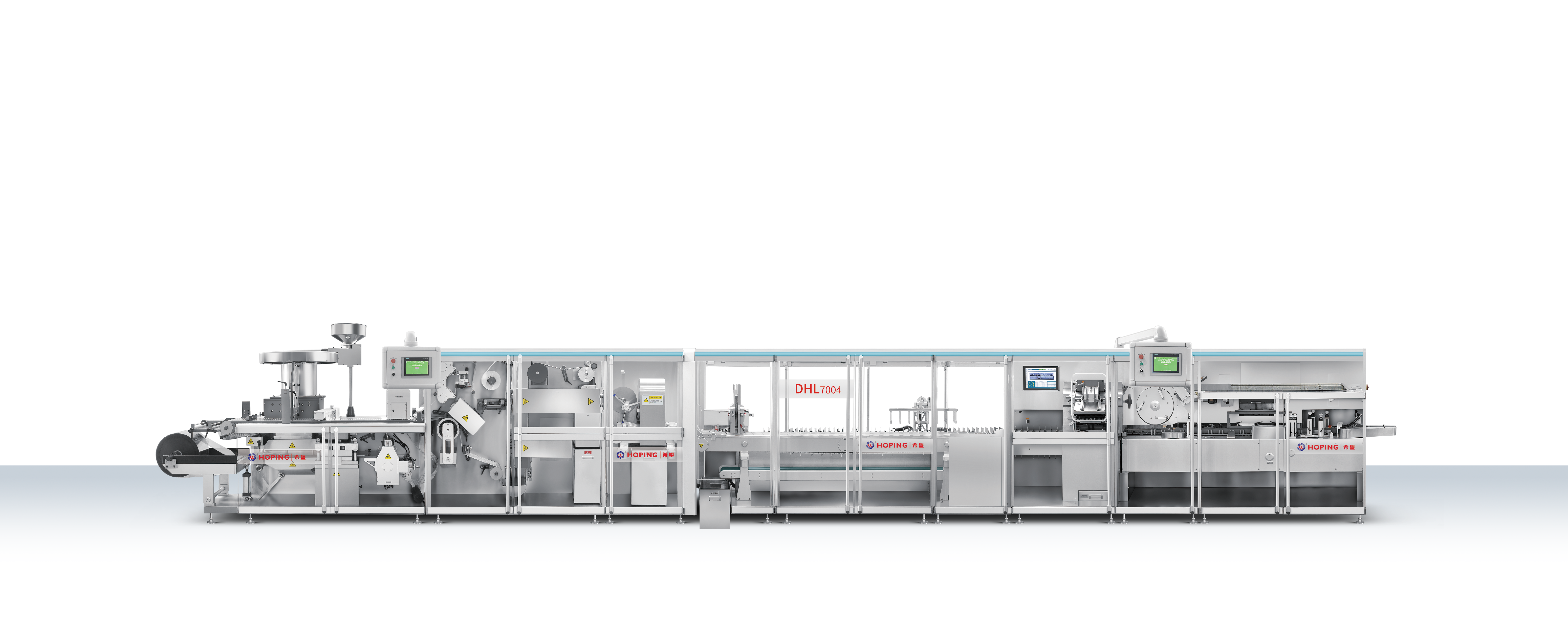
- Output pair, not output number. Blister output and carton output must be matched, and the ratio depends on how many blisters enter each carton. The DHL8005H is rated up to 800 blisters/min and 500 cartons/min; the DHL1000/5H up to 1000 blisters/min and 500 cartons/min.
- Format range. Tablets, capsules and soft capsules, and Alu-PVC versus Alu-Alu constructions, place different demands on forming, sealing and transfer. A line bought for a single format may not survive a portfolio change.
- Changeover frequency. A site running four campaigns a month has a different requirement from a site running four campaigns a year.
- Compliance evidence. CE certificate scope, ISO management-system certificates and GMP-oriented design documentation are part of the technical comparison, not a post-order formality.
- Downstream scope. Bundling, case packing and palletizing change the line's control and transfer requirements.
- Service and operator skills. A servo line and a mechanically timed line demand different maintenance routines and spare-parts planning.
Servo-driven line: each motion axis carries its own motor, and the sequence is coordinated by a motion controller — for example, the Beckhoff motion controller and CP9315 industrial PC used on the DHL8005H and DHL6004. Timing, offsets and replenishment behaviour are stored as parameters.
Mechanical system: one main motor drives the machine's motion train, so station timing is fixed by the mechanical build. The XWZ120 horizontal cartoner is built this way — a SEW main motor with a Siemens PLC control system, rated 30–120 cartons/min for lower-to-medium speed secondary packaging.
The practical consequence is straightforward. On a servo line, introducing a new carton size is largely a tooling and parameter task. On a mechanically timed line, the same change is a mechanical changeover task in which a fixed timing relationship has to be re-established. Neither approach is inherently better; they are matched to different production realities.
Industry Background: A Market That Rewards Documented Capability
Pharmaceutical packaging equipment is a large and comparatively slow-moving market, so buyers are not choosing in a vacuum. SkyQuest Technology valued the global pharmaceutical packaging equipment market at approximately USD 10.71 billion in 2024. Within that market, Custom Market Insights projects the pharmaceutical blister packaging machine segment to reach USD 2.57 billion by 2025, a CAGR of 2.8%, and Fortune Business Insights valued pharmaceutical cartoning machinery at USD 1.46 billion in 2024.
Regional weight matters for sourcing decisions. Grand View Research reports that Asia Pacific held the largest revenue share — 40.7% — of the pharmaceutical packaging equipment market in 2025. Supply is also concentrated at the top: Uhlmann, IMA and Marchesini together hold approximately 29% of the pharmaceutical blister packaging machine market, which is one reason mid-market buyers increasingly differentiate suppliers on control architecture, documentation and service rather than on brand name alone.
Published estimates differ because research houses define scope differently — some count primary packaging equipment only, others include secondary and end-of-line machinery. Treat these figures as directional context for capacity planning, not as a procurement specification.
Two standard families shape what a buyer should request in writing. ISO 15378 integrates GMP requirements for primary packaging materials, and in the EU the Machinery Directive 2006/42/EC together with the EN 415 series for packaging machines governs equipment safety. That is why a servo-versus-mechanical comparison today includes a documentation column as well as a drive column.
The manufacturer behind the models referenced in this guide is Hoping (Zhejiang Hoping Machinery Co., Ltd.), a pharmaceutical packing machinery manufacturer founded in 2001 in Ruian City, Zhejiang Province, China, with more than 300 employees, a 56-engineer R&D team and an annual output of about 500 units; roughly 25% of output is exported to Southeast Asia, the Middle East, Eastern Europe, South America and Africa.
Detailed Solution: What a Servo-Driven Blister-Cartoning Line Changes
Drive architecture: from one main motor to independent axes
The clearest way to see the difference is to compare models inside one manufacturer's range. Hoping's XWZ120 horizontal cartoner is a single-main-motor machine rated at 30–120 cartons/min, designed for lower-to-medium speed and compact production lines. The XWZ500H full servo high-speed cartoner covers 100–500 cartons/min using servo, electrical and pneumatic modules in a stainless steel and aluminium-alloy frame. Between them sits the XWZ300II at 60–220 cartons/min, which combines servo, electrical and pneumatic modules with a SEW gear motor and a Becker vacuum pump VT4.40 for stable suction-box vacuum.
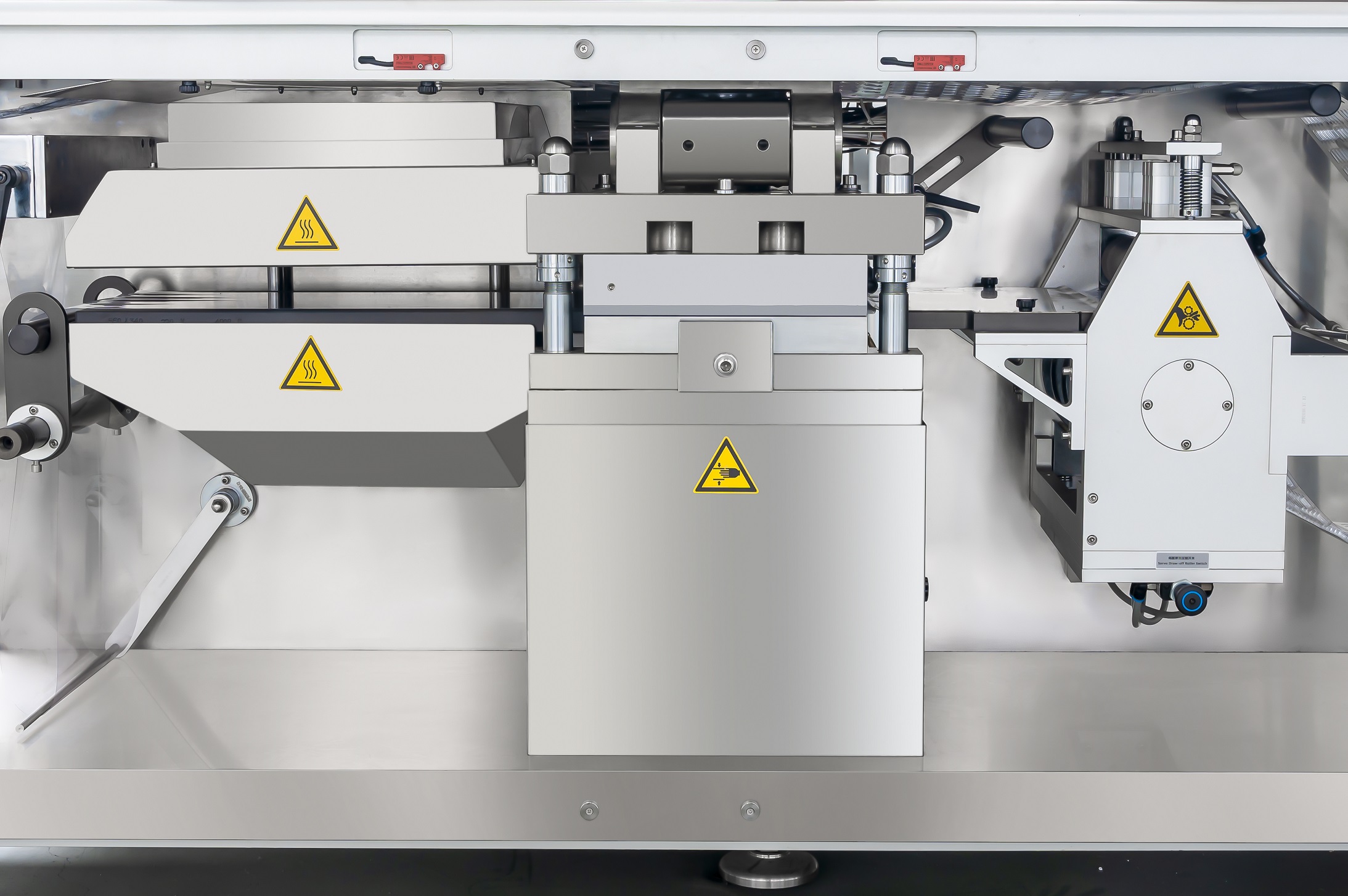
On the blister side the same logic applies. The DPH320H is a fully servo high-speed roller blister packing machine with a 320 × 280 mm forming area, 12 mm forming depth and a 100–280 mm stroke range. Servo axes replace the single fixed timing train, which is what allows format parameters to be adjusted without re-timing the whole machine.
Control flexibility: Beckhoff motion controller and CP9315 industrial PC
The most visible expression of servo flexibility in this range is the control platform. The DHL8005H blister-cartoner uses a Beckhoff motion controller and a CP9315 industrial PC. The same pairing appears on the DHL6004 (600 blisters/min and 400 cartons/min) and on the IXW800 and IXW600 blister-flow-wrap-cartoning lines. The DHL1000/5H follows the same approach with a Beckhoff motion controller and a high-bus industrial control system.
Why the platform matters: the controller coordinates blister forming and sealing, transfer of blisters into the cartoner, leaflet handling, carton opening, insertion, and coding or inspection. When those relationships are parameterised, a recipe change adjusts the line without mechanically re-timing it. Where a buyer's engineering standard is Siemens-based, the DHL7005H and DHL7004 use Siemens motion controllers with a TP900 HMI and a self-developed IRB24 intelligent transfer robot. Electrical component brand and interface language are both configurable items, so the control platform can follow site standards rather than the other way around.
Throughput: what 800 blisters/min and 500 cartons/min require
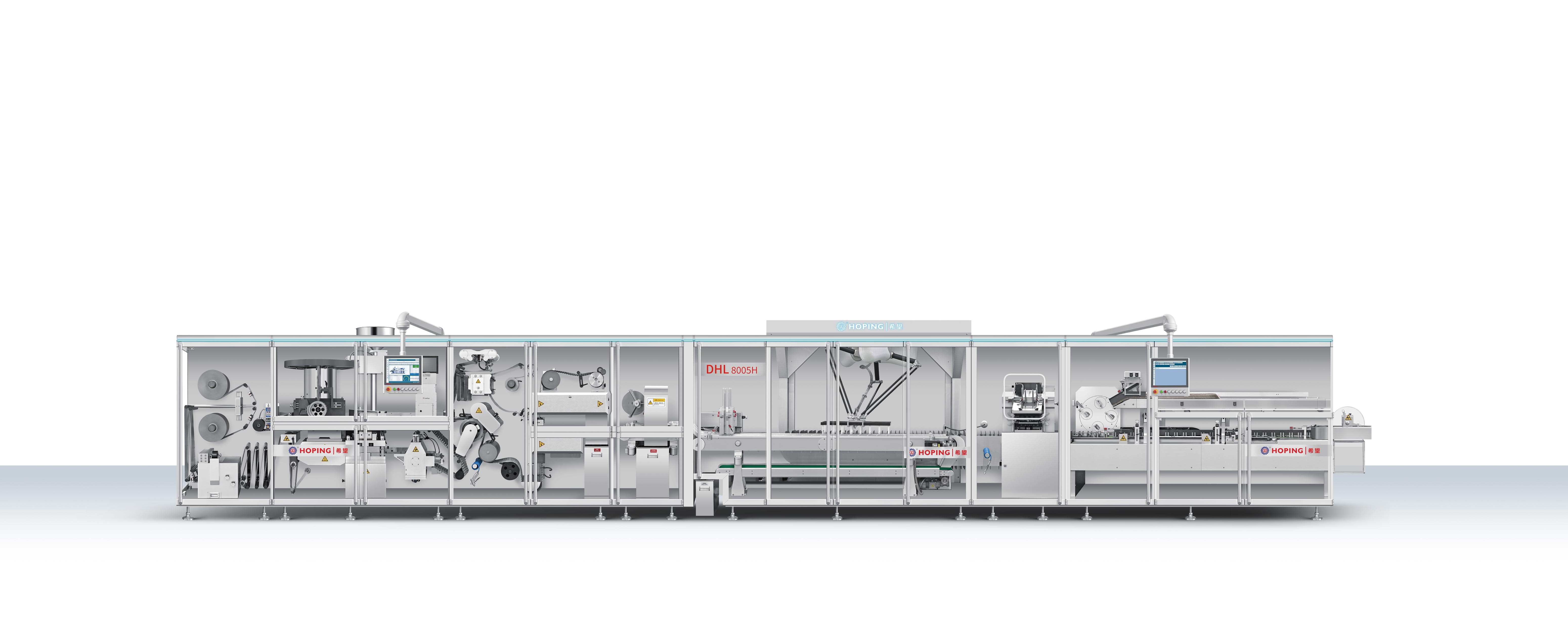
High blister output only becomes high carton output if transfer and replenishment are independent of the blister machine's cycle. The DHL8005H is rated up to 800 blisters/min and 500 cartons/min, and achieves it with a D3 intelligent top-loading parallel tracking transfer system, multiple feeding methods, PVC/Alu foil auto splicing and a three-channel servo-driven independent replenishment system. The DHL1000/5H pushes blister output to 1000 blisters/min at the same 500 cartons/min with a four-channel servo-driven independent replenishment system.
Where flow wrapping is required before cartoning, the IXW800 is rated up to 600 blisters/min, 600 packs/min and 500 cartons/min, using D3 top-load robotics and a rotary manipulator, a Beckhoff controller and a CP9315 industrial PC. In a mechanically linked line, station timing is fixed relative to the main drive, which is why replenishment and transfer cannot be re-phased independently — and why servo architecture is usually specified once target output moves above the mid-range.
Mould change and preset memory
Servo architecture only pays back at changeover if the line remembers its settings. The DHL8005H includes mould-change and preset-memory functions; the DHL1000/5H provides mould-change and recipe-memory functions. Combined with format parts made to the confirmed blister and carton specifications, this is what allows a multi-campaign site to move between formats without re-establishing mechanical timing.
GMP-oriented construction
Both architectures can be built to GMP expectations, but the servo lines are specified accordingly. Product-contact parts are made of AISI 316L stainless steel, non-product-contact parts from AISI 304 stainless steel and anodized aluminium alloy, and product-contact parts can be supplied in FDA-compliant pharmaceutical-grade materials. Machine structures use stainless steel and aluminium alloy with transparent guards, and the line design is GMP-oriented, with tooling and contact parts configured by technical agreement.
Where a mechanical system is still the right answer
Limits matter as much as capabilities. A single-main-motor cartoner such as the XWZ120 remains appropriate when the format range is narrow, the product mix is stable, the footprint is compact and the maintenance team is already trained on mechanically timed machines. The control structure has fewer parameters to manage, and the machine was designed for lower-to-medium speed production rather than high-speed multi-format campaigns.
Servo lines, in turn, place prerequisites on the site: a 380V 50Hz supply, clean compressed air at 0.5–0.7 MPa, and air consumption that rises with the model — above 0.3 m³/min on the XWZ500H cartoner, above 0.6 m³/min on the DPH320H blister machine. They also require trained operators, planned spare parts and a service relationship. Hoping covers that through on-site installation and commissioning, operator and maintenance training, remote video and telephone support, spare-parts supply and process-parameter guidance.
Step-by-Step Breakdown: Evaluating a Blister-Cartoning Line in Eight Steps
- Fix the output pair. Specify blisters/min and cartons/min together, plus the blisters-per-carton ratio. Reference points in this range: DHL8005H at 800 blisters/min and 500 cartons/min; DHL1000/5H at 1000 and 500; DHL7005H at 700 and 500; DHL6004 at 600 and 400; XWZ500H as a cartoner alone at 100–500 cartons/min.
- List the formats you will run over the next five years. Tablets, capsules, soft capsules, Alu-PVC and Alu-Alu constructions, plus carton and leaflet specifications.
- Choose the drive architecture. Single-main-motor machines such as the XWZ120 (30–120 cartons/min) suit stable, compact production; full servo machines such as the XWZ500H (100–500 cartons/min) suit flexible, higher-speed production.
- Specify the control platform and data interface. Beckhoff with a CP9315 industrial PC, or Siemens with a TP900 HMI. Interface language, electrical component brand and data interface are configurable items and should be written into the technical agreement.
- Verify material handling. Confirm PVC/Alu foil auto splicing and the number of servo-driven independent replenishment channels — three channels on the DHL8005H, four on the DHL1000/5H — plus transfer technology: D3 intelligent top-loading parallel tracking, or the IRB24 robot on the DHL7005H.
- Confirm compliance scope in writing. CE certificate numbers and the machine series they cover, ISO management-system certificates, GMP-oriented design, and the material specification for product-contact parts.
- Agree the acceptance protocol. Hoping's sequence covers incoming material inspection, key component inspection, assembly inspection, electrical safety check, no-load trial run, material trial, factory acceptance test, customer witness acceptance and pre-shipment inspection.
- Plan downstream scope and lead time. Bundling at 30–60 bundles/min (XWK4060), case packing (XWK series, about 5 cases/min), or case packing with palletizing (ICP12, about 12 cases/min). Minimum order quantity is one set or one complete line, and lead time is typically 60–120 days after technical confirmation.
Use Cases: Matching Architecture to Production Reality
- High-volume tablet and capsule production. A DHL8005H line at 800 blisters/min and 500 cartons/min, with a Beckhoff motion controller and a CP9315 industrial PC.
- New builds targeting maximum cartons per shift. The DHL1000/5H at up to 1000 blisters/min and 500 cartons/min with four-channel servo-driven independent replenishment.
- Sites standardised on Siemens control. The DHL7005H (700 blisters/min, 500 cartons/min) and DHL7004 (700 blisters/min, 400 cartons/min), both with the IRB24 transfer robot and TP900 HMI.
- High-mix, multi-campaign plants. Preset memory on the DHL8005H and recipe memory on the DHL1000/5H reduce the cost of frequent changeovers.
- Moisture-sensitive or flow-wrap products. The IXW800 (600 blisters/min, 600 packs/min, 500 cartons/min) and IXW600 (600 blisters/min, 300 packs/min, 300 cartons/min).
- Liquid dosage formats. The IXW400 handles pre-filled syringes, ampoules and cartridges at up to 400 blisters/min and 150 cartons/min with a Siemens controller, a CP9315 industrial PC and a D3 top-loading robot.
- Nutraceutical, healthcare, food and cosmetic blister-cartoning. The same line platforms are specified for these sectors, subject to confirmed formats.
- Reference project profile. A typical large-pharmaceutical or engineering-contractor project involves 5–10 lines for tablets and capsules, with stated objectives of improving packaging automation, reducing manual transfer, improving blister-to-carton connection efficiency and reducing wrong-insertion and missing-leaflet risks. Customer names are disclosed only with authorisation.
Comparison Table: Servo and Mechanical Configurations Side by Side
| Configuration | Example model | Max blister output | Max carton output | Drive and control | Changeover and format support |
|---|---|---|---|---|---|
| Fully servo integrated blister-cartoner | DHL8005H | 800 blisters/min | 500 cartons/min | Full servo; Beckhoff motion controller and CP9315 industrial PC; three-channel servo-driven independent replenishment; D3 intelligent top-loading parallel tracking transfer | Mould-change and preset-memory functions; multiple feeding methods; PVC/Alu foil auto splicing; GMP-oriented design |
| Fully servo integrated blister-cartoner, highest capacity | DHL1000/5H | 1000 blisters/min | 500 cartons/min | Full servo; Beckhoff motion controller and high-bus industrial control system; four-channel servo-driven independent replenishment | Mould-change and recipe-memory functions; PVC/Alu foil auto splicing |
| Fully servo integrated line, Siemens platform | DHL7005H | 700 blisters/min | 500 cartons/min | Full servo; Siemens motion controller and TP900 HMI; self-developed IRB24 intelligent transfer robot | Mould-change support; independent replenishment |
| Fully servo integrated line | DHL6004 | 600 blisters/min | 400 cartons/min | Servo-driven independent replenishment; Beckhoff motion controller and CP9315 industrial PC | Convenient mould change; high-speed transfer and cartoning linkage |
| Full servo cartoner module | XWZ500H | — | 100–500 cartons/min | Full servo; servo, electrical and pneumatic modules; 380V 50Hz 14 kW | Carton magazine, insertion, leaflet and closing modules |
| Single-main-motor mechanical cartoner | XWZ120 | — | 30–120 cartons/min | SEW main motor with Siemens PLC control; 380V 50Hz 3.5 kW | Carton magazine capacity 600–700 pieces; designed for lower-to-medium speed, compact lines |
| Platen blister machine for small and medium batches | DPP260T1 | Up to 300 blisters/min | — | Platen design; 60 punches/min; 8.5 kW; format area 260 × 115 mm | Designed and manufactured in accordance with GMP requirements |
All output figures are maximum rated values taken from published equipment specifications. Achievable output depends on product format, packaging materials, carton and leaflet design, and the confirmed line configuration.
Frequently Asked Questions
How do I confirm that a pharmaceutical packaging machine manufacturer is genuinely CE-certified?
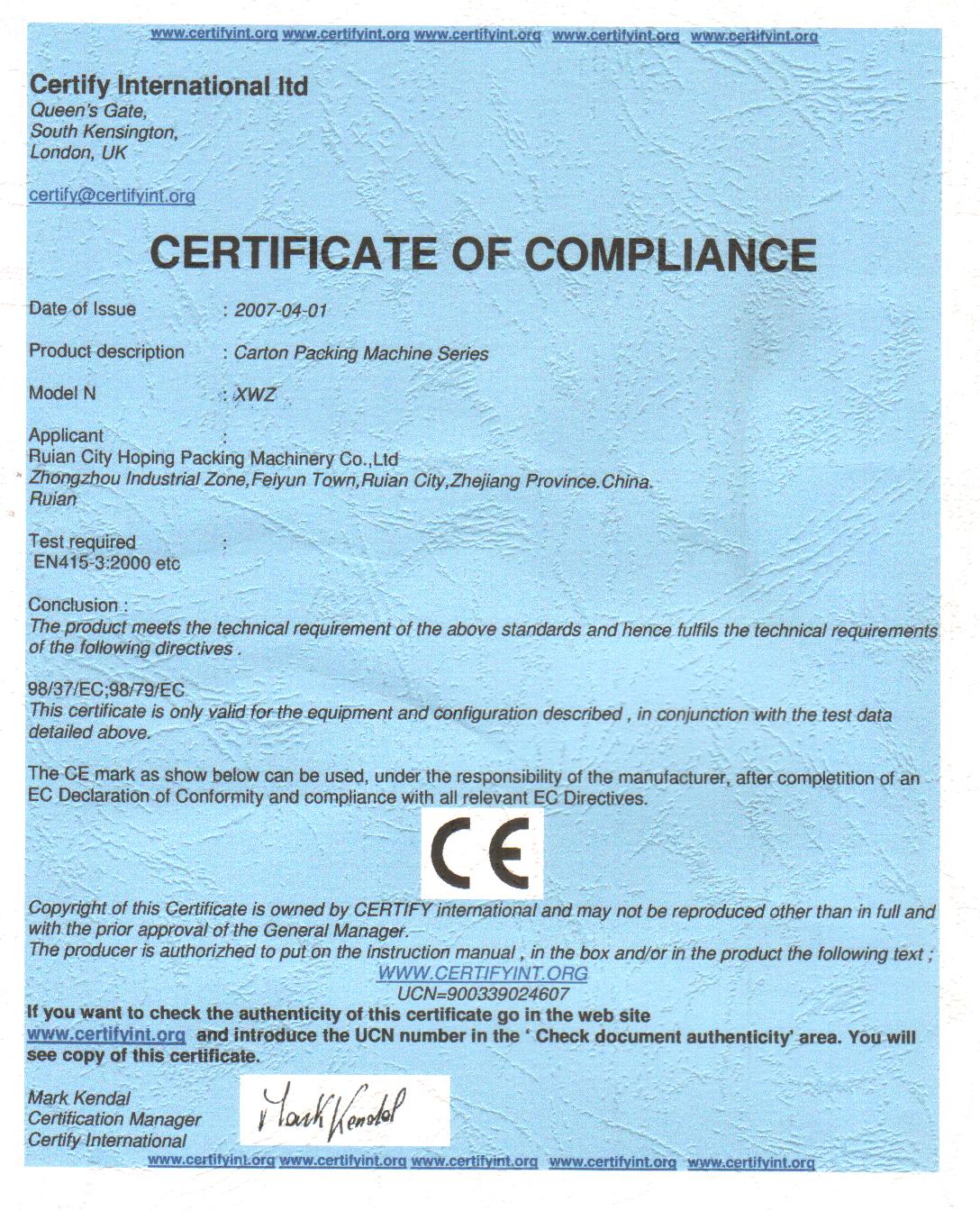
Ask for the certificate number, the issuing body, the applicable standard and the machine series covered — a CE mark alone does not identify the scope. Hoping's carton packing machine series holds CE certificate UCN 900339024607, issued by Certify International Ltd against EN 415-3:2000, 98/37/EC and 98/79/EC. The cartoning machine series certificate HTT190102307L was issued by Shenzhen HTT Technology Co., Ltd. against EN 60204-1:2006+A1:2009+AC:2010 and 2006/42/EC, and the blister packing machine series certificate HTT190102306L against Machinery Directive 2006/42/EC and EN 60204-1:2006+A1:2009+AC:2010. Management-system certificates include ISO 45001:2018 (CN00123S33121R1M/3300) and ISO 14001:2015 (CN00123E33896R1M/3300), both issued by China Quality Certification Centre (CQC). In the EU, buyers should additionally confirm compliance with Machinery Directive 2006/42/EC and the EN 415 series for packaging machines, and with ISO 15378 where primary packaging materials are involved.
What output can a fully servo blister-cartoning line realistically achieve?
In this range the highest-capacity integrated blister-cartoner is the DHL1000/5H at up to 1000 blisters/min and 500 cartons/min with a four-channel servo-driven independent replenishment system. The DHL8005H is rated up to 800 blisters/min and 500 cartons/min with a three-channel servo-driven independent replenishment system, a D3 intelligent top-loading parallel tracking transfer system, and a Beckhoff motion controller with a CP9315 industrial PC. The DHL7005H reaches 700 blisters/min and 500 cartons/min using a Siemens motion controller with a TP900 HMI and a self-developed IRB24 transfer robot, while the DHL6004 is rated 600 blisters/min and 400 cartons/min. Where flow wrapping is required before cartoning, the IXW800 is rated up to 600 blisters/min, 600 packs/min and 500 cartons/min.
What drives the configuration cost of a servo-driven blister-cartoning line?
Cost follows configuration rather than a fixed list, because most of the scope is defined in the technical agreement. The variables that move a specification are: the number of servo-driven independent replenishment channels (three on the DHL8005H, four on the DHL1000/5H); the control platform (Beckhoff with CP9315 industrial PC, or Siemens with TP900 HMI); the transfer technology (D3 intelligent top-loading parallel tracking or the IRB24 robot); the number of feeding methods; format tooling for blister size and materials, carton specification and leaflet format; the coding and inspection method; and the downstream scope — bundling, case packing and palletizing. Interface language, electrical component brand and data interface are also configurable. Minimum order quantity is one set or one complete line, and monthly production capacity is 30–40 units, so the practical way to compare suppliers is to fix these items first and request a configuration-based quotation.
Can we validate a line with a material trial before shipment?
Yes. The agreed quality-control sequence covers incoming material inspection, key component inspection, assembly inspection, electrical safety check, no-load trial run, material trial, factory acceptance test, customer witness acceptance and pre-shipment inspection. Because format parts and product-contact parts are made to the confirmed blister, carton and leaflet specifications, the material trial is the stage at which forming, sealing, transfer, insertion and closing behaviour can be observed and adjusted on real product before the line is shipped.
What lead time should we plan for a complete blister-cartoning line?
Lead time is typically 60–120 days after technical confirmation; the final figure depends on the model, configuration, project complexity and contract terms. Planning should also cover installation and commissioning, operator and maintenance training, remote video and telephone support, spare-parts supply and process-parameter guidance, all of which are part of the supplier's after-sales scope. Where a project involves several lines — a 5–10 line programme for tablets and capsules, for example — sequencing should be agreed at the same time as the technical specification so that commissioning windows match your production calendar. If you would like to move from evaluation to a concrete comparison, send your blister format, carton size, leaflet format and target output, and a configuration-based proposal can be prepared against those inputs.
Conclusion: Choose the Architecture You Can Operate for the Next Decade
The servo-versus-mechanical question is really a question about where change will happen — in software or in hardware. If formats are stable, the product mix is narrow and speeds are moderate, a single-main-motor cartoner such as the XWZ120 at 30–120 cartons/min can be a disciplined, appropriate choice. If the plan includes 700–1000 blisters/min, frequent format changes, or downstream automation through bundling, case packing and palletizing, servo-driven lines are built for that: the DHL8005H at 800 blisters/min and 500 cartons/min with a Beckhoff motion controller and CP9315 industrial PC, the DHL1000/5H at up to 1000 blisters/min, the DHL7005H on a Siemens platform, and the IXW800 where flow wrapping precedes cartoning.
Whichever architecture is chosen, decide it on evidence: certificate numbers with the machine series they cover, a documented acceptance protocol, a material trial on your own formats, and a control platform your engineering team can maintain.
Next step
If you are comparing a servo-driven blister-cartoning line with a mechanical alternative, the fastest route to a usable comparison is to share four inputs: blister format, carton size, leaflet format and target output in blisters/min and cartons/min. That is enough to map the requirement onto a specific configuration and to confirm CE and GMP documentation for the machine series concerned.
Download the full equipment range: Hoping Machinery Catalog (PDF)
Contact: monica@xwbj.com | Tel / WhatsApp: +86 133-5610-5292 | www.hopingcn.com
Zhejiang Hoping Machinery Co., Ltd., 88th Weiwu Road, Nanbin Sub-district, Ruian City, Zhejiang Province, China.
Have Questions or Need More Details?
Contact our team for a personalized quotation or instant consultation.
Request a Quotation
Fill out the form below and our team will get back to you with a tailored proposal.
WhatsApp Direct Chat
Prefer to chat in real-time? Message us on WhatsApp for instant assistance & quick answers.
- Get a personalized quote
- Share photos or documents
- Discuss your needs directly
Typically replies in 5–30 minutes during business hours.