
Application Guide: DHL8005H Blister-Cartoning Line for Tablets, Capsules, and Soft Capsules
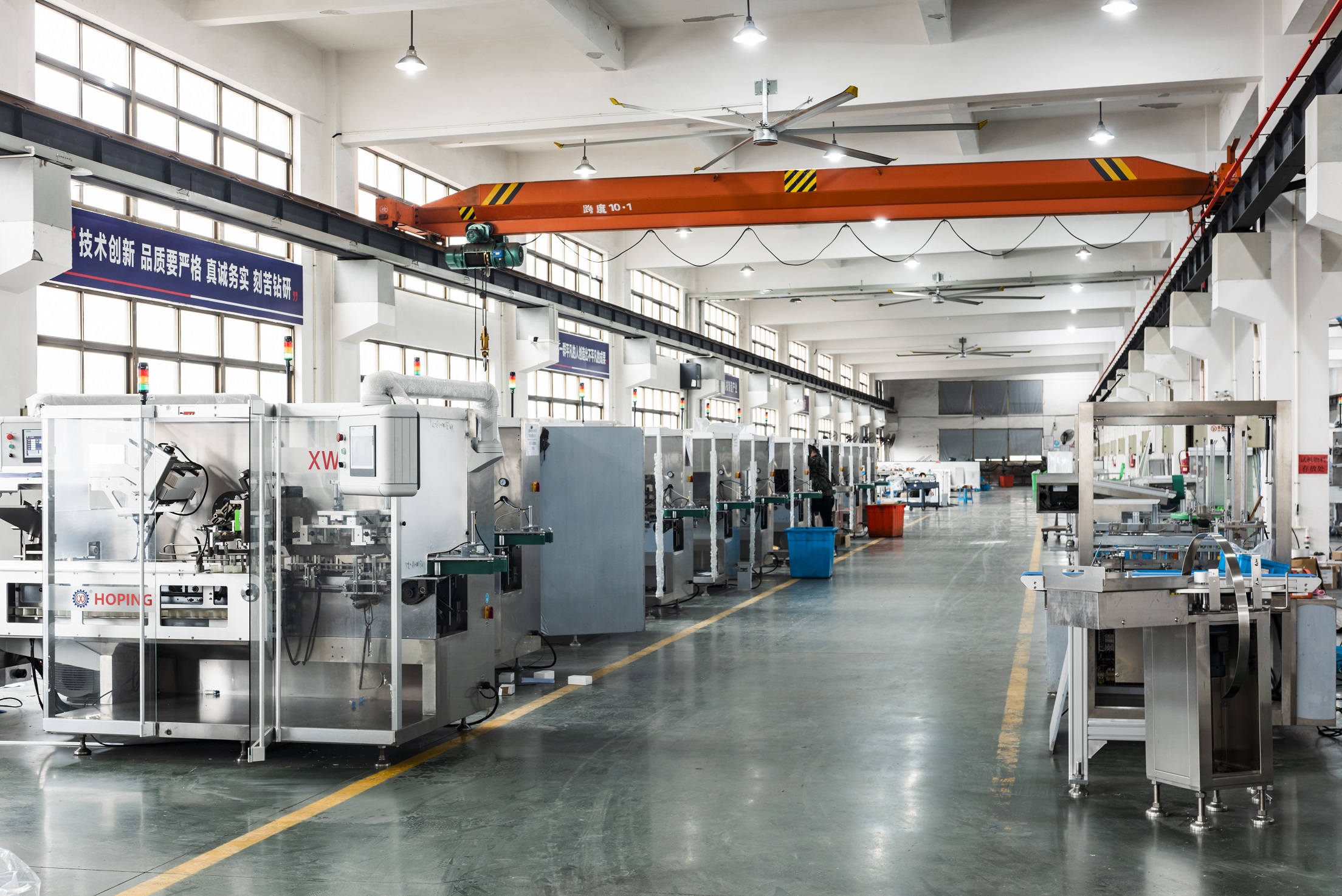
The DHL8005H is an integrated blister-cartoning line built by HOPING — Zhejiang Hoping Machinery Co., Ltd., a pharmaceutical packaging machinery manufacturer established in 2001 in Ruian, Zhejiang, China, with a 28,800 m² manufacturing facility. The line performs blister forming and sealing, product feeding, blister-to-carton transfer, leaflet handling, carton erection and closing, and rejection in one automated process. HOPING states that the DHL8005H runs at up to 800 blisters per minute, with cartoning output of up to 500 cartons per minute.
Those numbers describe a platform. They do not decide whether the platform belongs in your plant. A tablet project, a hard-capsule project, and a soft-capsule project can share the same machine base and still require different tooling, different feeding behaviour, different material structures, and different acceptance tests. This guide treats the DHL8005H as an application platform, works through the three solid-dosage families it is most often specified for, and then sets out the comparison and verification steps that turn a specification into a decision.
Problem definition: the line is chosen by dosage form, not by headline speed
The buying problem is not "which machine is fastest." It is "which configuration keeps blister output and carton output balanced across every SKU I run, without adding manual handling between the two stages." Three failure modes dominate the decision.
The speed basis. Stated maximum output depends on product format, blisters per carton, packaging materials, and process conditions. A figure quoted without those conditions cannot be compared with a competitor's figure. Buyers should ask for the basis, not the number.
The handoff. The defects that reach the market are rarely caused by the forming station alone. They appear where the blister leaves the primary pack: missing, wrong, or incomplete product feeding; missing leaflet; carton jam; coding or date-printing error; foreign-matter or contamination risk. Each of these is a station-level problem that needs a station-level control — sensor monitoring, missing-product alarm, automatic stop, automatic rejection, key-parameter locking, or mechanical safety protection.
The changeover. A line that runs one format well but takes most of a shift to switch cannot serve a multi-SKU portfolio. Molds are physical objects that must be changed; the question is how much of the rest of the setup is repeatable.
Hard capsules add a second layer of difficulty: they are lighter than most tablets of equivalent cavity size, they can orient unpredictably in a feeding channel, and they are sensitive to the physical handling in the transfer between blister and carton. Soft capsules add a third: a softgel is a filled, deformable body rather than a compressed solid, so cavity release, surface condition, and dimensional consistency across the batch matter more than nominal hardness.
Industry background: why integrated blister-cartoning decisions are getting harder
The commercial context is expansion, not consolidation. Custom Market Insights valued the global blister packaging machine pharmaceutical market at USD 2.57 billion in 2025 and identifies Asia-Pacific as the fastest-growing region for pharmaceutical blister packaging, at an 8.87% CAGR to 2031. Mordor Intelligence's end-load cartoning machine research reports that horizontal cartoning systems held 70.12% of market share in 2024 — the horizontal architecture is the mainstream choice for secondary packaging of solid dosage.
Regulation is the second pressure. The U.S. FDA describes Current Good Manufacturing Practice as the foundation for quality pharmaceuticals through regulatory standards, and ISO 15378:2017 specifies Good Manufacturing Practice requirements for primary packaging materials for medicinal products. ISO 15378 addresses the material supplier, not the machine builder — but the equipment must not undermine what the material's compliance assumes: cleanable surfaces, controlled and recorded parameters, and a documented change process. On the technology side, trade reporting of PMMI content notes that pharmaceutical manufacturers are turning toward digitised data collection and integrated solutions to meet regulations and improve visibility. In practice that moves the control platform from a purchasing afterthought to a specification item.
For a buyer at decision stage, the consequence is simple: the line must be evaluated as a process with a control layer, not as a set of mechanical stations with a speed plate.
The solution: what the DHL8005H actually integrates
One pass from formed blister to closed carton
HOPING's comparison material describes the integrated configuration as blister packaging, blister transfer, leaflet handling, carton opening, insertion, inspection and rejection, and downstream connection combined into one automated process. Compared with a traditional arrangement of blister machine, manual transfer, and standalone cartoner, this removes intermediate handling between the two stages and reduces manual intervention. Compared with a low-speed semi-automatic blister-cartoning setup or a conventional non-full-servo link line, the difference lies in motion synchronisation across the stations rather than in a single station's rating.
The practical benefit is not only labour. Every manual transfer point is an uncontrolled handling step; removing it also removes a class of handling damage and a class of documentation gaps, because the product path is inside one machine sequence with one set of sensors and one rejection logic.
Three-channel servo-driven independent replenishment
The DHL8005H uses three servo-driven replenishment channels that are replenished independently. Each channel is driven in its own right and coordinated by the line's motion controller, rather than being slaved to one shared feed motion. For a tablet project this matters because feed behaviour is where dust accumulation, partial cavities, and gap patterns first appear; independent channels mean replenishment logic is applied per channel. For capsules and soft capsules, the relevance is the same in principle — channel-level behaviour is observable and adjustable — but the proof has to come from a material test on your own product, not from the architecture description.
PVC and aluminium foil auto splicing
Blister lines stop for roll changes; on a fast line those stops are a visible share of the shift. The DHL8005H automates splicing of PVC film and aluminium foil, so the web join is made by the machine instead of by an operator manually re-threading and joining the web. The decision-relevant questions are not whether splicing exists, but how the splice is detected, which blisters are rejected around the splice, and whether the splice event is recorded. Those three items belong in the factory acceptance test protocol.
Mold change and preset memory
Format change on a blister-cartoning line involves two different kinds of work. The mechanical work is the mold change: forming, sealing, and cutting tooling matched to the cavity layout and blister format. The parameter work is everything else — stroke positions, temperatures, speeds, and the synchronisation between blister output and carton pitch. Preset memory stores parameter sets by format, so a returning SKU is recalled rather than rebuilt. It shortens the repeatable part of changeover; it does not shorten the mechanical part, and it does not replace a first-article check after the molds are seated.
Control platform and GMP-oriented construction
The line's motion control runs on a Beckhoff motion controller, with a CP9315 industrial PC handling the PC-based layer. For a buyer, the significance is that recipe storage, parameter management, and fault records sit in a PC-based layer that can be interrogated — which is the layer an auditor will ask about. Whether that layer meets a specific data-integrity rule in your market is a separate question and must be verified against your own requirements, not assumed from the hardware list.
Construction is GMP-oriented, using stainless steel and aluminium alloy. That supports cleanability and surface durability in a pharmaceutical environment. Buyers should still request material documentation for product-contact parts and confirm the cleaning agents your plant uses are compatible with the surfaces specified.
Step-by-step: qualifying a solid-dosage project on the DHL8005H
Step 1 — Fix the format data before discussing speed
Collect cavity dimensions, blister layout, blister count per carton, carton dimensions, leaflet format, and the coding requirement for each SKU. Line balancing follows from these numbers, not from the machine rating. At two blisters per carton, a stated 800 blisters per minute corresponds to 400 cartons per minute, which sits inside the stated 500 cartons per minute cartoning ceiling. At one blister per carton, the cartoner becomes the limit. Run this arithmetic for every SKU before you accept any output figure.
Step 2 — Confirm the packaging material structure
PVC film and aluminium foil are the material pair covered by the auto-splicing function. If a project requires an alu-alu (cold-form) structure, confirm it explicitly at model level: HOPING's catalogue covers flat-plate, roller-type aluminium-plastic, and aluminium-aluminium blister machines as separate machine categories, so format capability must be matched to the specific model and tooling rather than assumed across the range.
Step 3 — Confirm samples and materials at the early project stage
HOPING's stated project measure is to confirm samples and packaging materials early, then design the solution around the blister and carton formats. This is the cheapest point to discover that a softgel sticks in a cavity or that a capsule feeds unevenly at the target pitch.
Step 4 — Freeze the mold and recipe set, then verify the first article
Mold change establishes the mechanical format; preset memory recalls the parameter set. After a mold change, produce a first article and check forming depth, seal integrity, perforation or cut quality, and carton closing before the line is released back to production.
Step 5 — Run no-load and material tests before shipment
HOPING's stated practice is to conduct no-load and material tests before shipment. Treat this as a gate, not a formality: request the test report with the actual material lot and product used, and record which parameters were locked.
Step 6 — Agree the acceptance protocol
Factory acceptance and site acceptance testing should cover both output and defect handling. Build the protocol around the known risk list: poor blister forming or sealing, missing or wrong product feed, missing leaflet, carton jam, coding error, foreign-matter risk, and high-speed downtime. For key projects, HOPING states that customer witness acceptance can be arranged.
Step 7 — Plan the ramp-up and the support chain
HOPING provides installation, commissioning, training, spare parts, and remote technical support. Before handover, define which operator actions are permitted at the HMI, which parameters are locked, how fault records are exported, and what the spare-parts list contains for the first year of operation.
Use cases: four project profiles and what each one stresses
Profile 1 — High-volume tablet producer with a multi-SKU catalogue
Several cavity layouts, several carton counts, one line. The binding constraint is changeover, not peak speed. What to test: recall accuracy of stored parameter sets across consecutive changeovers, and the first-article routine after each mold change.
Profile 2 — Hard-capsule specialist running light, uniform product
Capsules are light for their volume, so feed consistency and cavity seating carry more weight than forming temperature. What to test: three-channel replenishment behaviour with your capsule size range, and the rejection logic for partially seated capsules.
Profile 3 — Soft-capsule and nutraceutical producer
Deformable product with batch-to-batch dimensional variation. What to test: cavity release, surface marking, and whether the transfer between blister and carton is gentle enough for your softgel shell. Nutraceutical and healthcare products often add label and carton copy variations, which makes preset memory a production tool rather than a convenience.
Profile 4 — Contract packer or CDMO with mixed batches
Many short runs, frequent material changes, and an audit trail requirement per batch. What to test: parameter locking, fault-record export, and the documented change-control routine between batches. The integrated single-pass architecture is the main argument here, because every manual transfer removed is a handling step that no longer needs to be documented and supervised.

Comparison: integrated line versus the two common alternatives
The comparison below is deliberately limited to the configurations HOPING's own comparison data describes. It does not rank brands, because verifiable third-party performance data at this level of configuration detail is not available, and a comparison built on assumptions would be worse than no comparison.
| Criterion | Blister machine + manual transfer + standalone cartoner | Low-speed semi-automatic blister-cartoning | Integrated servo DHL8005H line |
|---|---|---|---|
| Process integration | Separate machines joined by manual transfer between stages | Linked, but with partly manual handling in the sequence | Blister forming and sealing, blister transfer, leaflet handling, carton opening, insertion, inspection and rejection, and downstream connection in one automated process |
| Manual touchpoints | Highest — transfer and staging between machines | Reduced but present | Lowest of the three, because the product path stays inside one sequence |
| Stated output basis | Dependent on each machine's own rating; the slower stage sets the practical limit | Dependent on configuration | Up to 800 blisters per minute and up to 500 cartons per minute; actual output depends on format, blisters per carton, materials, and process conditions |
| Format change | Two changeovers to coordinate, one per machine | One changeover, largely manual | Mold change plus preset-memory recall of stored parameters |
| Control layer | Two separate control systems | Single control system, limited motion coordination | Beckhoff motion controller with CP9315 industrial PC; centralised control, alarm indication, and parameter management |
| Cost profile | Lower entry cost | Middle entry cost | Higher initial investment, offset by reduced labour, transfer, management, and quality-risk costs in large-scale continuous production |
| Best fit | Low volume, single format, or a plant already holding one machine | Moderate volume with limited SKU variation | Large-scale solid-dosage packaging, high-capacity workshops, and multi-format lines requiring stable operation with reduced manual contact |
Dosage-form fit: what to verify before you commit
The table below maps each solid-dosage family to the packaging considerations that most often change the outcome of a project. It is a verification checklist, not a capability claim — each item must be confirmed with a material test on your own product.
| Dosage form | Dominant packaging consideration | What to verify on the line |
|---|---|---|
| Tablets | Consistent solid body; dust generation and edge friability drive cleaning and cavity condition | Cavity depth against your tablet thickness range; dust behaviour across a full shift; three-channel replenishment consistency; rejection of partial cavities |
| Hard capsules | Light for cavity volume; orientation and seating are the weak points | Feeding behaviour across your capsule size range; seating verification; the alarm and stop logic for a missed or misoriented capsule |
| Soft capsules (softgels) | Deformable filled body with batch-to-batch dimensional variation | Cavity release and surface condition; handling through blister transfer; whether carton loading preserves shell integrity; batch variation tolerance |
| Nutraceuticals and healthcare products | Wide copy variation across labels, leaflets, and cartons; frequent short runs | Preset-memory coverage of the full SKU list; leaflet handling for your leaflet format; coding and date-printing verification; changeover time measured across consecutive SKUs |

FAQ
There are two layers, and buyers often confuse them. The regulatory layer is the framework: the U.S. FDA describes Current Good Manufacturing Practice as establishing the foundation for quality pharmaceuticals through regulatory standards, and ISO 15378:2017 specifies GMP requirements for primary packaging materials for medicinal products. ISO 15378 applies to the material supplier — the machine builder's obligation is not to undermine it. The equipment layer is what you can actually audit: material documentation for product-contact parts in stainless steel and aluminium alloy, cleanability of surfaces, key-parameter locking, fault records, a written FAT/SAT protocol, change-control records, and SOP-based operator training. HOPING's stated control measures for blister-cartoning lines include sensor monitoring, missing-product alarms, automatic stop and rejection, key-parameter locking, fault records, mechanical safety protection, and FAT/SAT acceptance. Ask for each item as a document, not as a verbal assurance.
There is no defensible answer without a comparison basis you define yourself, because published, verifiable performance data at configuration level is scarce. A workable basis has six items: whether the documented scope matches your dosage forms and formats; whether the control architecture can be inspected (servo axes, motion controller, industrial PC); whether changeover is supported by molds plus stored parameter sets; whether GMP and validation documentation exists as documents; whether acceptance testing includes material tests before shipment and witness acceptance; and whether installation, commissioning, training, spare parts, and remote support are defined in writing. Score each shortlisted supplier against the same six items. For reference, HOPING documents a 28,800 m² facility, more than 300 employees, 56 engineers, approximately 500 units of annual output, a 25% export ratio with markets in Southeast Asia, the Middle East, Eastern Europe, South America, and Africa, and a portfolio covering blister packaging machines, cartoning machines, case packing machines, and end-of-line packaging machines. A supplier that documents more of the six items is easier to audit; that is a different statement from being the better machine for your product, which only a material test can settle.
The platform is built for solid dosage, and the format range is set by tooling and recipes rather than by the machine base alone — mold sets and preset-memory parameter sets define what a given line can run. Three practical conditions apply. First, the blister format and cavity layout must be engineered for each dosage family. Second, aluminium-plastic structures using PVC film and aluminium foil are the pair covered by the auto-splicing function; if a project needs an alu-alu (cold-form) structure, confirm it explicitly at model level, because HOPING lists aluminium-aluminium blister machines as a separate machine category. Third, soft capsules require cavity release and transfer checks that tablets do not. Confirm all three with a material test on your own samples before the mold design is frozen.
The initial investment in an integrated line is usually higher than a standalone blister machine plus a standalone cartoner, or a semi-automatic blister-cartoning setup. The offsetting economics appear in continuous production: reduced labour, reduced transfer and intermediate handling, simplified production management, and lower quality-risk cost. That trade only works at volume. If your annual output is low, or if a single SKU dominates your plan, the standalone route can be the more rational purchase even though it carries more manual handling. Because configuration, mold sets, inspection options, and downstream scope vary by project, price and delivery terms have to come from a written quotation rather than from a published figure.
Send production-representative samples of each dosage form, the packaging materials you intend to use (PVC film and aluminium foil, or the structure your product requires), the blister and carton format drawings, and the leaflet specification. HOPING's stated project practice is to confirm samples and packaging materials at the early project stage, design the solution according to blister and carton formats, conduct no-load and material tests before shipment, and then provide installation, commissioning, training, spare parts, and remote technical support, with customer witness acceptance available for key projects. Delivery time depends on configuration, mold count, and inspection options, so it is confirmed in the quotation rather than quoted as a fixed figure here. To start that process, send your format data and sample request to monica@xwbj.com or via WhatsApp on +86 133-5610-5292.
Conclusion: the decision rule
Choose the DHL8005H when three conditions hold together: your blister-to-carton ratio keeps cartoner demand inside the stated 500 cartons per minute ceiling across your SKU list; your format portfolio is stable enough that mold sets and stored parameter sets pay back; and you want the blister-to-carton handoff inside one automated sequence with one rejection logic. Choose a standalone or semi-automatic route when volume is low, when a single format dominates, or when the capital envelope cannot carry the integration premium.
Whichever route you take, decide on evidence rather than on a speed plate: the output basis for your actual format, the material test on your actual product, the first-article routine after a mold change, and the acceptance protocol that covers the defects you already know about. Those four items decide the project. The machine rating only describes its ceiling.
Next step: check the DHL8005H against your own formats
Download the full HOPING Machinery catalogue for the blister packaging machine, cartoning machine, case packing machine, and end-of-line packaging machine range: Hoping Machinery Catalog (PDF).
Then send your blister and carton format drawings plus product samples for an application review and quotation. Contact: Monica — monica@xwbj.com, Tel / WhatsApp +86 133-5610-5292. Manufacturer: Zhejiang Hoping Machinery Co., Ltd., 88th Weiwu Road, Nanbin Sub-district, Ruian City, Zhejiang Province, China — www.hopingcn.com.
Have Questions or Need More Details?
Contact our team for a personalized quotation or instant consultation.
Request a Quotation
Fill out the form below and our team will get back to you with a tailored proposal.
WhatsApp Direct Chat
Prefer to chat in real-time? Message us on WhatsApp for instant assistance & quick answers.
- Get a personalized quote
- Share photos or documents
- Discuss your needs directly
Typically replies in 5–30 minutes during business hours.