
The Role of Industrial PCs in Blister-Cartoning Lines
An industrial PC on a blister-cartoning line coordinates the line; it does not drive the axes. Synchronized motion — forming, sealing, punching, blister transfer, carton erection, leaflet folding, insertion and closing — is executed by the motion controller and the servo drives beneath it. The industrial PC above that layer holds the recipe, the operator interface, the format-changeover parameters, the alarm and fault record and the data handover toward ERP or MES. That division of labour decides whether a line stays in step or drifts into buffer starvation, transfer jams and false rejects.
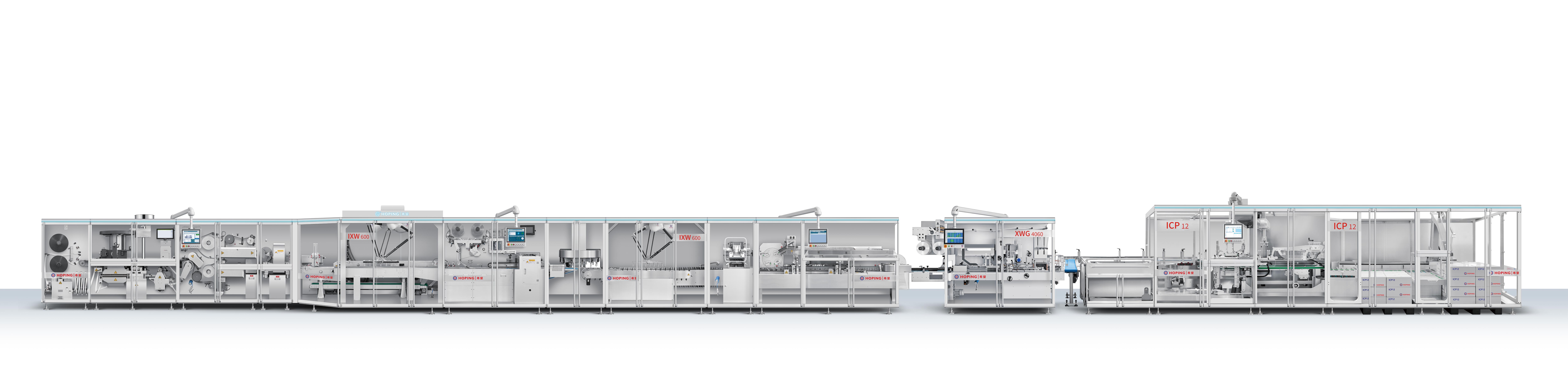
Zhejiang Hoping Machinery Co., Ltd. (HOPING) is a pharmaceutical packing machinery manufacturer based in Ruian City, Zhejiang Province, China, established in 2001 and producing blister packing machines, cartoners, flow wrappers, bundlers, case packers, palletizers and integrated blister lines. Its published specifications make the control architecture auditable rather than assumed: the CP9315 industrial PC is named alongside a Beckhoff controller on the IXW600 and IXW800 blister-flow-cartoner lines, and alongside a Siemens controller on the IXW400 liquid-dosage blister-cartoner. This article explains what each control layer does, where synchronization actually fails, and how to specify and test the architecture before a line ships.
Problem Definition: Where Blister-Cartoning Lines Lose Synchronization
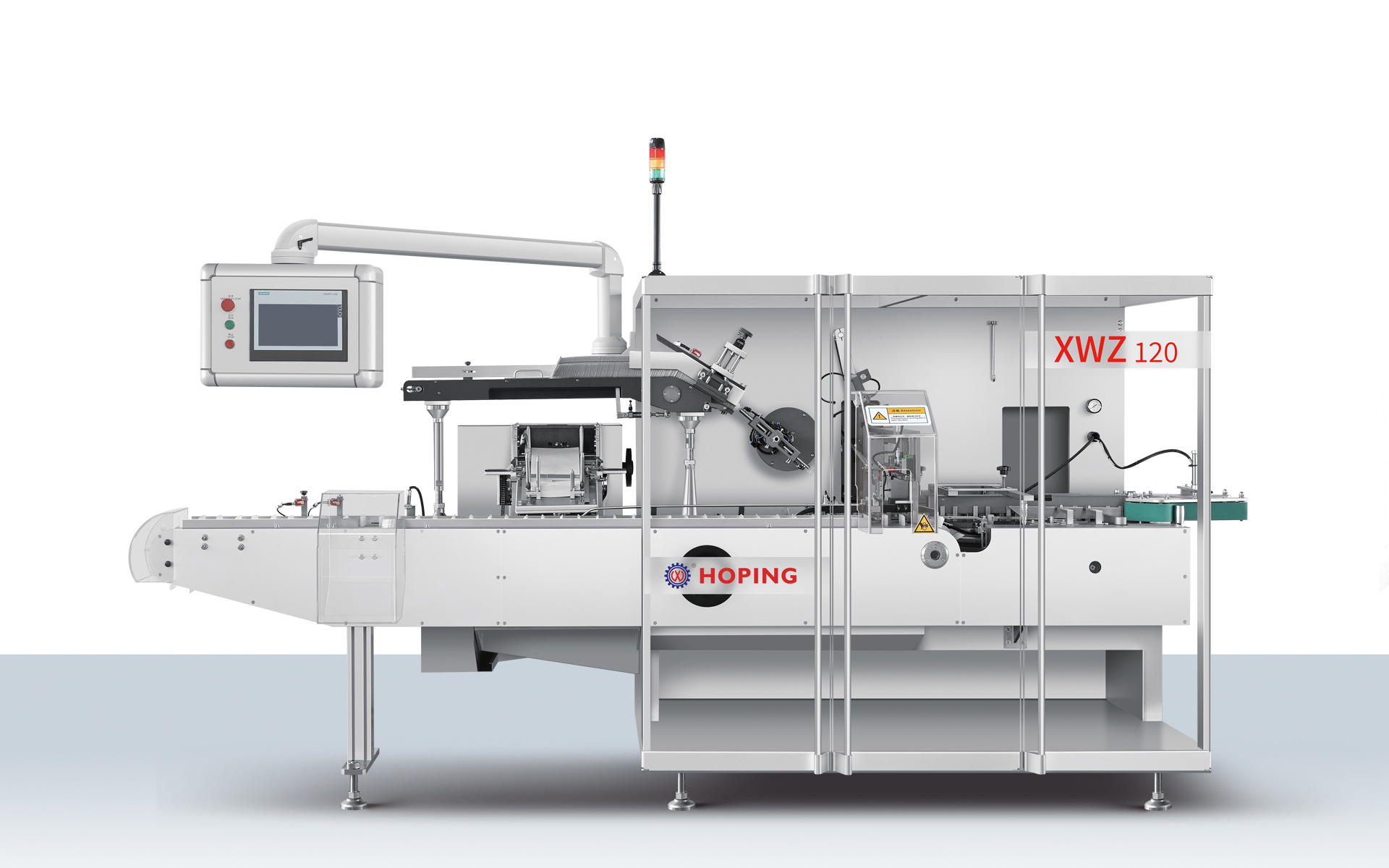
A blister-cartoning line is three machines behaving as one. The blister side forms and seals a cavity web and punches blisters at its own cadence, the transfer or flow-wrap stage moves product in groups, and the cartoner erects, fills and closes cartons at a third cadence. HOPING’s own model data shows how far apart those cadences sit. The DPH320H fully servo roller blister packing machine is documented with a punching frequency of 12 times per minute, a forming area of 320 × 280 mm, a forming depth of 12 mm and a stroke range of 100–280 mm. The XWZ120 horizontal cartoning machine is documented at approximately 30–120 cartons per minute. The integrated IXW400 is documented at up to 400 blisters per minute and 150 cartons per minute, the IXW600 at up to 600 blisters, 300 pillow packs and 300 cartons per minute, and the IXW800 at up to 600 blisters, 600 packs and 500 cartons per minute.
Those figures are not directly comparable. Punching frequency, blisters per minute, packs per minute and cartons per minute are four different measurement bases. That is the first synchronization problem, and it is definitional rather than mechanical: a line balanced on mismatched bases looks balanced in a proposal and behaves unevenly in production.
The second problem is temporal. Between the blister outfeed and the cartoner infeed there is a buffer, and the buffer absorbs variance only inside a narrow window. If the blister side runs fractionally ahead, the buffer fills and the line stops; if it runs behind, the cartoner starves and carton erection becomes erratic. On configurations that add a top-load robot — the D3 top-loading robot on the IXW400, the D3 top-load robotics and rotary manipulator on the IXW800 — the timing window is tighter still, because the robot picks on a fixed cycle and cannot wait.
The third problem is informational. Format changeover, alarm history, rejection counts and batch-linked parameters are not motion problems, and a motion controller is the wrong place to keep them. When a line keeps its recipes in operator memory instead of a stored recipe set, every changeover reintroduces the same setup variance, and no acceptance test can demonstrate repeatability.
Industry Background: Why Control Architecture Became a Procurement Item
Market data frames the investment context. The global pharmaceutical packaging machinery market is reported at USD 7.09 billion in 2026, growing at a CAGR of 7.15% toward USD 10.02 billion at the end of the forecast period (Mordor Intelligence; the forecast end year is truncated in the retrieved summary). The pharmaceutical blister packaging machine market was valued at USD 2.57 billion in 2025, with Asia-Pacific the fastest-growing region at an 8.87% CAGR to 2031 (Custom Market Insights). Horizontal cartoning systems held 70.12% of cartoning market share in 2024 (Mordor Intelligence). Each figure is publisher-reported and should be read as directional context rather than a benchmark for any single project.
Regulation shapes the same decision from a different direction. CE marking is a safety conformity question: HOPING’s cartoning machine series and blister packing machine series both carry CE certificates issued against Directive 2006/42/EC and EN 60204-1:2006+A1:2009+AC:2010. GMP is a separate question. ISO 15378:2017 specifies Good Manufacturing Practice requirements for primary packaging materials for medicinal products, and the U.S. FDA’s cGMP framework establishes the foundation for quality pharmaceuticals through regulatory standards. A CE certificate does not make a line GMP-compliant, and a GMP review does not substitute for CE conformity — a point that matters when a buyer reviews supplier documentation.
Digitisation closes the loop. Trade media reporting PMMI content describes pharmaceutical manufacturers turning toward digitised data collection and integrated solutions in order to meet regulations and improve visibility. On a packaging line, that trend lands squarely on the industrial PC: the layer where batch data, alarm history and recipe versions can be held and handed on.
Detailed Solution: What Each Control Layer Owns
The clearest way to evaluate a blister-cartoning line is to ask which layer owns which function. Four layers do the work, and confusion between them is the usual source of both over-specification and under-specification.
| Layer | What it owns | What it should not be asked to do |
|---|---|---|
| Field and actuator | Servo axes, pneumatic valves, sensors and safety interlocks at the machine. | Hold recipes, batch records or operator workflows. |
| Motion control | Executing synchronized motion and axis coordination — documented on HOPING lines as high-speed synchronous linkage and, on the IXW600 and IXW800, rotary reciprocating flow-wrapper matching technology. | Present operator screens or archive production data. |
| Industrial PC (CP9315) | Operator interface, recipe storage, format-changeover parameters, alarm stop and fault indication, interface language and data interface. | Generate real-time motion profiles; that remains with the controller. |
| Line and plant | ERP/MES data interface and connection to downstream bundling, case packing and palletizing where configured. | Replace machine-level safety functions. |
The controller executes; the industrial PC governs
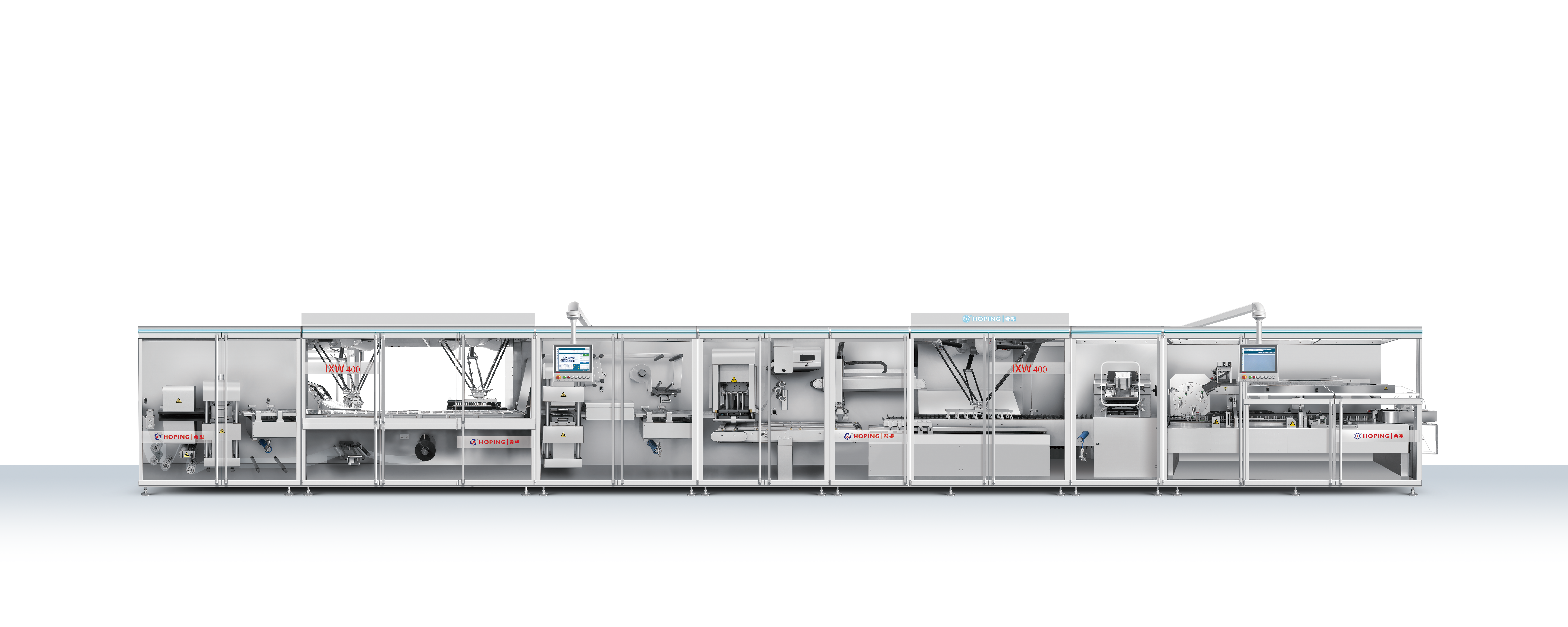
On the IXW400, HOPING documents a Siemens controller with a CP9315 industrial PC; on the IXW600 and IXW800, a Beckhoff controller with the same CP9315 industrial PC. The distinction is deliberate. The controller holds the motion program and the cam relationships that keep blister pitch, pillow-pack pitch and carton pitch in a fixed ratio. The industrial PC holds everything that changes between batches: which format is loaded, which parameters travel with it, what the operator sees, and what is written into the production record.
Documented line-level features show where that governance becomes visible. The IXW400 supports PVC and top-cover film auto splicing, servo-driven independent replenishment, high-speed synchronous linkage, a D3 top-loading robot and convenient mold change. The IXW600 adds PVC/Cold Alu auto splice, servo-driven replenishment and rotary reciprocating flow-wrapper matching technology. The IXW800 adds D3 top-load robotics and a rotary manipulator, with PVC/Cold Alu auto splice on a dual-track configuration. All three are described as GMP-oriented designs.
Why the industrial PC earns its place at changeover
Changeover is where the supervisory layer pays for itself. HOPING’s documented operating mode for integrated lines includes recipe storage, format changeover support, alarm stop and fault indication under synchronized multi-station control, with configuration-dependent scope. The customization scope explicitly covers blister size, blister materials, quantity per carton, carton specification, leaflet format, coding and inspection method, feeding method, downstream bundling, case-packing and palletizing connection, interface language, electrical component brand and data interface. Interface language and electrical component brand are control-layer decisions, not mechanical ones, and they belong in the same specification paragraph as the controller model.
Where the DHL8005H fits
The DHL8005H is part of HOPING’s Automatic Blister-Cartoning Line / Blister Cartoner Line family, and the control architecture described above is what a buyer should expect to fix at project stage rather than infer from a family name. HOPING’s published line material records a company-stated maximum of 1,000 blisters per minute and 500 boxes per minute for one line configuration. That figure is tied to a specific configuration and format and carries no independent acceptance-test disclosure, so it should be verified as sustained output during factory acceptance rather than treated as a guaranteed production rate.
Step-by-Step Breakdown: Specifying and Proving the Architecture
Step 1 — Fix the measurement basis before comparing machines. State output in blisters per minute, packs per minute and cartons per minute on the same format, and keep punching frequency out of cross-machine comparisons. The DPH320H is documented at 12 punching times per minute with a 320 × 280 mm forming area and 12 mm forming depth; the XWZ120 at 30–120 cartons per minute. Comparing a punching frequency with a finished-carton rate produces a number, not an answer.
Step 2 — Name the controller and the industrial PC in the technical agreement. Write down the controller family, the CP9315 industrial PC, the interface language and the electrical component brand. HOPING lists these as customization variables, which means they are negotiable items with a documented place in the contract rather than assumptions.
Step 3 — Define the recipe boundary. Agree which parameters travel with a format: blister size and materials, quantity per carton, carton specification, leaflet format and coding or inspection method. A recipe that stops at blister pitch leaves the cartoner to be set up by hand at every changeover.
Step 4 — Specify what the line does when something goes wrong. Alarm stop, fault indication and rejection logic should be described in the agreement, together with any vision inspection or checkweigher in the matched-equipment list. HOPING describes reduced false rejection and downtime as configuration-dependent objectives, which is the correct status: they are targets proven at acceptance, not specifications guaranteed by a datasheet.
Step 5 — Prove it at factory acceptance. HOPING’s quality sequence runs from incoming material inspection and key component inspection through assembly inspection, electrical safety check, no-load trial run, material trial, FAT, customer witness acceptance and pre-shipment inspection. The material trial is the step that tests synchronization, because it is the first point at which blister cadence, transfer timing and carton cadence meet real product.

Step 6 — Commission, train and hand over the data. HOPING’s after-sales scope covers on-site installation and commissioning, operator training, maintenance training, remote video and phone support, spare parts supply, process-parameter guidance and regular follow-up, subject to contract and project configuration. Training is where recipe discipline is either established or lost, and it should cover fault diagnosis at the industrial PC, not only button operation.
Use Cases: Where the Supervisory Layer Changes the Outcome
High-speed solid dosage with flow wrap. The IXW600 links blister packing, flow wrapping and cartoning at up to 600 blisters, 300 packs and 300 cartons per minute; the IXW800 runs a dual track at up to 600 blisters, 600 packs and 500 cartons per minute. When pack and carton counts diverge, the industrial PC is where the ratio is corrected without stopping the blister side.
Liquid dosage formats. The IXW400 is built for pre-filled syringes, ampoules and cartridges, at up to 400 blisters and 150 cartons per minute, with a D3 top-loading robot placing product. Top-loading tolerates less timing slack than push-through transfer, which is why a documented controller-and-IPC pairing matters more here than on a lower-speed line.
Multi-format contract packaging. A contract packager changes format more often than it changes product family. Recipe storage, mold-change support and a defined changeover sequence convert that into a repeatable routine instead of a skilled operator’s memory.
Nutraceutical and high-value tablet production. HOPING’s project record describes 5–10 line engagements with large pharmaceutical manufacturers and pharmaceutical engineering contractors, where stated objectives include improved packaging automation, reduced manual transfer, improved blister-to-carton connection efficiency and lower wrong-insertion or missing-leaflet risk, alongside downstream automation integration.
Comparison Table: Documented Configurations
The table below uses only specifications published for the listed models. Blank or qualified entries are shown as such rather than estimated.
| Configuration | Machine scope | Documented output | Documented controller / industrial PC | Documented line automation |
|---|---|---|---|---|
| IXW400 | Liquid dosage blister-cartoner integral machine | Up to 400 blisters/min and 150 cartons/min | Siemens controller and CP9315 industrial PC | PVC and top-cover film auto splicing; servo-driven independent replenishment; D3 top-loading robot; mold change |
| IXW600 | Blister-flow-wrap-cartoner integral machine | Up to 600 blisters/min, 300 packs/min and 300 cartons/min | Beckhoff controller and CP9315 industrial PC | PVC / Cold Alu auto splice; rotary reciprocating flow-wrapper matching; high-speed synchronous linkage |
| IXW800 | Dual-track blister-flow-wrap-cartoner integral machine | Up to 600 blisters/min, 600 packs/min and 500 cartons/min | Beckhoff controller and CP9315 industrial PC | D3 top-load robotics and rotary manipulator; PVC / Cold Alu auto splice |
| DPH320H | Blister packing machine (primary stage only) | Punching frequency 12 times/min; forming area 320 × 280 mm; forming depth 12 mm; stroke 100–280 mm | Not stated in the published specification | 380V 50Hz 29.5 kW; air 0.5–0.7 MPa, >0.6 m³/min |
| XWZ120 | Horizontal cartoning machine (secondary stage only) | Approximately 30–120 cartons/min | Not stated in the published specification | 380V 50Hz 3.5 kW; approx. 3650 × 1330 × 1700 mm |
| DHL8005H | Automatic blister-cartoning line | Defined per project configuration | Fixed in the technical agreement | Integrated blister-to-carton line family |
Read the table as a specification checklist, not a ranking. Three configurations document a CP9315 industrial PC, one controller family each way, and two component machines document no controller at all — which is precisely the gap a buyer closes by writing the control architecture into the agreement.
Frequently Asked Questions
Which CE certificates apply to HOPING pharmaceutical packaging machines?
HOPING holds CE certification for both machine families used in a blister-cartoning project. Cartoning Machine Series certificate HTT190102307L was issued on 22 January 2019 by Shenzhen HTT Technology Co., Ltd. against EN 60204-1:2006+A1:2009+AC:2010 and Directive 2006/42/EC; Blister Packing Machine Series certificate HTT190102306L carries the same issue date and body, against Machinery Directive 2006/42/EC and EN 60204-1:2006+A1:2009+AC:2010. Earlier certificates exist as historical evidence: UCN 900339024607 from Certify International Ltd (1 April 2007) for the carton packing machine series under EN 415-3:2000, 98/37/EC and 98/79/EC, and UCN 900175009261 from CELAB (6 November 2006) for an automatic blister packing machine under EN 60204-1:1997 and EN 415-3:1999. CE marking addresses safety conformity and is not a GMP certificate; ISO 15378:2017, which specifies GMP requirements for primary packaging materials, sits on the material side of the same project.
Does the industrial PC change a line’s stated output?
No. Statement output is a model rating. The IXW400 is documented at up to 400 blisters/min and 150 cartons/min, the IXW600 at up to 600 blisters, 300 packs and 300 cartons/min, and the IXW800 at up to 600 blisters, 600 packs and 500 cartons/min. The CP9315 industrial PC governs recipes, changeover parameters, alarms and data handover; the Beckhoff or Siemens controller executes synchronized motion. What the supervisory layer changes is how much of the rated output is recovered in practice across changeovers and fault recovery.
What drives the budget of an industrial-PC-controlled blister-cartoning line?
HOPING quotes per project and does not publish price bands, so the useful budget exercise is to list the documented configuration variables that move scope: blister size and materials, quantity per carton, carton specification, leaflet format, coding and inspection method, feeding method, downstream bundling, case-packing and palletizing connection, interface language, electrical component brand and data interface. Add the number of format sets and any vision inspection or checkweigher in the matched-equipment list. Minimum order quantity is one set or one complete line.
Can the control architecture be validated before shipment?
Yes, through the acceptance sequence. HOPING’s quality control covers incoming material inspection, key component inspection, assembly inspection, electrical safety check, no-load trial run, material trial, FAT, customer witness acceptance and pre-shipment inspection. The material trial and witness acceptance are the points at which recipe handling, alarm behaviour and inter-machine timing are demonstrated on real product rather than asserted in a proposal.
What is the lead time for a specific controller and industrial PC configuration?
HOPING states a typical lead time of 60–120 days after technical confirmation, with the final figure subject to model, configuration, project complexity and contract terms. Because the controller, the CP9315 industrial PC, the electrical component brand and the data interface are customization items, they are confirmed during technical review and fixed in the agreement; requesting a sample discussion or a project quotation early is the practical way to convert those variables into a dated schedule.
Conclusion
An industrial PC is not the fastest element on a blister-cartoning line and it is not meant to be. Its value is that it separates what must happen in real time from what must be recorded, repeated and audited. On HOPING’s integrated lines that separation is documented in the specification: a CP9315 industrial PC above a Beckhoff controller on the IXW600 and IXW800, and above a Siemens controller on the IXW400, with recipe storage, format changeover support, alarm and fault indication and a data interface available in the configuration.
For a buyer at research and evaluation stage, four actions follow. Compare machines on one measurement basis. Write the controller, the industrial PC, the interface language and the data interface into the technical agreement. Define the recipe boundary before discussing changeover time. And prove synchronization at the material trial, not on the datasheet. The DHL8005H and the rest of HOPING’s automatic blister-cartoning line family are specified the same way — configuration first, then acceptance.
Specify the control layer before you compare prices.
Send your blister format, carton specification and target output, and HOPING will confirm the controller, the CP9315 industrial PC, the data interface and the acceptance sequence for your configuration.
Contact: Monica · monica@xwbj.com · Tel / WhatsApp: +86 133-5610-5292
Website:www.hopingcn.com
Catalog download:Hoping Machinery Catalog (PDF)
Zhejiang Hoping Machinery Co., Ltd., 88th Weiwu Road, Nanbin Sub-district, Ruian City, Zhejiang Province, China. Established 2001; 28,800 m² manufacturing facility; documented annual output of 500 units; 26 invention patents, 70 utility patents and 28 software copyrights listed in the company profile.
Have Questions or Need More Details?
Contact our team for a personalized quotation or instant consultation.
Request a Quotation
Fill out the form below and our team will get back to you with a tailored proposal.
WhatsApp Direct Chat
Prefer to chat in real-time? Message us on WhatsApp for instant assistance & quick answers.
- Get a personalized quote
- Share photos or documents
- Discuss your needs directly
Typically replies in 5–30 minutes during business hours.