
Blister-Cartoning Line Comparison: What to Check Before You Commit
Blister-Cartoning Line Comparison: What to Check Before You Commit
A blister-cartoning line comparison should not start with price, and it should not start with the two headline output figures either. It should start with three checks: how blisters are fed and transferred into the cartoner, what the product-contact parts are actually made of and documented as, and whether the cartoner's carton rate is genuinely matched to the blister machine's blister rate. Hoping Machinery's DHL8005H is a practical benchmark for that comparison — an integrated, fully servo blister-cartoner specified at up to 800 blisters/min and 500 cartons/min, with a D3 intelligent top-loading parallel tracking transfer system, a three-channel servo-driven independent replenishment system, and a Beckhoff motion controller with CP9315 industrial PC.
This guide is written for buyers in the evaluation and execution phases of an integrated pharmaceutical packaging line project. It explains why line comparisons fail, how the market context should shape your shortlist, which differentiators actually separate one integrated blister-cartoning line from another, and the sequence to follow before a purchase order is signed.
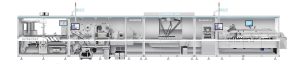
An integrated blister-cartoning line links blister forming and sealing directly to transfer, leaflet handling, cartoning and downstream connection.
The Comparison Problem: Three Sets of Numbers That Rarely Line Up
Most integrated line quotations are assembled from three separate number sets — blister machine capacity, cartoner capacity, and downstream equipment capacity. Buyers then compare blister maximum against blister maximum, carton maximum against carton maximum, and price against price. The number that determines whether the line runs at the rate you paid for — the capacity of the feeding and transfer interface — is often not stated at all.
That gap produces a predictable pattern of problems:
- Blister output is quoted without the feeding or transfer capacity needed to sustain it.
- Carton rate is quoted without stating how many blisters go into each carton, which is the figure that converts one number into the other.
- Manual transfer or manual leaflet handling caps real output below both stated maxima.
- Product-contact parts are described only as “stainless steel”, with no grade, certificate or contact-part list.
- Downstream modules — bundling, case packing, palletizing — are specified separately and never rate-matched to the cartoner.
The consequences are commercial, not cosmetic. A line can meet its blister specification and still miss its carton commitment, because the cartoner was selected on a carton-per-minute figure that assumed a different products-per-carton count.
Hoping Machinery's representative project with a large pharmaceutical manufacturer and solid dosage production company was scoped around exactly this class of risk. The project addresses manual transfer and leaflet insertion errors in pharmaceutical packaging, and covers blister packaging and automatic cartoning of tablets, capsules and other solid dosage forms. It was structured for new line construction, capacity expansion or upgrading existing packaging lines, across 5–10 packaging lines. Customer names are disclosed only with authorization, so the project is described here by type rather than by name — but the problem it was designed to solve is the one many buyers discover only after installation.
Industry Background: A Large Market With a Concentrated Top Tier
Integrated lines are being specified more often in a market that is large, growing moderately, and concentrated mainly at the very top.
- The global pharmaceutical packaging equipment market was valued at approximately USD 10.71 billion in 2024 (SkyQuest Technology).
- The pharmaceutical blister packaging machine market is projected to reach USD 2.57 billion by 2025, at a CAGR of 2.8% (Custom Market Insights).
- Pharmaceutical cartoning machinery was valued at USD 1.46 billion in 2024 (Fortune Business Insights).
- Asia Pacific held the largest revenue share of the pharmaceutical packaging equipment market, at 40.7%, in 2025 (Grand View Research).
- The top three players — Uhlmann, IMA and Marchesini — together hold approximately 29% of the pharmaceutical blister packaging machine market (Market Intelligence Report).
Published market-size estimates differ depending on whether primary and secondary equipment are counted together, so treat absolute figures as directional and use the structure of the market instead: a concentrated top tier, and a long tail of regional manufacturers whose lines can look identical on a datasheet. That structure is why comparison discipline matters. When the leading players hold roughly a quarter to a third of the market, most projects are awarded in a fragmented segment where documentation quality, transfer architecture and acceptance discipline vary far more than the headline speeds do.
Two standards references recur in supplier discussions and work well as filters. ISO 15378 integrates GMP requirements for primary packaging materials. In the EU, pharmaceutical packaging equipment safety is governed by the Machinery Directive 2006/42/EC and the EN 415 series for packaging machines. Neither replaces a review of the specific machine, but both tell you what a supplier's documentation package should be able to answer.
Three Differentiators That Decide Most Line Comparisons
1. Feeding and Transfer Architecture: Where “Servo” Has to Become Specific
Almost every integrated line is marketed as servo-driven. The comparison question is which parts of the motion system are servo-controlled, and how product is handed from the blister side to the carton side.
On the DHL8005H, blister transfer is handled by a D3 intelligent top-loading parallel tracking transfer system, and product replenishment by a three-channel servo-driven independent replenishment system; the line also supports multiple feeding methods and PVC/Alu foil auto splicing. One step up in capacity, the DHL1000/5H uses the same D3 top-loading parallel tracking transfer family with a four-channel servo-driven independent replenishment system. Elsewhere in the range the transfer concept is different: the DHL7005H and DHL7004 both use Hoping's self-developed IRB24 intelligent transfer robot, with independent replenishment, full servo drive on the DHL7005H, and a Siemens motion controller with TP900 HMI on both models.
For a buyer, the architecture determines how much of the blister machine's nominal output actually reaches the cartoner without an operator standing at the interface, and how dependent the line is on manual intervention during format changes or short stoppages. Independent replenishment channels matter because they let the line keep feeding product while one channel is empty or being reloaded, which is what separates sustained output from peak output.
There is a limit worth stating: more channels is not automatically better. The correct architecture is the one that matches your blister layout, the number of products per carton and your changeover frequency. A four-channel system configured for a format family you do not run adds cost without adding output.
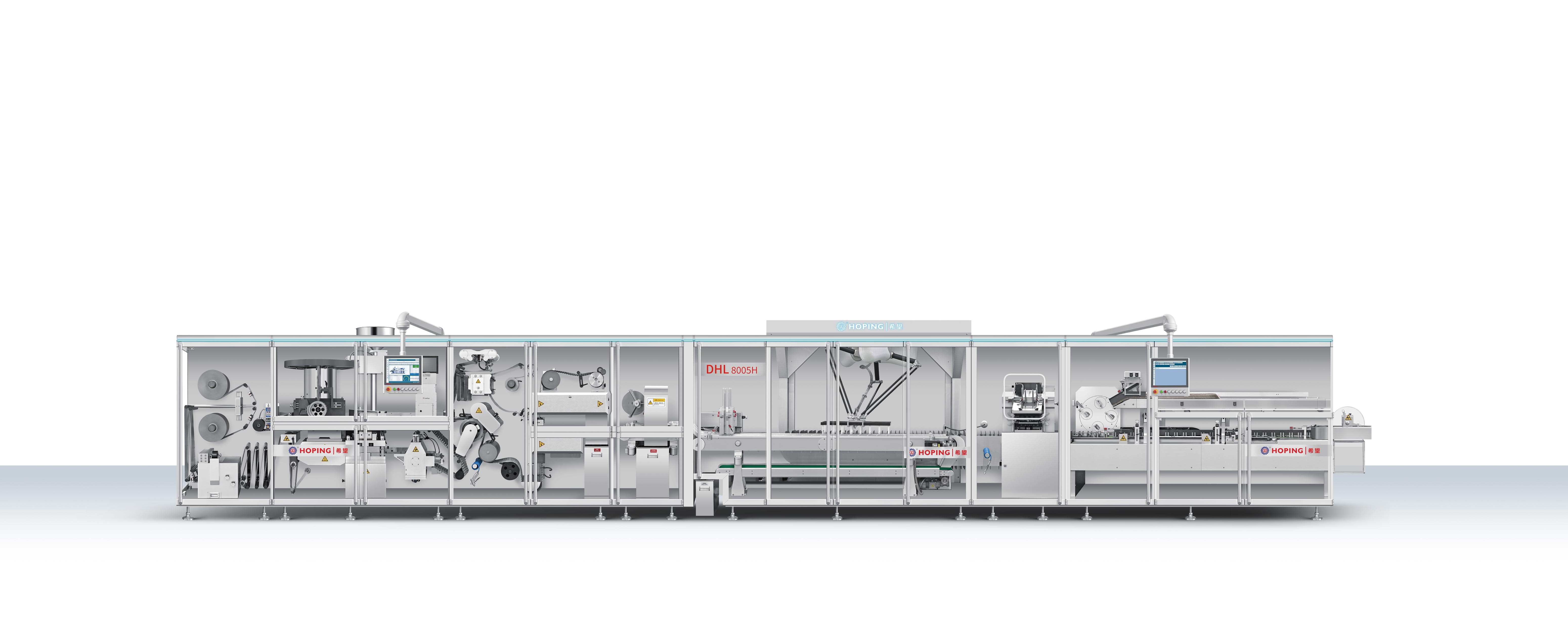
Hoping DHL8005H: up to 800 blisters/min and 500 cartons/min, D3 top-loading parallel tracking transfer, three-channel servo-driven independent replenishment.
2. GMP Compliance of Contact Parts: Compare Evidence, Not Adjectives
Product-contact parts are where a GMP conversation becomes concrete. On Hoping's high-speed roller and platen blister platforms, such as the DPH320HII and DPP260T1, product-contact parts are made of AISI 316L stainless steel and FDA-compliant pharmaceutical-grade materials. Non-product-contact parts are manufactured from AISI 304 stainless steel and anodized aluminum alloy, and the machines are designed and manufactured in accordance with GMP requirements, with corrosion-resistant, easy-to-clean surfaces. On the integrated lines, product-contact parts and tooling are configured to GMP-oriented project requirements within the technical agreement.
When comparing suppliers, ask each of them for the same four items:
- Material grades for every product-contact part, with supporting certificates.
- A contact-part list that clearly distinguishes contact from non-contact components.
- Cleaning access — where the guards open, which parts are removable, and how tooling is cleaned between batches.
- The tooling and format-part specification, because on an integrated line the format parts are usually the most project-specific item in the entire quotation.
ISO 15378 is a useful reference point for what GMP-oriented documentation covers in primary packaging, and it is a reasonable benchmark to hold a supplier to even where the standard itself applies to packaging materials rather than to machinery.
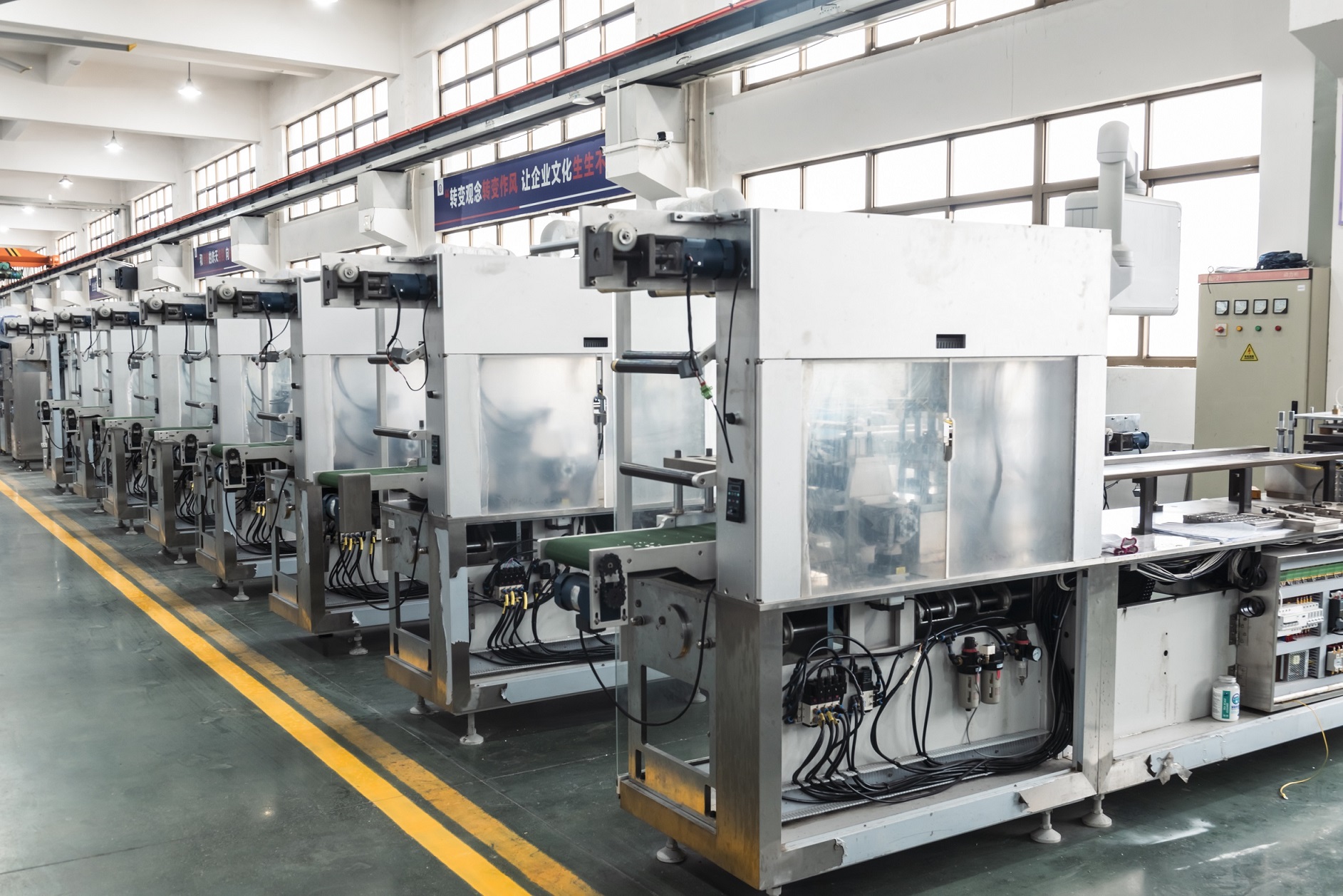
Blister machine assembly: cleaning access, guarding and GMP-oriented design are built in during assembly rather than added at commissioning.
3. Throughput Specs: Compare Matched Rates, Not Headline Maxima
The DHL8005H is specified at up to 800 blisters/min and 500 cartons/min. Those two numbers only mean something together once you know how many blisters go into a carton, because the required carton rate equals the blister output divided by the blisters per carton.
Two illustrations show why this single calculation changes the outcome of a comparison:
- Two blisters per carton: an 800 blisters/min output requires 400 cartons/min, which sits inside the 500 cartons/min specified for the DHL8005H.
- One blister per carton: the same 800 blisters/min output requires 800 cartons/min, which is above that ceiling — meaning the cartoner, not the blister machine, becomes the constraint on the whole line.
The same logic runs through the rest of the range. The DHL1000/5H is specified at up to 1000 blisters/min and 500 cartons/min; the DHL7005H at up to 700 blisters/min and 500 cartons/min; the DHL7004 at up to 700 blisters/min and 400 cartons/min; the DHL6004 at up to 600 blisters/min and 400 cartons/min. Where a flow wrapper sits between blister and carton, a third rate enters the calculation: the IXW800 is specified at up to 600 blisters/min, 600 packs/min and 500 cartons/min, while the IXW600 is specified at up to 600 blisters/min, 300 packs/min and 300 cartons/min. The IXW400 covers liquid dosage formats such as pre-filled syringes, ampoules and cartridges, at up to 400 blisters/min and 150 cartons/min.
Downstream, rate matching continues: an XWK4060 stretch bander is specified at about 30–60 bundles/min, an XWK series case packer at about 5 cases/min, and the ICP12 case packing and palletizing integral machine at about 12 cases/min. The slowest module in the chain sets your real line output, so compare the whole chain or you will compare the wrong thing.
A Seven-Step Comparison Sequence Before You Commit
- Fix the pack format before comparing machines. Blister size, blister materials, quantity per carton, carton specification, leaflet format and coding/inspection method all sit inside the customization scope of a project line, and each of them changes the required rates. A supplier quoting before these are defined is quoting a different project.
- Convert outputs into matched rates. Calculate the required blister rate, the required carton rate and, where a flow wrapper is involved, the required pack rate. Check each one against the corresponding module, not against the line's best number.
- Classify the transfer and feeding architecture. Ask which transfer concept is used — D3 intelligent top-loading parallel tracking, as on the DHL8005H and DHL1000/5H, or the IRB24 intelligent transfer robot, as on the DHL7005H and DHL7004 — how many servo-driven independent replenishment channels are configured, and which feeding methods are supported.
- Request contact-part and GMP evidence. Material grades, certificates, a contact-part list, tooling specification and cleaning access. This is the step where two suppliers with identical speeds stop looking identical.
- Map the integration boundary. Confirm whether the supplier's scope runs from blister forming and sealing through transfer, leaflet handling, carton opening, insertion and coding/inspection to downstream connection with bundling, case packing and palletizing — and whether interface language, electrical component brand and data interface are part of the configuration.
- Define acceptance terms before signing. Hoping's quality chain runs through incoming material inspection, key component inspection, assembly inspection, electrical safety check, no-load trial run, material trial, FAT, customer witness acceptance and pre-shipment inspection. In procurement terms, sample testing forms part of acceptance, FAT takes place before shipment, SAT is carried out at the customer site, and third-party inspection can be arranged according to project requirements.
- Compare commercial and delivery terms on the same basis. Minimum order quantity is 1 set or 1 complete line. Delivery can be EXW Ruian/Wenzhou, FOB Ningbo or Shanghai, or CIF/CFR to a destination port. Lead time is typically 60–120 days after technical confirmation, subject to model, configuration, project complexity and contract terms, with a monthly capacity of 30–40 units. Payment terms are subject to quotation, contract value, customer credit, project scope, destination market and the final agreement.
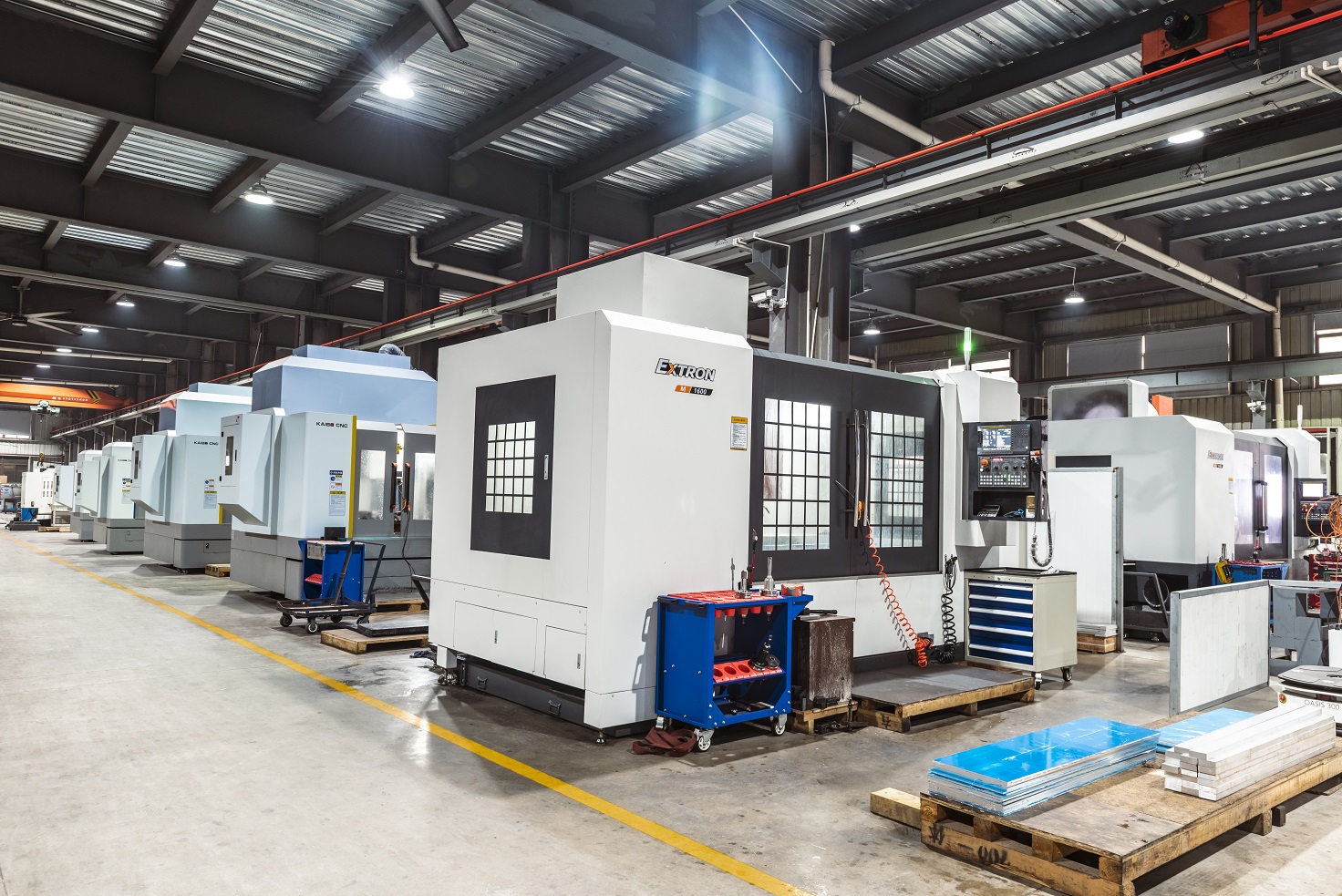
Machining workshop: format parts, tooling and change parts follow the same quality chain as the machine structure.
Integrated Blister-Cartoning Lines: Specification Comparison
The table below compares Hoping's integrated blister-cartoning and blister–flow-wrap–cartoning configurations on the dimensions that decide most line comparisons: matched output, transfer architecture and control platform. Figures are the maximum capacities stated in the technical data.
| Model | Max blister output | Max carton output | Transfer & feeding architecture | Control platform |
|---|---|---|---|---|
| DHL1000/5H | Up to 1,000 blisters/min | Up to 500 cartons/min | D3 intelligent top-loading parallel tracking transfer; four-channel servo-driven independent replenishment; PVC/Alu foil auto splicing | Beckhoff motion controller and high-bus industrial control system |
| DHL8005H (benchmark) | Up to 800 blisters/min | Up to 500 cartons/min | D3 intelligent top-loading parallel tracking transfer; three-channel servo-driven independent replenishment; multiple feeding methods; PVC/Alu foil auto splicing | Beckhoff motion controller and CP9315 industrial PC |
| DHL7005H | Up to 700 blisters/min | Up to 500 cartons/min | Self-developed IRB24 intelligent transfer robot; independent replenishment; full servo drive | Siemens motion controller and TP900 HMI |
| DHL7004 | Up to 700 blisters/min | Up to 400 cartons/min | Self-developed IRB24 intelligent transfer robot; servo-driven independent replenishment | Siemens motion controller and TP900 HMI |
| DHL6004 | Up to 600 blisters/min | Up to 400 cartons/min | Servo-driven independent replenishment; high-speed transfer and cartoning linkage | Beckhoff motion controller and CP9315 industrial PC |
| IXW800 | Up to 600 blisters/min | 600 packs/min; 500 cartons/min | Dual-track design; D3 top-load robotics and rotary manipulator; rotary reciprocating flow-wrapper matching technology | Beckhoff controller and CP9315 industrial PC |
| IXW600 | Up to 600 blisters/min | 300 packs/min; 300 cartons/min | Servo-driven replenishment; rotary reciprocating flow-wrapper matching technology; high-speed synchronous linkage | Beckhoff controller and CP9315 industrial PC |
| IXW400 (liquid dosage: pre-filled syringes, ampoules, cartridges) | Up to 400 blisters/min | 150 cartons/min | D3 top-loading robot; servo-driven independent replenishment; PVC and top cover film auto splicing | Siemens controller and CP9315 industrial PC |
| DPH320H–XW8200–XWZ300II | Approx. 300–600 blisters/min | 50–200 packs/min; 50–220 cartons/min | Linked blister–flow wrap–carton configuration; 380V 50Hz, 36 kW | Project-configured (module platforms as specified) |
| DPP Series + XWZ Series | Approx. 100–600 blisters/min | 100–400 cartons/min | Linked flat-platen blister packing machine with intelligent high-speed cartoning machine | Project-configured (DPP + XWZ platforms) |
Contact-part and compliance evidence is a separate comparison axis, and it is the one buyers most often leave out of a scoring sheet.
| Verification item | Evidence | Where it applies |
|---|---|---|
| Product-contact parts | AISI 316L stainless steel and FDA-compliant pharmaceutical-grade materials | DPH320HII and DPP260T1 blister platforms |
| Non-product-contact structure | AISI 304 stainless steel and anodized aluminum alloy | DPH320HII and DPP260T1 blister platforms |
| Design intent | Designed and manufactured in accordance with GMP requirements, with corrosion-resistant and easy-to-clean surfaces | DPH320HII and DPP260T1 blister platforms |
| Integrated line contact parts and tooling | GMP-oriented line design; product-contact parts and tooling configured according to the technical agreement | DHL8005H and the integrated DHL / IXW range |
| CE — cartoning machine series | Certificate HTT190102307L issued by Shenzhen HTT Technology Co., Ltd.; EN 60204-1:2006+A1:2009+AC:2010; 2006/42/EC | Cartoning machine series |
| CE — carton packing machine series | Certificate UCN 900339024607 issued by Certify International Ltd; EN 415-3:2000; 98/37/EC; 98/79/EC | Carton packing machine series (historical certificate evidence) |
| CE — automatic blister packing machine | Certificate UCN 900175009261 issued by CELAB; EN 60204-1:1997; EN 415-3:1999; 73/23/EEC; 93/68/EEC; 98/37/EC; 98/79/EC | Sample automatic blister packing machine (historical certificate evidence) |
| Management systems | ISO 14001:2015 (CN00123E33896R1M/3300) and ISO 45001:2018 (CN00123S33121R1M/3300) issued by the China Quality Certification Centre (CQC) | Design, production and after-sales service of packing machines and packing production lines |
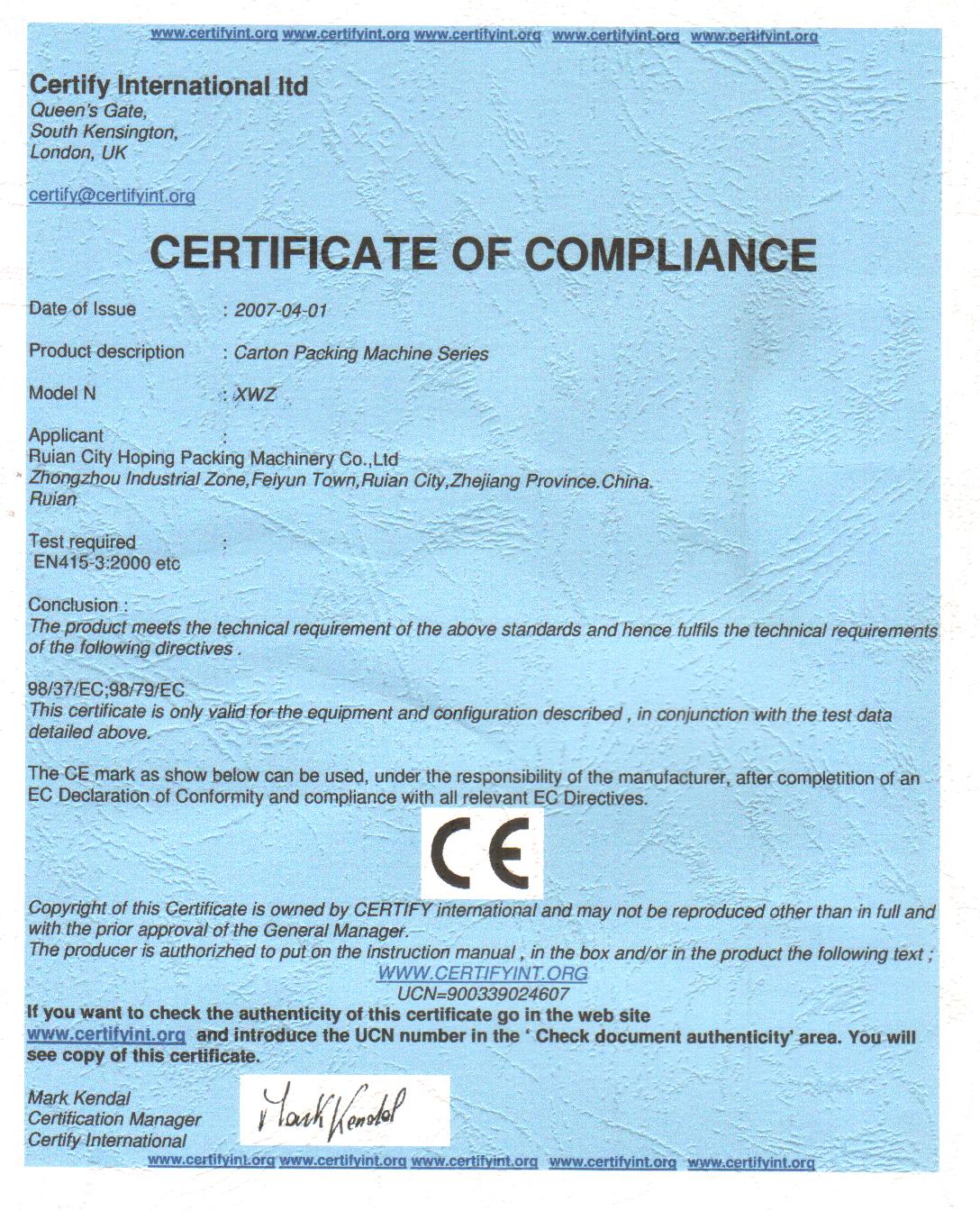
CE certificate evidence for the carton packing machine series (UCN 900339024607, issued by Certify International Ltd, referencing EN 415-3:2000).
Three Project Scenarios Where the Comparison Shifts
New line construction. In a greenfield project the downstream chain is decided at the same time as the blister machine, so start from the end of the line and work backwards: bundling, case packing, palletizing and transfer rates all constrain what the cartoner can deliver. Configurations in the DHL1000/5H and DHL8005H class, designed for connection to bundling, case-packing and palletizing equipment, fit this scenario. Compare suppliers on how much of that chain they take responsibility for.
Capacity expansion on an existing site. Expansion projects are constrained by formats that already exist, so mold-change convenience and parameter memory move up the comparison list: the DHL8005H includes mold-change and preset-memory functions, the DHL1000/5H includes mold-change and recipe memory, and the DHL6004 is specified with convenient mold change. A line that changes format slowly can lose more output than a line with a lower nominal maximum.
Upgrading a partially automated line. Where manual transfer and leaflet insertion are the actual bottleneck, a linked configuration may be sufficient: the DPP Series + XWZ Series linked line covers approximately 100–600 blisters/min and 100–400 cartons/min, while the DPH320H–XW8200–XWZ300II configuration covers about 300–600 blisters/min, 50–200 packs/min and 50–220 cartons/min where a pillow pack is required before cartoning. Hoping provides ODM, OEM and customizable production services with a minimum order quantity of one set or one complete line, which matters when an upgrade has to fit an unusual format combination rather than a catalogue model.
FAQ: Blister-Cartoning Line Comparison Questions
What GMP and CE documentation should we verify before committing to an integrated blister-cartoning line?
Verify four things. First, the standard framework that applies to your market: ISO 15378 integrates GMP requirements for primary packaging materials, and in the EU, packaging machinery safety is governed by the Machinery Directive 2006/42/EC and the EN 415 series. Second, the certificate number, issuing body and scope of each CE certificate — Hoping's cartoning machine series certificate HTT190102307L was issued by Shenzhen HTT Technology Co., Ltd. against EN 60204-1:2006+A1:2009+AC:2010 and 2006/42/EC, and the carton packing machine series certificate UCN 900339024607 was issued by Certify International Ltd against EN 415-3:2000, 98/37/EC and 98/79/EC. Third, management-system certificates, including ISO 14001:2015 and ISO 45001:2018 issued by the China Quality Certification Centre (CQC). Fourth, the material statement for product-contact parts, which on Hoping's blister platforms means AISI 316L stainless steel and FDA-compliant pharmaceutical-grade materials, with AISI 304 stainless steel and anodized aluminum alloy used for non-product-contact structure. A CE certificate covers a defined scope, so confirm that the scope matches the machine series and configuration you are buying.
What does OEM/ODM customization cover on a blister packaging machine line?
Hoping provides ODM, OEM and customizable production services. On a blister-cartoning line the customization scope covers blister size, blister materials, quantity per carton, carton specification, leaflet format, coding/inspection method, feeding method, downstream bundling, case-packing and palletizing connection, interface language, electrical component brand and data interface. Minimum order quantity is 1 set or 1 complete line and monthly capacity is 30–40 units, so an OEM configuration is a project-engineering exercise rather than a catalogue selection. Buyers comparing OEM suppliers should compare the customization list item by item: a supplier that can change blister dimensions but not the coding/inspection method or the downstream interface will limit how far the line can scale.
How should we compare commercial terms between line suppliers?
There is no meaningful public price list for an integrated line, because configuration drives the number. Compare suppliers on the same commercial basis instead: minimum order quantity of 1 set or 1 complete line; delivery options of EXW Ruian/Wenzhou, FOB Ningbo or Shanghai, or CIF/CFR to a destination port; payment terms subject to quotation, contract value, customer credit, project scope, destination market and the final agreement; and an acceptance structure built on a technical agreement, sample testing, FAT before shipment, SAT at the customer site and third-party inspection where required. Before comparing any commercial figures, align the scope of supply — blister machine, transfer, cartoner, leaflet handling, coding/inspection and downstream modules — so that two quotations describe the same line.
Can we validate a line with a material trial or sample before shipment?
Yes. Hoping's quality chain includes incoming material inspection, key component inspection, assembly inspection, electrical safety check, no-load trial run, material trial, FAT, customer witness acceptance and pre-shipment inspection. In contract terms, sample testing forms part of acceptance, FAT takes place before shipment and SAT is carried out at the customer site, with third-party inspection arranged according to project requirements. A material trial run on the project's blister film, foil and carton board is the most direct way to confirm that format parts, transfer system and cartoner behave as one line rather than as separate machines.
What is the lead time from technical confirmation to delivery?
Typical production lead time is 60–120 days after technical confirmation, with the final lead time subject to model, configuration, project complexity and contract terms; monthly capacity is 30–40 units. The clock starts from technical confirmation, which is why format definition and contact-part documentation should be settled during evaluation rather than after the order. As a next step, download the Hoping Machinery catalog for the full model and module list, or send your blister format, carton specification and target output to the project team for a configuration review: email monica@xwbj.com, call or message +86 133-5610-5292, or visit www.hopingcn.com. The factory is located at 88th Weiwu Road, Nanbin Sub-district, Ruian City, Zhejiang Province, China.
Conclusion: The Checks That Decide the Comparison
An integrated blister-cartoning line is judged on three things before price is discussed. The feeding and transfer architecture decides how much of the blister machine's output actually reaches the cartoner. The material and documentation status of product-contact parts decides whether the line will pass a GMP review without rework. The matched-rate calculation — blister output divided by blisters per carton — decides whether the cartoner you buy can keep up with the blister machine you bought, and whether downstream bundling, case packing and palletizing are sized correctly.
Hoping Machinery's DHL8005H is a useful benchmark for that comparison: up to 800 blisters/min and 500 cartons/min, a D3 intelligent top-loading parallel tracking transfer system, three-channel servo-driven independent replenishment, a Beckhoff motion controller with CP9315 industrial PC, mold-change and preset-memory functions, and a GMP-oriented line design. Placed alongside the DHL1000/5H, DHL7005H, DHL7004, DHL6004 and the IXW flow-wrap series, it also shows how a supplier's own range differs internally — which is exactly the comparison a buyer needs to complete before committing.
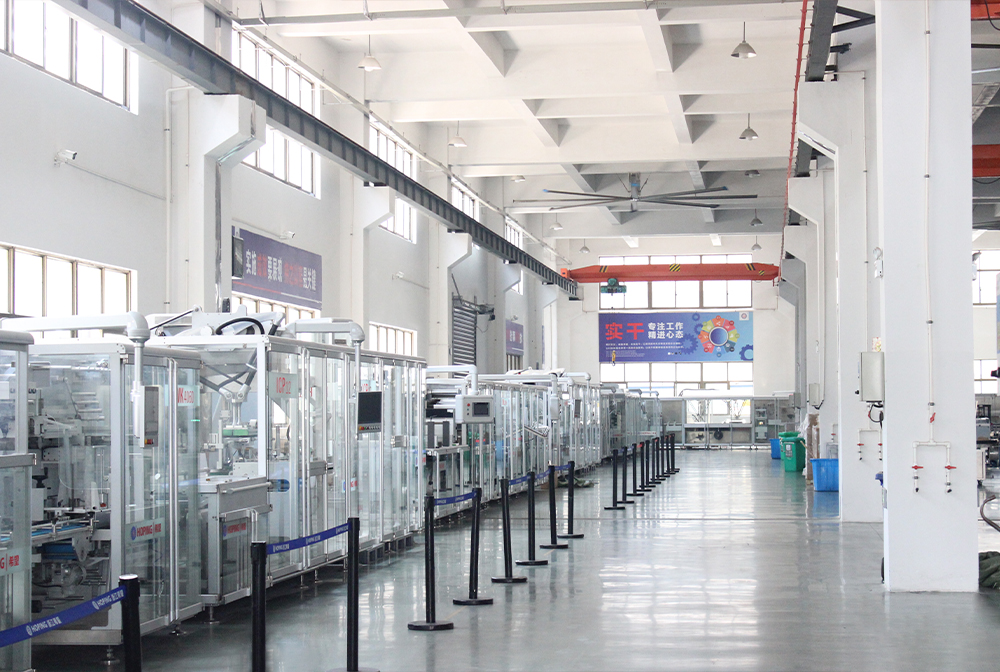
Machine showroom at Hoping Machinery — line configuration reviews start from the pack format, not from the machine model.
Next step: compare lines on your format, not on a brochure
Send your blister dimensions, blisters per carton, carton specification and target output to the Hoping Machinery project team for a configuration review, or download the Hoping Machinery catalog for the full model and module list.
Have Questions or Need More Details?
Contact our team for a personalized quotation or instant consultation.
Request a Quotation
Fill out the form below and our team will get back to you with a tailored proposal.
WhatsApp Direct Chat
Prefer to chat in real-time? Message us on WhatsApp for instant assistance & quick answers.
- Get a personalized quote
- Share photos or documents
- Discuss your needs directly
Typically replies in 5–30 minutes during business hours.