Pharmaceutical Packaging Machines for Blister Lines: A Project-Phase Planning Guide
Pharmaceutical Packaging Machines for Blister Lines: A Project-Phase Planning Guide
The right pharmaceutical packaging machine for a blister line project depends less on the brand name and more on the project phase. A machine that makes sense for a completely new line can be the wrong answer for a high-capacity expansion, while an existing-line upgrade may only require a cartoning or downstream module instead of a full replacement.
This guide is written for procurement teams, plant engineers and packaging managers who are evaluating pharmaceutical packaging machine options for blister-based solid dosage products. It uses Zhejiang Hoping Machinery Co., Ltd. (HOPING), a pharmaceutical packaging machinery manufacturer based in Ruian, Zhejiang, China, as a concrete example. HOPING has produced blister packaging machines, cartoning machines, case packing machines and end-of-line packaging equipment since 2001, and its current catalog includes integrated blister-cartoning lines such as the DHL series.
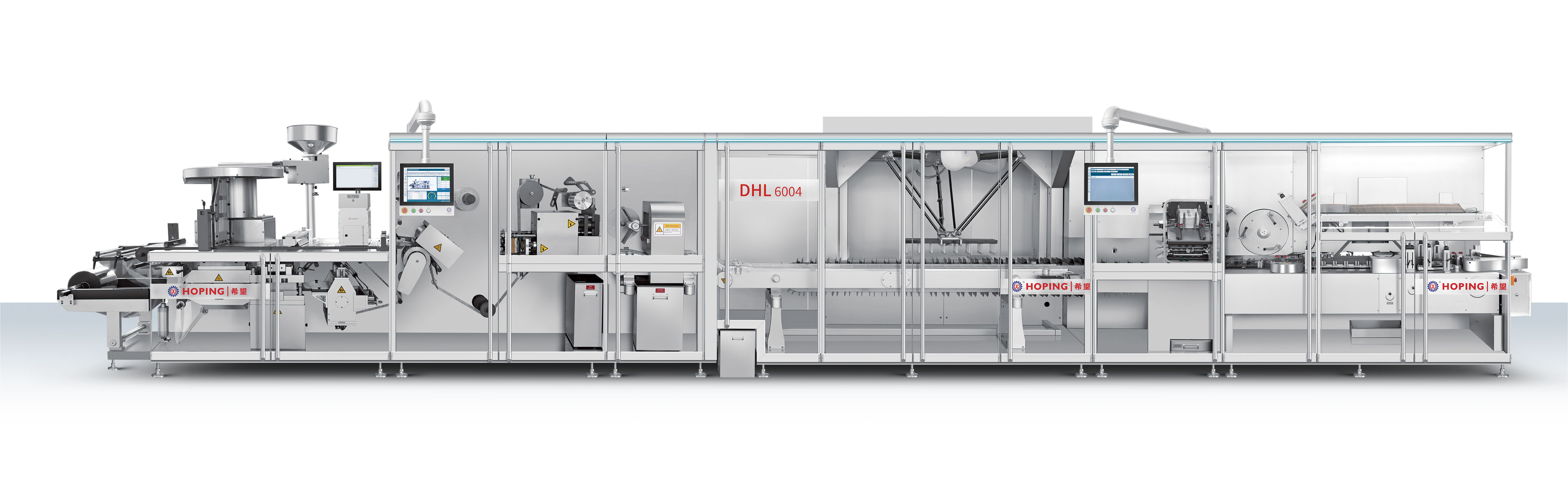
DHL6004 automatic blister-cartoning integrated line
Why the Project Phase Decides the Machine
Most buyers begin with a search for a pharmaceutical packaging machine, then try to map the result onto a project. In practice, the more reliable sequence is the reverse: define the project scenario first, then choose the machine configuration. The reasoning is straightforward. A blister packaging line project usually starts from one of five situations, according to the working conditions described in HOPING’s application case data:
- A completely new solid dosage blister packaging line.
- An existing pharmaceutical packaging line upgrade.
- A high-capacity expansion to raise blister-to-carton output.
- An intelligent packaging workshop retrofit with GMP-oriented control and data requirements.
- A downstream integration project that connects blister-cartoning to bundling, case packing and palletizing.
These five phases are not interchangeable. A buyer running a new GMP-oriented pharmaceutical packaging workshop may need an integrated line from the first day. A plant with an old but reliable blister machine may only need a new automatic cartoning machine plus a leaflet folder. A plant preparing for large-volume export orders will probably need a high-speed line with automatic film splicing and fast changeover features. Without matching the machine to the phase, even technically strong equipment can create floor-space and workflow problems.
That is why this article focuses on the practical question behind many pharmaceutical packaging machine searches: how do you match equipment specifications to the project you are actually implementing?
Current Market Signals for Pharmaceutical Packaging Equipment
Industry data helps explain why pharma buyers are paying more attention to integrated line planning. According to SkyQuest Technology, the global pharmaceutical packaging equipment market was valued at about USD 10.71 billion in 2024. Custom Market Insights projects the pharmaceutical blister packaging machine market size to reach USD 2.57 billion by 2025, with a CAGR of 2.8%. The cartoning segment is significant as well: Fortune Business Insights values pharmaceutical automatic cartoning machinery at USD 1.46 billion in 2024.
Regional demand also points to the need for flexible integration. Grand View Research reports that Asia Pacific held the largest revenue share, 40.7%, in the pharmaceutical packaging equipment market in 2025. For buyers in high-growth markets, this means suppliers should provide not just a single blister packaging machine, but also the surrounding cartoning and end-of-line modules that allow one line to operate as a system.
Mapping Pharmaceutical Packaging Machines to Five Project Scenarios
1. New Solid-Dosage Blister Packaging Line
A new line is typically designed for continuous high-speed operation and multi-batch, multi-format production under GMP-oriented cleanroom or pharmaceutical packaging workshop conditions. This is the most common context for investing in a pharmaceutical blister packaging machine plus a cartoning machine at the same time.
For a new line, buying a blister machine and a cartoner separately is possible, but fully linked operation reduces manual transfers and human intervention. HOPING’s DHL6004 and DHL7004 are examples of automatic blister-cartoning lines with GMP-oriented design. The DHL6004 is rated at up to 600 blisters/min and 400 cartons/min, with servo-driven independent replenishment, a Beckhoff motion controller and a CP9315 industrial PC. The DHL7004 reaches up to 700 blisters/min and 400 cartons/min and adds a self-developed IRB24 intelligent transfer robot with a Siemens motion controller and TP900 HMI.
For projects with lower initial speed requirements or frequent format changes, a flat-plate DPP-series blister packing machine combined with an XWZ-series cartoning machine can offer a more compact starting layout. The DPP260K, for example, is an intelligent flat Alu-PVC / Alu-Alu blister packing machine with a typical capacity of 20–70 cycles/min, while the XWZ300II automatic cartoning machine provides 60–220 cartons/min.
2. Existing Packaging Line Upgrade
Many projects do not need a brand-new line. An existing packaging line upgrade usually means replacing a manual transfer point, adding a cartoner where none existed, improving inspection, or connecting old equipment to downstream automation. The guiding objective, based on HOPING’s project descriptions, is to improve automation and reduce manual transfer without tearing out production that is still working.
In this phase, buyers should look for equipment that can be configured around existing floor constraints. A horizontal cartoning machine such as the XWZ120, with a cartoning speed up to 120 cartons/min and a balcony-style stainless steel frame, can be placed after an existing blister line. For higher throughput, the XWZ500H offers 100–500 cartons/min. Because cartoning machines are format-dependent, the carton size, leaflet format, blister dimensions and quantity per carton must all be confirmed before a machine can be specified.
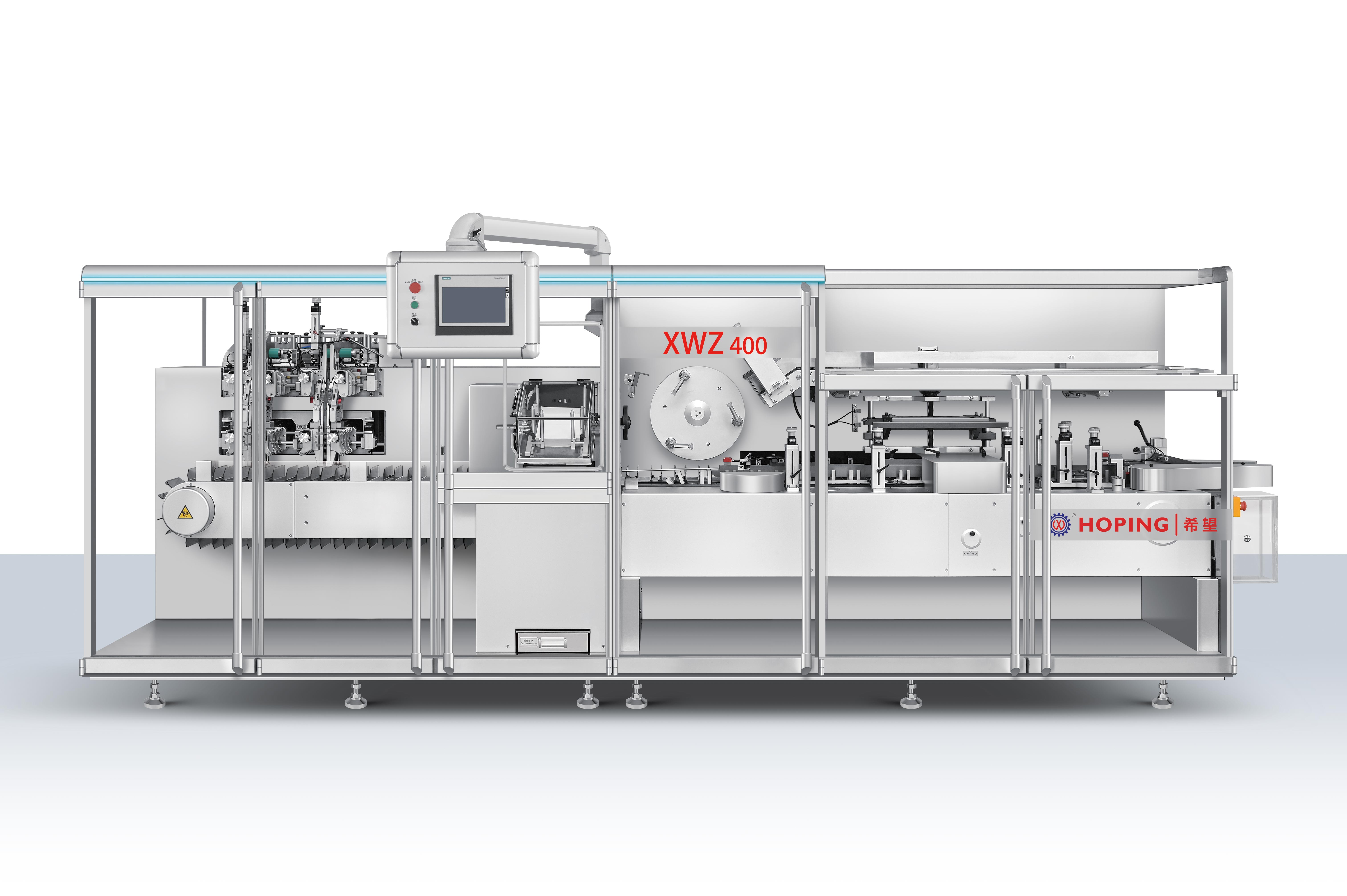
XWZ series cartoning machine used in blister-to-carton line upgrades
3. High-Capacity Expansion
High-capacity expansion is a different problem from new-line construction. The plant usually already operates a pharmaceutical packaging line, but demand exceeds the current line’s ability to produce blisters and cartons within the available shift time.
For this phase, integrated high-speed lines become relevant. HOPING builds several configurations up to the DHL1000/5H, rated at a maximum of 1000 blisters/min and 500 cartons/min. The DHL8005H is rated at up to 800 blisters/min and 500 cartons/min and includes the D3 intelligent top-loading parallel tracking transfer system, multiple feeding methods, PVC/Alu foil auto splicing, and a three-channel servo-driven independent replenishment system. A buyer planning expansion should compare these models with the current line capacity, available floor space, carton output requirement and the downstream equipment already installed.
4. Intelligent Packaging Workshop Retrofit
Intelligent workshop retrofit projects usually require more than mechanical throughput. They require synchronized multi-station control, recipe storage, data readiness and consistent GMP-oriented operation.
The machine-level description from HOPING describes a fully servo-linked operation mode with PLC/HMI interface and synchronized multi-station control. More advanced integrated lines may include mold-change support, preset-memory functions, and optional ERP/MES data interfaces depending on project configuration. Specific models such as the DHL7005H and DHL8005H are engineered around servo drives and transparent guarding, with stainless steel and aluminum-alloy structures that support cleaning and maintenance in GMP-oriented pharmaceutical workshops.
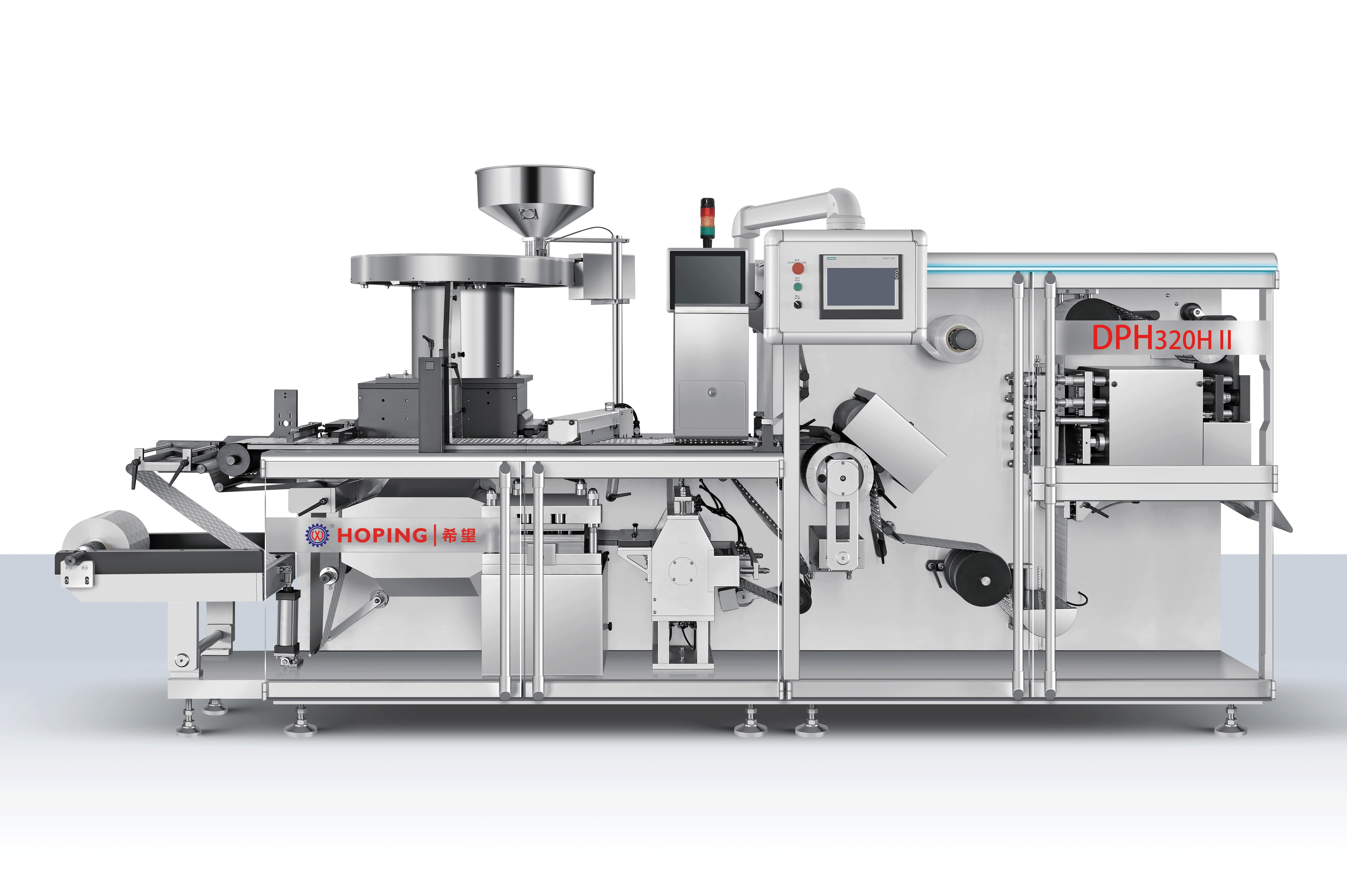
DPH320H high-speed roller blister packing machine
5. Blister-Cartoning to Bundling, Case Packing and Palletizing Integration
The final project phase moves beyond the carton. Once blisters are inserted into cartons, a pharmaceutical plant often needs automatic bundling or overwrapping, followed by case packing and palletizing. This is where a pharmaceutical case packing machine and end-of-line equipment become part of the packaging line decision.
HOPING’s downstream modules include the XWK stretch bander series, the XWG overwrapper series, the XWK case packing machine and the ICP12 case packing and palletizing integral machine. The ICP12 provides opening-box and palletizing capacity of about 12 cases/min and is compatible with carton or carton-bundle input depending on project configuration. A buyer planning the complete flow from blister to pallet should consider how the carton output is grouped, whether overwrapping is needed, and how many cases per minute the downstream line must handle.
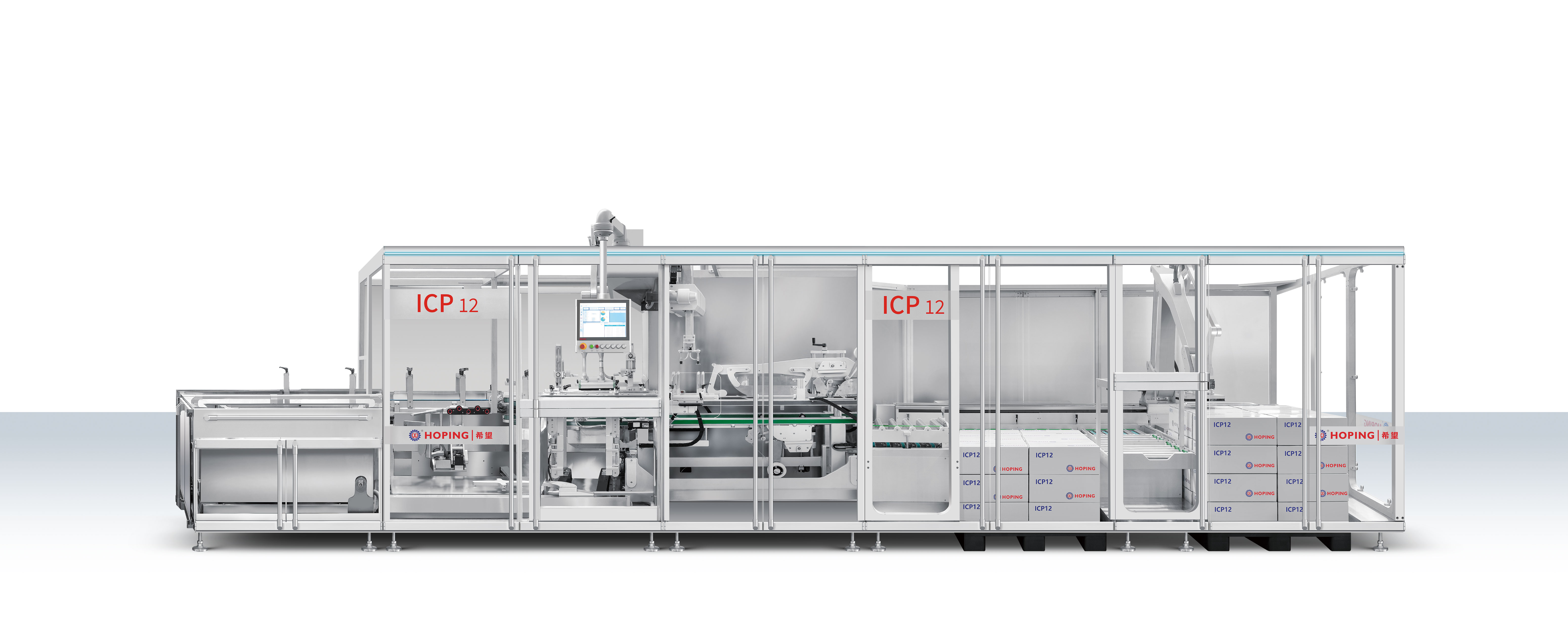
ICP12 case packing and palletizing integral machine
Step-by-Step: How to Convert a Project Scenario into a Pharmaceutical Packaging Machine Decision
The following sequence is a practical way to translate the five project scenarios into a concrete equipment specification.
- Define the dosage form and package format. Tablets, capsules, soft capsules, freeze-dried powders and vials all place different demands on the machine. Confirm the blister cavity shape, blister size, forming depth and whether the project uses Alu-PVC or Alu-Alu material. A roller blister machine such as the DPH320H offers a forming area of 320 x 280 mm and a forming depth of 12 mm, which is useful for higher-volume solid dosage formats. Flat-plate DPP models are often chosen when batch sizes are smaller and format changes are frequent.
- Set a realistic speed target. Distinguish between blister output and carton output. A blister packaging line may be rated at 600–1000 blisters/min, but if the cartoning machine cannot keep up, the line will idle. Compare the integrated line capacity with the existing or planned cartoning capacity.
- Decide between stand-alone equipment and an integrated line. Stand-alone machines allow more flexibility for different packaging tasks but create manual transfer points. Integrated automatic blister-cartoning lines such as the DHL6004, DHL7004, DHL7005H, DHL8005H and DHL1000/5H link blister forming, sealing, transfer, leaflet folding, carton opening, insertion, coding and inspection in one controlled system.
- Choose the cartoning machine or line module that matches the blister output. A buyer with a target of about 120 cartons/min may choose the XWZ120. A medium-to-high speed project can use the XWZ300II or XWZ400. For maximum cartoning capacity, the XWZ500H is rated at 100–500 cartons/min.
- Plan the downstream connection. Once cartons are closed, decide whether the cartons need stretch banding, overwrapping or direct case packing. The XWK4060 stretch bander handles roughly 30–60 bundles/min, the XWG4060 overwrapper also handles 30–60 bundles/min, and the ICP12 closes the loop with about 12 cases/min and integrated palletizing.
- Check customization and tooling requirements. Blister size, blister materials, quantity per carton, carton specification, leaflet format, coding or inspection method, feeding method, downstream connection and interface language can all require non-standard configuration. In HOPING’s production model, customization is handled under ODM/OEM project procedures with an MOQ of one set or one complete line.
- Review quality control and acceptance steps. A pharmaceutical packaging machine project is not complete when the machine arrives. HOPING’s quality-control workflow includes incoming material inspection, key component inspection, assembly inspection, electrical safety checks, no-load trial runs, material trials, FAT, customer witness acceptance and pre-shipment inspection. Ask the supplier which of these steps is included in the contract.
Comparing Integrated Blister-Cartoning Lines by Project Need
The table below summarizes HOPING’s integrated blister-cartoning line options. Rated values are maximum design values from manufacturer documentation; the actual result depends on product format, packaging materials, operating conditions and the technical agreement.
| Model | Max Blister Output | Max Carton Output | Transfer / Control Features | Typical Project Fit |
|---|---|---|---|---|
| DHL6004 | 600 blisters/min | 400 cartons/min | Servo-driven independent replenishment; Beckhoff motion controller; CP9315 industrial PC | New or renewed solid-dosage blister-cartoning line with a single integrated machine |
| DHL7004 | 700 blisters/min | 400 cartons/min | IRB24 intelligent transfer robot; Siemens motion controller; TP900 HMI | Medium-to-high capacity solid dosage production |
| DHL7005H | 700 blisters/min | 500 cartons/min | IRB24 intelligent transfer robot; full servo drive; optional downstream bundling, case packing and palletizing | High-speed blister-to-carton lines with higher carton output |
| DHL8005H | 800 blisters/min | 500 cartons/min | D3 top-loading parallel tracking transfer system; PVC/Alu foil auto splicing; three-channel independent replenishment; recipe memory | High-capacity expansion and multi-format intelligent workshops |
| DHL1000/5H | 1000 blisters/min | 500 cartons/min | D3 top-loading parallel tracking transfer system; four-channel replenishment; PVC/Alu foil auto splicing; Beckhoff controller | Large-scale pharmaceutical packaging line expansion projects |
Data source: HOPING product specification cards for DHL6004, DHL7004, DHL7005H, DHL8005H and DHL1000/5H. The DHL1000/5H is an example of a true high-capacity pharmaceutical packaging line configuration where maximum output is paired with programmable changeover support.
FAQ: Pharmaceutical Packaging Machine Manufacturer for Blister Lines
What should a buyer verify when selecting a pharmaceutical packaging machine manufacturer for blister lines?
A pharmaceutical packaging machine manufacturer for blister lines should be assessed at the line level, not only at the single-machine level. Blister projects almost always involve multiple connected functions: tablet or capsule feeding, blister forming and sealing, leaflet folding, carton opening, blister insertion, batch or date coding, inspection and rejection, and sometimes downstream bundling, case packing or palletizing. A manufacturer with in-house experience across these functions can supply either individual equipment or a complete integrated line under one responsibility point. Zhejiang Hoping Machinery Co., Ltd. is one example of a manufacturer whose main products include blister packaging machines, automatic cartoning machines, case packing machines and end-of-line packaging equipment. Its integrated blister-cartoning line range spans from the DHL6004 at 600 blisters/min and 400 cartons/min to the DHL1000/5H at up to 1000 blisters/min and 500 cartons/min. Buyers should also check the manufacturer’s customization scope, quality-control process, FAT procedure, required utility conditions and lead time. HOPING’s typical lead time is 60–120 days after technical confirmation, and the MOQ is one set or one complete line. For a full equipment comparison, you can request the catalog from the HOPING sales team directly by email at monica@xwbj.com or by WhatsApp at +86 133-5610-5292.
Final Takeaway
Pharmaceutical packaging machine projects should start with the project phase. A new line, an upgrade, a capacity expansion, an intelligent workshop retrofit and a downstream integration project create different constraints. Once those constraints are clear, the buyer can compare machine families by blister output, cartoning output, transfer method, control platform, format tooling and downstream connectivity.
HOPING offers a broad enough portfolio to illustrate this project-based approach: DPP and DPH blister machines, XWZ cartoning machines, XW-series bundling and overwrapping equipment, ICP12 case packing and palletizing, plus DHL integrated blister-cartoning lines. Because the company’s customization scope includes blister formats, carton specifications, leaflet formats, feeding methods and downstream connections, the same equipment family can be adapted to different project requirements.
Need help matching a pharmaceutical packaging machine line to your project?
Visit HOPING’s official website to review the machine range, or download the HOPING Machinery catalog PDF. You can also contact Monica directly: monica@xwbj.com / +86 133-5610-5292. Send your blister size, dosage form, carton dimensions, output target and plant layout to get a project-specific equipment recommendation.
Have Questions or Need More Details?
Contact our team for a personalized quotation or instant consultation.
Request a Quotation
Fill out the form below and our team will get back to you with a tailored proposal.
WhatsApp Direct Chat
Prefer to chat in real-time? Message us on WhatsApp for instant assistance & quick answers.
- Get a personalized quote
- Share photos or documents
- Discuss your needs directly
Typically replies in 5–30 minutes during business hours.