
DHL8005H vs Separate Blister and Cartoning Machines: Head-to-Head Decision
DHL8005H vs Separate Blister and Cartoning Machines: Head-to-Head Decision
An integrated blister-cartoning line concentrates blister forming, sealing, transfer, leaflet handling and cartoning inside one linked machine. A separate configuration splits the same work across two standalone units joined by a transfer conveyor. The Hoping DHL8005H is an intelligent fully servo high-speed blister-cartoner integrated machine rated at up to 800 blisters/min and 500 cartons/min, with a D3 intelligent top-loading parallel tracking transfer system. A comparable separate route can be assembled from a DPH320HII rotary blister packing machine (up to 1000 blisters/min) and an XWZ500H cartoner (100–500 cartons/min) — but the transfer, synchronization, buffering and interface responsibility then sit with the plant.
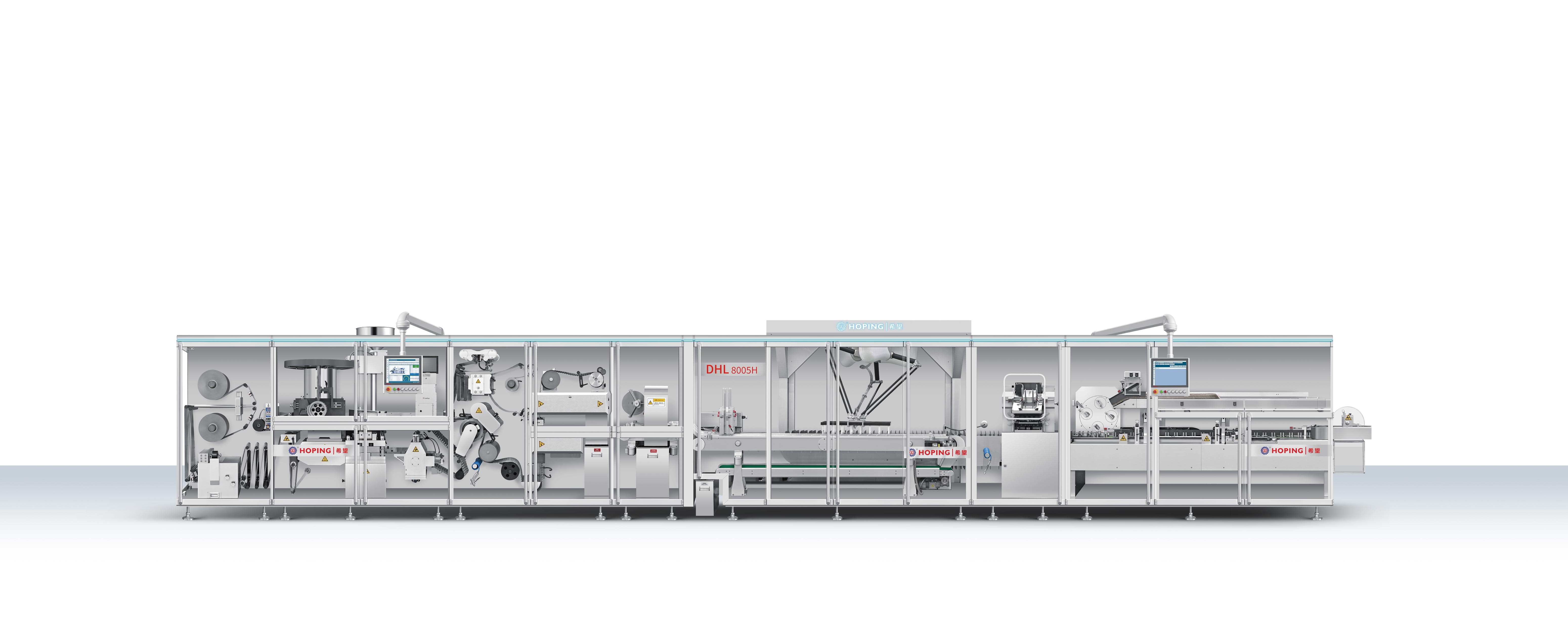
Both structures can pass a GMP audit and both can reach the required output. They differ in where the risk of a multi-line packaging programme sits: inside one machine design and one supplier, or inside the plant's own integration of two machines and the conveyor between them. This head-to-head follows the order a pharma project team actually decides in — process definition, transfer, control architecture, footprint, compliance evidence, changeover, downstream expansion and commercial terms.
Problem Definition: What the Integrated-vs-Separate Question Really Asks
When a plant buys a standalone pharmaceutical blister packaging machine and a standalone cartoning machine, it places two orders and evaluates two datasheets — blisters per minute and forming area on one side, cartons per minute and carton size range on the other. The line that results from joining them is rarely evaluated by anyone, because it is not a purchased object. Three consequences follow routinely.
- Transfer ownership. The conveyor, buffer and reject handling between the two machines usually become the plant's own engineering scope. No supplier datasheet describes them.
- Insertion integrity. Leaflet insertion, wrong-board detection and coding/inspection sit exactly at the junction of two independent control systems.
- Footprint and utilities. Two standalone units plus transfer, guarding and service clearance are planned separately from the cleanroom layout, and the layout is what the room is finally built around.
Hoping's solid-dosage project documentation points at the same two symptoms in plants running separated equipment: manual transfer between blister packaging and cartoning, and leaflet insertion errors. A representative project profile describes a large pharmaceutical manufacturer and solid dosage production company operating 5 to 10 packaging lines for blister packaging and automatic cartoning of tablets, capsules and other solid dosage forms, covering new line construction, capacity expansion and upgrading of existing packaging lines.
Framed that way, the head-to-head is not a speed contest. It asks one structural question: should the blister-to-carton interface be designed, controlled and warranted by a single supplier, or engineered and maintained by the plant?
Industry Background: Why Plants Are Re-Making This Decision Now
The global pharmaceutical packaging equipment market was valued at approximately USD 10.71 billion in 2024 (SkyQuest Technology). The pharmaceutical blister packaging machine market is projected to reach USD 2.57 billion by 2025, with a CAGR of 2.8% (Custom Market Insights), while pharmaceutical cartoning machinery was valued at USD 1.46 billion in 2024 (Fortune Business Insights). Asia Pacific held the largest regional revenue share at 40.7% in 2025 (Grand View Research) — a relevant figure for buyers who are now shortlisting regional and specialist builders alongside European OEMs.
Market structure matters as much as market size. The top three players — Uhlmann, IMA and Marchesini — collectively hold approximately 29% of the pharmaceutical blister packaging machine market (Market Intelligence Report), which means most installed capacity comes from a long tail of regional manufacturers. For a plant specifying an integrated line, that long tail is where configuration flexibility, format tooling and lead time are usually decided, rather than in the headline speed range.
Regulatory framing is fixed regardless of supplier. In the EU, pharmaceutical equipment safety is governed by Machinery Directive 2006/42/EC and the EN 415 series of standards for packaging machines (European Committee for Standardization), and ISO 15378 integrates GMP requirements for primary packaging materials (ISO). These references define what a machine supplier must be able to document — which is why the compliance step later in this article is written as a certificate-by-certificate checklist rather than a marketing statement.
Detailed Solution: What the DHL8005H Puts Inside One Frame
The DHL8005H is described in Hoping's product data as an intelligent fully servo high-speed blister-cartoner integrated machine and a solid-dosage turnkey packing line. Its published capability is specific enough to compare directly against a two-machine configuration:
- Maximum capacity: up to 800 blisters/min and 500 cartons/min on one linked machine
- D3 intelligent top-loading parallel tracking transfer system
- Multiple feeding methods, configurable to the project
- PVC/Alu foil auto splicing
- Three-channel servo-driven independent replenishment system
- Beckhoff motion controller and CP9315 industrial PC
- Mold-change and preset-memory functions
- GMP-oriented line design
The scope of supply covers high-speed blister forming and sealing, transfer, leaflet handling, carton opening, insertion, coding/inspection, and connection to bundling, case-packing and palletizing equipment. Translated into buying decisions, each element changes something concrete:
- D3 top-loading parallel tracking transfer. Board orientation and pitch are established inside the machine rather than re-created on an external conveyor, so the blister-to-carton handover is part of the line's mechanical and control design.
- Three-channel servo-driven independent replenishment. Absorbs the instantaneous rate difference between blister forming and cartoning without manual topping-up of the cartoner infeed.
- PVC/Alu foil auto splicing. Reduces material-thread downtime — a factor that weighs more on Alu-Alu constructions where film handling is more demanding.
- One line-level control layer. A Beckhoff motion controller with a CP9315 industrial PC gives a single recipe, alarm and data architecture; interface language and data interface are named customization items rather than afterthoughts.
- Mold change with preset memory. Format parameters are stored and recalled at line level, which shortens changeover on multi-format campaigns.
- GMP-oriented construction. Stainless steel and aluminium-alloy structure, transparent guarding, and product-contact parts and tooling configured according to a technical agreement.
Right-sizing matters as much as choosing between architectures. The same Hoping family offers DHL1000/5H (up to 1000 blisters/min and 500 cartons/min, four-channel servo-driven independent replenishment), DHL7005H (up to 700 blisters/min and 500 cartons/min), DHL7004 (up to 700 blisters/min and 400 cartons/min) and DHL6004 (up to 600 blisters/min and 400 cartons/min). Where a product must be pillow-wrapped before cartoning, the IXW800 (up to 600 blisters/min, 600 packs/min and 500 cartons/min) and IXW600 (up to 600 blisters/min, 300 packs/min and 300 cartons/min) link blister, flow wrapping and cartoning in one line. Downstream, the line can be connected to an XWK4060 stretch bander (about 30–60 bundles/min), an XWK series case packing machine (up to about 5 cases/min) or an ICP12 case packing and palletizing integral machine (about 12 cases/min).
The Separate Route: Two Standalone Machines, Two Datasheets
The alternative is the classic separated configuration, and it is worth pricing it against its own real specifications rather than an assumed one.
Standalone blister packaging machines
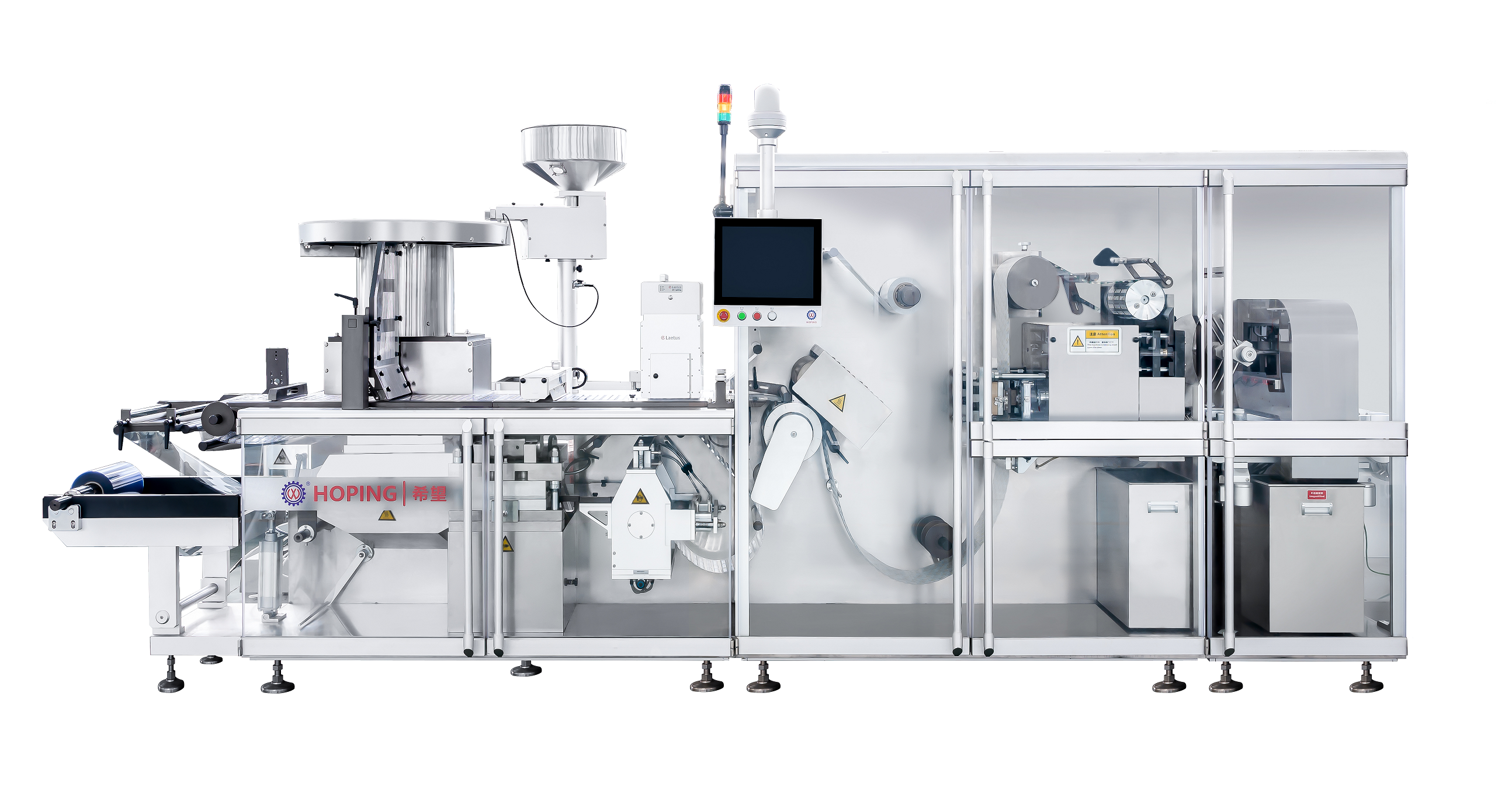
- DPH320HII rotary blister packing machine: maximum punch frequency 250 punches/min; maximum format area 320 × 280 mm; feed stroke 100–280 mm; maximum capacity up to 1000 blisters/min; total power 30 kW; machine size 5000 × 1500 × 2100 mm; weight 6000 kg. Product-contact parts use AISI 316L stainless steel and FDA-compliant pharmaceutical-grade materials; non-contact parts use AISI 304 stainless steel and anodized aluminium alloy, in a GMP-oriented design with corrosion-resistant, easy-to-clean surfaces.
- DPH320H fully servo high-speed roller blister packing machine: forming area 320 × 280 mm; forming depth 12 mm; stroke range 100–280 mm; power supply 380V 50Hz 29.5 kW; overall dimension about 5000 × 1500 × 2100 mm.
- Flat-plate DPP series for lower speeds and medium batches: DPP260K at 20–70 cycles/min, 9.5 kW, about 4700 × 735 × 1820 mm and about 3900 kg; DPP260TI at 20–60 cycles/min, 9.5 kW, 4420 × 710 × 1700 mm and about 2200 kg; DPP260T1 platen machine with up to 60 punches/min, up to 300 blisters/min and 8.5 kW.
Standalone cartoning machines
- XWZ500H full servo high-speed cartoner: about 100–500 cartons/min; 380V 50Hz 14 kW; overall dimension about 6700 × 1950 × 2100 mm; net weight about 6000 kg; scope includes carton opening, product insertion, leaflet insertion, carton closing and coding/inspection integration according to project configuration.
- XWZ300II: about 60–220 cartons/min; 5 kW; about 5160 × 1600 × 2100 mm; about 4800 kg.
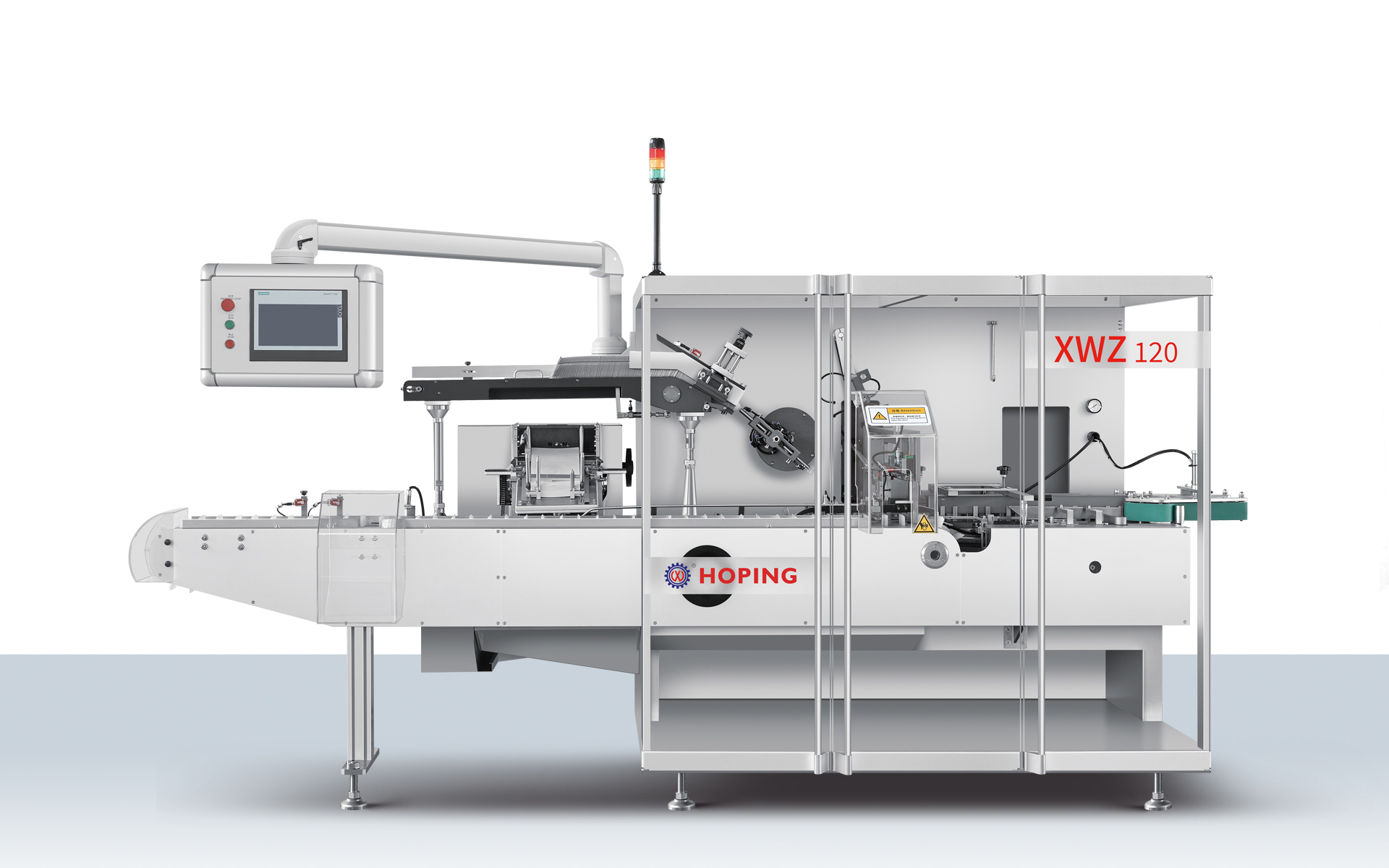
- XWZ120 horizontal cartoner: about 30–120 cartons/min; 3.5 kW; about 3650 × 1330 × 1700 mm; about 2700 kg; balcony-style design for easier cleaning.
- XWZ series: XWZ400 at about 100–400 cartons/min and XWZ300 at about 100–300 cartons/min depending on model.
Between the two extremes sits a linked configuration rather than a fully integrated machine: a DPP intelligent flat Alu/PVC/Alu-Alu blister packing machine joined to an XWZ intelligent high-speed cartoning machine, typically rated 100–600 blisters/min and 100–400 cartons/min. It keeps two machine frames but purchases the link from one supplier.
One structural fact appears in every separated specification: each standalone unit carries its own control system, its own guarding and its own factory acceptance test. The conveyor between them — with its buffering, reject handling and synchronization logic — is a third scope that the plant normally owns and maintains.
Step-by-Step Breakdown: Seven Steps From Format to Purchase Order
Step 1 — Fix the format before the speed
Confirm blister cavity layout, forming material (Alu-PVC or Alu-Alu), product form (tablet, capsule, soft capsule), boards per carton and carton style. Hoping's customization scope names exactly these items: blister size, blister materials, quantity per carton, carton specification, leaflet format and coding/inspection method. A decision made before this step is a decision made on the wrong variables.
Step 2 — Verify what "blister per minute" means in the datasheet
Confirm whether a published rating refers to blister boards or to individual cavities, and confirm the boards-per-carton ratio. That ratio determines whether the cartoner must match the blister machine's full rate or only a fraction of it — and it is the single most common source of mis-sized capacity in separated configurations.
Step 3 — Decide who owns the transfer
If the answer is "the supplier," the DHL8005H structure applies: the D3 top-loading parallel tracking transfer is inside the line, and the blister-to-carton interface is designed and warranted as one unit. If the answer is "the plant," budget for conveyor engineering, buffering, reject logic and the validation work that follows.
Step 4 — Compare control architecture, not just I/O count
A single line-level control system (Beckhoff motion controller and CP9315 industrial PC with mold-change and preset-memory functions) means one recipe layer, one data interface and one troubleshooting path. Two standalone machines mean two control systems plus an engineered handshake that the plant must document.
Step 5 — Measure footprint, guarding and utilities honestly
In the separated example above, the two main units alone occupy 5000 × 1500 × 2100 mm (DPH320HII) and 6700 × 1950 × 2100 mm (XWZ500H) before the transfer conveyor, guarding and service clearance are added. An integrated line consolidates forming, sealing, transfer, leaflet handling and cartoning in one linked machine frame; final line layout and utility points should be confirmed in the technical agreement, because they are project-specific.
Step 6 — Build the compliance and acceptance file
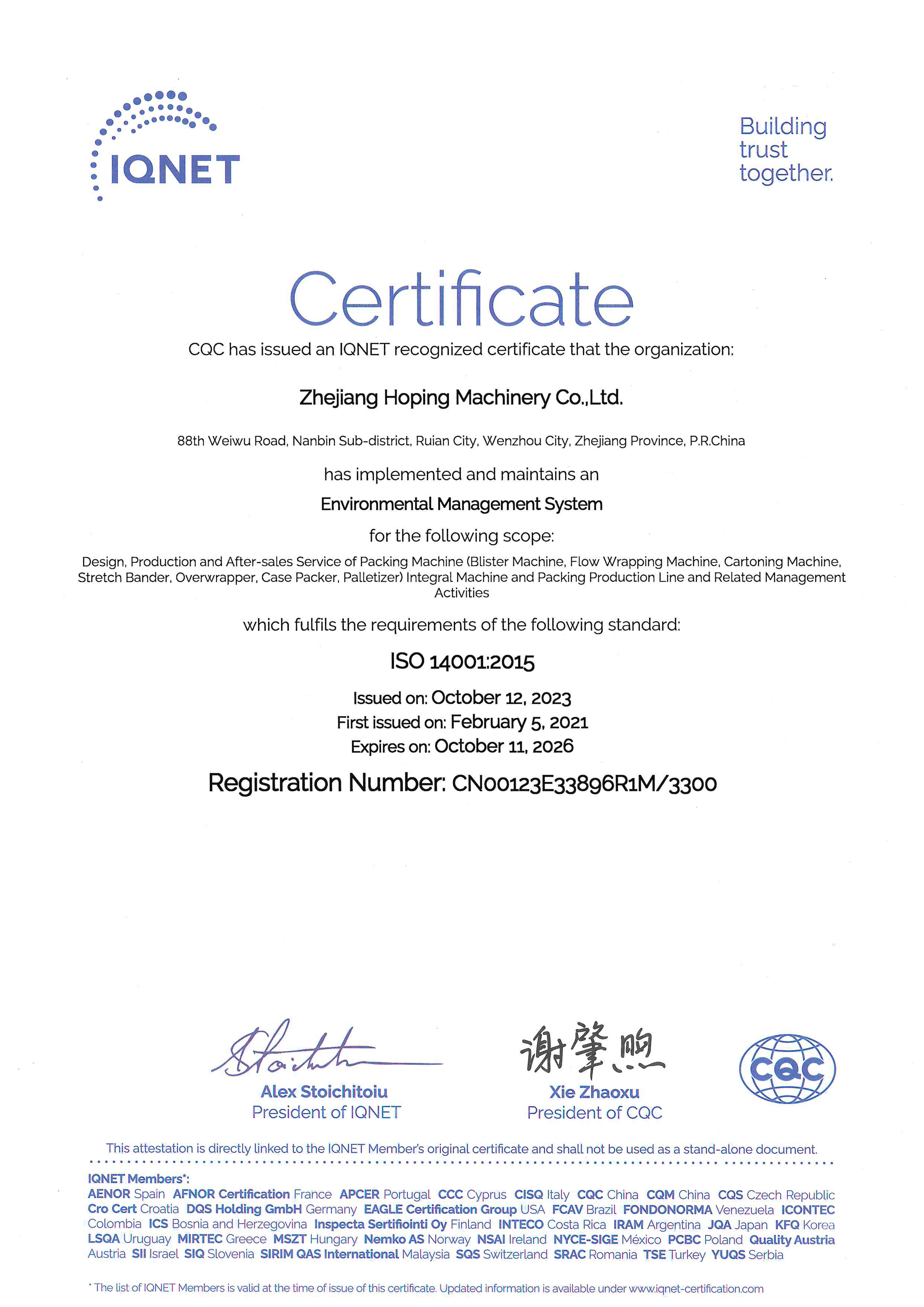
Request certificates with numbers and issuing bodies, not badges. Hoping's documentation set includes CE certification for the cartoning machine series (certificate HTT190102307L, issued by Shenzhen HTT Technology Co., Ltd. on 2019-01-22 under EN 60204-1:2006+A1:2009+AC:2010 and 2006/42/EC), CE certification for the blister packing machine series (HTT190102306L, same issuer and date, under Machinery Directive 2006/42/EC and EN 60204-1), and an earlier CE certificate for the carton packing machine series (UCN 900339024607, issued by Certify International Ltd on 2007-04-01 under EN 415-3:2000, 98/37/EC and 98/79/EC). Management-system certificates include ISO 14001:2015 (CN00123E33896R1M/3300, China Quality Certification Centre, valid 2023-10-12 to 2026-10-11) and ISO 45001:2018 (CN00123S33121R1M/3300, CQC, valid 2023-10-10 to 2026-10-09). The acceptance path for either architecture is technical agreement confirmation, sample testing, factory acceptance test before shipment, site acceptance test at the customer site, with third-party inspection arranged on request. The quality-control sequence behind it runs from incoming material inspection and key component inspection through assembly inspection, electrical safety check, no-load trial run, material trial and customer witness acceptance to pre-shipment inspection.
Step 7 — Fix commercial terms before the technical freeze
Minimum order quantity is 1 set or 1 complete line. Lead time is typically 60–120 days after technical confirmation, subject to model, configuration, project complexity and contract terms, with monthly production capacity of 30–40 units. Delivery can be structured as EXW Ruian/Wenzhou, FOB Ningbo or Shanghai, or CIF/CFR destination port, with final terms subject to contract and destination-country requirements. Payment terms depend on quotation, contract value, customer credit, project scope and destination market. After-sales scope to agree at the same time: on-site installation and commissioning, operator training, maintenance training, remote video/phone support, spare parts supply, process-parameter guidance and regular follow-up.
Use Cases: Which Structure Fits Which Plant
- Single product family, high volume, dedicated line. The integrated DHL8005H at up to 800 blisters/min and 500 cartons/min, or the DHL1000/5H where demand exceeds that rating, fits a plant that runs one format long enough to justify a line-level design and a single control architecture.
- New construction or capacity expansion across several lines. Hoping's representative case covers 5 to 10 packaging lines for a large solid-dosage producer, built for new line construction, capacity expansion or upgrading existing packaging lines — a scenario where line-level responsibility reduces coordination load across parallel projects.
- Multi-format, small-batch, frequent changeover. Separate machines, or the linked DPP + XWZ configuration at 100–600 blisters/min and 100–400 cartons/min, let a plant change over or upgrade one process without re-validating an entire line.
- Moisture-sensitive or market-specific pack styles. Where a pillow pack must sit between blister and carton, the IXW600 and IXW800 linked lines cover blister, flow wrapping and cartoning in one sequence.
- Nutraceutical, healthcare and cosmetic solid dosage. The same architecture applies; format tooling, contact parts and feeding method are customized to the product rather than standardized.
- End-of-line automation build-out. Whichever primary structure was chosen, downstream stages can be added: XWK4060 stretch banding (about 30–60 bundles/min), XWK series case packing (up to about 5 cases/min) and ICP12 case packing with palletizing (about 12 cases/min).
Comparison Table: DHL8005H vs Separate Blister and Cartoning Machines
| Decision dimension | DHL8005H integrated blister-cartoning line | Separate blister machine + cartoner |
|---|---|---|
| Published capacity | Up to 800 blisters/min and 500 cartons/min on one linked machine | Each unit rated independently (example: DPH320HII up to 1000 blisters/min; XWZ500H 100–500 cartons/min) |
| Transfer between blister and cartoning | D3 intelligent top-loading parallel tracking transfer system, inside the line | No line-level transfer supplied; conveyor, buffer and reject logic are plant scope |
| Control architecture | One line-level layer: Beckhoff motion controller and CP9315 industrial PC, with mold-change and preset-memory functions | Two independent machine control systems plus an engineered handshake for synchronization and data |
| Board supply stability | Three-channel servo-driven independent replenishment system | Defined by the standalone blister machine configuration and its interface to the cartoner infeed |
| Material handling | PVC/Alu foil auto splicing | Depends on the selected standalone blister machine |
| Format change | Mold-change support with preset memory at line level | Changeover performed on two machines, then re-synchronized and re-verified |
| Footprint and guarding | Forming, sealing, transfer, leaflet handling and cartoning consolidated in one linked frame | Two standalone units plus transfer, guarding and service clearance; the example pair measures 5000 × 1500 × 2100 mm and 6700 × 1950 × 2100 mm before conveyor |
| Leaflet insertion and inspection | Leaflet handling and coding/inspection are inside the integrated line scope | Cartoner scope covers carton opening, insertion, leaflet insertion, closing and coding/inspection per configuration (XWZ500H) |
| Downstream expansion | Line-level connection to bundling, case packing and palletizing (XWK4060, XWK case packing, ICP12) | Downstream interfaces are added after the two machines are already joined |
| Compliance evidence | CE certification for blister and cartoning machine series (HTT190102306L, HTT190102307L), ISO 14001:2015 and ISO 45001:2018 | The same Hoping documentation set applies to the standalone units |
| Ownership of the interface | Single supplier owns the blister-to-carton interface | Interface risk is shared between two equipment suppliers and the plant |
| Typical best fit | Stable product family, high volume, one carton format per campaign | Multi-format plants, staged investment, or an existing blister machine or cartoner already in service |
FAQ
Q1. What compliance evidence should a pharma plant verify before buying an integrated blister-cartoning line?
Ask for the certificate number, issuing body, standard and validity date, not just a CE mark. Hoping's file includes CE certification for the cartoning machine series (HTT190102307L, Shenzhen HTT Technology Co., Ltd., issued 2019-01-22, EN 60204-1:2006+A1:2009+AC:2010 and 2006/42/EC), CE certification for the blister packing machine series (HTT190102306L, same issuer and date, Machinery Directive 2006/42/EC and EN 60204-1), CE certification for the carton packing machine series (UCN 900339024607, Certify International Ltd, issued 2007-04-01, EN 415-3:2000, 98/37/EC, 98/79/EC), ISO 14001:2015 (CN00123E33896R1M/3300) and ISO 45001:2018 (CN00123S33121R1M/3300). In the EU, packaging machinery safety is also framed by Machinery Directive 2006/42/EC and the EN 415 series, and ISO 15378 integrates GMP requirements for primary packaging materials. Certificates cover machine conformity; the plant's own process validation still has to be built on top of factory and site acceptance testing.
Q2. How does the DHL8005H compare with a separate blister machine plus cartoner in actual capability?
The integrated line delivers up to 800 blisters/min and 500 cartons/min through a D3 intelligent top-loading parallel tracking transfer system, with a three-channel servo-driven independent replenishment system, PVC/Alu foil auto splicing, a Beckhoff motion controller with CP9315 industrial PC, mold-change and preset-memory functions, and GMP-oriented line design. A separated route reaches comparable output from two machines — for example a DPH320HII at up to 1000 blisters/min (250 punches/min, 320 × 280 mm format area, 30 kW) and an XWZ500H at 100–500 cartons/min (14 kW, about 6700 × 1950 × 2100 mm) — but transfer, synchronization and reject handling between them are not part of either machine's deliverable scope.
Q3. What commercial terms and production limits should be planned for?
Minimum order quantity is 1 set or 1 complete line, covering both an integrated line and standalone machines. Lead time is typically 60–120 days after technical confirmation; the final figure depends on model, configuration, project complexity and contract terms. Monthly production capacity is 30–40 units. Delivery can be arranged as EXW Ruian/Wenzhou, FOB Ningbo or Shanghai, or CIF/CFR destination port, with final terms subject to contract and the customer's country requirements. Payment terms are defined by quotation, contract value, customer credit, project scope and destination market — there is no fixed public price list, because the configuration drives the scope.
Q4. Can the machine be validated on samples before shipment and before final payment?
Yes. The acceptance path runs from technical agreement confirmation and sample testing to a factory acceptance test before shipment and a site acceptance test at the customer's plant, with third-party inspection arranged if required. The internal quality-control sequence covers incoming material inspection, key component inspection, assembly inspection, electrical safety check, no-load trial run, material trial, FAT, customer witness acceptance and pre-shipment inspection. After installation, the support scope includes on-site commissioning, operator training, maintenance training, remote video/phone support, spare parts supply, process-parameter guidance and regular follow-up — all subject to contract and project configuration.
Q5. When shortlisting a blister packaging machine OEM manufacturer, what should be verified first — and what is the next step?
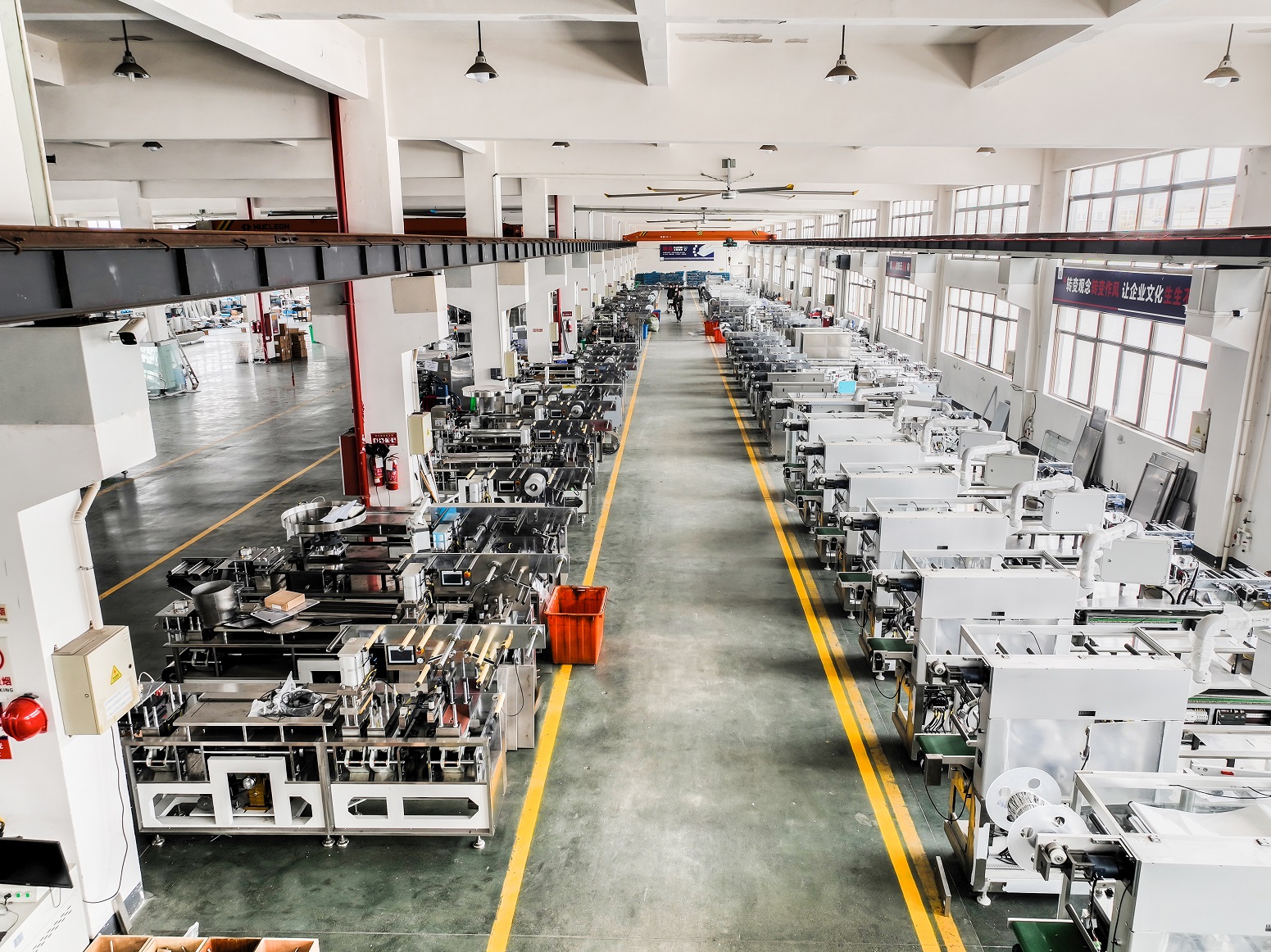
Verify the customization scope, the engineering depth behind it and the delivery structure. Hoping is a pharmaceutical packing machinery manufacturer established in 2001 in Ruian City, Zhejiang Province, China, with 28,800 m² of factory space, more than 300 employees, 56 R&D engineers, an annual output of about 500 units and an export ratio of about 25%, serving markets including Southeast Asia, the Middle East, Eastern Europe, South America and Africa. It provides ODM, OEM and customizable production, with customization covering blister size, blister materials, quantity per carton, carton specification, leaflet format, coding/inspection method, feeding method, downstream bundling/case-packing/palletizing connection, interface language, electrical component brand and data interface. MOQ is 1 set or 1 complete line, monthly capacity 30–40 units, and lead time typically 60–120 days after technical confirmation. The practical next step is to request a line-level proposal instead of two machine quotations: ask for the transfer definition, control architecture, format tooling list, acceptance plan and lead time in one document — request a quote or sample validation plan at monica@xwbj.com / +86 133-5610-5292, or download the Hoping Machinery catalog.
Conclusion: The Decision Rule in One Paragraph
Choose the integrated DHL8005H when the product family, format and demand curve are stable enough that the blister-to-carton interface should be designed, controlled and warranted by one supplier — up to 800 blisters/min and 500 cartons/min, one control architecture, one acceptance file. Choose separate blister and cartoning machines when the plant must optimize each process independently, must reuse an existing machine, or must spread investment across formats; in that case, plan the transfer, synchronization and reject logic as a named scope with its own budget, supplier and validation. In both cases, the verification work is identical: confirm what the speed rating actually measures, confirm the compliance documents by number, and confirm the acceptance path before the purchase order is signed.
Next step for pharma packaging projects
Request a line-level proposal covering the blister-to-carton transfer, control architecture, format tooling, acceptance plan and lead time — or arrange a sample validation / FAT witness visit.
Zhejiang Hoping Machinery Co., Ltd. · 88th Weiwu Road, Nanbin Sub-district, Ruian City, Zhejiang Province, China
Website: www.hopingcn.com · Catalog: Hoping Machinery Catalog (PDF)
Contact: Monica · monica@xwbj.com · Tel/WhatsApp: +86 133-5610-5292
Have Questions or Need More Details?
Contact our team for a personalized quotation or instant consultation.
Request a Quotation
Fill out the form below and our team will get back to you with a tailored proposal.
WhatsApp Direct Chat
Prefer to chat in real-time? Message us on WhatsApp for instant assistance & quick answers.
- Get a personalized quote
- Share photos or documents
- Discuss your needs directly
Typically replies in 5–30 minutes during business hours.