
Partnering With a Pharma Packaging Line Supplier: FAQs on Customization and Commissioning
Customization on a pharmaceutical packaging machine is a defined scope, not an open-ended promise. On an integrated blister-cartoning line, the adjustable items — blister and carton formats, feeding method, transfer system, control platform, product-contact parts and the downstream connection — are normally written into a technical agreement before the machine is built. Commissioning is the stage that proves that agreement under real production conditions.
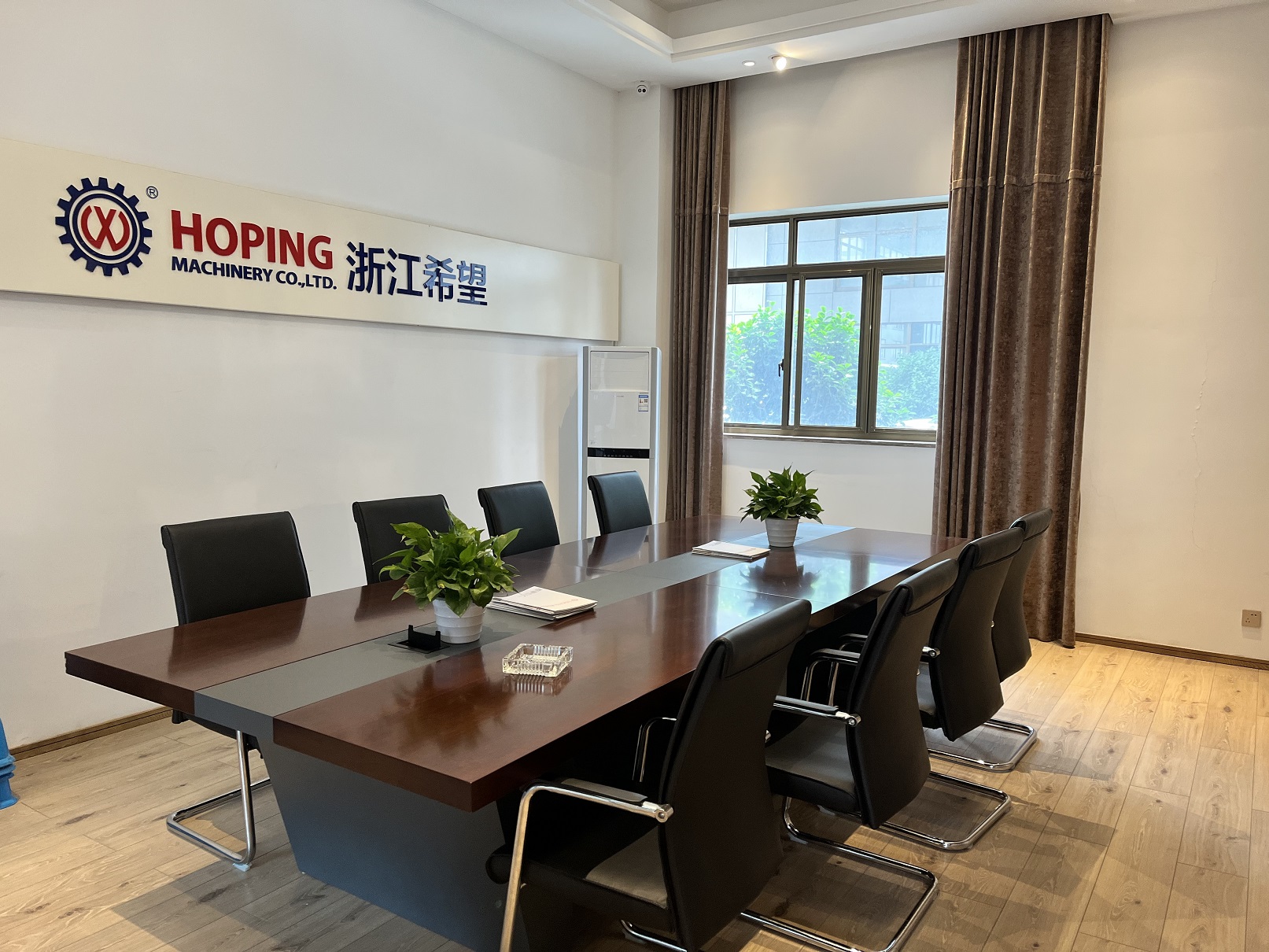
Technical agreement review: format scope, tooling and GMP-related design points are settled before a pharmaceutical packaging line is released for build.
This FAQ is written for buyers in the research stage of a packaging line project. It answers five practical questions: what can be customized, what a technical agreement must contain, how custom tooling is defined, what GMP orientation means in machine design, and how commissioning is planned and handed over.
Zhejiang Hoping Machinery Co., Ltd. (brand: Hoping Machinery) is a pharmaceutical packaging machinery manufacturer established in 2001 in Ruian City, Zhejiang Province, China. Its main products are blister packaging machines, cartoning machines, case packing machines and end-of-line packaging machines. The integrated blister-cartoner line used as the working example in this article is the DHL8005H, a fully servo high-speed blister-cartoner integrated machine from the same manufacturer. More product information is available at www.hopingcn.com.
The Problem: "Customized" Means Different Things in Different Contracts
Most customization disputes in pharma packaging projects are not engineering failures. They are definition failures, and they follow three recognizable patterns.
- Format scope is left open. The line is ordered as "a blister-cartoner," the tooling is built for one blister layout and one carton size, and the second SKU arrives with no agreed place in the contract. The buyer discovers the gap only when a new format has to be introduced.
- GMP expectations stay implicit. Cleanability, guarding, surface finish and product-contact materials are treated as general assumptions rather than specified items. They surface later as rework requests during validation or audit preparation.
- Commissioning is defined as "the machine runs." Nothing is said about line linkage, downstream connection, changeover routines, alarm behaviour or the documentation the buyer needs in order to release the line for production.
The remedy is the same in each case: make the technical agreement the central document of the project, list custom tooling part by part, and treat commissioning as the verification of a written scope rather than as an open-ended service visit.
Industry Background: Why Configuration Fit Now Competes With Brand Name
The global pharmaceutical packaging equipment market was valued at approximately USD 10.71 billion in 2024 (SkyQuest Technology). Within that figure, pharmaceutical cartoning machinery was valued at USD 1.46 billion in 2024 (Fortune Business Insights), and the pharmaceutical blister packaging machine segment was projected to reach USD 2.57 billion by 2025 with a CAGR of 2.8% (Custom Market Insights). Asia Pacific held the largest regional revenue share, at 40.7%, in 2025 (Grand View Research). Published estimates differ noticeably because studies define primary and secondary equipment differently, which is itself a useful warning: check what a market number includes before using it in an internal business case.
Market concentration is moderate. The top three blister packaging machine players — Uhlmann, IMA and Marchesini — hold approximately 29% of that market (MarketsandMarkets). The remaining share is served by a broad field of regional and specialist manufacturers. For a buyer, this means the practical difference between suppliers is less often the nameplate and more often the configuration: whether the feeding method, transfer system, tooling approach, control platform and downstream connection actually match the formats the buyer intends to run.
Regulatory expectations push in the same direction. ISO 15378 integrates GMP requirements for primary packaging materials, and in the EU, packaging machine safety is governed by the Machinery Directive 2006/42/EC together with the EN 415 series of standards for packaging machines. These are not abstract references: each one translates into design and documentation items that either appear in the technical agreement or cause discussion at the validation stage.
Production patterns have also shifted. Solid dosage packaging increasingly runs as continuous high-speed operation in multi-batch, multi-format environments under GMP-oriented cleanroom conditions. That combination — speed plus frequent format change — is what makes tooling and changeover design, not only output rate, a core evaluation criterion.
What Customization Actually Covers on a Fully Servo Blister-Cartoner Line
On a line such as the DHL8005H, customization per technical agreement covers five areas: capacity and line architecture, feeding and transfer method, control platform, tooling and format parts, and the downstream connection. Anything outside those areas is normally part of the standard platform and should be confirmed as such in writing.
1. Capacity and line architecture
The DHL8005H is an intelligent fully servo high-speed blister-cartoner integrated machine and a solid dosage turnkey packing line. Its stated maximum capacity is up to 800 blisters/min and 500 cartons/min, with a D3 intelligent top-loading parallel tracking transfer system, multiple feeding methods, PVC/Alu foil auto splicing and a three-channel servo-driven independent replenishment system. Within the same product family, the DHL1000/5H is specified at up to 1,000 blisters/min and 500 cartons/min with a four-channel servo-driven independent replenishment system, and the DHL6004 at up to 600 blisters/min and 400 cartons/min. Capacity tier is therefore the first customization decision a buyer makes, because it determines the transfer system, replenishment architecture and line footprint that follow.
2. Feeding, transfer and replenishment method
Feeding and transfer are where two lines with the same output rating can behave very differently. The DHL8005H uses a D3 intelligent top-loading parallel tracking transfer system with multiple feeding methods. The DHL7005H, by contrast, uses a self-developed IRB24 intelligent transfer robot with full servo drive, a Siemens motion controller and a TP900 HMI. On the DHL1000/5H, feeding methods are described as being selected according to customer requirements. For a buyer, the practical question is not which concept is better in general, but which concept fits the product geometry, the inspection points and the maintenance skills available on site.
3. Tooling and format parts
Tooling is the part of a customization scope that is easiest to under-specify. On Hoping blister-cartoner lines, format parts are made according to confirmed blister and carton specifications, and GMP-oriented product-contact parts and tooling are supplied according to the technical agreement. In practice the tooling set is defined by the blister layout, the carton dieline, the leaflet format and the downstream grouping pattern.
Material specifications are part of the same discussion. On models such as the DPP260T1 and DPH320HII, product-contact parts are made of AISI 316L stainless steel and FDA-compliant pharmaceutical-grade materials, while non-product-contact parts are manufactured from AISI 304 stainless steel and anodized aluminum alloy, with corrosion-resistant and easy-to-clean surfaces and a design and manufacturing approach aligned with GMP requirements. Buyers evaluating a pharmaceutical packaging machine should ask for these material and surface specifications in writing, because they affect cleaning validation and audit preparation.
4. Changeover: mold-change and preset memory
Mold-change and preset-memory functions are the two features that decide what a future format change actually costs in downtime. The DHL8005H includes mold-change and preset-memory functions; the DHL7005H and DHL6004 specify mold-change support with convenient changeover; the DHL1000/5H combines mold-change with recipe memory.
Preset memory works differently from a paper setup sheet. Approved settings for a validated format are stored as a recipe and recalled at changeover instead of being re-adjusted from scratch. Combined with mold-change design, this allows a line to move between supported formats without treating every switch as a new engineering exercise. Format changeover and recipe storage are supported according to configuration, which is precisely why the number of formats and the changeover procedure should be written into the agreement rather than assumed.
5. Downstream connection and GMP-oriented line design
The DHL8005H scope covers high-speed blister forming and sealing, transfer, leaflet handling, carton opening, insertion, coding/inspection, and connection to bundling, case-packing and palletizing equipment. Depending on project configuration, the matched equipment list can include a leaflet folder, coding machine, vision inspection, checkweigher, XWK4060 stretch bander, case packer, palletizer and an ERP/MES data interface.
The line itself is built on a stainless steel and aluminum-alloy structure with transparent guarding and servo-driven motion components, and is described as a GMP-oriented line design. On the control side, the DHL8005H uses a Beckhoff motion controller with a CP9315 industrial PC — the same control family that the DHL6004 and IXW800 specify. Alarm stop and fault indication are part of normal line operation, and both are relevant to how quickly a shift team can recover from a format or feed problem.
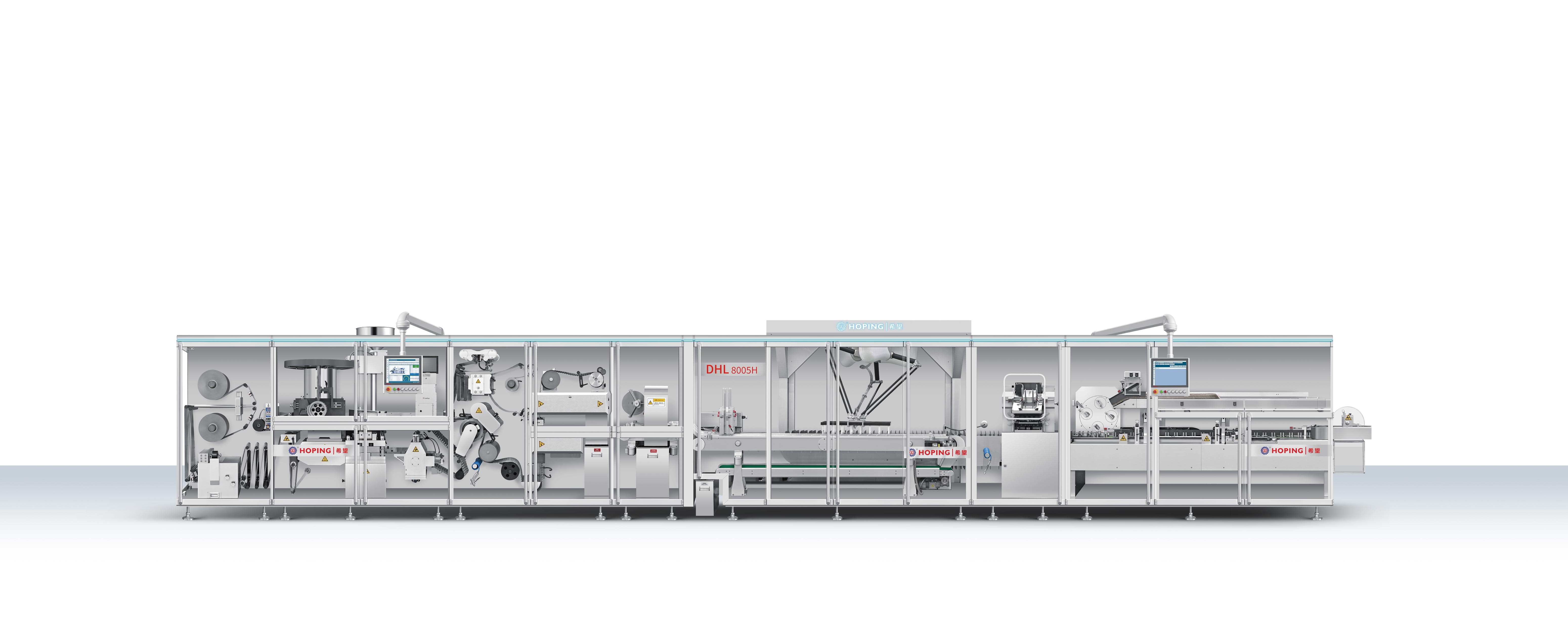
DHL8005H: a fully servo high-speed blister-cartoner integrated machine with mold-change and preset-memory functions, rated up to 800 blisters/min and 500 cartons/min.
What the buyer defines on each customization item
| Customization item | What the buyer must define | Where it is fixed |
|---|---|---|
| Format scope | Blister layout, carton size, leaflet format, and the number of future SKUs to be supported | Technical agreement |
| Tooling and product-contact parts | Format parts per confirmed blister and carton specifications; material requirements for product-contact parts | Technical agreement |
| Feeding and transfer | Feeding method and transfer concept, for example D3 top-loading parallel tracking transfer or an IRB24 robot | Technical agreement |
| Replenishment and film handling | Number of servo-driven independent replenishment channels; PVC and Alu foil auto splicing | Technical agreement |
| Control and data | Controller and HMI platform; ERP/MES data interface where required | Technical agreement |
| Coding and inspection | Coding position, inspection points and rejection handling | Technical agreement |
| Downstream connection | Bundling, case packing, palletizing and overall line layout | Technical agreement |
Commissioning, Step by Step
Commissioning on an integrated blister-cartoning line is a sequence, and every step in that sequence should have a written counterpart in the agreement. The eight steps below reflect how a customization scope moves from a format list to steady production.
- Format and capacity definition. The buyer provides the product list, blister layout, carton size, leaflet format, downstream grouping and target output. These inputs determine the capacity tier and the tooling set.
- Technical agreement freeze. Scope items, responsibilities and acceptance criteria are fixed in writing, with custom tooling listed item by item rather than described as "customized as required."
- Tooling and format part confirmation. Format parts are made according to confirmed blister and carton specifications; GMP-oriented product-contact parts and tooling follow the agreement.
- Build and in-house running checks. Machine assembly, electrical and pneumatic setup, and control configuration, including the Beckhoff motion controller and CP9315 industrial PC on the DHL8005H platform.
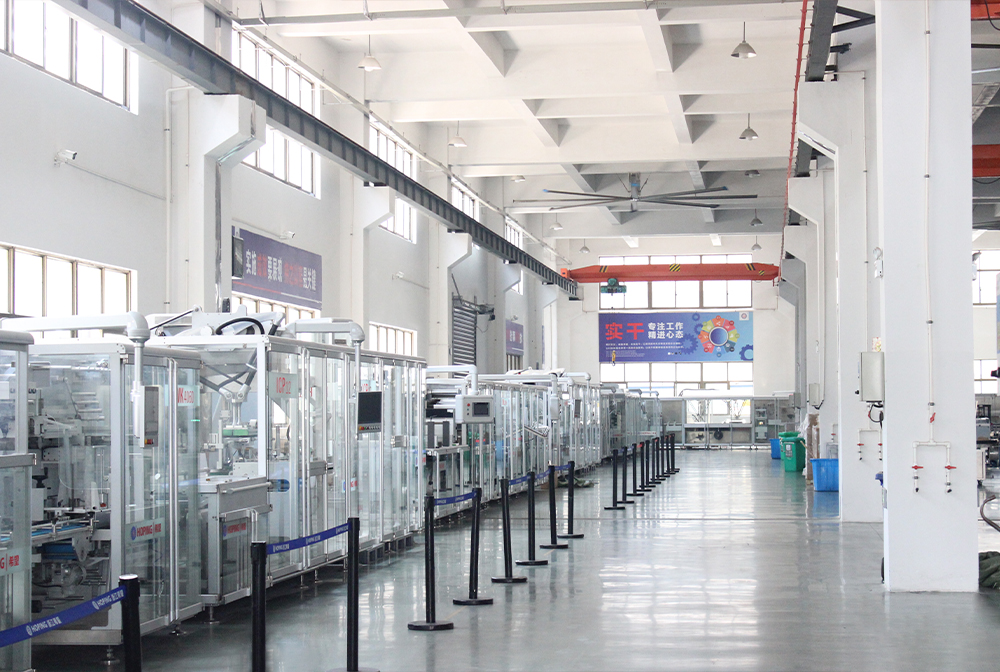
- Pre-shipment verification. The agreed format set is run before shipment and reviewed against the acceptance criteria, with buyers able to inspect machines in the manufacturer's showroom.
- Installation and line linking. The blister module is linked to the cartoner and to downstream modules such as the XWK4060 stretch bander, case packer or palletizer, including an ERP/MES interface where configured.
- Format changeover practice. Mold change and preset-memory recall are performed on site, together with alarm and fault-indication checks. This is the step where buyers most often find out whether future formats are genuinely supported.
- Training and handover. Operators learn HMI-based operation and changeover routines; documentation supporting the buyer's own qualification work is handed over. Hoping Machinery maintains a training hall and a machine showroom used for this purpose.
Practical note: the duration of each step depends on scope, site conditions and the number of formats, so it should be defined as an agreed schedule and acceptance criterion rather than as a general estimate. Buyers should confirm who is responsible for each step — supplier, integrator or plant engineering — before the agreement is signed.
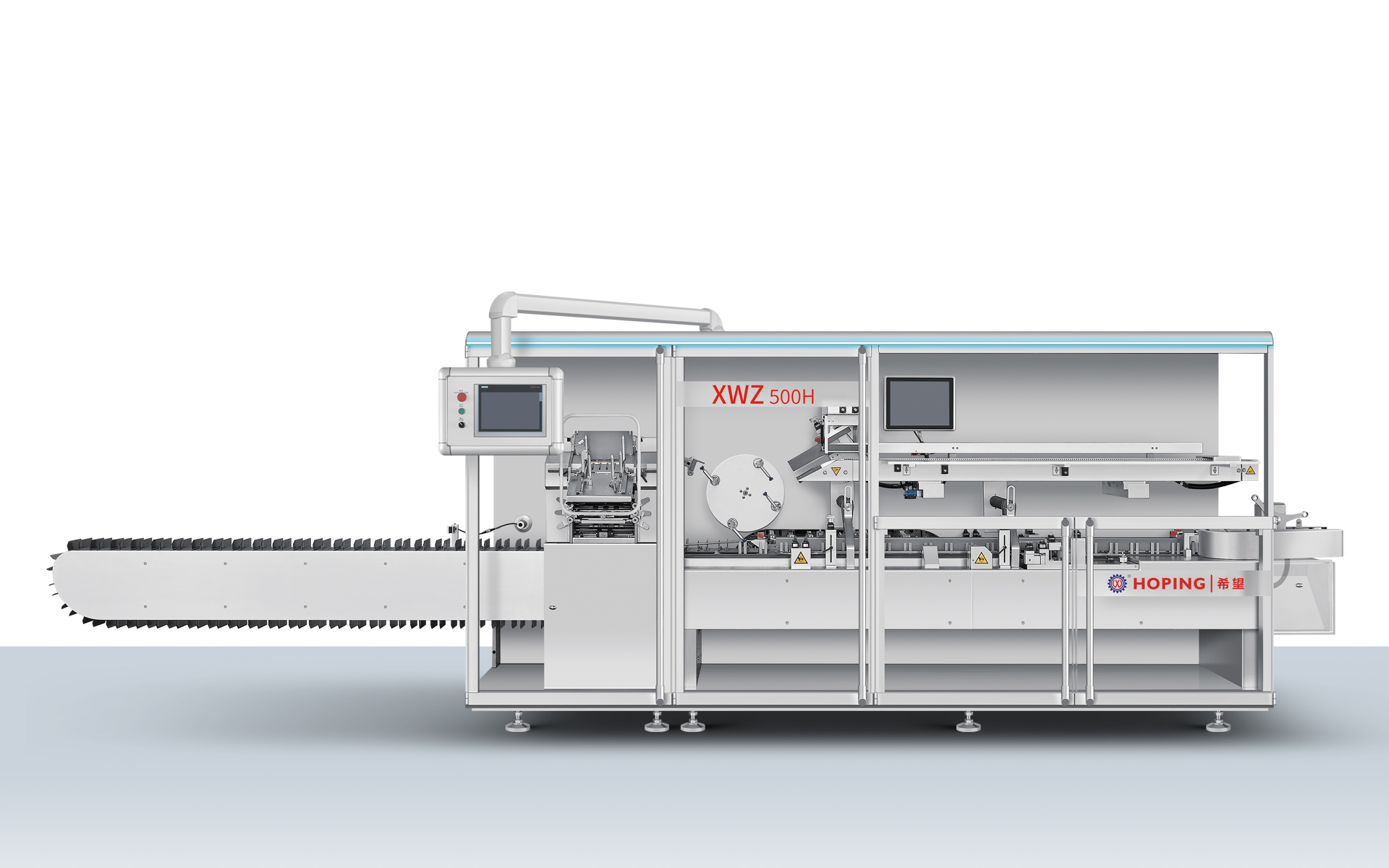
Cartoning stage: the XWZ500H full servo high-speed cartoning machine runs at 100–500 cartons/min and is configured with the blister module as part of an integrated line.
Projects Where Customization and Commissioning Decide the Outcome
Customization questions become urgent in a recognizable set of project types. In each one, the definition of scope matters as much as the machine specification.
- New solid dosage blister packaging line. A new line built around tablets or capsules, where blister format, carton size and coding position are defined for the first time and become the template for later SKUs.
- Existing packaging line upgrade. An installed line is upgraded for higher output or better changeover behaviour, and the technical agreement has to describe how new modules integrate with equipment already on the floor.
- High-capacity expansion. Projects targeting the upper end of the family, such as the DHL1000/5H at up to 1,000 blisters/min and 500 cartons/min, where transfer and replenishment architecture become the dominant design questions.
- Multi-batch, multi-format production. Sites running many small batches depend on mold-change and preset/recipe memory more than on peak output, because changeover time rather than cycle time limits their capacity.
- Downstream integration projects. Blister-cartoning lines that must connect to bundling, case packing or palletizing — for example the automatic cartoner production line combining XWZ300II, XWK4060 and ICP12 at about 60–220 cartons/min, 30–60 bundles/min and about 12 cases/min.
- Adjacent dosage and product categories. Nutraceutical, healthcare and cosmetic blister-cartoning projects that run on the same platform logic with different tooling, contact-part and cleaning requirements.
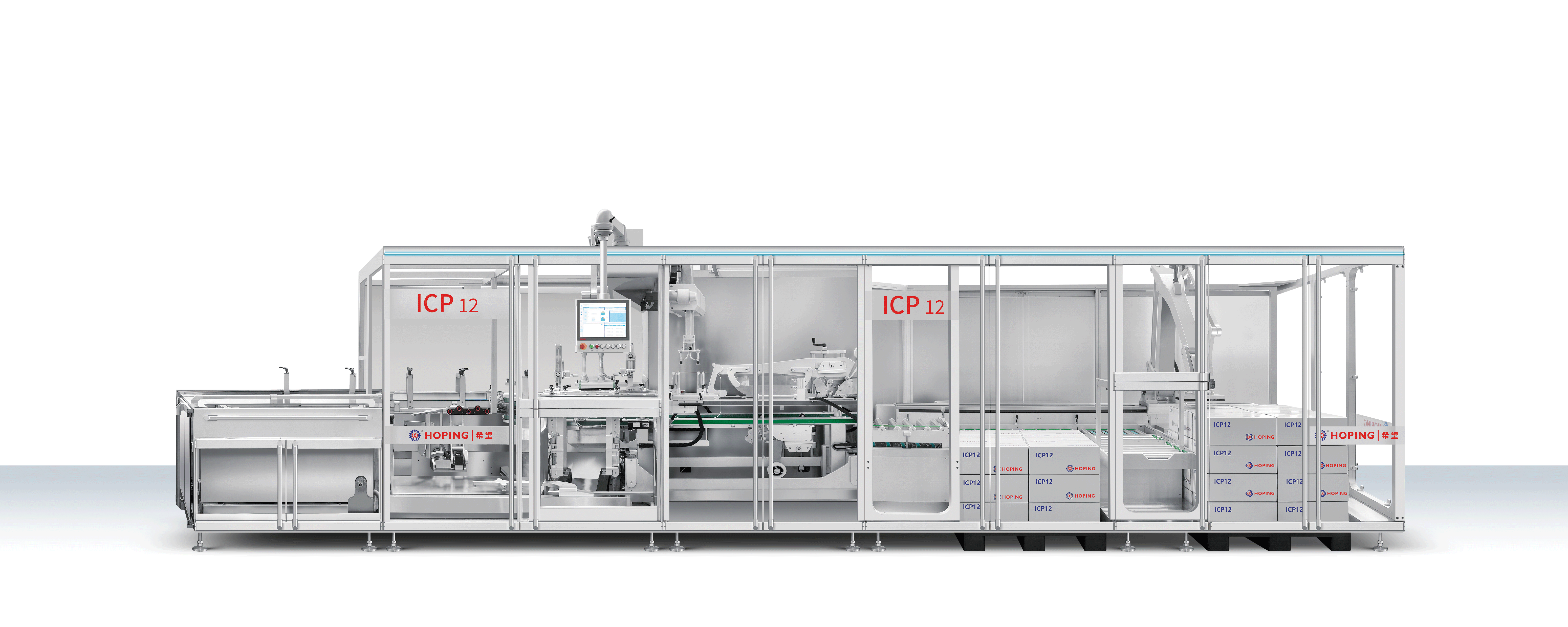
Downstream scope: the ICP12 case packing and palletizing integral machine handles case opening, loading, sealing, conveying and palletizing at about 12 cases/min.
Comparing Hoping Integrated Blister-Cartoner Lines by Configuration
Configuration options are easier to judge side by side. The table below summarises manufacturer specifications for four integrated blister-cartoner lines from the same range, and shows how capacity tier, transfer concept and control platform change together. Final configuration, tooling scope and downstream equipment are confirmed per project technical agreement.
| Model | Maximum capacity | Transfer system | Servo replenishment | Control platform | Changeover functions |
|---|---|---|---|---|---|
| DHL1000/5H | Up to 1,000 blisters/min and 500 cartons/min | D3 intelligent top-loading parallel tracking transfer; feeding methods according to customer requirements | Four-channel servo-driven independent replenishment; PVC/Alu foil auto splicing | Beckhoff motion controller and high-bus industrial control system | Mold-change and recipe memory |
| DHL8005H | Up to 800 blisters/min and 500 cartons/min | D3 intelligent top-loading parallel tracking transfer; multiple feeding methods | Three-channel servo-driven independent replenishment; PVC/Alu foil auto splicing | Beckhoff motion controller and CP9315 industrial PC | Mold-change and preset memory |
| DHL7005H | Up to 700 blisters/min and 500 cartons/min | Self-developed IRB24 intelligent transfer robot | Servo-driven independent replenishment | Siemens motion controller and TP900 HMI | Mold-change support |
| DHL6004 | Up to 600 blisters/min and 400 cartons/min | High-speed transfer and cartoning linkage | Servo-driven independent replenishment | Beckhoff motion controller and CP9315 industrial PC | Convenient mold change |
FAQ: Customization and Commissioning
1. Which compliance points should be written into the agreement for a pharmaceutical packaging machine?
Start with the standards that apply to the project. ISO 15378 integrates GMP requirements for primary packaging materials, and in the EU, pharmaceutical equipment safety is governed by the Machinery Directive 2006/42/EC together with the EN 415 series for packaging machines. In a machine specification, those requirements translate into concrete items: GMP-oriented line design, a stainless steel and aluminum-alloy structure with transparent guarding, product-contact parts specified by material, and corrosion-resistant, easy-to-clean surfaces. On models such as the DPP260T1 and DPH320HII, product-contact parts are made of AISI 316L stainless steel and FDA-compliant pharmaceutical-grade materials, and non-product-contact parts from AISI 304 stainless steel and anodized aluminum alloy. The manufacturer profile for Hoping Machinery lists CE and ISO 9001/14001 certifications. The practical rule is to name the standards and the required documents in the agreement rather than to assume them.
2. How much of a blister-cartoning line can actually be customized?
Customization is bounded by the platform. On the DHL8005H, the adjustable items per technical agreement are the capacity tier, feeding methods, transfer system, number of servo-driven independent replenishment channels, PVC/Alu foil auto splicing, controller and HMI configuration, coding and inspection scope, product-contact parts and tooling, and the downstream connection to bundling, case packing or palletizing. Line dimensions are also project-specific. Items outside that list are standard platform features and should be confirmed as standard in writing. This boundary is what makes customization controllable — an open-ended scope is harder to validate than a defined one.
3. What determines the investment level of a customized line?
Six factors dominate. First, the number of formats and the resulting tooling sets. Second, the capacity tier — a 600, 800 or 1,000 blister/min platform implies different transfer and replenishment architecture. Third, the transfer and feeding concept. Fourth, the control platform, since Beckhoff and Siemens architectures differ in components and integration work. Fifth, the inspection and coding scope, including vision inspection or checkweigher integration. Sixth, the downstream modules configured with the line, such as a stretch bander, case packer, palletizer or ERP/MES data interface. Because scope defines configuration, commercial terms are normally quoted against a frozen format list and a technical agreement rather than against a generic model number — a quote requested that way is comparable against competing offers on equal terms.
4. How can we be sure our own blister and carton formats will run on the line?
Format certainty comes from three written items. First, format parts made according to confirmed blister and carton specifications, so tooling is built against a drawing rather than a verbal description. Second, GMP-oriented product-contact parts and tooling configured according to the technical agreement. Third, an agreed project requirement list covering capacity, blister format, carton size, leaflet format and downstream connection. Changeover validation then uses the mold-change and preset-memory functions to recall stored settings for each approved format. Buyers are advised to review format samples and specifications with the supplier before the agreement is signed, since format data is the single input that everything else depends on.
5. How is commissioning planned after the technical agreement is signed?
Commissioning follows the sequence described earlier: format and capacity definition, agreement freeze, tooling confirmation, build and in-house running checks, pre-shipment verification, installation and line linking, format changeover practice, and operator training with documentation handover. Two things should be settled in advance: the acceptance criteria for each stage, and the responsibility split between supplier, integrator and plant engineering. Buyers should also confirm that the first full format changeover will be practised on site, not documented only on paper, because mold-change and preset-memory routines are learned rather than read. For projects still at the evaluation stage, the most efficient next step is to send the current format list and target output to the manufacturer's export contact, and to request a quotation against that scope.
Conclusion: The Agreement Is the Product
On a pharma packaging line, what a buyer actually purchases is a written scope: the formats the line will run, the tooling that makes them, the material and GMP-oriented design points that survive an audit, and the changeover functions that keep future SKUs economical. The DHL8005H shows how that scope looks in practice — up to 800 blisters/min and 500 cartons/min, a D3 intelligent top-loading parallel tracking transfer system, three-channel servo-driven independent replenishment, a Beckhoff motion controller with CP9315 industrial PC, and mold-change and preset-memory functions supporting format changes over the life of the line. Commissioning is simply the point at which all of it is proven together.
Hoping Machinery, established in 2001, supports that process with a 56-engineer R&D team, a 28,800 m² manufacturing facility, annual production capacity of 500 units and export sales representing 25% of total sales across Southeast Asia, the Middle East, Eastern Europe, South America and Africa. Its product portfolio spans blister packaging machines, cartoning machines, case packing machines and end-of-line packaging machines — the same components that make up a turnkey pharmaceutical packaging line.
Next Step: Define Your Format Scope Before the Agreement
Send your blister format, carton size, leaflet format and target output, and ask for a quotation against a written technical agreement — including tooling, changeover functions and downstream connection.
Email: monica@xwbj.com | Tel / WhatsApp: +86 133-5610-5292 | Website: www.hopingcn.com
Download the full equipment catalog: Hoping Machinery Catalog (PDF)
Have Questions or Need More Details?
Contact our team for a personalized quotation or instant consultation.
Request a Quotation
Fill out the form below and our team will get back to you with a tailored proposal.
WhatsApp Direct Chat
Prefer to chat in real-time? Message us on WhatsApp for instant assistance & quick answers.
- Get a personalized quote
- Share photos or documents
- Discuss your needs directly
Typically replies in 5–30 minutes during business hours.