
Solving Changeover Headaches on Blister-Cartoning Production Lines
A blister-cartoning line does not lose time because it runs slowly — it loses time between batches, when forming positions, transfer timings, carton sizes, leaflet folds and print settings have to be re-established for the next product. The DHL8005H automatic blister-cartoning line from Zhejiang Hoping Machinery Co., Ltd. (HOPING) is documented with two functions aimed directly at that problem: mold-change support and preset memory, running on a fully servo architecture with a Beckhoff motion controller and a CP9315 industrial PC. Recipe storage and format changeover are supported according to configuration. For anyone specifying a pharmaceutical packaging machine, the useful question is therefore not whether a machine can store settings, but how much of a batch transition can be recalled instead of re-tuned by hand.
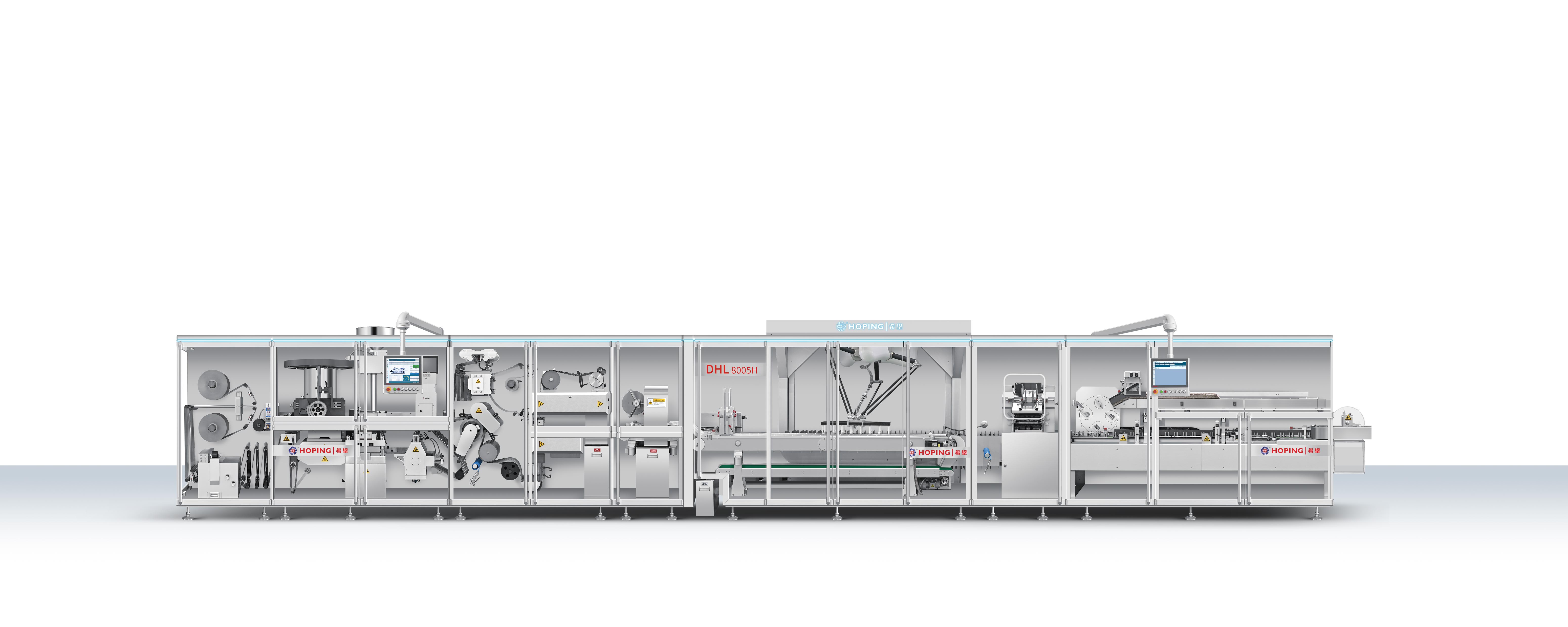
HOPING DHL8005H — intelligent fully servo high-speed blister-cartoner integrated line, documented at up to 800 blisters/min and 500 cartons/min.
Problem Definition: Where Changeover Time Actually Goes
Changeover is a multi-point adjustment problem. On an integrated blister-cartoning line, each item below exists twice — once as a mechanical position, once as a stored control value — and each has to be re-established when the product changes:
- Blister forming — forming mold, forming area and forming depth, plus heating and sealing positions.
- Punching and cutting — the punch pattern and cutting geometry that define the blister card.
- Packaging material — PVC, aluminium foil or Alu-Alu structures, including tension and reel-splice handling.
- Transfer — the pick-up position and timing that move blisters from the blister section into the cartoner.
- Carton handling — magazine width and height, carton opening geometry and insertion stroke.
- Leaflet handling — fold format, feeding and insertion timing.
- Coding — batch, expiry and other three-date characters.
- Inspection and rejection — detection thresholds and reject confirmation behaviour.
- Downstream modules — bundling, case packing and palletizing parameters where these are part of the line.
When those points are rebuilt by trial and error, the symptoms are predictable: cartons that open poorly, leaflets that miss the insertion window, blisters picked at the wrong moment, and rejected product that later has to be reconciled. Several of these failures are mechanical rather than electrical. Poor carton opening, for example, is usually a suction and magazine geometry issue rather than a software issue, which is why HOPING documents an eccentric suction-counter suction-release box device on the XWZ120 horizontal cartoning machine — a design intended to reduce adhesion problems during the box-opening process.
Two further costs are easy to miss at the specification stage. The first is documentation: in GMP-oriented pharmaceutical environments a format change is typically a controlled event that has to be recorded and released, and that paperwork does not shrink because the machine runs faster. The second is the interface itself. A line assembled from a standalone blister machine plus a standalone cartoner carries an extra alignment problem, because the transfer point has to be re-established relative to two separate machines rather than within one integrated frame.
Industry Background: Why Multi-Batch, Multi-Format Production Is Now the Norm
Changeover has moved up the buyer's agenda because the commercial base for these lines keeps growing. Custom Market Insights places the global blister packaging machine pharmaceutical market at USD 2.57 billion in 2025 and describes Asia-Pacific as the fastest-growing region at an 8.87% CAGR to 2031. Mordor Intelligence reports the wider pharmaceutical packaging machinery market at USD 7.09 billion in 2026, growing at a 7.15% CAGR toward USD 10.02 billion by the end of its forecast window. Within cartoning specifically, Mordor Intelligence reports that horizontal cartoning systems held 70.12% of cartoner market share in 2024 — the orientation that dominates pharmaceutical carton handling.
These are commercial research estimates published under publisher-specific market definitions, and they should not be quoted as an official statistical series. Their practical value for a buyer is directional: capacity keeps being added and replaced, and the equipment being added is expected to handle more than one format.
Regulation frames the same problem from a different angle. ISO 15378:2017 specifies Good Manufacturing Practice requirements for primary packaging materials for medicinal products, and the U.S. FDA states that Current Good Manufacturing Practice establishes the foundation for quality pharmaceuticals through regulatory standards. Neither source defines a machine-level changeover time, and neither should be presented as if it did. What they establish is that repeatable, documented processing — including how a line is reset between products — sits inside a regulated framework.
HOPING describes its blister-cartoning equipment as designed for continuous high-speed operation and multi-batch, multi-format production environments under GMP-oriented cleanroom or pharmaceutical packaging workshop conditions, with alarm stop, fault indication, recipe storage and format changeover supported according to configuration. That is a design assumption rather than a performance guarantee, and the distinction matters exactly when a line is being specified.
Detailed Solution: How Mold-Change and Preset Memory Reduce Downtime
The core idea behind both functions is the same: separate the work that must be done physically from the work that can be recalled electronically. Mold-change support handles the physical half; preset memory handles the informational half.
Mold-change support: replacing the format set as a set
Mold change on a blister-cartoner is not a single operation. It is the replacement of a coordinated group of format parts — forming and sealing tooling on the blister side, and carton magazine guides, opening and insertion geometry on the cartoning side. HOPING documents format parts and product-contact tooling as being produced according to a confirmed technical agreement, and the DHL7004 and DHL7005H blister-cartoner lines are documented with convenient mold change and mold-change support respectively. The DHL8005H goes one step further in the published specification by pairing mold-change support with preset-memory functions.
This matters commercially because a format set that is designed as a matched group can be swapped and re-registered as a group. When format parts are individually fitted, every part carries its own adjustment, and those adjustments accumulate into the changeover time.
Preset memory: recalling settings instead of rebuilding them
Preset memory stores the machine's format settings so that a recurring product can be returned to production without re-tuning each position. HOPING documents the DHL8005H with preset-memory functions and the DHL1000/5H with recipe memory functions; the application description for these lines states that recipe storage and format changeover are supported according to configuration.
The honest boundary is worth stating plainly: preset memory recalls control positions. It does not remove the mechanical tooling change, it does not clean the line, and it does not on its own define changeover time. A line with excellent preset memory and poorly organised tooling can still lose more time than a simpler line with a well-drilled changeover routine.
The servo layer that makes recall meaningful
Stored settings are only useful if the axes can be commanded back to them. On HOPING's XWZ500H full servo high-speed cartoning machine, the pressing carton device is servo-controlled for height adjustment: changing to different carton specifications can be carried out through the human-machine interface, and the servo motor adjusts the height of the box. That is a concrete example of a setting being commanded rather than hand-adjusted and then re-measured.
The same architecture appears at line level on the DHL8005H, which is documented with a three-channel servo-driven independent replenishment system, PVC/Alu foil auto splicing, multiple feeding methods and a D3 intelligent top-loading parallel tracking transfer system. Independent replenishment matters during transitions because channel-level refilling does not force the whole line to a stop at the same moment, and PVC/Alu foil auto splicing addresses the separate downtime source of reel changes.
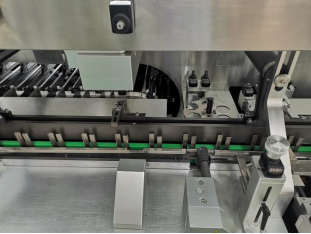
Servo-controlled pressing carton device: box-specification changes are made through the HMI, with the servo motor adjusting carton height.
Two further details on the same cartoning platform support repeatable changeover. The carton magazine uses a servo-driven box-feeding device documented as accommodating up to 1,800 cartons, which reduces how often the magazine must be reloaded mid-batch. An adjustment device with a digital display and scale ruler lets an operator return a mechanism to a recorded position mechanically, which is what makes a stored recipe credible when a mechanical part has been disturbed.
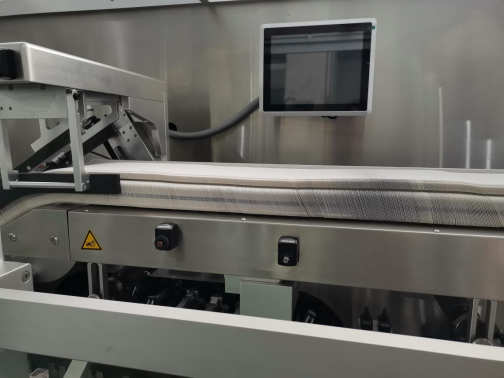
Servo-driven carton magazine feeding device, documented to accommodate up to 1,800 cartons.
What still stays manual
Even on a preset-memory line, a changeover retains a human portion: handling and fitting format tooling, loading reels, replacing coding characters, verifying the first cartons, cleaning, and releasing the batch. The DHL8005H and DHL1000/5H are both described as GMP-oriented in design, with stainless steel and aluminium-alloy structures and transparent guarding, which supports cleaning and inspection during those manual steps. The design intent is to shrink the manual portion, not to eliminate it.
Step-by-Step Breakdown: A Changeover Sequence on an Integrated Line
The sequence below reflects how the documented functions on an integrated blister-cartoner are used in practice. It is a planning framework, not a substitute for the machine's own operating manual or the site's quality procedures.
- Confirm the incoming format pack. Blister layout, blister card dimensions, carton size, leaflet format and feed method are the inputs that determine which recipe and which format set apply.
- Select or check the stored recipe. With preset memory, the operator recalls the stored settings for the format rather than starting from the previous product's state. On models documented with recipe memory, this is the step that converts stored data into machine positions.
- Swap the format tooling. Forming and sealing tooling on the blister side, magazine guides and insertion geometry on the cartoning side are replaced as a matched set, produced to the confirmed blister and carton specifications.
- Return mechanical references. Where a mechanism has been physically disturbed, the adjustment device with digital display and scale ruler is used to return it to its recorded position before the recipe is trusted.
- Command the servo-set positions. Carton-height and similar servo-controlled adjustments are entered through the HMI rather than hand-cranked, so the machine — not the operator's judgement — sets the final value.
- Set the coding characters. Batch, expiry and other three-date characters are replaced. On the cartoning platform HOPING documents a front-mounted batch number stamping device, positioned for quicker replacement of the three-date steel characters.
- Load materials. PVC or Alu foil is loaded and spliced, using the auto-splicing function where the line provides it, and the carton magazine is refilled.
- Run a verification batch. The first cartons are checked for transfer timing, carton closing, leaflet presence, coding position and reject behaviour. This is the point at which a trimmed setting should be written back to the recipe rather than left as tribal knowledge.
- Document and release. The changeover record is completed and the line released according to the site's GMP procedures.
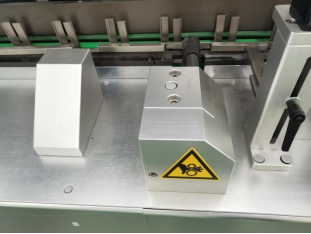
Front-mounted batch number stamping device, positioned for convenient replacement of three-date steel characters.
How to verify changeover performance before you buy
Because changeover time depends on the format set, the product and the operator, it should be measured rather than assumed. Buyers can reasonably ask a supplier to run the changeover procedure during factory acceptance using the buyer's own blister and carton formats, to record which steps are servo-commanded and which are manual, and to state which settings are stored in the recipe. Capacity figures quoted for a line are maximum values and depend on product format, station count and line configuration; the same caveat applies to any changeover figure quoted without those conditions.
Use Cases: Where Changeover Performance Pays Back
Faster transitions are not equally valuable to every plant. They pay back most clearly in the following situations.
- Solid dosage plants running several oral solid dose SKUs on one line. Where weekly or daily format changes are normal, the accumulated changeover hours, not the peak speed, usually decide the real output of the line.
- Plants adding Alu-Alu alongside Alu-PVC. Alu-Alu and aluminium-based formats change material handling as well as tooling, so recipe memory and auto splicing reduce two different sources of stoppage at once.
- Nutraceutical and healthcare producers with frequent carton size changes. Carton-size variation is handled largely on the cartoning side, where HMI-driven servo adjustment and servo magazine feeding directly reduce manual work.
- Plants expanding into downstream modules. When bundling, case packing or palletizing are added, the format change has to propagate downstream; addressing it at the integrated line level avoids re-inventing the changeover at each module.
- Plants upgrading from standalone blister and cartoning machines. Consolidating the transfer point inside one frame removes one of the most stubborn alignment tasks in a multi-batch environment.
- Multi-format contract and private-label operations. Where format changes are driven by customer orders rather than internal planning, predictable changeover supports more reliable delivery commitments.
Comparison Table: Changeover-Relevant Capability Across HOPING Blister-Cartoner Lines
The table below compares documented changeover-relevant features across HOPING integrated blister-cartoner lines. All entries are taken from HOPING product documentation; figures are maximum stated capacities and depend on product format, station count and line configuration.
| Model | Max blister output | Max cartoning output | Transfer / feeding | Controller platform | Changeover-related functions |
|---|---|---|---|---|---|
| DHL6004 | Up to 600 blisters/min | Up to 400 cartons/min | High-speed transfer and cartoning linkage; servo-driven independent replenishment | Beckhoff motion controller + CP9315 industrial PC | Convenient mold change; GMP-oriented design |
| DHL7004 | Up to 700 blisters/min | Up to 400 cartons/min | Self-developed IRB24 intelligent transfer robot; servo-driven independent replenishment | Siemens motion controller + TP900 HMI | Convenient mold change; full servo drive; format parts to confirmed blister and carton specifications |
| DHL7005H | Up to 700 blisters/min | Up to 500 cartons/min | Self-developed IRB24 intelligent transfer robot; independent replenishment | Siemens motion controller + TP900 HMI | Mold-change support; in-line GMP-oriented design |
| DHL8005H | Up to 800 blisters/min | Up to 500 cartons/min | D3 intelligent top-loading parallel tracking transfer; multiple feeding methods; three-channel servo-driven independent replenishment | Beckhoff motion controller + CP9315 industrial PC | Mold-change and preset-memory functions; PVC/Alu foil auto splicing; GMP-oriented line design |
| DHL1000/5H | Up to 1000 blisters/min | Up to 500 cartons/min | D3 intelligent top-loading parallel tracking transfer; four-channel servo-driven independent replenishment | Beckhoff motion controller + high-bus industrial control system | Mold-change and recipe memory functions; GMP-oriented design |
Read across the table, the pattern is that preset or recipe memory appears on the higher-capacity models, while mold-change support appears across the range. For a plant whose constraint is format variety rather than peak speed, the presence of preset memory can matter more than the difference between 600 and 1000 blisters per minute.
FAQ
Q1. What GMP-related requirements should we consider when changing formats on a blister-cartoning line?
ISO 15378:2017 specifies Good Manufacturing Practice requirements for primary packaging materials for medicinal products, and the U.S. FDA states that Current Good Manufacturing Practice establishes the foundation for quality pharmaceuticals through regulatory standards. Neither source sets a machine-specific changeover time. In practice this means the changeover itself — what was replaced, what was verified, and what was released — belongs inside a documented process. HOPING blister-cartoner lines are described as GMP-oriented in design, with stainless steel and aluminium-alloy structures, transparent guarding and product-contact parts and tooling configured according to technical agreement. Buyers should confirm which documents accompany the machine and how format-part changes are recorded at their own site.
Q2. How do the DHL8005H mold-change and preset-memory functions reduce changeover downtime?
The DHL8005H automatic blister-cartoning line is documented with mold-change and preset-memory functions. Mold-change support addresses the physical half of a transition: matched format parts for the blister and cartoning sections are replaced as a set rather than adjusted individually. Preset memory addresses the informational half: stored format settings are recalled instead of rebuilt, and the line's application description states that recipe storage and format changeover are supported according to configuration. The two work together — a recalled recipe is only reliable if the mechanical format set has returned to the position the recipe expects.
Q3. What configuration factors influence the investment in a line with fast changeover capability?
Investment follows configuration rather than a list price. The factors that most often move the scope are the number of formats to be supported and the associated format-part sets, the required blister and cartoning capacity, the transfer system and number of servo-driven replenishment channels, the material set (PVC, aluminium or Alu-Alu), whether coding and inspection are integrated, and whether downstream bundling, case packing or palletizing modules are included. On the DHL8005H these elements are specified together: a D3 intelligent top-loading parallel tracking transfer system, three-channel servo-driven independent replenishment and PVC/Alu foil auto splicing, controlled by a Beckhoff motion controller with CP9315 industrial PC. HOPING issues quotations against confirmed formats and line configuration, so the format list is the practical starting point for budget discussion.
Q4. Can we check a format changeover with our own blister and carton before committing?
A changeover should be verified against the buyer's own formats, because the work involved depends on the blister layout, carton size and leaflet format. Buyers commonly request that the changeover procedure be demonstrated and timed during factory acceptance, using their own blister and carton formats, with a record of which steps are servo-commanded and which remain manual, and which settings are stored in the recipe. HOPING's lines are configured with format parts produced to confirmed blister and carton specifications, which is what makes such a trial meaningful. To arrange a format review and a machine demonstration, contact HOPING directly — the sample, format and trial discussion is normally handled alongside the technical quotation.
Q5. How should format parts and changeover kits be planned into the project timeline?
Format tooling for a blister-cartoner is not a catalogue item: HOPING documents product-contact and format parts as produced according to the technical agreement and to confirmed blister and carton specifications. That means the format list should be fixed early in the project rather than after the machine order, because tooling, recipe creation and the acceptance procedure all depend on it. A practical approach is to agree the full format list and the corresponding kit at the specification stage, confirm which formats are covered by stored recipes, and align the tooling and machine delivery schedules so that acceptance testing can be run with production formats. Delivery and tooling schedules are confirmed by HOPING against the agreed configuration at quotation stage.
Conclusion
Changeover is where a blister-cartoning line either earns its capacity or quietly loses it. The design answer that HOPING documents across its blister-cartoner range splits the problem in two: mold-change support reduces the physical work of swapping a format set, and preset or recipe memory removes the need to rebuild settings that the machine has already learned. On the DHL8005H, these functions sit alongside a fully servo architecture, a Beckhoff motion controller with CP9315 industrial PC, PVC/Alu foil auto splicing and a three-channel servo-driven independent replenishment system, with recipe storage and format changeover supported according to configuration.
For buyers at the research stage, the practical next step is not to compare headline speeds but to compare changeover scope: how many formats are covered by stored recipes, which adjustments are servo-commanded through the HMI, how format parts are produced and grouped, and how the changeover is verified with the buyer's own product formats. Zhejiang Hoping Machinery Co., Ltd. was established in 2001, employs approximately 300 staff across a 28,800 square metre facility, and holds 26 invention patents, 70 utility patents, 4 appearance patents, 10 PCT-protected patents and 28 software copyrights.
Next Step: Request the Catalog or Discuss Your Format List

Hoping Machinery exhibition hall — integrated blister, cartoning and end-of-line equipment.
Send us your blister layout, carton size and leaflet format, and we will confirm which HOPING blister-cartoner line fits, which settings are covered by preset memory, and how the format changeover can be verified before delivery.
Catalog download: Hoping Machinery Catalog (PDF)
Website: www.hopingcn.com
Contact: Monica | Email: monica@xwbj.com | Tel / WhatsApp: +86 133-5610-5292
WhatsApp: Start a conversation
Address: 88th Weiwu Road, Nanbin Sub-district, Ruian City, Zhejiang Province, China
Have Questions or Need More Details?
Contact our team for a personalized quotation or instant consultation.
Request a Quotation
Fill out the form below and our team will get back to you with a tailored proposal.
WhatsApp Direct Chat
Prefer to chat in real-time? Message us on WhatsApp for instant assistance & quick answers.
- Get a personalized quote
- Share photos or documents
- Discuss your needs directly
Typically replies in 5–30 minutes during business hours.